Turn ETF ideas into real portfolios. Try the builder now →



Currency Risk in International Equity ETFs: To Hedge or Not to Hedge?
Some international equity ETFs accept foreign exchange fluctuations, while others try to mitigate them. Here’s an overview of the practical effects of that decision for investors.


Keep up with what matters in ETFs
Get timely ETF insights, market trends, and top ideas straight to your inbox.
Your newsletter subscriptions with us are subject to ETF Central's Privacy Policy and Terms and Conditions.
When you buy an equity ETF, there are several forces working together to drive returns. At the most basic level, the underlying stocks can rise or fall based on earnings growth, changes in valuation, dividends, and broader economic conditions.
Even if nothing dramatic happens at the company level, prices can still move as investors reassess risk, rotate between sectors, or react to interest-rate changes. These drivers apply to equity ETFs everywhere, whether the fund owns U.S., Canadian, or international stocks.
Where things start to differ is when those stocks trade outside your home market and are priced in a foreign currency. In that case, your ETF’s return is no longer determined solely by how the companies perform. It is also affected by how the foreign currency moves relative to your own.
ETF providers are well aware of this dynamic. That is why, for some international equity strategies, you may find two versions of the same ETF: one that leaves currency exposure unhedged and another that actively hedges foreign exchange fluctuations back to the investor’s home currency.
The idea behind hedging is straightforward. By neutralizing currency movements, the ETF aims to deliver returns that more closely reflect the performance of the underlying stocks alone. The question is whether that added complexity is worth it.
Many of the most widely used international equity ETFs from large providers like Vanguard and iShares do not hedge currency exposure, even though hedged alternatives exist. Should investors follow suit, or does hedging make sense in certain environments?
In the sections that follow, we’ll walk through how currency risk works in practice, why it exists, and how it has affected international equity returns historically, using some ETF examples.
Global ETF Survey 2026 is Live!
With 1,790 new products launched by July 2026, choosing is harder than ever. Our Global ETF Survey 2026, built on 620 professional investors and allocators, shows how active, fixed income, options-based and thematic ETFs are reshaping fund selection.
What is Currency Risk in ETF Investing?
Imagine an ETF that trades in U.S. dollars but holds stocks from the European Union, where those companies trade in euros. When you buy the ETF, you are using U.S. dollars. Behind the scenes, the ETF issuer uses those dollars to gain exposure to European equities, which means euros are involved in the process even though you never personally exchange currencies.
This creates a situation where two currencies matter at the same time. The performance of the underlying stocks is one factor, but the exchange rate between the U.S. dollar and the euro is another. The ETF’s return reflects the combination of both.
- All else being equal, if the U.S. dollar strengthens relative to the euro, the ETF will tend to underperform. That happens because the euro-denominated stock gains are worth fewer U.S. dollars once they are translated back into the ETF’s trading currency. Even if European stocks rise in local terms, a stronger dollar can offset part or all of that gain when measured in U.S. dollars.
- Conversely, if the U.S. dollar weakens against the euro, the ETF can outperform. In that case, the same euro-denominated stock prices translate into more U.S. dollars. Even modest local market returns can look stronger once currency effects are added on top. This is why investors sometimes see positive ETF returns even when foreign markets appear flat in headlines.
Over long periods, currency effects often tend to balance out. Exchange rates are difficult to forecast, and sustained trends are hard to predict with consistency. Despite frequent narratives about de-dollarization, or alternative reserve currencies, the U.S. dollar has remained strong relative to many major currencies in recent years and continues to function as the world’s primary reserve currency.
Currency Hedging in ETFs: EFA and DBEF
To illustrate how currency hedging can affect long-term performance results, it helps to look at two ETFs that hold the same underlying stocks but treat currency exposure differently.
The first is the iShares MSCI EAFE ETF
The comparison point is the Xtrackers MSCI EAFE Hedged Equity ETF
Looking at a 14.5-year backtest from June 9, 2011, to December 15, 2025, the performance difference is striking. Over that period, DBEF delivered a cumulative return of 286.12%, translating to an annualized return of 9.75%. EFA, by contrast, posted a cumulative return of 147.74% and an annualized return of 6.45%.
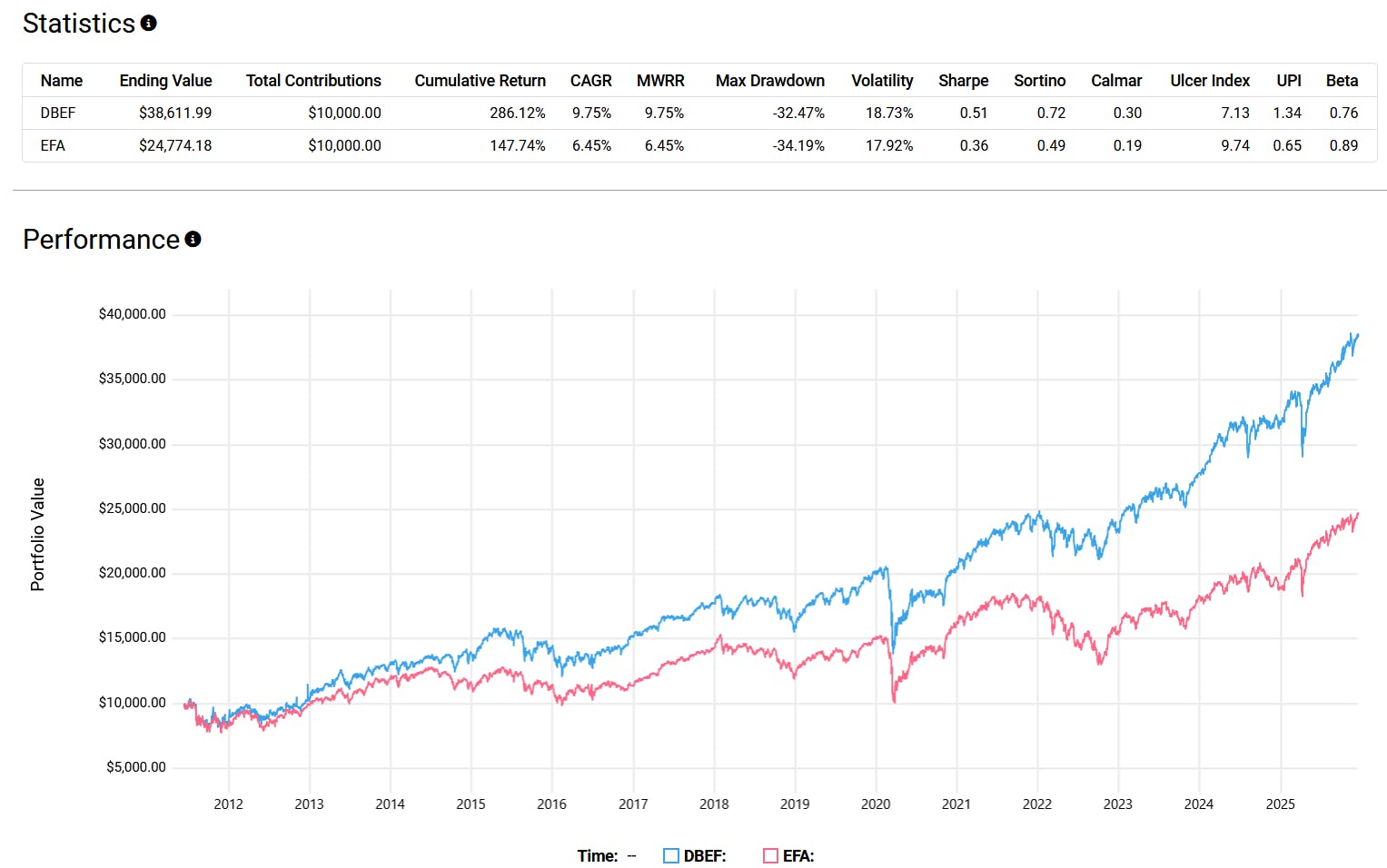
The gap reflects the broader currency environment during that time. The U.S. dollar experienced extended periods of strength, particularly against the euro.
Because EFA leaves foreign exchange exposure intact, euro and yen weakness reduced U.S. dollar–based returns even when local equity markets performed reasonably well. DBEF, by hedging that currency exposure using derivatives, neutralized that effect. As a result, its returns more closely reflected the performance of the underlying companies.
In short, if an investor has a strong conviction that the U.S. dollar will weaken over time, remaining unhedged may be preferable. On the other hand, investors who want their international equity allocation to reflect stock performance alone, without currency fluctuations helping or hurting returns, may prefer a hedged option like DBEF.
Please note this article is for information purposes only and does not in any way constitute investment advice. It is essential that you seek advice from a registered financial professional prior to making any investment decision.
Segments
See all
Mentioned ETFs
Further reading
Latest ETF News
See all ETF newsBeyond Big Tech: The Increasing Specialization of AI ETFs

There's an ETF for That? Humanoid Robotics and Physical AI

How Some ETF Issuers Use Their Own Funds for Cash Management

These Public-Private ETFs Invest in Polymarket and Anduril

There's an ETF for That? Frontier Markets



 Advantages of ETFs over Mutual Funds1/6
Lower Costs
In this guide, we'll explore the advantages of ETFs over mutual funds, giving you valuable insights into why ETFs have gained significant popularity among investors like yourself.
Leveraged ETFs: Unlocking the Potential for Amplified Returns1/6
Understanding Leveraged ETFs
Explore leveraged ETFs: potential for amplified returns & risks. 5 ETFs to consider across equities, commodities & fixed income.
What is a Leveraged ETF?1/6
Introducing Leveraged and Inverse ETFs
In this guide, we'll dive into the world of leveraged ETFs, exploring their definition, mechanics, potential risks, and rewards.
Recent educational content

First Look ETF
First Look ETF: Income, International, and Cash Flow ETFs
In this season 6 episode of First Look ETF, Stephanie Stanton @etfguide examines the latest ETF marketplace trends with NYSE and guests.


ETF Trends
ETF Industry KPIs October 5, 2026
This week’s KPI data overview highlights key metrics and trends shaping the ETF landscape.

ETF Trends
ETF Industry KPIs September 28, 2026
This week’s KPI data overview highlights key metrics and trends shaping the ETF landscape.
ETF Trends
ETF Industry KPIs September 22, 2026
This week’s KPI data overview highlights key metrics and trends shaping the ETF landscape.