Keep tabs on your favorite ETFs with a personalized weekly tracker. Create a Watchlist now →



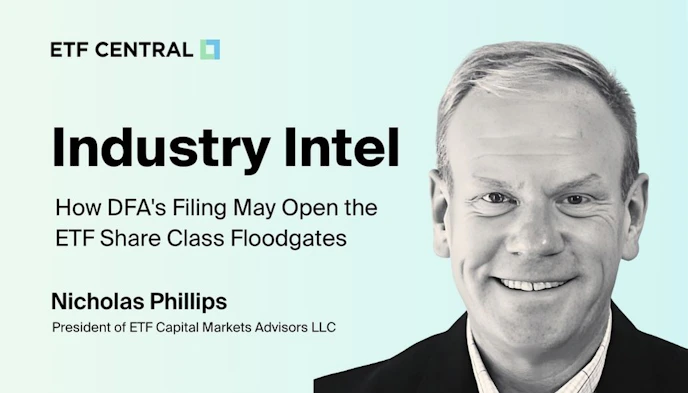
Cracking the Code: How DFA's Filing May Open the ETF Share Class Floodgates
A long-standing regulatory bottleneck may finally be breaking—and Dimensional Fund Advisors holds the key.

Keep up with what matters in ETFs
Get timely ETF insights, market trends, and top ideas straight to your inbox.
Your newsletter subscriptions with us are subject to ETF Central's Privacy Policy and Terms and Conditions.
In a development that could reshape how asset managers launch ETFs, the SEC is now signaling a clear path forward for mutual fund/ETF share class structures—urging fund shops to follow the model presented by Dimensional Fund Advisors’ (DFA) recently amended application.
According to legal counsel working directly with applicants, the SEC has begun referencing DFA’s revisions in its feedback to other asset managers, effectively establishing a regulatory blueprint for firms pursuing the dual structure. If DFA’s revised application is approved—and others amend their filings to match—it appears the SEC is prepared to greenlight them “in short order.”
Like what you're reading?
Stay in the loop — get the latest ETF insights: trends, analysis, and expert picks.
Why DFA’s Amendment Matters
At the core of the SEC’s concerns is how fund costs are distributed across share classes. Specifically, the agency raised questions about whether ETF shareholders could be unfairly impacted by cash flows or redemptions tied to mutual fund classes—potentially triggering brokerage costs, capital gains distributions, or cash drag.
DFA’s fix? Ongoing monitoring and an annual evaluation process built into the fund’s structure to ensure equitable treatment across classes. This thoughtful addition appears to have satisfied regulators—at least for now.
That said, while DFA’s solution introduces monitoring and annual evaluation as a safeguard, it’s worth noting that this doesn’t solve the structural issue outright. Instead, it surfaces the problem more transparently—placing the burden back on asset managers to address any imbalances as they arise. Transparency is a step forward, but the market will need to determine whether it’s enough.
Scale and Infrastructure Will Be Key
If the SEC indeed moves forward with broad approvals, the industry will face a wave of structural, operational, and capital markets implications. Firms that want to participate will need to be prepared:
- Market Makers and APs will need to manage balance sheet usage more carefully, ensuring any new share class doesn’t sit idle and consume capital without scale or trading interest.
- Lead Market Makers (LMMs) will play a crucial role in providing spreads and liquidity for these hybrid structures—especially early in their lifecycle. Selecting the right LMM is critical: issuers must work with partners who will actively market, support, and grow the product, rather than passively carry a listing that ties up valuable balance sheet and limits opportunity for growth.
- Custodians and Fund Admins must be ready for the operational nuances of servicing multi-class funds with both open-end and ETF flows.
- Fund Managers will need to assess whether the strategy itself can scale within both wrapper formats—and determine how to market the ETF share class to avoid cannibalizing mutual fund assets.
This is where experienced capital markets professionals will play a key role—helping issuers evaluate the right mix of partners, navigate operational trade-offs, and ensure successful go-to-market execution.
A Long-Awaited Catalyst
Since Vanguard’s patent expired in May 2023, over 50 asset managers have filed for ETF share class exemptions. Yet none had been approved—until now, potentially. Acting SEC Chairman Mark Uyeda has signaled that ETF share class review is a priority, and his office appears to be following through.
This shift marks more than just a regulatory green light. It’s a signal that the ETF industry may be entering a new phase—where wrapper choice becomes even more customizable, and operational alignment across platforms is no longer optional but essential.
Is your team ready for the next wave of ETF innovation?
Source: Tania Mitra, "SEC tells fund shops to follow DFA's amended ETF share class application," Citywire, April 9, 2025.
About the Author
Nicholas Phillips | President of ETF Capital Markets Advisors LLC
With over 25 years of experience in ETF market making and capital markets, Nicholas Phillips is recognized as a subject matter expert in the ETF industry. He started his career spending the first ten years as a lead market maker for SIG and Goldman Sachs.
At the helm of MCAP LLC's ETF Desk, Nicholas built and scaled the division, enhancing its operations through innovative pricing and risk models, and robust relationships with market makers and issuers. His tenure at VanEck Associates as Director of ETF Capital Markets further solidified his expertise, managing critical facets of operations and deepening connections within the trading community.
Beyond market making, Nicholas is an avid content creator, sharing insights that demystify complex market dynamics. He is keen on exploring board member roles that benefit from his extensive background and forward-thinking approach to ETF strategies. His dual US/Ireland citizenship complements his global perspective, enriching his professional endeavors in diverse markets.
Disclaimer
Please note that this article reflects the author's personal views and does not represent the opinions of the publication or its affiliates. It is for informational purposes only and does not constitute investment advice. It is essential to seek guidance from a registered financial professional before making any investment decisions.


Latest ETF News
See all ETF newsHow Much ETF Infrastructure Do You Really Need?

Are ETFs Getting Too Complicated? Not Necessarily, But Complexity Has a Cost

Form 4 Has 20 Transaction Codes. None Say "Section 351 ETF Swap"


Who Really Owns a White-Label ETF?

What If a Futures-Based ETF Never Had to Roll Again?

How Do You Build a Winning ETF Business?


 Advantages of ETFs over Mutual Funds1/6
Lower Costs
In this guide, we'll explore the advantages of ETFs over mutual funds, giving you valuable insights into why ETFs have gained significant popularity among investors like yourself.
Leveraged ETFs: Unlocking the Potential for Amplified Returns1/6
Understanding Leveraged ETFs
Explore leveraged ETFs: potential for amplified returns & risks. 5 ETFs to consider across equities, commodities & fixed income.
What is a Leveraged ETF?1/6
Introducing Leveraged and Inverse ETFs
In this guide, we'll dive into the world of leveraged ETFs, exploring their definition, mechanics, potential risks, and rewards.
Recent educational content

ETF Trends
ETF Industry KPIs October 5, 2026
This week’s KPI data overview highlights key metrics and trends shaping the ETF landscape.

ETF Trends
ETF Industry KPIs September 28, 2026
This week’s KPI data overview highlights key metrics and trends shaping the ETF landscape.
ETF Trends
ETF Industry KPIs September 22, 2026
This week’s KPI data overview highlights key metrics and trends shaping the ETF landscape.

First Look ETF
First Look ETF: Income, Corporate Arbitrage, and Growth and Value Investing
First Look ETF September 2026: iCapital, Mast Investments and North Square unpack new ETFs targeting monthly income, merger arbitrage and complementary growth and value exposure.

Browse all educational columns



Expert-Built ETF Portfolios, All in One Place
Don’t start from scratch. Discover ready-made ETF portfolios built by professionals to match different goals, timelines, and market views. Use them as inspiration or as a starting point for your own allocation.