Create, analyze, optimize your ETF portfolio. Start now →



COP28: Financing Food Fast
In this episode, Host and CEO of Vegtech Invest, Elysabeth Alfano recaps her time at COP28.


Keep up with what matters in ETFs
Get timely ETF insights, market trends, and top ideas straight to your inbox.
Your newsletter subscriptions with us are subject to ETF Central's Privacy Policy and Terms and Conditions.
This was the first COP to focus on food systems transformation, connecting the food system to climate change. Elysabeth shares all the highlights throughout the week, focusing on the finance discussions of blended capital to further meaningful change.
Specifically, she discusses:
Like what you're reading?
Stay in the loop — get the latest ETF insights: trends, analysis, and expert picks.
- The highlights from panel guests throughout the week, particularly those focising on financing food fast.
- The important themes and outcomes of the financial conversations and panels at COP28, including Elysabeth's four presentations on food systems transformations in the policy-making blue zone.
- The tipping points toward potentially irreversible planetary damage due to climate chance and biodiversity loss.
- The plans governments have made and pledged to support.
Transcript
Elysabeth: Hey everyone, welcome to the VegTech Invest Upside & Impact podcast. I’m your host, Elysabeth Alfano, the CEO of VegTech Invest, Advisor to the Plant-based Innovation and Climate ETF, EATV. On Upside & Impact I chat with the leaders and movers who are shaping and growing impact investing for meaningful change. We “pull up as we go up” as the expression goes so this podcast is all about making meaningful and productive impact while also managing one’s portfolio for upside. Of course, always managing for upside.
If you’d like more information about VegTech Invest you can visit us at VegTechInvest.com and subscribe to our newsletter. You can also find us on LinkedIn and on Twitter @VegTechInvest. We record live every first and third Wednesday of the month on our LinkedIn page at 1:30pm eastern standard time. So, check us out live and be sure to bring your questions.
Now if you’re listening as part of a podcast, of course subscribe to this podcast right now so that you never miss an episode. And if you’re listening on iTunes, be sure to leave a 5-star review. It really does help.
So now let’s get down to today’s show and thanks for being with me on today’s episode of VegTech Invest’s Upside & Impact. And as always, a reminder, this podcast is for informational purposes only and is not meant to recommend any specific company or investment. Now, onto the show.
Hi everyone. This is Elysabeth Alfano, CEO of VegTech Invest and welcome to another episode of Upside and Impact: Investing for Change. I’m still on the ground in Dubai here for COP28. This is the first COP, the annual climate change summit meeting of the United Nations, that is addressing agriculture and food systems transformation. And it indeed took center seat at the table.
It was a major part of all discussions. I anticipated that it would be discussions primarily on the food and agriculture day, but indeed negotiations were woven all throughout the 12-day summit and it was extremely impressive. With finance really taking a major role in all the discussions, I’d like to elaborate on that for you here. If you can remember anything from this podcast, remember financing food fast.
I’ll tell you, as I record this still on the ground in Dubai, I’m just struck by so many swift moves to bring sustainable food system change through diversified proteins to the forefront, not just of the climate conversation, but to the climate strategy and execution conversation. I had four speaking engagements myself and was amazed at the rapid zeitgeist shift. People and governments and negotiators have wrapped their minds around the zeitgeist shift that we need to transform food if we are indeed to significantly impact climate change in the time, we need to do it.
Now when I spoke at COP27 last year in Egypt, I was pushing to be heard along with dedicated colleagues from Food for Climate, Food Systems Pavilion, The Good Food Institute, Mighty Earth, Food Tank, and FAIRR - the Farm Animal Investment Risk and Return. Of course, it does indeed take a village. I’m certainly not alone. But with many people on the ground, I still felt that there was little to no traction in food systems conversations. Now, fast forward one year, we have not only the climate change conversation, but it is well understood that we will not hold on to any aspiration of 1.5 degrees Celsius without it.
We went from not being noticed to being part of the discussion of financing the transformation. For myself, as I’ve worked in this almost a decade now, I can’t tell you how surreal it is to almost from one day to the next it seems, to have woken up and realized that the world, collectively and in unison, is now focused on financing protein diversification for climate change, biodiversity loss and deforestation, as well as food security.
So, if the phrase to remember is financing food fast, then the phrase on everyone’s tongue over the last ten days was “blended finance.” That means not just government money and not just foundational philanthropic large names like Bill Gates and Bezos’ money, but also Wall Street money and that finally came into the conversation of private capital. So let me go over some of the highs that came through COP28 from within the food perspective.
So, the sustainable food systems and protein diversification took center stage when 154 countries have now pledged to set food targets in their nationally determined contributions, what’s known as an NDC, marking a level of commitment in the food systems community that we have never seen before and would never have expected to have seen this time last year. NDC’s are at the heart of the Paris Agreement and the achievement of its long-term goals is necessary.
So NDC’s embody efforts by each country to reduce national emissions and adapt to the impacts of climate change with food systems being one of those levers for adaptation. These commitments are non-ending but really show the direction of where everyone’s going. According to World Wildlife Foundation negotiations on exactly how much each country is going to give and commit is going to take place in June of 2024, but the commitment to do so is there.
And this makes sense because we have talked about on this podcast from the Boston Consulting Group how it is shown that investing in protein diversification through proteins from plants, proteins from fermentation, proteins from cultivating cells, can be 30 times to 40 times more impactful at reducing greenhouse gasses than investing in other green technologies such as electric vehicles, alternative energy, and alternative building materials. So, it seems that suddenly almost overnight, for lack of a better expression, food systems transformation is realized as the low-hanging fruit. It can get you where you need to be for lower expenditures at a faster rate.
So indeed, according to Mahesh Roy, whom I will quote later. No, I have it here. He’s from the IIGCC. It’s an investor organization focused on climate change. He said that “food systems transformation is the only sector that can actually reach net zero by 2030.” So, everyone’s focused on it. Okay, so let’s get into the next advancements. So again, 154 countries pledged food-based targets. Now we’re talking about implementation.
So according to the World Resources Institute, thus far 2.5 billion, which is a drop in the bucket granted, of financial commitments have been pledged in support of that declaration of sustainable agriculture resilient food systems and climate action that was put forth by the UAE. This will include 200 million to support CGIAR. That’s an agricultural resource think tank and agricultural research organization. So, 200 million to support that research and aim for scale, which is led by Her Excellency, Mariam Almheiri and our Secretary of Agriculture, Tom Vilsack. They’re aimed for climate and now aim for scale, which is how they’re going to scale climate change solutions through food and keep us on an aspiration of 1.5 degrees Celsius. But I think at this point, we’re really looking at 2 degrees Celsius.
So, we’ve started the implementation, and along with that implementation we’ve started the big critique of why in the past have we spent so little? Between 2 and 4.8% of climate funding has gone to food and agriculture, when finally, people call the spade a spade. Agriculture is responsible for 30% of the world’s emissions and animal agriculture is responsible for 60% of that 30%. So why are we giving 2-4% of our funding to the problem that takes up one third of the problem?
So, financing really took center stage. A highlight for me was when Geeta Sethi, the subject matter expert on food systems at the World Bank, said, “We need 300 to 400 billion of blended capital.” That’s the phrase to remember everyone. That’s sort of the hot topic: blended capital, meaning government capital as well as philanthropic and private capital and Wall Street capital. 300 to 400 billion every year for the next ten to fifteen years. That’s how we’re going to get sustainable food systems shift, and it’s a matter of urgency for human and planetary health. She further went on to be quite critical saying “Right now, the external costs of our current food supply system are pushed to the consumer in the form of taxes for covering damages” such as eutrophication, which is the dirtying of water from animal manure, exponential health care costs, and environmental damage.
These damages that the consumer must pay through taxes, because ultimately our animal-based food system externalizes these costs to us to the tune of 10% of global GDP. That’s approximately $12.7 trillion. So, it’s meaningful and it really came under the magnifying glass this year at COP28. I’ll just say as a side note, of course food is not the only thing that was discussed at COP. Obviously, we’re talking about the doubling of electrification and the tripling of renewable energies, but I’m only covering food as it is here today, as it’s my area of expertise. But it wasn’t just food financing and implementation. It was also food loss and food waste.
300 million was attributed to that in terms of resources for cutting down food waste, which is so painful really to see when you think of how many people, 800 million, are food insecure around the world. And yet food waste is the top reason to bring down emissions or possibly bring down emissions according to Project Drawdown. So, food is obviously a very meaningful sector as we’ve discussed and really the only way, we’re going to get to 1.5 degrees Celsius, which is why at VegTech Invest we have such a strong food waste program as well as protein diversification scope, if you will.
And then finally nutrition. It is human and planetary health, so it was great to see a COP28 declaration on climate and health, really highlighting moving away from animal proteins for health, but also other ways to put nutrition first. One of the major costs coming out of our food system are exponential health costs. One out of two people are sick, despite all the money we spend on food, and obesity costs us 180 billion a year. That’s from the former Finance Ministry of Rwanda. So, these are some startling statistics. And again, I will quote Mahesh Roy from IIGCC who said, “Keep it simple. Show people the data around the inefficiency of our current food supply system and they’ll find the opportunity to make money.”
Where there’s inefficiency, obviously, there is an opportunity to make money. That last sentence is my own. “Show them the added benefit of impact and the trillions will flow into the sector.” This caused Dr. Rehan Mari Tomas, the CEO of the Green Finance Institute, to say in response to this and many other things, “we are at the end of the beginning.” And this COP28 really felt like the end of the beginning. No longer were we pushing for having people understand the crisis at hand, but people were starting to come together. And even with that, I’ll say a little bit of frustration as to saying, “hey the problem’s right in front of our face, when are we going to get at it?”
Of course, scientists were abounding at COP28, and the Bezos Earth Fund put together a tipping points report. It was upsetting to see that five of the seven global tipping points have already been impacted, perhaps to the point of no return. Let me see if I can name those five tipping points for you because I believe it’s important to address them. These tipping points can trigger devastating domino effects according to Tim Lenton of the University of Exeter’s Global Substance Institute. These tipping points past the point of potentially no return are the collapse of big ice sheets in Greenland, the collapse of big ice sheets in the west Antarctic, the widespread thawing of permafrost, the death of coral reefs and warm waters, and the collapse of the oceanic current in the North Atlantic.
At the same time, Boston Consulting Group says that we’ve pushed through nine of the planetary boundaries, things like ocean acidification. We were just on the brink of this as well as climate change and some of the other nine boundaries. So that was disappointing to see as well, that through the introduction of novel elements, which is one of the boundaries, and basically it means chemicals in our soil that we ourselves are poisoning our own planet, perhaps to the point of no return.
So perhaps in the closing of this podcast, I realize it’s kind of a lot of information down the road, but I think it’s very interesting and I cover it because unlike energy and transportation- food systems are more than all transportation including aviation combined and it’s as much as energy. And there’s a big overlap between food and energy, food using so much energy, meat processing and just the general processing of food and its heavy transportation, meat being very heavy and how we create food and then ship it so far from home. You know this because you probably don’t live near a banana plantation and yet you probably eat bananas every day or every other day.
So, we just need complete system shifts, not a little bit of methane change in the cows’ food. That’s not going to address biodiversity loss. That’s not going to affect land use. That’s not going to affect water use. It is going to take entire food systems change, so I will close by quoting Her Excellency Mariam Almheiri again, the United Arab Emirates Minister for Climate Change and Environment when she says, “Even if you were able to fix the just energy transition and go completely renewable, you still wouldn’t be able to reach 1.5 degrees if you don’t solve the food systems issue.” That’s how big of a cause this is. Food systems will now be center stage at this COP and all the COPs remaining.
The Secretary of Agriculture, Tom Vilsack, who is her partner in Aim for Climate and Aim for Scale. Her Excellency Mariam Almheiri is partnering with the Secretary of Agriculture in the U.S., Tom Vilsack. She furthers to go on and say “We have the bigger issue that Secretary Vilsack and I continue to think about day on day, as the population is rising will we have enough food? Will we have enough protein for all? So that’s why technology and innovations are so good. We need to look at a lot of the alternatives, alternatives that are more sustainable, that don’t need so much water, that don’t need so much land, that don’t throw out methane emissions. And that’s why things like alternative proteins are so very important.”
So, Tom Vilsack then followed up with her saying that he agrees and just wanted to see more collaboration, more innovation, more funding, and right now. So, they’re actually an interesting pair, the two of them. I love to see them together. They have a big friendship and seemingly good camaraderie. And while appearing to be quite opposites, are forging quite a unique bond in the programs that they’re running for Aim for Climate, Aim for Sea, and Aim for Scale. You can check those out and you can always sign up for the VegTech Invest Newsletter. Much of this information that I’ve quoted to you is on the newsletter, the most recent one. And you will get that if you sign up and then you can see all the links.
Some other products, if you will, coming out of COP28, the United Nations Environmental Program launched an important paper on what’s cooking, talking again about food systems and how we won’t reach 1.5 C until we address this and some of the novel innovations that are requiring funding. And as we discussed how the capital markets, both governments, philanthropists and Wall Street money is going to start flowing into this huge opportunity for wealth, this disruption isn’t a negative thing. Real wealth isn’t created because one company has 3% more revenue one year over the next. Real wealth is created because I can’t remember the last time, I stood in line to develop film that took 3 days to develop and cost me $15. That system was inefficient. It took my time, it took my money, and then often the pictures weren’t even good. It was an inefficient system, and where there is inefficiency, there is disruption and real wealth creation.
When you go from the horse and buggy to the car and the landline to the cell phone, that’s when you have real wealth creation and real job creation. So, this is nothing but an enormous opportunity and I’m so happy that now food systems is part of the climate conversation for real, but more importantly, Wall Street money and the opportunity to make money on this huge system shift has entered the building. Welcome, welcome. Everyone, thank you for sharing this podcast.
Be sure to subscribe on iTunes and Spotify. You can also catch us distributed by the New York Stock Exchange Platform, ETFCentral.com. Please sign up for the VegTech Invest newsletter where you can always get information. Thanks everyone and have a wonderful holiday.
Thanks for being with me everyone on today’s episode of VegTech Invest’s Upside & Impact. I hope that you’ve found this to be a knowledge drop and I’m always here to answer any questions so please feel free to reach out to me on LinkedIn. Elysabeth Alfano, you can find me there. I’m also on Twitter @ElysabethAlfano and you can find the VegTech Invest pages on both LinkedIn and Twitter.
Sign up for our newsletter at VegTechInvest.com and share this podcast with your colleagues, friends, and clients. And of course, be sure to subscribe to this podcast to never miss an episode. Remember we record live on the VegTech Invest LinkedIn page every first and third Wednesday of the month at 1:30pm eastern standard time. So come find us there to join the conversation live. Until then, thanks for leaving a 5-star review on this podcast app because it really does help.
If you’d like more information about VegTech Invest you can visit us at VegTechInvest.com and subscribe to our newsletter. Okay everyone, great show today. See you next time on VegTech Invest’s Upside & Impact.
VegTech Invest is a registered investment advisor focused on investing in sustainable food and materials. This podcast is for informational purposes only and should not be relied on as the basis for investment decisions. It does not constitute either explicitly or implicitly any provision of services or products by VegTech Invest. All statements made regarding companies and securities are strictly beliefs and points of view held by VegTech Invest or podcast guests and are not endorsements or recommendations to buy, sell, or hold any security. Clients of VegTech Invest may maintain positions in the securities discussed in this presentation. VegTech Invest believes that the information presented is accurate and was obtained from sources that VegTech Invest believes to be reliable. However, VegTech Invest does not guarantee the accuracy or completeness of any information and such information may be subject to change without notice from VegTech Invest.
Certain statements in this presentation may be statements of future expectations and other forward-looking statements that are based on VegTech Invest’s views and assumptions at the time of publication and involve risks that could cause actual results, performance or even events to differ materially from what is expressed or implied by such statements. VegTech Invest’s strategies are actively managed and not intended to replicate the performance of any cited index which may differ materially. You cannot invest directly in an index.

Latest ETF News
See all ETF newsThis is How Calamos Turned Wall Street’s $100 Billion Secret Into an ETF




From Dot-Com to ETFs: How One Entrepreneur Helped Spark an Investment Revolution
How Blossom Social Is Revolutionizing Retail Investing and ETF Marketing

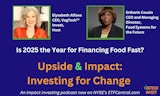
Is 2025 the Year for Financing Food Fast?

 Advantages of ETFs over Mutual Funds1/6
Lower Costs
In this guide, we'll explore the advantages of ETFs over mutual funds, giving you valuable insights into why ETFs have gained significant popularity among investors like yourself.
Leveraged ETFs: Unlocking the Potential for Amplified Returns1/6
Understanding Leveraged ETFs
Explore leveraged ETFs: potential for amplified returns & risks. 5 ETFs to consider across equities, commodities & fixed income.
What is a Leveraged ETF?1/6
Introducing Leveraged and Inverse ETFs
In this guide, we'll dive into the world of leveraged ETFs, exploring their definition, mechanics, potential risks, and rewards.
Recent educational content
ETF Trends
ETF Industry KPIs September 14, 2026
This week’s KPI data overview highlights key metrics and trends shaping the ETF landscape.

ETF Trends
ETF Industry KPIs September 8, 2026
This week’s KPI data overview highlights key metrics and trends shaping the ETF landscape.
ETF Trends
ETF Industry KPIs August 31, 2026
This week’s KPI data overview highlights key metrics and trends shaping the ETF landscape.
ETF Trends
ETF Industry KPIs August 24, 2026
This week’s KPI data overview highlights key metrics and trends shaping the ETF landscape.
Browse all educational columns



Expert-Built ETF Portfolios, All in One Place
Don’t start from scratch. Discover ready-made ETF portfolios built by professionals to match different goals, timelines, and market views. Use them as inspiration or as a starting point for your own allocation.