Explore professionally built ETF model portfolios. Discover now →



Contagion from Silicon Valley Bank Causes Rout in Regional Bank ETFs
Industry-specific ETFs holding regional bank stocks are in crisis. Here's what you need to know.


Keep up with what matters in ETFs
Get timely ETF insights, market trends, and top ideas straight to your inbox.
Your newsletter subscriptions with us are subject to ETF Central's Privacy Policy and Terms and Conditions.
The U.S. banking sector is currently experiencing yet another crisis, but unlike in 2008 the focus isn't on the big "bulge bracket" firms of Wall Street. Rather, the unrest is fomenting on the smaller, less covered side of the industry: regional banks.
These banks comprise a smattering of smaller banks serving various regions of the U.S., hence the moniker. Officially, the Federal Reserve categorizes any bank with assets of $10 billion to $100 billion as regional. Any bank with less than that range is deemed a community bank.
At the center of this is a California-based institution called Silicon Valley Bank (SIVB), which plays a crucial role in the U.S. business ecosystem as a financier of start-ups. From Monday Feb. 6 to Friday Feb. 10, the company's stock has been in free-fall, dropping by over 62% throughout the week.
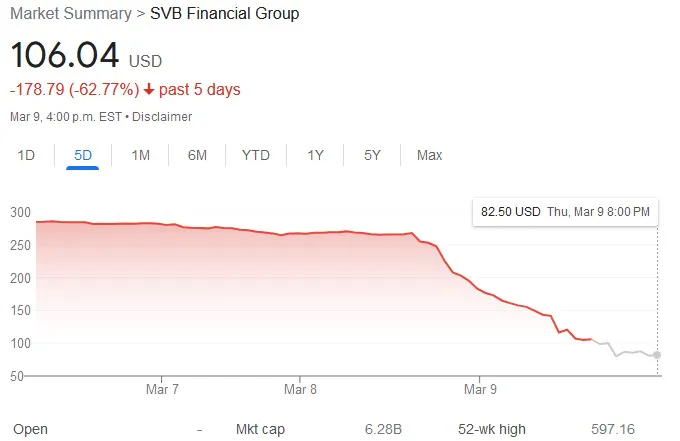
On the morning of Mar. 10, 2023, U.S. regulators were finally forced to step in, with the California Department of Financial Protection and Innovation closing SIVB and the Federal Deposit Insurance Corporation (FDIC) intervening to take receivership.
The collapse of SIVB marked the largest bank failure in recent years since the collapse of Washington Mutual during the 2008 Great Financial Crisis and will likely send shockwaves reverberating through the U.S. financial sector as the liquidation proceeds.
Let's look at what exactly happened to SIVB, and the possible consequences for investors with positions in regional bank ETFs or financial sector ETFs.
Get data on 14,000+ ETFs
Access Trackinsight's reliable and comprehensive data with 500M+ points on 14,000+ ETFs.
Silicon Valley Bank: What exactly happened?
According to the Financial Times, the root cause of the crisis was SIVB's $91 billion bond portfolio, which incurred heavy unrealized losses as interest rates rose throughout 2022.
The majority of SIVB's capital is comprised of cash deposits from its customers, most of whom are US-based tech start-ups. SIVB invested this capital in longer-duration mortgage-backed securities. However, this was done at a time when bond yields were low, thus locking in a low, but steady return.
The problem is that as a bank, SIVB is also required to make interest payments to customers who hold deposits with them. When rates rise, SIVB must pay higher and higher levels of interest on these deposits, while their portfolio of bonds continues to earn much lower rates.
This created a problem for SIVB, specifically when it came to its net interest income. But that’s not all. Thanks to rising bond yields, bond prices have fallen sharply over the last year, with longer-duration assets like SIVB's holdings suffering particularly hard.
Currently, SIVB's $91 billion bond portfolio has suffered a $15 billion haircut and is sitting at a market value of $76 billion. To avoid locking in a loss, the bank has elected to hold these bonds until maturity, where their original face value will be paid out.
However, the fact still stands that SIVB is staring down a $15 billion unrealized loss. Once it disclosed this, all hell broke loose. Short sellers began targeting the stock, while customer hysteria sparked a run on the bank. This Twitter thread from a former employee sums up the situation well.
What this means for regional bank ETFs
The situation with SIVB has spilled into its industry thanks to the interconnected nature of today's markets. With 2008 firmly in the rear-view mirror, many investors have forgotten about the potential for contagion, especially when it comes to concentrated industry bets.
Over the last week, the SPDR S&P Regional Banking ETF (KRE) has fallen by -17%, despite SIVB comprising just 1.01% of its portfolio as of Mar. 9, 2023. The broader SPDR S&P Bank ETF (KBE) lost -15% while only having a 0.73% exposure to SIVB.
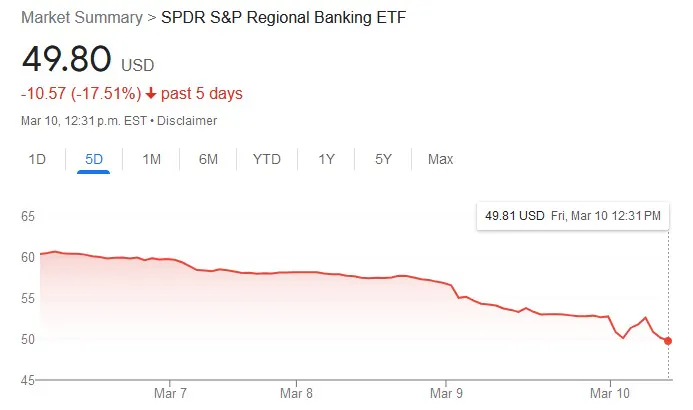
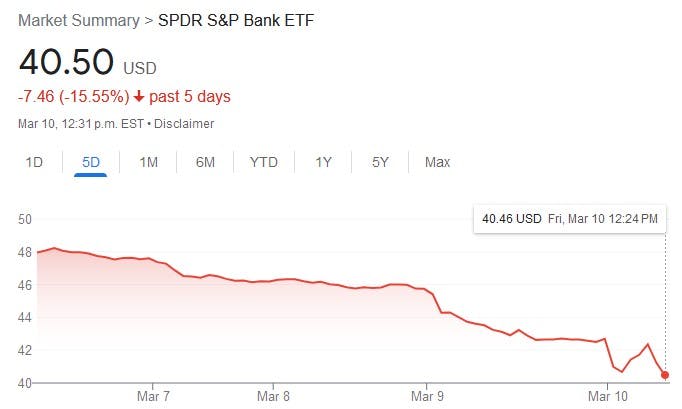
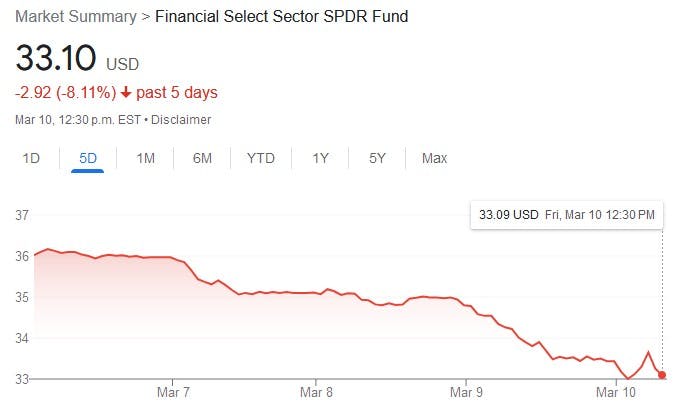
It's clear from the performance of these industry-specific ETFs that contagion is very much alive and present, especially for industries like banking where counter-party exposure can be widespread. Even the much broader SPDR Financial Select Sector SPDR Fund (XLF) suffered a -8% loss over the week.
Investors looking to make these industry-specific bets must also become familiar with the concept of idiosyncratic risks – those that have outsized effects on single companies, industries, or sectors. This contrasts with systematic risk, which affects the entire market.
As with most investment risks, the correct way to mitigate this is diversification. By adding additional industries, sectors, or assets with lower correlations, investors can offset the effects of potentially devastating tail risks like what happened with SIVB.
Even investors who are not specifically targeting bank stocks must reconsider their risk exposure. For example, the dividend ETFs held by many income investors tend to have concentrated exposure to high-yielding financial sector stocks such as regional banks.
For instance, consider the much higher losses suffered over the last week by the SPDR Portfolio S&P 500 High Dividend ETF (SPYD) versus the benchmark SPDR S&P 500 ETF Trust (SPY). The former has a much higher 19.39% weighting to the financial sector, which many dividend investors may have overlooked.
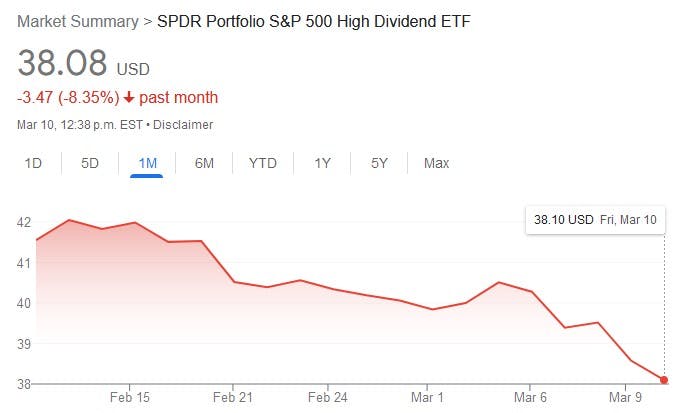
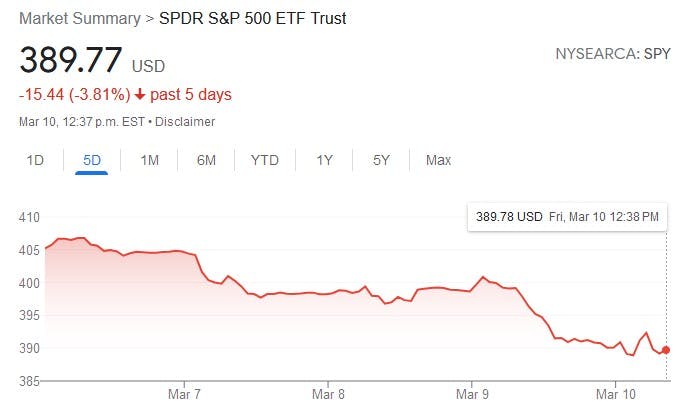
At the very least, the ongoing SIVB crisis serves as a somber reminder to ETF investors to always examine the underlying holdings carefully in their funds of choice, especially when it comes to narrow ETFs targeting specific sectors or industries.
Please note this article is for information purposes only and does not in any way constitute investment advice. It is essential that you seek advice from a registered financial professional prior to making any investment decision.

Latest ETF News
See all ETF newsWhich Fixed-Income ETFs Benefit from Rising Interest Rates?

MoneyShow Chart of the Day 9/16/26: Oil? Surging. Oil Stocks? Not So Much.


MoneyShow Chart of the Day 9/4/26: Don't Just Watch Oil. Watch THESE.
Chart of the Day 8/14/26: The Great "Hot Money" Migration




 Advantages of ETFs over Mutual Funds1/6
Lower Costs
In this guide, we'll explore the advantages of ETFs over mutual funds, giving you valuable insights into why ETFs have gained significant popularity among investors like yourself.
Leveraged ETFs: Unlocking the Potential for Amplified Returns1/6
Understanding Leveraged ETFs
Explore leveraged ETFs: potential for amplified returns & risks. 5 ETFs to consider across equities, commodities & fixed income.
What is a Leveraged ETF?1/6
Introducing Leveraged and Inverse ETFs
In this guide, we'll dive into the world of leveraged ETFs, exploring their definition, mechanics, potential risks, and rewards.
Recent educational content

ETF Trends
ETF Industry KPIs October 5, 2026
This week’s KPI data overview highlights key metrics and trends shaping the ETF landscape.

ETF Trends
ETF Industry KPIs September 28, 2026
This week’s KPI data overview highlights key metrics and trends shaping the ETF landscape.
ETF Trends
ETF Industry KPIs September 22, 2026
This week’s KPI data overview highlights key metrics and trends shaping the ETF landscape.

First Look ETF
First Look ETF: Income, Corporate Arbitrage, and Growth and Value Investing
First Look ETF September 2026: iCapital, Mast Investments and North Square unpack new ETFs targeting monthly income, merger arbitrage and complementary growth and value exposure.

Browse all educational columns



Have you tried our ETF Compare tool?
Compare ETFs like a pro. Analyze fees, performance, exposure & holdings side-by-side.