Ready-made ETF portfolios built for real investor needs. Explore now →



Changing Regulation and the Cannabis Industry
Cannabis ETFs have risen, due to the possibility of regulatory reclassification.


Keep up with what matters in ETFs
Get timely ETF insights, market trends, and top ideas straight to your inbox.
Your newsletter subscriptions with us are subject to ETF Central's Privacy Policy and Terms and Conditions.
Over the last few months, there have been progressive signals on current regulations affecting the cannabis industry, resulting in cannabis-related stocks and exchange-traded funds rising on the possibility of meaningful change within the industry.
Like what you're reading?
Stay in the loop — get the latest ETF insights: trends, analysis, and expert picks.
A change in the regulatory landscape
At the end of August 2023, the U.S. Department of Health and Human Services made a formal recommendation to the U.S. Drug Enforcement Agency that cannabis be reclassified from Schedule 1 of the Controlled Substances Act, a classification for drugs that have a high potential for abuse and no recognized medicinal value, to the much less restrictive Schedule 3. Rescheduling cannabis to Schedule 3 would be monumental for state-legal cannabis businesses. Although rescheduling would not federally legalize the state-legal programs, it would eliminate the 280E tax burden, which explicitly prohibits businesses engaged in the trade or distribution of either Schedule 1 or Schedule 2 controlled substances from deducting expenses on their federal taxes, which currently applies to cannabis businesses.
The change in classification would also have secondary implications. Presently, the Senate Banking Committee is reviewing an updated version of the Secure and Fair Enforcement (SAFE) Banking Act; which is designed to prohibit federal regulators from punishing financial institutions for the sole reason that they choose to provide such services to cannabis companies, their owners, and their employees. Under current federal law, banks and credit unions face federal prosecution and penalties if they provide services to state-legal cannabis businesses because cannabis is still a Schedule 1 substance. Thus, the reclassification of cannabis would allow state-legal cannabis businesses the opportunity to utilize financial services providers, rather than operate as predominately cash enterprises.
The new version of the SAFE Banking Act, now known as the “Secure And Fair Enforcement Regulation Banking Act” or the SAFER Banking Act creates a safe harbor for depository institutions that wish to provide financial services to state-sanctioned marijuana businesses or service providers, however, it makes clear that federal banking agencies have a duty to ensure that the depository institutions supervised by those agencies (I) are operating in a safe and sound manner, and (II) have processes and procedures in place to identify fraudulent or illegal activity, whether activity occurs at a depository institution or through vendors or customers with which a depository institution has a relationship.
The Cannabis ETF Landscape
Given the recent progressive developments occurring within the cannabis regulatory space, the sentiment towards cannabis investments has been exceedingly positive and reflected in the performance of many cannabis ETFs. The following chart shows that the 1-month performance for many notable cannabis ETF solutions have been eye-catching. However, when a longer timeframe is taken, the performance of these solutions has been less than ideal.
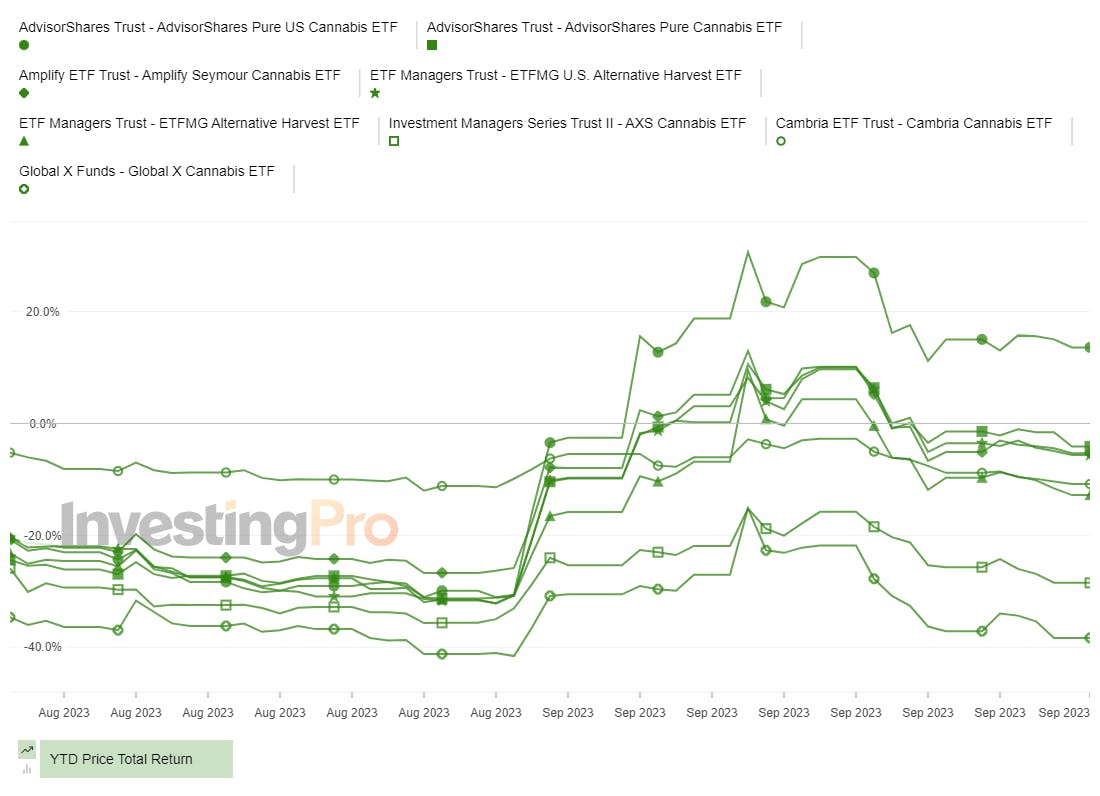
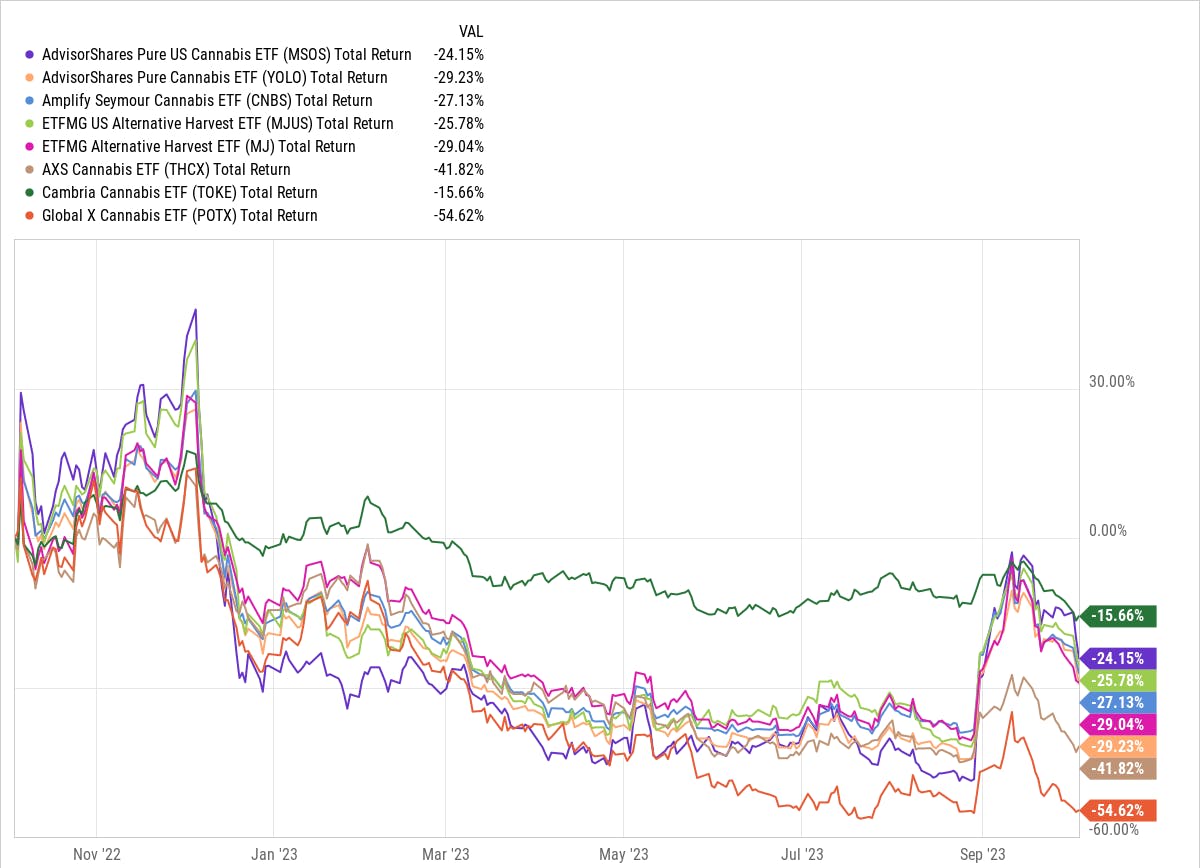
While the present fervor around cannabis regulation has allowed for short-term gains, the long-term success of this industry will truly be predicated on the regulatory environment. For individuals who believe that the U.S. regulatory hurdles currently in place for cannabis will be lifted in the medium-to-long term future, then ETF solutions such as AdvisorShares Pure U.S. Cannabis ETF (Ticker: MSOS), ETFMG U.S. Alternative Harvest ETF (Ticker: MJUS), and Amplify Seymour Cannabis ETF (Ticker: CNBS) are worth considering, due to their broad exposure to cannabis producers and industry participants.
Please note this article is for information purposes only and does not in any way constitute investment advice. It is essential that you seek advice from a registered financial professional prior to making any investment decision.

Latest ETF News
See all ETF newsChart of the Day 8/14/26: The Great "Hot Money" Migration


MoneyShow Chart of the Day 7/29/26: Now, THAT's What I Call Market Rotation!

MoneyShow Chart of the Day 7/16/26: Good News/Bad News on Inflation (and the Fed)

MoneyShow Chart of the Day 7/1/26: The H1 Scorecard – and What Comes Next




 Advantages of ETFs over Mutual Funds1/6
Lower Costs
In this guide, we'll explore the advantages of ETFs over mutual funds, giving you valuable insights into why ETFs have gained significant popularity among investors like yourself.
Leveraged ETFs: Unlocking the Potential for Amplified Returns1/6
Understanding Leveraged ETFs
Explore leveraged ETFs: potential for amplified returns & risks. 5 ETFs to consider across equities, commodities & fixed income.
What is a Leveraged ETF?1/6
Introducing Leveraged and Inverse ETFs
In this guide, we'll dive into the world of leveraged ETFs, exploring their definition, mechanics, potential risks, and rewards.
Recent educational content
What’sTheFund
What's the Fund | Ocean Park Diversified Income ETF (DUKZ)
James St Aubin, Chief Investment Officer at Ocean Park Asset Management, discuss the DUKZ ETF, exposing investors to the whole spectrum of asset classes in the fixed income markets, through their rules-based process.

ETF Takeaway
ETF Takeaway: Ocean Park Diversified Income ETF (DUKZ)
James St Aubin, Chief Investment Officer at Ocean Park Asset Management discusses the state of fixed income markets and how their DUKZ ETF, through their rules-based process, tactically allocates to 11 sectors of fixed income through underlying ETFs.

ETF Trends
ETF Industry KPIs August 17, 2026
This week’s KPI data overview highlights key metrics and trends shaping the ETF landscape:


First Look ETF
First Look ETF: Cycle Aware Investing & Next-Gen Nicotine Shifts
In this season 6 episode of First Look ETF, Stephanie Stanton examines the latest ETF marketplace trends with NYSE and guests.

Browse all educational columns



Have you tried our ETF Compare tool?
Compare ETFs like a pro. Analyze fees, performance, exposure & holdings side-by-side.