Keep tabs on your favorite ETFs with a personalized weekly tracker. Create a Watchlist now →



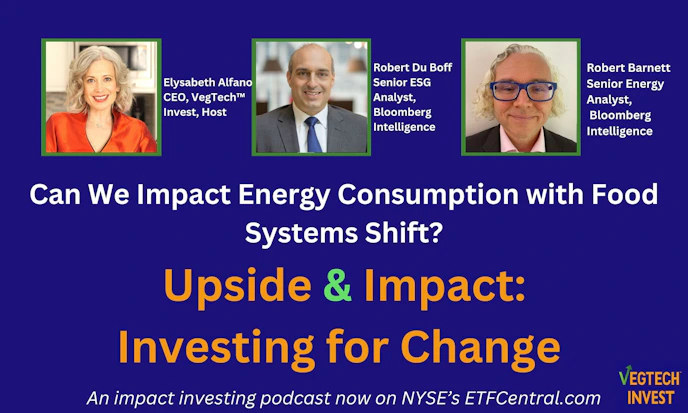
Can We Impact Energy Consumption with Food Systems Shift?
Join Robert Barnett and Robert Du Boff as they explore the intersection of food and energy systems with Elysabeth Alfano, discussing climate impacts and investment strategies.

Keep up with what matters in ETFs
Get timely ETF insights, market trends, and top ideas straight to your inbox.
Your newsletter subscriptions with us are subject to ETF Central's Privacy Policy and Terms and Conditions.
Robert Barnett, Senior Bloomberg Intelligence Energy Analyst, and Robert Du Boff, Senior Bloomberg Intelligence ESG Analyst, join CEO of VegTech Invest, Elysabeth Alfano, to discuss the overlap of food and energy systems and how shifting one can create massive reductions in the other.
Specifically, they discussed
1. What were the outcomes of Bloomberg Intelligence's Looking Back on Dubai (COP28), Looking Ahead to Baku (COP29) summit, and specifically what were the outcomes of the panel on climate, nature and biodiversity?
2. Given the agricultural-food systems' large environmental footprint (30% of the world's GhGE according to the UNEP), why are there not more discussions on food systems as a solution to 2030 goals?
3. The food/energy overlap and how changing food systems impacts changing energy use.
4. According to the Food and Agriculture Organization of the United Nations (FAO), the food system externalizes $12.7 trillion to the global taxpayer. Are externalized costs to taxpayers considered when speaking of a just transition?
5. What role will blended capital play in the Finance COP29 at Baku and beyond for impact investing?
6. Energy stocks have taken it on the chin. Do you see this turning around, and if so, when?
Get data on 14,000+ ETFs
Access Trackinsight's reliable and comprehensive data with 500M+ points on 14,000+ ETFs.
Listen here
Full Transcript
Elysabeth: Hey everyone, welcome to the VegTech Invest Upside & Impact podcast. I’m your host, Elysabeth Alfano, the CEO of VegTech Invest, Advisor to the Plant-based Innovation and Climate ETF, EATV. On Upside & Impact I chat with the leaders and movers who are shaping and growing impact investing for meaningful change. We “pull up as we go up” as the expression goes so this podcast is all about making meaningful and productive impact while also managing one’s portfolio for upside. Of course, always managing for upside.
If you’d like more information about VegTech Invest you can visit us at VegTechInvest.com and subscribe to our newsletter. You can also find us on LinkedIn and on Twitter @VegTechInvest. We record live every first and third Wednesday of the month on our LinkedIn page at 1:30pm eastern standard time. So, check us out live and be sure to bring your questions.
Now if you’re listening as part of a podcast, of course subscribe to this podcast right now so that you never miss an episode. And if you’re listening on iTunes, be sure to leave a 5-star review. It really does help.
So now let’s get down to today’s show and thanks for being with me on today’s episode of VegTech Invest’s Upside & Impact. And as always, a reminder, this podcast is for informational purposes only and is not meant to recommend any specific company or investment. Now, onto the show.
Hi everybody. It’s Upside & Impact: Investing for Change. I’m Elysabeth Alfano, CEO of VegTech Invest. Huge shoutout to the New York Stock Exchange, which distributes Upside & Impact: Investing for Change on the ETFCentral.com website. So, you can always go there for this podcast and others. But of course, if you can’t get to that website for some strange reason, you can always get it on iTunes and Spotify, and yes, reviews do matter. They count. So don’t only share the podcast but give it a five-star review.
I’m so happy to be with everyone today. As we head to COP29, so we’re about halfway there, halfway through the year, as we head to Azerbaijan for COP28. COP28 was a record cop, in my opinion, because food made it to the discussions. Now, other ESG analysts and sustainability analysts have other opinions, which is why I wanted to bring them on today to discuss food at COP29. Will that be on the agenda? Food as it relates to biodiversity loss, climate change, energy usage, and the food conversation in general, where it’s getting its traction, where it isn’t, but just sustainability. Where are we as we head into an election and maybe a better economy will come in 2025?
Who knows? No one knows the answer to these things, but if anyone is even close it would be my guests today. I want to bring on Senior ESG Analyst Rob Du Boff. I lived in Paris. Can I say that with that accent? Should I be saying it differently?
Rob Du Boff: I’ve never been to Paris so I can’t tell you, but yes, Du Boff is fine.
Elysabeth: Du Boff, okay. I’m going with that. And Senior Energy Analyst, both at Bloomberg Intelligence, Rob Barnett. That I can pronounce, I think.
Rob Barnett: So, in the UK it’s Barnett, not Barnett.
Elysabeth: Oh, the accent up front. From now on you are Barnett to me. Barn, that’s going to be easy. I’m going to share my screen here. Forward warning to anyone watching on video on X, YouTube, and LinkedIn, thank you for doing that. I’m sharing my screen. You might want to pull out your readers, everybody, if that’s what you do. On Monday of this week, I think, there was a conference pretty much led by Rob Du Boff.
Hopefully, you can see this. The conference was called Looking Back on Dubai, so COP28, and now we’re Looking Ahead to Baku which is in Azerbaijan for COP29. We’re calling the look back COP28.5 which is very fun. I want to read something here. This just took place a couple days ago.
“We look at the role the oil and gas industry can play in this transition following a historical COP28 deal to phase out fossil fuels. Key decisions on funding for an orderly and just transition.” Just transition, we’re going to get into the bottom of that. “That will be made at COP29, already dubbed the finance cop.” We’re going to get into that. I’ve talked a lot about blended finance on this podcast and then they looked at the intersection of climate and biodiversity, having some incredible guests.
So, I’ll just scroll down to climate and biodiversity first. Rob D, I’m going to call you from now on. Rob D, can you talk to me a little bit about what were the outcomes of this panel, the intersection of nature and climate? You had some great panelists there, David Craig, co-chair of the Task Force on Nature-related Finance Disclosures. Kelly Levin, Chief of Science at Bezos Earth Fund. They’re very big in food systems transformation. Some other great folks, can you tell us what was the outcome of that?
Rob Du Boff: Yeah, I think ultimately, one of the key outcomes is just that we need a better language to talk about it. For example, when people talk about greenhouse gas emissions, I don’t want to say they’re easy to measure, but everybody kind of knows what you’re talking about. There’s a single unit. It helps kind of get us along the path. It’s easy to measure that. You know biodiversity, everyone realizes it’s important, but to quantify it which is ultimately kind of what you need in a lot of policy settings is just not there yet.
So, I think a lot of the discussion was around how do we get people talking about biodiversity the right way? How do we quantify impacts that need to be done? In general, just how do we raise education around the topic?
Elysabeth: We do that a lot on this podcast. Was there any talk about it becoming an interest in investment portfolios? So, climate change or impacting climate change in a positive way, along with an interest in investing. What about protecting biodiversity loss? What are you seeing?
Rob Du Boff: Yeah, again I think people are always looking for opportunities kind of whether there’s a business case or whether government policy will create, you know, I don’t want to call an artificial business case, but certainly emboldened the business case. I think there’s talk of where capital can go to create opportunities around biodiversity or to mitigate biodiversity loss. And also, as a risk mitigation tool as well within your investment portfolio, you want to make sure that your asset values are not going to be severely impaired whether it’s due to regulation or a dependency on certain biodiversity or natural inputs. You really want to protect your investments by making sure that’s something you’re paying attention to.
Elysabeth: Sure, this makes so much sense. According to the United Nations Environmental Programme, the food category is the leading cause of deforestation. According to Our World in Data, animal factories are causing 41% of the world’s deforestation. Deforestation is the largest driver of biodiversity loss. For those who might not know, this is an oversimplification and I’m no scientist, but you have a very unstable world if you have the mass extinction of so many species, even the small ones, the microbes in the soil, etc. that make for a very unstable planet when you have biodiversity loss. So, it’s a critical issue. Did food come up much in this discussion of what’s driving it and what can mitigate it?
Rob Du Boff: You know, I wouldn’t say more than other topics, but certainly I think food and the realization that particularly in the global south having to be alert to the food systems that are out there, certainly in how they evolve and kind of how agriculture has been done for generations. It’s certainly something that is a concern.
Elysabeth: Yes, definitely and we’ll talk about the just transition in a second because I do want to get to energy as well and I think it might mean different things to different people, but that’s part of that just transition, making sure as we move into an era of new building materials, an era of new food systems, an era of new transportation, an era of new energy, that groups aren’t left behind as you discuss the global south.
But Rob B, let’s bring you in around energy. I’m always amazed that food systems aren’t talked about more in the general energy conversation. Let’s see if I can share my screen again and everybody again watching on LinkedIn and X and YouTube might be able to see this, again pull out your readers.
This was done on a Beyond Meat burger, but it really can be any plant-based burger. This study coming out of the University of Michigan, switching out for compatible proteins or diversified proteins, you’re going to use 99% less water, 93% less land- so now we’re into the biodiversity question. You’ll also emit 90% fewer greenhouse gas emissions and use 46% less energy. There was a follow-up study that had the numbers as 99% less water, 99% less land, 90% fewer greenhouse gasses and 37% less energy. So, either way, the studies are showing big savings here, yet it’s not often discussed. Is that what you see, Rob B?
Rob Barnett: Yeah, I think the food system is sort of an important part of the global greenhouse gas footprint. So, I think you’ve got to think about it from an emissions perspective. On the energy front, I think that there are so many other things on the pecking order. I’m optimistic on the energy side of the equation, so in terms of where emissions could be headed.
Just this morning, the IA put out the latest investment figures globally for spending on fossil fuels and spending on clean energy. There is about a trillion dollars a year being spent on fossil fuel projects and development and there’s about two trillion a year being spent on clean energy right now. So clean energy is out spending fossil by two to one and to get to net zero it’s got to be closer to three to one.
So, I think there’s a lot of green shoots. It’s trending in the right direction. I don’t know the food piece of it that well, but I can envision a world in a few decades where the energy piece of emissions is solved. So that’s going to put increasing pressure on the food industry to also solve its problems. I know from prior conversations, you’re pretty optimistic on food. So maybe the world will look pretty good from an emissions perspective in a few decades.
Elysabeth: This is why I like to hang out with you. We are both optimists at heart and there are so few of us. So, I appreciate that perspective. I’d like to comment on that. Coming out of COP28, which maybe I’ll go back to Rob D here in a moment, but coming out of COP28 I really dubbed that the food COP because food was on the conversation and coming out of the World Bank, they were declaring that food tech is climate tech. They wanted to see $300 to $500 billion spent on food innovation every year for the next ten years because they felt that in this pecking order, which certainly exists, it would be fossil fuel first and then transportation and then food is way down on the list perceptually.
That’s data-wise not accurate. More emissions are coming out of the food sector than transportation and you simply won’t get to climate change impacts with fossil fuel alone and food is more than transportation. So, it’s going to have to be all hands-on deck, I guess is what I’m saying and it’s what they were saying from the World Bank out of COP28. So, I think while food has a lot to catch up, I mean it gets 2.5% of the climate tech spending. So, if you want three to one for energy and food is only getting a smidgen of what energy gets, that’s disappointing.
You’re going to have to see that ramp up, which is good for investors, but also the silver lining to this is that my understanding is it’s a longer tail to switch energy and transportation like building a new electric grid for everyone’s cars is a much longer tail and much more money is needed than shifting the food system where so many technologies already exist in the pharmaceutical world for creating food stuffs, etc. Now that’s a different price point than what we need for consumer staples, but the tech is there. So, you don’t need to spend as much, and the change can happen faster.
So back to our original point. This is why I’m an optimist because I think change can happen faster with less money. So, food can quickly be an important lever we push on as we all look to COP29, 2025 and 2030. So going back to Rob D, 2025 is an important year because this is when everyone puts their five-year plans together. Was anyone talking about this and what those five-year plans will include?
Rob Du Boff: No, I mean, I think again the focus of the conference this year was more on COP29 and as you mentioned before this is the finance COP and they are really thinking about some of the financial decisions that need to be made to finance that transition. I think it’s on people’s minds, the kind of stock thinking that needs to happen.
Then we also talked longer term around some of the kind of systems that need to be in place to kind of keep us on the glide path beyond 2030. Whether it’s adaptation, continued mitigation, some substitutions in the system that we normally depend on and really kind of thinning through the longer-term ramifications of the transition.
Elysabeth: Just so that I understand what we’re talking about, are you talking about R&D innovations? Are you talking about finance? What kind of implementation are you talking about?
Rob Du Boff: I would say for our audience it was mostly on the finance side, but certainly enabling R&D and how to get money into that R&D that needs to be done. So obviously R&D is ultimately how you get innovation, but especially now that we’re competing against other things like AI for example. Something that came up was whether that’s competing for intellectual capital or whether that’s competing for electricity. It really is important to kind of make sure that these things are funded and funded in a just way as well.
Elysabeth: I want to get to that just question and we will but before I do that and before I head back to Rob B, was there any discussion about blended capital or are you seeing blended capital come into the fore?
Rob Du Boff: Yeah, I mean I think that was a big part of it. There’s certainly an acknowledgment that the private sector and certainly the public sector needs to do a lot and a lot of the burden needs to fall on them. But certainly, the private sector has a very large role to play in it. It’s a very symbiotic relationship in that the private sector can be very successful allocating capital in these ways, but they also need government policy to make capital formation both more efficient and more lucrative, shall we say. It takes two to tango, as they say. In the blended finance world, you really do need to make sure both the policy side and the financial banking side are both kind of thought through.
Rob Barnett: Can I weigh in? I have a thought here. So, my personal view probably diverges a little bit from Rob on this topic. So, when I think about the COP meetings, one of the things I would observe is that I really don’t see the world aligning on a top-down kind of approach like you get from a COP meeting and especially in America where we just don’t care what an international body has to say about anything. I think that’s largely true in most countries.
So, the policy to me that really matters, whether it’s energy or food or anything like that, is probably going to be driven bottom up at maybe local or national levels. So, I think a lot of this stuff in my mind happens in fits and starts. In the U.S. there’s a lot of great policy momentum, especially on the clean energy side of the equation with the inflation reduction act and arguably some other policies, but certainly that's really helping to propel a lot of things in the marketplace.
Oddly, even though we’re doing that to promote clean energy and have the supply chain built in the U.S., I would say our European partners don’t particularly like the policy because we’ve abandoned the notions of free trade and all this other stuff because we’re intervening in the markets and we’re saying we’re going to subsidize the manufacturing of goods in America and we don’t care whether that’s inefficient and things like that and so I think probably across the spectrum we’re going to see lots of interventions in the marketplace and it’s probably not going to matter what the COP meetings really say and it’s probably not going to matter what the World Trade Organization says.
I do think there’s generally support for a lot of the transition type of spending at the societal level. You poll people and you sort of ask questions about whether they want to pay carbon taxes. No, nobody wants to do that. Do you like solar? Yes, the very high percent of the population is going to say, “Let’s do more solar.” So, a little bit depends on what you’re pushing and how it’s being framed.
I just personally think all the sort of big picture COP type discussions will be promptly ignored, particularly in the U.S.
Elysabeth: So, let me weigh in on that because I was going to comment something similar, although I wasn’t going to maybe go that far. I like the COPs because they are a litmus test for what’s out there and how people are thinking in a very broad way. What I don’t like about the COPs is that nothing gets done. I would say that in general, going out on a limb here and I can do this because I work for myself, if you’re going to wait on governments to solve problems, you’re going to be waiting a long time.
That’s why I’m a capitalist and this is what business does well. It takes a problem, and it solves it at scale, and then governments muck that up when they intervene with subsidies. As Rob B was saying, you get into interfering with the free market. Real wealth comes from that innovation that companies can do without government meddling. That said, the things that we’re talking about like food and energy, these are national security issues as much as they are, “let’s save the planet, let’s make money.” Both are very important to me, personally. So, could this be the exception where governments lead rather than follow lagging way behind? Rob D and then Rob B.
Rob Du Boff: Yeah, I mean I guess just to add to the conversation, certainly that came up during our conference, the idea that a lot of things coming out of the UN are incremental and incremental is not going to get the job done.
Elysabeth: Right.
Rob Du Boff: That said, I think I would agree that there are multiple reasons why government should be incentivized to push the transition along, whether it’s national security, whether it’s placating the electorate because you don’t want everyone displaced by climate or food supplies dwindling or things like that. Yes, I 100% agree that it’s business that really drives a lot of the innovation, but someone’s got to win the race, but someone also has to kind of build the roads, right?
So, you do need governments to come in and create some rules of the road to enforce things like property rights so that you’re not investing in a project that you lose claim over. You need the rules of the road. There was a big announcement in the White House last week around carbon markets. Carbon markets in theory sound like a great idea, but what we hear today is that implementation has been horrible. So having some kind of mechanism that’s much better enforced to properly price carbon, whether it is having more robust carbon credits or carbon tax, I think that’s really what’s going to incentivize businesses to move because ultimately businesses are doing well. Look at the stock market. You must incentivize them to switch from business as usual to something else, right?
Elysabeth: Rob B, do you want to chime in before I do?
Rob Barnett: Yeah sure. Look, a couple of things. One is on the notion of carbon regimes. I don’t know where I stand on the issue, but what I would say is that you have trade-offs, right? You can either have carbon price certainty, or you can have carbon emissions certainty. I think some people want a carbon price that’s just higher and higher through time. If you really want that you probably want a tax. Carbon tax is probably a bad word.
Now, Cam trade is also a tax, which is kind of by a different name but one of the things that in the design of these programs has been challenging is governments set a cap on what they want emissions to be. Let the market determine the price and often the programs reduce emissions faster than the governments were hoping, which causes the price to lower. But conceptually, people want to hire a carbon price so you change your behavior and so I think it’s sort of this near-term optimization versus this long-term optimization and nobody knows the right sort of way to do it.
My general take is that a lot of the clean energy stuff is happening almost independent of that carbon price signal or shadow price that may or may not be out there depending on what jurisdiction you’re in. I think the last thing that I would sort of just generally observe based on some of the previous comments is I think in the energy domain, I imagine this is true in food, it’s always about trade-offs and there’s no perfect form of energy.
I could see in a century once we’ve determined lots of new technologies that just simply aren’t even on the drawing board today, we’ll look back at wind turbines as maybe silly or that we covered large swaths of land in solar panels. Maybe silly, I don’t know. Nothing like that is going to happen in the near term, but it’s not as if wind and solar don’t have an impact on the environment. They do, but they just don’t have the carbon piece of it.
Elysabeth: I think what I’m going to say is going to build off that, but maybe on a more pedestrian level, if you will. I don’t want to dis the governments completely. I acknowledge the R&D that comes out of NASA and the military and the food they want to take to space. Those learnings and innovations are trickling right down to the capital markets. That in addition to the fact that you do need the roads, I mean, sort of setting up the structure. Not executing, but maybe setting up the structure.
So, I see their point, you can easily look to countries and second and third world countries that are warring with themselves. They have no belief in the government. There’s no reason for them to start businesses. They don’t believe they could ever be successful or that their business would be allowed to thrive. So obviously you can’t have that kind of situation. So, I do see the point in governments, but I do think that most of it comes from the capital markets, and the capital markets are human like everyone else.
While they move towards carrots, they really react to sticks. So, I see pain as a large driver in innovation and we have that pain coming on daily. This is hurricane season on the east coast. I believe Rob B, you’re in Florida, are you not?
Rob Barnett: Normally. I’m sitting in New York right now.
Rob Du Boff: He’s a couple rows back there.
Elysabeth: Oh, that’s too funny. I should have sent you guys lunch today, my gosh. So, you look at the east coast heading into hurricane season, and you’ve got these natural disasters which take up in our daily lives and then you also have the EPA giving fines. I speak to food. The EPA, Environmental Protection Agency, is giving fines for water pollution or the more vaccines or more viruses that are flowing through because of the food system etc. So, there are these pains that keep coming and I think that is going to drive more velocity.
So, I see the changes coming quickly because of that pain factor and the government will take more of a back seat. They won’t need to intervene so much because everyone will be in pain. I hope I’ve made my point clear. I want to transition a little bit to the “just” portion of the conversation. I don’t know that everyone knows what that means, and I think it might be different things to different people. Can you talk to me about the panel on a just transition and what the outcomes were from that?
Rob Du Boff: Yeah, so I would say kind of the most basic terms, the whole thought is that we’re talking about governments and their roles and setting these rules, but ultimately government and governments are representatives of the people, and if the transition does not benefit everyone and if it’s only benefiting a certain segment of the population you run the risk of those government policies being forced to change whether it’s through an orderly means, meaning an election, where you change who’s in power or a disorderly where the great fear is that people revolt if they’re being left out of the transition.
So, the whole thought of the just transition is really thinking about how we, I don’t know if spreading the wealth is the right term, but just making sure no one gets disadvantaged by it, right? I mean obviously we talk about the transition from oil and gas to renewables but certainly there’s no denying that in the current state, oil and gas are a lot more reliable. If you’re suddenly moving too quickly into a form of power that is not as reliable and suddenly you have a lot of people left without power for long stretches or maybe not as resilient over the long term, that creates a good deal of risk. So really thinking about keeping the transition in an orderly fashion, but also making sure that no one’s getting left behind.
Elysabeth: Sure, that accessibility factor is so key, which is why scaling food is so much easier because it doesn’t require these huge innovations that are sometimes still insurmountable as we are today. I don’t want to hijack this conversation because I wanted to hear it from you and everyone else who’s listening to hear it from you, that key purpose of a just transition. I don’t want to lose that thread, but I’d like to add another layer that I find unjust, but it’s not unjust in the way that you’re saying, which is making sure that no one’s left behind.
It’s unjust in another way, and that is how companies can externalize their costs to the global taxpayer. So, there is an article put out by the FAO, the Food and Agriculture Organization of the United Nations, saying that the food industry externalizes $12.7 trillion to the global taxpayer and that is surmountable to 10% of global GDP. It shows its head as 73% of that $12.7 trillion being due to people not feeling well. So, they’re not giving the output that they could at work. Then 20% is due to taxpayers having to clean up the environmental damage from the food system and then you’ve got your random other percentages.
So, this to me is a different form of injustice. It’s not the welfare injustice angle, but it’s a different angle. I wondered if externalizing costs ever come up either at the conference on Monday, Rob D, or in the energy conversation, Rob B.
Rob Du Boff: Not to keep going back to this conversation around carbon pricing but the way I think of it is that it really is kind of internalized. It’s one mechanism to internalize costs that maybe you know are not being properly priced into budgeting decisions, through either the private or the public level. Again, it’s not just carbon pricing. There are other ways to really think about externalizing the impact.
We talk about impact, and I think impact is so difficult to manage but when you are doing business planning you do need to think about the impacts of decisions that are being made. If you’re just ignoring certain impacts, then the true cost to either your business or society is not going to be accurately reflected. There’s a lot of inefficiencies that are created from that.
Elysabeth: And disadvantages therein. I don’t know, Rob B, any thoughts?
Rob Barnett: Yeah, I would just say that one of the things that’s a little bit surprising to me about the overall conversation around renewables and clean energy deployment is that a lot of the focus tends to be on the climate side of the equation. I would argue that a lot of the deployment has very tangible, real world health impacts at the local level.
One of the biggest things that affects asthma, heart attack risk and all these things if you can reduce particulate matter. You can reduce nitrogen oxides, all these things. So, there’s real tangible benefits to reducing conventional pollution that I think any local person should care about the smokestack that they can see. Climate change is a complex multi-generational problem. Debt will be solved over the course of centuries really and so for me the idea that there’s less particulate in the air, there’s less oxides in the air because we’re transitioned to cleaner fuels should be a great story and I feel like we’ve gone from that sort of very tangible concrete win for why solar would be good and why wind would be good, even why gas would be preferable to coal, and we’ve made it about this more abstract thing.
My advice to those of you who kind of think about how all the messaging fits together on this would be that there are some interesting things that you can point to about why it is good for you today to have less particulate around. You know, I’m middle-aged. I'm at prime heart attack risk. Reducing nitrogen oxides and reducing particulate matter is good for me and I think that’s great and that should be more part of the conversation.
Rob Du Boff: I think going back to our panel before about what the tangible impacts and good news are. I think one of the conversations that came out was just the number of jobs that are being created as part of this transition. You think of climate as kind of red state, blue state, but in terms of where the benefits are flowing, it’s really a lot of these same states that are kind of in some state of climate denialism are also creating many jobs from the transition, whether it’s just building solar panels or whether it’s some of the other kind of aspects of the investors that go into it.
I imagine on the food side as well the innovation can create jobs in different communities that maybe have been neglected in recent years. I think one of the stories that was told on the panel I hosted on the just transition was about how even though it’s a very contentious political spot and you have all the kids that think of mommy and daddy working at a solar plant as heroes because they’re saving the planet. Just bringing it back to that bear and at the end of the day creating these jobs to help the planet does give a positive sense of community as well in addition to putting more money in people’s pockets.
Elysabeth: Yes, in this way it’s so complex. There are so many levels. There’s that home story that you’re telling, then there’s the community story, then there’s the national story, then there’s the international story. So much to unpack there. I’ll just quickly give some comments. You see this a lot in food as well. The job growth is going to red states, not just because making sure they’re part of a just transition, but that’s often where you’re getting your base ingredients for innovation in food.
That’s also where universities are. So, we like to see that triangle of universities, community jobs, and capital come in, be it government capital or private capital, that blended capital come together. So, we like to see that triangle for really a successful innovation. Something that’s interesting that Rob B said is that personal health story, and obviously food has such a personal health story, going back to that $12.7 trillion in externalized costs from the FAO. 73% of that is that people don’t feel well.
So better and more nutritious food is obviously a very personal story. Then there’s animal factories, so there’s 80 billion animals in factories. There are 8 billion people on the planet, but there are 80 billion animals in factories. So, the ammonia level that is coming out of there. Where do they go to the bathroom? It's not luxury plumbing in a condo. It’s in your land, water, and your air. So, the ammonia coming out of that has real health implications for communities and real health implications are real health care costs. So now we’re back to that externalized cost.
But it almost gets to be, and this maybe is our final question for today, it almost gets to be overwhelming. Both Robs, you see how many layers we’re talking about, how much negativity there is and how much destruction. We started on climate and then biodiversity loss, and now we’re talking about a just transition, now we’re talking about healthcare costs. So much needs to be repaired. Is it just too much for people to take in?
Rob Barnett: No.
Elysabeth: Okay, you say no. Well then if that’s the case, then I push back on this. You see this enormous slump for sustainability investing. I mean personally, I’m starting to get endowments coming to be for biodiversity exposure. First, they were coming to me for food because it was personal to them. Then they branched out. They were coming to me for climate impact. Now in the last three weeks, I’ve had two endowments come to me for discussions on biodiversity loss and deforestation.
So, they’re getting the message, but the average person is just watching the media headlines, maybe even Bloomberg media, and they’re thinking that sustainability is dead and ESG is dead. What do you guys say to this?
Rob Du Boff: I would say that it is very topic specific. It can be overwhelming if you just talk about it as an umbrella term. There’s been so many pieces that I don’t fully agree with about how ESG is dead because it’s basically this giant umbrella that has so much underneath it. There are some of these places where you can’t even talk about ESG, but if you go in and say, “Let’s talk about physical risk or resilience and specific issues,” back to what Rob was saying, the bread and butter issues that actually impact you over the short term, I think when you couch it in those terms it’s a lot easier to sell.
Certainly, the push back has not been great for the industry and the kind of ESG backlash we’re seeing, but if there is a positive to come out of it, it forces people to be more robust about how they talk about these things and in more tangible levels as opposed to just saying “ESG is great. Look at this picture of the windmill.” You’re talking about how it benefits you so it’s forcing people to think more rationally about how they think about these issues rather than just saying “Oh of course everyone wants a sustainable world.” What does that even mean? You need to talk about how it impacts you personally.
Rob Barnett: So, I’ll add a little bit. If you wanted to make the case against wind or solar it’s possible, right? With wind turbines there’s a lot of questions about the sustainability of steel and how you recycle the turbines, blades, et cetera. With solar there’s some real concerns about labor in China and how many of the panels around the world are manufactured. So, I don’t think that it’s necessarily that any of the companies have a perfect ESG record, but I think we have landed in a world where now clean energy is outspending traditional energy two to one.
That ratio is probably going to go up and when you look at the trajectory of solar for instance, last year global solar demand increased over 50%. This year it’s probably going to be 30+% and when you are growing at a double-digit pace like that it doesn’t take long before the relevance is just apparent to everyone and there’s no other corner within energy that’s growing as fast. A good year in oil demand would be 1% growth. A good year in gas demand may be a few percent growth. When solar and wind are growing it’s a different ball game, how quickly they’re going, and batteries are going fast.
The transition is underway. Now are we going to hit everything perfectly by 2050? Maybe not. Maybe it’s 2060 instead, but the momentum is all going in the way that every COP attendee should be proud of.
Elysabeth: Yeah, bringing it back to COP. That’s funny since I know how you feel about COP. I’ll make a couple comments on what Rob D said and then kind of wrap up with Rob B’s comment. I agree that the messaging needs to be very personal. So, there are to the right arguments and there are to the left arguments for food. National security is certainly of concern for both parties and maybe we’ll even say for sure a red issue. And job growth, obviously, and real wealth creation comes from innovation. It doesn’t come because a stock is up 2% or something.
So, you’re really looking for those novel innovations that drive mass consumption for better efficiency on a global scale. We started by saying that’s what business does well. That’s the point of capitalism in my personal perspective, to seek out that innovation and fix something at a global scale. So, you can really target that message, but it’s fun to hear those stats or interesting and educational to hear those stats on the solar stocks because I think the perception out there is that energy stocks have not done well. Would that be accurate Rob B?
Rob Barnett: It’s been a tough year for the solar stocks and the wind stocks, but really a couple of years. But in the last twelve, eighteen months they’ve been in a bit of a rut. Energy generally is underperforming the world indices. All the stock market cares about now is tech and AI at some level in some sense, right? So, we’ll see.
I mean, there are outliers. First Solar is a very interesting company based in the U.S. It’s sort of almost our national champion of solar module makers. It’s almost 60% year-to-date and the reason why is because it’s got a moat. Basically, they’ve got the IRA helping them out, the Inflation Reduction Act. They’ve got new tariffs announced from President Joe Biden and I believe even if it goes for Donald Trump, I think he’s also generally supportive of those kinds of tariffs. So, if you’ve got some national champions that are given subsidies protected by trade policy, maybe there are some good news stories for some of the investment community out there.
But again, I do think this flies in the face of how the U.S. and maybe other countries have historically approached these kinds of questions because they’re not just saying, “Hey, it’s free trade. Let the market figure it out.” It’s saying, “Hey, we actually want certain outcomes, and we want it done in a certain way and we want solar, but we don’t want China to do all the solar manufacturing.” These kinds of questions.
So, I think it’s an exciting time, but the old-world paradigm of just kind of free trade, let the market figure it out, which seems to be for now, that’s the old story. The new story is something quite different.
Elysabeth: I think because we need it fast. It needs to happen fast in all sectors, food, and energy, and so you’re going to need all hands-on deck, hence the blended capital. Food enjoying some of the same numbers. Food sales of, we call them compatible proteins or diversified proteins, are up 53% over the last three years and the food category moves like oil and gas. Usually if you’re up 2%, grocery stores are elated. It’s so very interesting there. But of course, overlooked by AI. Everything is Nvidia now and others of course.
So maybe as we wrap up here, I’ll ask you both. I hope to be at COP29. I don’t think Rob B will be there. Rob D, are you going?
Rob Du Boff: No.
Elysabeth: Oh, you won’t be going?
Rob Du Boff: No. I think there’s some higher-level folks here at Bloomberg that will probably be going in my place.
Elysabeth: I spoke four times at COP28, and I really hope to be there at COP29. So, I am looking forward to that. Maybe we’ll do this podcast all over again come January. As a quick outgoing question, taking the investment conversations off the table, going at a very personal level. You’re having a busy day; things aren’t going your way and you don’t have time for lunch. What’s your favorite snack? Rob D?
Rob Du Boff: It depends on if my wife is going to be watching this. I would normally say chips but of course I’m going to say a nice piece of celery with maybe a little peanut butter.
Elysabeth: Good answer. I’m sure she doesn’t believe you though, but it’s okay. It’s a nice try. Rob B, what’s your favorite snack?
Rob Barnett: The correct answer is Doritos and I’m waiting; all the innovation and I want the food industry to give me Doritos that I can enjoy without any health consequences, and it would be great if they’d be sustainable as well.
Elysabeth: Oh, so actually this is happening. First, if I may. Maybe I’ll close on this. First, giving people some hope. There are some flavors of Doritos that have no animal products whatsoever. So, let’s end on innovation because that’s always exciting.
What you’re going to see is that soon through precision fermentation, which is something we already do. If you eat cheese, the rennet comes from precision fermentation. If you take insulin, they used to factory farm pigs for this. They didn’t want the insulin to be tainted with feces because of how they live so now they do that through precision fermentation. So, if you or anyone else takes insulin, that’s how it’s done. You ferment beer and yeast. These things have been done for a long time. So, nothing novel here.
You’re going to ferment proteins that then you can apply to potato chips or Doritos. So, your dream snack is coming and what this does is I’d like to end on the potato chip aisle. Little quick story, I was born in Illinois. That’s where they had the Jays potato chip factory. Does anyone remember the Jays potato chip factory? Oh my God, the best and the original potato chip. Potatoes, salt, and oil. Not much to it. Why would you ever change it?
And yet walk down the potato chip aisle and it’s baked and fried and salted and not salted and gluten-free and it’s a square, it’s a triangle, it’s ridged, it’s in a bag, it’s in a can. I mean, there are so many choices of chips, something that no one even though needed to be reinvented. Why? Because consumers like choice and choice brings resiliency to a sector.
So, as we all went through Covid and we saw how unresilient our global food supply system is, it’s that innovation that brings resiliency. I believe that to be a left and right issue. My favorite snack is peanut butter and apples. I want to thank Rob D and Rob B for the knowledge drop that you’ve brought today. I hope we can do this in another six or eight months. I’d love to see where energy is there in eight months. I think big things are going to happen, so I’m optimistic.
Rob Barnett: Me too. Great to see you.
Elysabeth: Wonderful. You two, don’t go away. Everybody else on LinkedIn, X, and YouTube, I will see you all in two weeks. I’ll be at the US SIF Conference, the Sustainable Investment Forum in Chicago in about two weeks and I will be live from there. You two, say put for just a second. Everybody else, thanks for being here. I hope you enjoyed it. See you, everybody.
Thanks for being with me everyone on today’s episode of VegTech Invest’s Upside & Impact. I hope that you’ve found this to be a knowledge drop and I’m always here to answer any questions so please feel free to reach out to me on LinkedIn. Elysabeth Alfano, you can find me there. I’m also on Twitter @ElysabethAlfano and you can find the VegTech Invest pages on both LinkedIn and Twitter.
Sign up for our newsletter at VegTechInvest.com and share this podcast with your colleagues, friends, and clients. And of course, be sure to subscribe to this podcast to never miss an episode. Remember we record live on the VegTech Invest LinkedIn page every first and third Wednesday of the month at 1:30pm eastern standard time. So come find us there to join the conversation live. Until then, thanks for leaving a 5-star review on this podcast app because it really does help.
If you’d like more information about VegTech Invest you can visit us at VegTechInvest.com and subscribe to our newsletter. Okay everyone, great show today. See you next time on VegTech Invest’s Upside & Impact.
VegTech Invest is a registered investment advisor focused on investing in sustainable food and materials. This podcast is for informational purposes only and should not be relied on as the basis for investment decisions. It does not constitute either explicitly or implicitly any provision of services or products by VegTech Invest. All statements made regarding companies and securities are strictly beliefs and points of view held by VegTech Invest or podcast guests and are not endorsements or recommendations to buy, sell, or hold any security. Clients of VegTech Invest may maintain positions in the securities discussed in this presentation. VegTech Invest believes that the information presented is accurate and was obtained from sources that VegTech Invest believes to be reliable. However, VegTech Invest does not guarantee the accuracy or completeness of any information and such information may be subject to change without notice from VegTech Invest.
Certain statements in this presentation may be statements of future expectations and other forward-looking statements that are based on VegTech Invest’s views and assumptions at the time of publication and involve risks that could cause actual results, performance or even events to differ materially from what is expressed or implied by such statements. VegTech Invest’s strategies are actively managed and not intended to replicate the performance of any cited index which may differ materially. You cannot invest directly in an index.
Segments
See all
No specific market segments were tagged
Mentioned ETFs
No specific ETFs were tagged
Further reading

Latest ETF News
See all ETF newsThis is How Calamos Turned Wall Street’s $100 Billion Secret Into an ETF


From Dot-Com to ETFs: How One Entrepreneur Helped Spark an Investment Revolution
How Blossom Social Is Revolutionizing Retail Investing and ETF Marketing

Is 2025 the Year for Financing Food Fast?

 Advantages of ETFs over Mutual Funds1/6
Lower Costs
In this guide, we'll explore the advantages of ETFs over mutual funds, giving you valuable insights into why ETFs have gained significant popularity among investors like yourself.
Leveraged ETFs: Unlocking the Potential for Amplified Returns1/6
Understanding Leveraged ETFs
Explore leveraged ETFs: potential for amplified returns & risks. 5 ETFs to consider across equities, commodities & fixed income.
What is a Leveraged ETF?1/6
Introducing Leveraged and Inverse ETFs
In this guide, we'll dive into the world of leveraged ETFs, exploring their definition, mechanics, potential risks, and rewards.
Recent educational content

ETF Trends
ETF Industry KPIs October 5, 2026
This week’s KPI data overview highlights key metrics and trends shaping the ETF landscape.

ETF Trends
ETF Industry KPIs September 28, 2026
This week’s KPI data overview highlights key metrics and trends shaping the ETF landscape.
ETF Trends
ETF Industry KPIs September 22, 2026
This week’s KPI data overview highlights key metrics and trends shaping the ETF landscape.
First Look ETF
First Look ETF: Income, Corporate Arbitrage, and Growth and Value Investing
First Look ETF September 2026: iCapital, Mast Investments and North Square unpack new ETFs targeting monthly income, merger arbitrage and complementary growth and value exposure.

Browse all educational columns



ETFs’ Next Act: From Access to Selection
With 1,790 new products launched by July 2026, choosing is harder than ever. Our Global ETF Survey 2026, built on 620 professional investors and allocators, shows how active, fixed income, options-based and thematic ETFs are reshaping fund selection.