Explore professionally built ETF model portfolios. Discover now →



Can Sustainable Investing Bring Returns? Peter Krull of Earth Equity
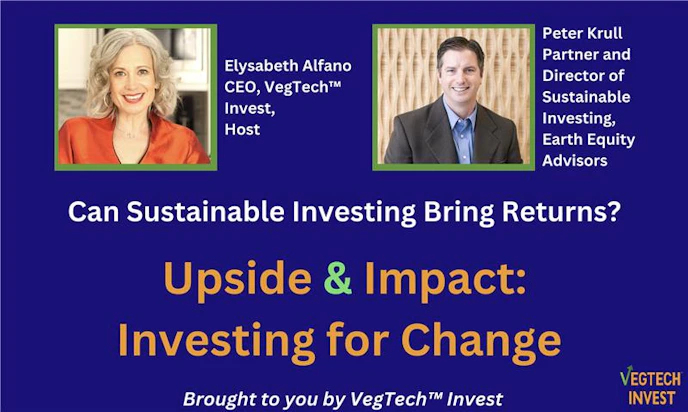
Partner and Director of Sustainable Investments at Earth Equity Advisors, Peter Krull, discusses the viability of returns from sustainable investing on this episode of the Upside & Impact: Investing for Change podcast.

Keep up with what matters in ETFs
Get timely ETF insights, market trends, and top ideas straight to your inbox.
Your newsletter subscriptions with us are subject to ETF Central's Privacy Policy and Terms and Conditions.
Peter Krull, discusses the viability of returns from sustainable investing:
- Can you have meaningful returns with SRI as a focus?
- What portion of any portfolio should be SRI?
- Peter's thoughts on the validity of the attacks on ESG
- Peter explains positive bias philosophy and slow-motion active management
- They end, as always, with an investment tip
Like what you're reading?
Stay in the loop — get the latest ETF insights: trends, analysis, and expert picks.
Transcription
Elysabeth: Hey everyone, welcome to the VegTech Invest Upside & Impact podcast. I’m your host, Elysabeth Alfano, the CEO of VegTech Invest, Advisor to the Plant-based Innovation and Climate ETF, EATV. On Upside & Impact I chat with the leaders and movers who are shaping and growing impact investing for meaningful change. We “pull up as we go up” as the expression goes so this podcast is all about making meaningful and productive impact while also managing one’s portfolio for upside. Of course, always managing for upside.
If you’d like more information about VegTech Invest you can visit us at VegTechInvest.com and subscribe to our newsletter. You can also find us on LinkedIn and on Twitter @VegTechInvest. We record live every first and third Wednesday of the month on our LinkedIn page at 1:30pm eastern standard time. So, check us out live and be sure to bring your questions.
Now if you’re listening as part of a podcast, of course subscribe to this podcast right now so that you never miss an episode. And if you’re listening on iTunes, be sure to leave a 5-star review. It really does help.
So now let’s get down to today’s show and thanks for being with me on today’s episode of VegTech Invest’s Upside & Impact. And as always, a reminder, this podcast is for informational purposes only and is not meant to recommend any specific company or investment. Now, onto the show.
Hi everyone, I’m Elysabeth Alfano. Welcome to Upside & Impact: Investing for Change podcast now featured on the New York Stock Exchange platform, ETFCentral.com. It’s great to be with you today. If you only know what it took to get me on this podcast today. I am packing to leave for Dubai to speak at COP28, the annual summit on climate change from the United Nations that happens every year. I spoke last year in Egypt.
I’ll speak this year in Dubai at least three times, not including press talks. I’ll be speaking on a sustainable food systems transformation, and I’m very excited to be talking about the intersection of sustainability, investing, and our global food supply system. We’re kind of going to talk about that today as well. Of course, by the time everyone hears this, it will be the month of December 2023, moving into 2024. I think everyone’s happy to get 2023 behind them. But it’s the time of year when we say, what does the future look like?
We’ll be focusing on this at COP28, the investable opportunities and sustainable options. But we’re focusing on that as well today. I want to bring on my guest who is the partner and director of Sustainable Investing at Earth Equity, Peter Krull. Peter, thanks for being with me.
Peter Krull: Thanks, Elysabeth. It’s great to see you again.
Elysabeth: So, on your website- and everybody can see it scrolling at the bottom of the screen. If you’re only listening to audio let me tell you it is EarthEquity.com. On your website, you say, “Well, we’re not really focused on the economy of the past. We focus for our investors on the economy of the future.” So, let’s get right into it. What is the future? Where do you see us going in the markets?
Peter Krull: Well, in terms of the markets, I don’t think anybody knows where we’re going. I mean, there’s a lot baked into that from everything from interest rates to political action. From what I understand is an election is happening next year, so there might be something to go on with that. But, you know, to really focus on what you were talking about, how our philosophy is about the new economy and where the economy is going. So often we’re sort of trapped in this paradigm of investing in these indexes like the S&P 500 or the Russell 200 or All Cap World Index, things like that. They’re put together based on what the economy was yesterday.
I like to call it rearview mirror investing, because that’s really where the companies that are in those indexes- they got in there because of what they did yesterday. We want to invest in where the economy is going. So, I don’t necessarily believe you can index the next economy or the new economy by looking at where we were, because we’re going somewhere else than where the legacy industries have taken us.
Elysabeth: I would agree 100%. And of course, no one knows the future, but the past is not necessarily predictive of the future. Obviously, you can’t predict the future, but you do have your finger on the pulse, just like I do, of sustainable investing. So specifically for the realm, I won’t even use the term ESG because now it’s just been so torn apart. I don’t think anyone even fully understands it anymore. It’s been so picked apart. But for sustainable investing, you do see more folks focused on alternative energy, electric vehicles, alternative building materials, alternative proteins, and different food systems. Where do you see that really popping? I mean, alternative energy has had a tough go of it since Covid in the post-Covid market.
Peter Krull: Yeah, well it probably was a little overvalued post-Covid. So, we’re probably reverting to a bit of a mean, and then you compound that a little bit with rising interest rates. A lot of growth companies, especially in the clean energy sector, are taking it on the chin, and so that’s hard.
Our main sustainable portfolio, the Green Safe Sustainability Portfolio, which in December we’ll be hitting our 11-year anniversary of, so it’s nice to have something that’s got a nice long track record. We’ve been really looking at that. We rebalance on December 1st, and how do we continue to maintain a true sustainability focus while maybe sort of deemphasizing some of the industries that are going to have a tough time at least in the near term? So that’s what I’ve been working on the last couple of weeks here and we’re getting ready for that rebalance. At the end of this week, we’re recording the end of November here.
When I’m putting this portfolio together, you named some of the industries that we would see in there. Some others that you may not necessarily think of, I mean, there’s always going to be technology in sustainable portfolios. We look at technology as a means for efficiency, because I like to say the best kilowatt is the one that’s never used. So, any way that we can use technology to reduce our consumption of energy is a good thing. Not a lot of people look at insurance. I think insurance is probably one of the biggest industries, or one of the industries that can have the biggest impact on climate change policy, because they’re the ones who are paying the claims when a hurricane comes through, when wildfires come through, when all these things come through. So, we’ve started to see them pulling out of states like California and Florida because they can’t afford to stay in those states because there’s so many claims that are coming through because of these climate-related disasters.
So, when it comes to policy, and I know that’s a lot about what you’re going to be talking about when you’re in Dubai, but one of the important things about insurance is that they should have a much larger voice in policymaking because they price everything. They price risk, right? So, their ability to be able to say that we need to integrate climate into our underwriting practices and if you happen to live on the coast and you’re in a danger zone, you’re simply going to pay more, or your business is there, or the municipality is there. An important part of sustainable investing is also building in risk.
Another part that we like to look at as well is resilience because as we know, climate change is here. It’s happening. How can we invest to look at the infrastructure and things that are going to need to be built up because of the greater storms, because of wildfires, because of droughts and things like that?
Elysabeth: Gosh, there’s so much to unpack there. I love that you say that insurance is really a barometer for where we’re going perhaps in the market because as you see insurance pull out of high-risk states like Florida and California, you know that we’re sort of past the point of no return I would say. From the food standpoint, you see companies leaving California and going to places like Illinois where there’s plentiful water and you have access to farmers and crops and cane sugar. It’s such an important part of the bio economy, helping fuel cells for alternative protein or cultivated meat. So, you see companies wanting to be closer and shortening that supply chain and reducing their footprint.
They want to be closer to the natural resources for better management of these natural resources, and they want to be in a place where there’s plentiful water. Of course, we’ve got the Great Lakes there and they want to be away from the coast, which have proven to be so risk intensive. But are you saying that you would have your clients invest in insurance companies, or you just look to the insurance companies as a barometer?
Peter Krull: We always have insurers in our portfolio, typically not US-based insurers because they’re behind the curve in terms of integrating climate into their underwriting policy. It’s typically European insurers that we’ve got, both traditional insurers and reinsurers as well.
Elysabeth: I’m going to go ahead and share my screen here. I just want to pull up some of the areas that you talk about on your website. Hopefully everybody can see this. So, you see your positive bias here.
Peter Krull: Let me explain what that means to us. Traditionally socially responsible investing, which is what it was called when I got started in this almost 20 years ago, was about excluding things. We don’t want to own fossil fuels or tobacco or different things like that. When I talk about positive bias, I’m talking about creating a portfolio from the ground up. Looking at what are the different industries and what are the different sectors that are leading us into that new or next economy? There’s even more to it than what’s showing up here. We typically will have biotech in our portfolios, and a big reason for that is I tend to believe that a healthier society is a more sustainable society.
I’m not talking about big pharma or anything like that. I’m talking about cutting edge kinds of biotechnology. When I started this portfolio 11 years ago, there were no individual battery stocks. You couldn’t buy battery stock. Now, we must choose which stock or which stocks we’re going to put into the portfolio because we’ve got several of them that we can choose from. So, building a portfolio from the ground up I think is where you can really get these solutions providers. When you find a lot of these, the big ESG funds, all they’re really doing is taking a traditional index, they’re layering on some ESG metrics and they’re calling it sustainable.
At the end of the day, it’s not a sustainable portfolio. It’s just a less bad version of the original. They’re not starting with any values. They’re just simply trying to quantify ranks, not necessarily risks that the companies are posing to the world, but the risks that the world is posing on the companies. This is truly risk management, and there’s nothing wrong with it. I think it’s an important part of the process, but I think you also need to look at it from the other side and really start to look at where the solutions providers are.
Elysabeth: Yes, we look at this at VegTech Invest as real wealth isn’t created because one company has 3% more revenue. Real wealth is created when you have complete systems transformation, and you go from the horse and buggy to the car or the landline to the cell phone. When’s the last time you stood in line at Walgreens and developed film? You and I grew up on film.
Peter Krull: Absolutely.
Elysabeth: Look how quickly we shifted to not even knowing how to develop film and the thought of waiting ten days for your pictures would be insane. Now everyone switched over, not just Brooklyn and San Francisco. China, India, the U.S., old, young, educated, not educated, etc. switched. So that kind of enormous transformation not only does GDP an enormous service with job growth and economic growth, but it does the investor, particularly if they get in early, a wonderful chance at real wealth creation.
I want to go ahead for the folks listening to audio to just quickly list the positive bias that we’ve been talking about. You couldn’t list everything here, but some of what Peter’s looking at as alternative energy, energy efficiency, water, technology, natural and organic products, green real estate, technology, big data, internet of things, green finance, and community investments. We’ve talked about food systems transformation, insurance, as well as biotechnology. I’ll just add to that, that biotech has been big on the Biden administration’s mind. I don’t know if you saw the big, bold goals of biotechnology and biomanufacturing documents. Spoiler alert, page 20 is all about alternative proteins, plant-based innovation, precision fermentation and cultivated meat. I think the administration is also focusing on biotechnology because just as we’ve brought investment back to the U.S. for semiconductors, it’s an issue of national security. You’re going to start bringing food production, really this novel innovation where real wealth is created, to the U.S., I think as well.
Peter Krull: You know what’s interesting when it comes to biotech, I had a call yesterday with Mark Charest who runs a biotech mutual fund, and biotech has been in about a two-year bear market at this point. It’s been on about the same track as clean energy has, and even though I think clean energy is probably going to remain low for just a little bit longer, I joked with him yesterday. I said, “Everybody always says to buy low and sell high, but nobody actually wants to pull the trigger, if you will, when it’s time to actually buy low.” We’re at that point right now, both for clean energy and biotech that select quality names as financial advisors, we also talk about dollar cost averaging which is buying both when markets are down. Now’s a great time to be dollar cost averaging, especially into those sectors because they have been down for a while, and they probably won’t remain down forever.
Elysabeth: Yeah, we feel the same thing about food as we head into COP28. Food has finally gotten to the general public’s understanding of how our current system doesn’t work for us. It’s inefficient and it's a mismanagement of natural resources. It has pandemic risk. It can’t feed everyone as we are a growing population but not growing natural resources like land, water, and forests. So, I think this leads me to my next question which is that we as the sector has been under attack for sustainable investing and there have been claims perhaps more press and clickbait driven than logic driven, or statistic driven. But there have been claims that you can’t really make money on sustainable and responsible investing. What are your thoughts on this as we talk about the pop that could happen in food, biotechnology, etc.?
Peter Krull: I think there’s ultimately two questions there. There is, you know, what’s the deal with the concerns about ESG in general and what is performance like? So, I’m going to address the first part first. You know, politicians love to divide us, and this is an easy one where you can say, “Well they do this, and we do this.” But at the end of the day, if you’re a registered investment advisor, which means you’re a fiduciary, you must always do what’s in the client’s best interest, that is what you are charged with. I would find it hard to argue that having more data is not in the client’s best interest. That’s what ESG is. ESG is more data. So again, I’ll separate out sustainable investing from ESG here, but having more data is a good thing. Some people might say, “Well, it’s not material. It doesn’t impact the company.” But that’s also not true at the same time.
I’ll give you a very brief example, and I’ll try to remember this. This is in my normal PowerPoint. Utah is a great example of this. The Great Salt Lake levels have dropped considerably over the years, and they continue to accelerate. S&P gave a negative environmental rating to the municipal bonds of Utah, and all the politicians were up in arms saying, “You can’t do this. It’s not material. This doesn’t necessarily help.” But what happened is, BYU came out with a report that said the Great Salt Lake could be dry in five years. This came out, I believe at the beginning of this year. What does that do? It does a couple of things.
First, it provides about $2.5 billion, don’t quote me on that because I’m trying to remember back to my PowerPoint, but about $2.5 billion in annual economic activity comes from the Great Salt Lake. One of the second things that it does is that having water in there maintains some safety factor because salt water has a lot of heavy metals in it. So, if that were to dry up, you’re going to have some toxic wind that’s blowing right straight to Salt Lake City. It’s going to be very unhealthy. The third thing is that having water there also supports lake effect snow up in the mountains to the east of Salt Lake for the powder that they get up there. That’s another billion and a half in economic activity. So, there is a direct material economic hit should something happen to the Great Salt Lake.
So, somebody who is complaining that it’s immaterial doesn’t really know what they’re talking about. I’ll start with that on the ESG side. On the second half of the question, which was about performance, you know we can’t talk specifically about it because of compliance rules. I know you probably know the same thing, but the one thing I will note is that sustainable portfolios are typically very competitive, but I will also say that they tend to skew to the growth side. If you are in a value cycle, like we have been for a little while, you’re probably going to underperform because it’s a growth-oriented investment. It’s a new economy or a next economy investment. But when you look at it over the long term, which is what any good investor is going to be, you’re going to have competitive returns across the board for the long term.
Elysabeth: I just want to respond to this because I think sometimes investors- maybe it’s hard to consider the scale of things when we talk about natural resources and what the personal implications might be, so I use this example to bring it really kind of home to people. I invest in real estate and of course I look at the rent roll. Of course, I look at the income coming in and my bottom line after I’ve taken out expenses. But I would be remiss and a completely negligent investor if I didn’t look at the roof because I don’t want to put on a $40,000 roof in two years. It’s the same if I didn’t look at the boiler or if I didn’t look at the plumbing because these are enormous costs that could come my way, even if they’re not in today’s rent roll. So, I think of having more data, as you say, and kind of ESG investing, if we want to use that term which I don’t even know, maybe we’ll just stay with responsible investing. I look at the whole picture. Otherwise, I’m leaving myself completely open to- “Oops, you have toxic waste on your site and we’re shutting down your building.” I mean, this would be destructive to my investment. So, it’s important to get the whole picture.
Peter Krull: Yeah, are we going to answer questions that we got because I see we have a good one.
Elysabeth: Yes, we do have many good questions so let’s get to them. Are your clients realizing the difference between real sustainable investing and greenwashing, or are they even paying attention to the political dialogue at all, or they’re just with your lockstep?
Peter Krull: Our clients are typically highly educated, so they’re paying attention to everything that’s going on and part of the reason why they’re with us is because they know that we have the philosophy that we have that is a true sustainable investing philosophy as opposed to the less bad ESG philosophy. So, I think that there’s a serious disconnect between what institutional investors think that retail investors want. So the BlackRocks of the world and the Vanguards and Fidelities are putting out these products that might say they’re sustainable or clean energy or low carbon or whatever label you want to put on them, but until you actually look under the hood and see what these particular investments hold, you really can’t buy those securities for a client because in all the experience that I’ve had, retail investors want solutions-based portfolios.
They don’t want to get their annual or semi-annual statement for their ESG-aware fund or whatever BlackRock’s fund is and start looking through the holdings and see that they own Exxon. They don't want to do that. That drives me absolutely nuts, and it sets a bad precedent for the industry. That’s where we get a lot of the criticism because that truly is greenwashing. I’m sorry, you cannot both own the cause and then try to own the solution. That doesn’t make any sense. We want to own the solution.
Elysabeth: I would say this is where capitalism shines. It takes a problem, and it solves it at scale and real wealth is created from that solution. That’s where business shines, and that’s where capitalism shines. Businesses that are efficient because they have provided a solution are rewarded. So, I like that you have this positive bias as we do as well and what we do to really be active in choosing the solutions and putting them in a portfolio.
So maybe you could explain your philosophy, which I agree with, and I love. Index-based investing is basically a slow-motion kind of management. Tell me what you mean.
Peter Krull: I can’t take credit for that. My buddy Garvin J. Bush that runs the Green Alpha Funds, I got that from him. Index investing is slow motion active investing because they do change out holdings in the index, but it’s after the company has already had a bunch of issues or had problems and so you know you still are actively investing, it’s just slow motion. It’s rearview mirror investing like I was talking about earlier, whereas positive and active investing is really spending time to do some research and understand and look and see where the economy is going.
Elysabeth: I love this. So, for your clients that are on board they get it. They’re beyond politics. They want solutions. Do you put them 100% in sustainable options? Or are you looking at sleeves of 100%? How are you addressing this?
Peter Krull: It’s all we do. All we do is sustainable investing. My business partner, Neil, likes to say we don’t have a green option and a gray option. Our clients come to us just to be sustainable, and that’s all we’ve done for almost 20 years now. In June of ‘24 it will be our 20th anniversary.
Elysabeth: Congratulations.
Peter Krull: That’s all we’ve been doing. I don’t think it makes sense to have multiple sleeves. If you’re a traditional investor and you want to learn about it and put a little bit in, that's fine, but ultimately the clients that we’ve got coming to us are clients who truly believe that it matters what you own and that’s it more than just an investment.
Elysabeth: When I speak at COP28, I will be using much of what we’ve discussed here. I love your perspective and it makes so much sense. I’ll be on panels with the United Nations Responsible Investing, UNPRI, organization and they share so much for your perspective and my perspective as well.
So, as we wrap up again for those on audio it’s EarthEquity.com. If you want to see more about Peter’s philosophy, what they do at Earth Equity and have these further discussions about investing in things like alternative energy, biotech, food, electric vehicles, etc. you can go to EarthEquity.com and here’s an exit question for you, Peter: What’s your go-to investment tip?
Peter Krull: That’s a good one. My go-to investment tip is when you’re buying something you want to buy a market leader or somebody who’s going to be a market leader. When you look at sustainable investing and you look at this next economy investing like we talk about, it really is the definition of growth investing, right? It is the definition of investing for the future. So, when you’re investing look at who are going to be the market leaders five, ten, twenty years from now.
Elysabeth: I love this perspective. We do a lot of work around high growth companies at low growth prices. So, as you say, we have been in a value period, but those growth stocks have been undervalued. The market perhaps hasn’t priced them in. So, when we look for those leaders that have built in competitive advantages like an IP moat or capital expenditures into building out the infrastructure so that when things pop, they’re there and they’re ready. We look for these kinds of leaders so that they can capture that potential financial upside when growth stocks come back.
There’s been a lot of talk about small caps and growth stocks and when that might be, of course nobody knows the future, but do you want to venture a guess?
Peter Krull: I don’t. JP Morgan puts out a quarterly report that I really pay a lot of attention to, JP Morgan Asset Management. It’s easy to find. I think it’s called State of the Markets. They’ve got a a chart that basically shows the relationship between growth investing and value investments, and for the last couple of years or so value investing has been the style that has had more opportunities in it. We’ve obviously seen it with performance.
I’d love to answer Jeff’s question. I don’t know if you saw it on the list here. I don’t want to miss that. Jeff’s question asks, “How do we ethically address the need to mine rare earth minerals to manufacture batteries for electric cars and other products? How’s this different from mining fossil fuels?” First, I think the difference is that the minerals that are going into batteries aren’t going up into the air and contributing to CO2, methane, and other greenhouse gas problems. It’s not good from a social perspective, and that’s for sure. I will absolutely agree on that. The thing is, we need to get off fossil fuels as fast as possible, and the technology that we currently have requires some of these rare earth minerals.
But at the same time, there are a ton of companies out there, most of them aren’t publicly traded, but there’s a ton of companies and universities for that matter that are actively working to make cleaner batteries and to make that technology as clean as possible. So, we’re at sort of an interim point in this shift to a fully electric economy and it’s one of the unfortunate things that we’re going to have to deal with in this short term because, again, we don’t have any more time to stop our emissions. They needed to be stopped yesterday. So, everything and anything that we can do to get that transition done is where we need to focus and knowing that we hopefully will be able to recycle those minerals and have different battery technologies soon is what we must look at.
Elysabeth: I love this question because I also think it begs the general understanding of the innovation curve. So, the current fossil fuel-based car, kind of at the end of its innovation curve, but the electric vehicle and mining for batteries is just at the beginning of the innovation curve. So, I think there’s lots of room for- of course it will depend on capital investment into the infrastructure, but there’s lots of room for more R&D and more solutions to be found. So, I don’t think where we are today with batteries and electric vehicles is where we’re going to be in five years. Would you agree?
Peter Krull: I agree. Jeff’s other comment was that I’m using a Domini cup. We have used their funds in the past. We don’t use them right now, partly because they are mostly index based. But they have been a pioneer for a very long time in sustainable and responsible investing. So, thank you for the cup anybody from Domini that’s listening.
Elysabeth: Thanks Jeffrey, for your comments. I see you are chiming in from LinkedIn. We’ve got folks here from Facebook, YouTube, Twitter, and LinkedIn. So, thanks, Jeff, for your comments and great questions.
Okay, as we wrap up, this is maybe an easier question for you than the investment tip. You’ve having a busy day like today and you have very little time for lunch, what’s your go-to snack?
Peter Krull: What’s my go-to snack? That’s a very hard question. I don’t snack, that’s the thing. I rarely snack. I’m usually going from meal to meal. I can’t answer that because I’m not usually snacking.
Elysabeth: This is the problem. I think I’m snacking for the two of us. It is a real problem. Oh my gosh, everybody, go to EarthEquity.com. Peter Krull, obviously very knowledgeable on sustainable investing, very holistic in his approach, very positive bias in. We talked about finding the companies that are really the innovators, providing the solutions. There’s wealth to be made there I believe as we become a solutions-oriented economy. That’s what I think we’re shifting to on so many levels, not just food. On so many levels the old systems are no longer working for us. That job growth and that wealth creation is really through the solutions, and we have to find so many solutions for so many things. So, we’re a solutions-based economy, as I see it. That’s my prediction for 2024: a solutions-based economy, although who knows what the election will do to things.
Are you at all trepidatious about what the election will do to the markets, or do you think we’ll just sail right through? Politics be damned.
Peter Krull: I think that the markets are insulated from politics. I mean, we look at the last two administrations, current one and the one previous, and we saw better clean energy performance during the previous administration. So, I think that it’s not something that we really think about. At the end of the day, it’s the fundamentals that matter. But things like interest rates certainly do matter and that’s the Fed. Hopefully they are politically insulated as well.
Elysabeth: So, we’ll let the politics come and go, and we will stick with the fundamentals. Peter Krull, Partner, and Director of Sustainable Investing at Earth Equity. That is EarthEquity.com. I want to thank you for being on Upside & Impact: Investing for Change, the podcast that’s featured on the New York Stock Exchange platform ETFCentral.com. I may not see you by the end of the year, so I do hope that you have a wonderful holiday.
Peter Krull: Thank you and I also did want to say if I could really quick, that Elysabeth will be an upcoming guest on my brand-new video podcast which we have not quite launched yet, but we’re coming out soon called Dollars and Change: The Experts’ Guide to Sustainable and Responsible Investing. So, keep an eye out for that as well.
Elysabeth: And that will be on iTunes? Can anybody subscribe?
Peter Krull: Yes, that will be on iTunes, but it also will be video versions where we will be able to see our beautiful faces on that too.
Elysabeth: Wonderful! I’ll also encourage everyone to subscribe to this podcast on Spotify and iTunes. Everybody on Facebook, LinkedIn, YouTube, and Twitter I will see you from Dubai. Peter don’t go anywhere. Everybody else, I’ll see you from the Middle East. Bye all!
Thanks for being with me everyone on today’s episode of VegTech Invest’s Upside & Impact. I hope that you’ve found this to be a knowledge drop and I’m always here to answer any questions so please feel free to reach out to me on LinkedIn. Elysabeth Alfano, you can find me there. I’m also on Twitter @ElysabethAlfano and you can find the VegTech Invest pages on both LinkedIn and Twitter.
Sign up for our newsletter at VegTechInvest.com and share this podcast with your colleagues, friends, and clients. And of course, be sure to subscribe to this podcast to never miss an episode. Remember we record live on the VegTech Invest LinkedIn page every first and third Wednesday of the month at 1:30pm eastern standard time. So come find us there to join the conversation live. Until then, thanks for leaving a 5-star review on this podcast app because it really does help.
If you’d like more information about VegTech Invest you can visit us at VegTechInvest.com and subscribe to our newsletter. Okay everyone, great show today. See you next time on VegTech Invest’s Upside & Impact.
VegTech Invest is a registered investment advisor focused on investing in sustainable food and materials. This podcast is for informational purposes only and should not be relied on as the basis for investment decisions. It does not constitute either explicitly or implicitly any provision of services or products by VegTech Invest. All statements made regarding companies and securities are strictly beliefs and points of view held by VegTech Invest or podcast guests and are not endorsements or recommendations to buy, sell, or hold any security. Clients of VegTech Invest may maintain positions in the securities discussed in this presentation. VegTech Invest believes that the information presented is accurate and was obtained from sources that VegTech Invest believes to be reliable. However, VegTech Invest does not guarantee the accuracy or completeness of any information and such information may be subject to change without notice from VegTech Invest.
Certain statements in this presentation may be statements of future expectations and other forward-looking statements that are based on VegTech Invest’s views and assumptions at the time of publication and involve risks that could cause actual results, performance or even events to differ materially from what is expressed or implied by such statements. VegTech Invest’s strategies are actively managed and not intended to replicate the performance of any cited index which may differ materially. You cannot invest directly in an index.
Segments
See all
No specific market segments were tagged
Mentioned ETFs
No specific ETFs were tagged
Further reading

Latest ETF News
See all ETF newsThis is How Calamos Turned Wall Street’s $100 Billion Secret Into an ETF



From Dot-Com to ETFs: How One Entrepreneur Helped Spark an Investment Revolution
How Blossom Social Is Revolutionizing Retail Investing and ETF Marketing
Is 2025 the Year for Financing Food Fast?

 Advantages of ETFs over Mutual Funds1/6
Lower Costs
In this guide, we'll explore the advantages of ETFs over mutual funds, giving you valuable insights into why ETFs have gained significant popularity among investors like yourself.
Leveraged ETFs: Unlocking the Potential for Amplified Returns1/6
Understanding Leveraged ETFs
Explore leveraged ETFs: potential for amplified returns & risks. 5 ETFs to consider across equities, commodities & fixed income.
What is a Leveraged ETF?1/6
Introducing Leveraged and Inverse ETFs
In this guide, we'll dive into the world of leveraged ETFs, exploring their definition, mechanics, potential risks, and rewards.
Recent educational content

ETF Trends
ETF Industry KPIs September 28, 2026
This week’s KPI data overview highlights key metrics and trends shaping the ETF landscape.

ETF Trends
ETF Industry KPIs September 22, 2026
This week’s KPI data overview highlights key metrics and trends shaping the ETF landscape.
First Look ETF
First Look ETF: Income, Corporate Arbitrage, and Growth and Value Investing
First Look ETF September 2026: iCapital, Mast Investments and North Square unpack new ETFs targeting monthly income, merger arbitrage and complementary growth and value exposure.

ETF Trends
ETF Industry KPIs September 14, 2026
This week’s KPI data overview highlights key metrics and trends shaping the ETF landscape.
Browse all educational columns



Have you tried our ETF Compare tool?
Compare ETFs like a pro. Analyze fees, performance, exposure & holdings side-by-side.