Create, analyze, optimize your ETF portfolio. Start now →



Can Gold Miner ETFs Be a Better Alternative to Leveraged Gold ETFs?
Gold miner ETFs can offer amplified exposure to gold prices without using derivatives. Here's how they compare with leveraged gold ETFs.

Keep up with what matters in ETFs
Get timely ETF insights, market trends, and top ideas straight to your inbox.
Your newsletter subscriptions with us are subject to ETF Central's Privacy Policy and Terms and Conditions.
Personally, I wouldn't use leverage on gold. The metal is already fairly volatile, and because it has historically exhibited a relatively low correlation with both stocks and bonds, it can provide meaningful diversification benefits within a broader portfolio. In my view, adding leverage doesn't materially improve the risk-reward trade-off for most long-term investors.
That said, leverage remains an indispensable tool for short-term traders looking to amplify price movements and maximize returns without holding positions for extended periods. Traditionally, that has meant using gold futures or listed options on products such as the SPDR Gold Shares
A simpler alternative is to use ETFs that provide amplified exposure to gold. The most common examples are leveraged gold ETFs, which typically use swaps to target a multiple of the daily return of a gold benchmark. There is another, less conventional approach, however: investing in gold mining companies.
Gold miners possess a form of embedded operating leverage. A large portion of a mining company's costs, such as labor, equipment, and mine development, are relatively fixed over the short term. As a result, when gold prices rise, much of the additional revenue flows directly to operating margins and earnings, often causing mining stocks to appreciate by more than the underlying metal.
Of course, the relationship is far from perfect. Gold miners are still publicly traded companies, meaning they're exposed not only to fluctuations in gold prices, but also to broader equity market risk, operational issues, geopolitical developments, and company-specific execution.
So, can a gold miner ETF serve as a practical alternative to a leveraged gold ETF? To find out, we'll look back at the last three years of the current gold bull market and compare the performance of a gold miner ETF against a leveraged gold ETF, using GLD as the baseline for our analysis.
Get data on 14,000+ ETFs
Access Trackinsight's reliable and comprehensive data with 500M+ points on 14,000+ ETFs.
The Gold ETFs Under Examination
For our leveraged gold ETF, we'll use the ProShares Ultra Gold
Instead, its portfolio consists primarily of cash collateral held in the ProShares GENIUS Money Market ETF
As with all daily leveraged ETFs, it's important to remember that the 2x objective applies only to a single trading day. Over longer holding periods, returns can diverge substantially from exactly twice the underlying index because of daily compounding, particularly during volatile or sideways markets.
UGL is also relatively expensive, charging a 0.95% expense ratio. One additional consideration is taxes. Because UGL gains part of its exposure through commodity futures, it is structured as a commodity pool and issues investors a Schedule K-1 instead of the more familiar Form 1099.
In comparison, the VanEck Gold Miners ETF
Its holdings include many of the world's largest gold producers, such as Newmont, Agnico Eagle Mines, and Barrick Mining, alongside precious metals royalty and streaming companies including Wheaton Precious Metals and Franco-Nevada.
Unlike bullion-based products, GDX also generates a modest amount of income from the dividends paid by its underlying holdings. As of the latest data, the ETF offers a 0.62% 30-day SEC yield.
UGL vs. GDX vs. GLD: Which Delivered Better Results?
According to Testfolio's backtesting tool, I examined the period from December 30, 2022, through August 3, 2026, covering just over three and a half years of the current gold bull market.
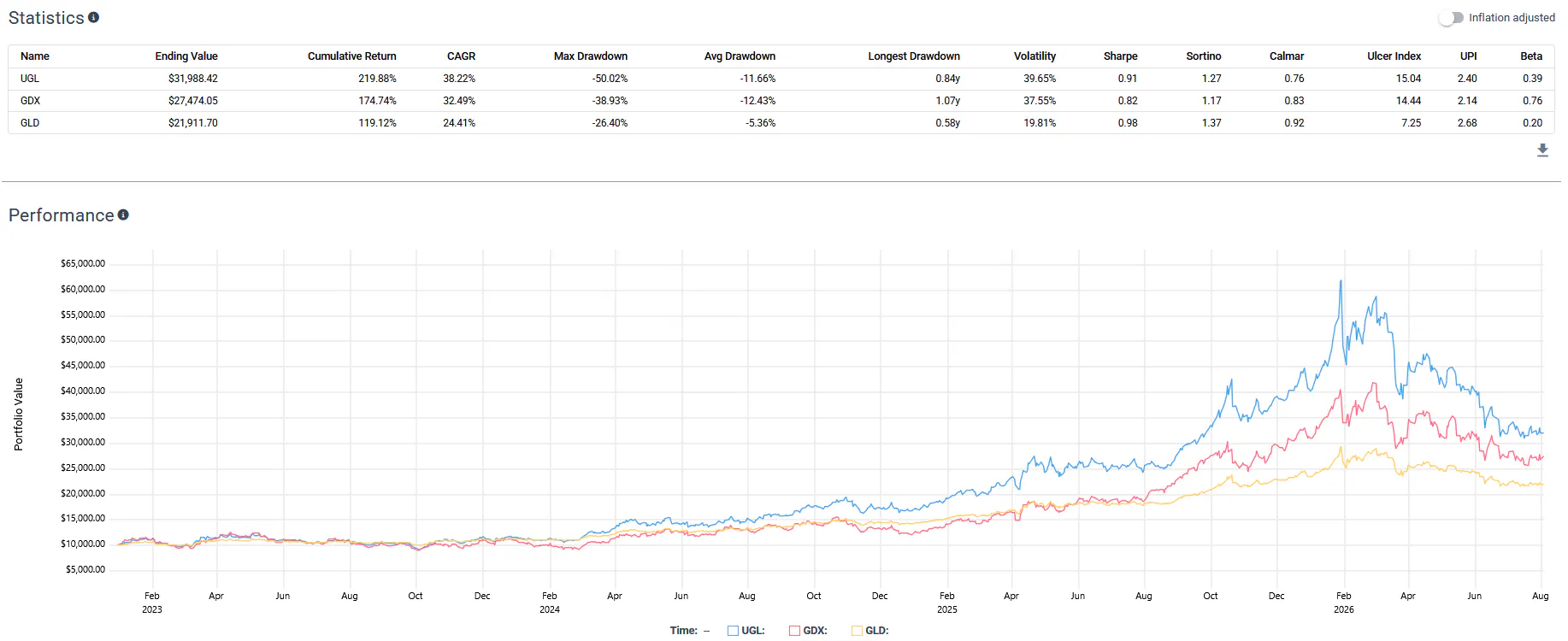
Both UGL and GDX outperformed GLD, but that isn't particularly surprising. UGL is designed to provide 2x daily exposure to gold, while gold miners typically benefit from operating leverage as higher gold prices flow through to profits.
What is interesting is that UGL did not deliver exactly twice GLD's return over the full period. Leveraged ETFs reset their exposure daily, meaning long-term returns are determined by the geometric rather than the arithmetic mean. Gains and losses compound on each other, so over extended periods, particularly during volatile markets, performance naturally drifts away from a simple two-times multiple for better or worse. Even so, UGL still produced the strongest upside of the three funds.
Risk tells a different story. UGL's annualized volatility was almost exactly double that of GLD. In other words, while returns didn't compound into a perfect 2x multiple, the volatility was much closer to the stated leverage target. That helps explain why UGL actually produced a lower risk-adjusted return than GLD, finishing with a Sharpe ratio of 0.91 versus 0.98 for GLD.
UGL's worst decline was nearly twice that of GLD, illustrating that leverage tends to amplify downside more consistently than it amplifies long-term returns. While leveraged ETFs can be effective tactical trading vehicles, investors should recognize that the additional risk compounds just as readily as gains.
GDX also struggled on a risk-adjusted basis. Although its annualized volatility was modestly lower than UGL's, its average drawdowns were remarkably similar, even if its maximum drawdown was somewhat smaller. The result was the weakest Sharpe ratio of the group at 0.82.
The diversification characteristics also differed meaningfully. One of gold's primary attractions is its relatively low correlation with equities. That was reflected in GLD's beta of roughly 0.20 versus the S&P 500. UGL's beta of 0.39 was higher because of its leverage, but still low.
GDX was different. Despite being tied to gold prices, it remains a portfolio of publicly traded mining companies. Over the test period, it exhibited a much higher beta of 0.76 versus the S&P 500, making it considerably more sensitive to movements in the broader equity market.
The correlation data reinforces that conclusion. As expected, GLD and UGL remained highly correlated because both ultimately derive their returns from the price of gold. GDX, however, displayed lower correlations with both funds.
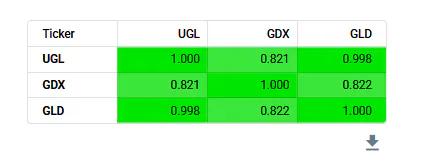
While gold prices remain an important earnings driver for miners, the ETF is still exposed to the same market forces that affect other equities, including changes in investor sentiment, operating performance, and company-specific risks. The result is that GDX behaves less like leveraged gold and more like a specialized equity sector with significant exposure to the price of gold.
Different Tools for Different Investors
I still think GDX can be an acceptable substitute for UGL for certain investors. While it doesn't provide the same direct exposure to gold prices, it avoids UGL's high 0.95% expense ratio, the added tax complexity of a Schedule K-1, and the path dependency that comes with daily leveraged ETFs.
They're simply different tools for different jobs. If your objective is a long-term buy-and-hold allocation with the potential for amplified exposure to a rising gold price, GDX may be the more practical choice despite its higher equity market risk. If, however, you're a short-term trader looking for a vehicle that tracks movements in gold itself as closely as possible on a leveraged basis, UGL might be better.
Please note that this article reflects the author’s personal views and does not represent the opinions of the publication or its affiliates. It is for informational purposes only and does not constitute investment advice. It is essential to seek guidance from a registered financial professional before making any investment decisions.
Segments
See all
Mentioned ETFs
Further reading

Latest ETF News
See all ETF news10-Year Treasury Yield Hits 5%: Which Bond ETFs Offer the Most Direct Exposure?

ETF comparison: NEOS S&P 500 High Income ETF (SPYI) Versus Goldman Sachs S&P 500 Premium Income ETF (GPIX)

There’s an ETF for That? Investing Like University Endowments

Could Water ETFs Be the Next AI Bottleneck Trade?

What is a Boomer Candy ETF?



 Advantages of ETFs over Mutual Funds1/6
Lower Costs
In this guide, we'll explore the advantages of ETFs over mutual funds, giving you valuable insights into why ETFs have gained significant popularity among investors like yourself.
Leveraged ETFs: Unlocking the Potential for Amplified Returns1/6
Understanding Leveraged ETFs
Explore leveraged ETFs: potential for amplified returns & risks. 5 ETFs to consider across equities, commodities & fixed income.
What is a Leveraged ETF?1/6
Introducing Leveraged and Inverse ETFs
In this guide, we'll dive into the world of leveraged ETFs, exploring their definition, mechanics, potential risks, and rewards.
Recent educational content

ETF Trends
ETF Industry KPIs September 14, 2026
This week’s KPI data overview highlights key metrics and trends shaping the ETF landscape.

ETF Trends
ETF Industry KPIs September 8, 2026
This week’s KPI data overview highlights key metrics and trends shaping the ETF landscape.
ETF Trends
ETF Industry KPIs August 31, 2026
This week’s KPI data overview highlights key metrics and trends shaping the ETF landscape.
ETF Trends
ETF Industry KPIs August 24, 2026
This week’s KPI data overview highlights key metrics and trends shaping the ETF landscape.
Browse all educational columns



Expert-Built ETF Portfolios, All in One Place
Don’t start from scratch. Discover ready-made ETF portfolios built by professionals to match different goals, timelines, and market views. Use them as inspiration or as a starting point for your own allocation.