ETF model portfolios designed for real investor needs. Discover →



Can the Economy Thrive Amid Dwindling Natural Resources?
Economic growth must balance natural resource constraints and environmental impact, highlighting the need for policy-driven solutions.

Keep up with what matters in ETFs
Get timely ETF insights, market trends, and top ideas straight to your inbox.
Your newsletter subscriptions with us are subject to ETF Central's Privacy Policy and Terms and Conditions.
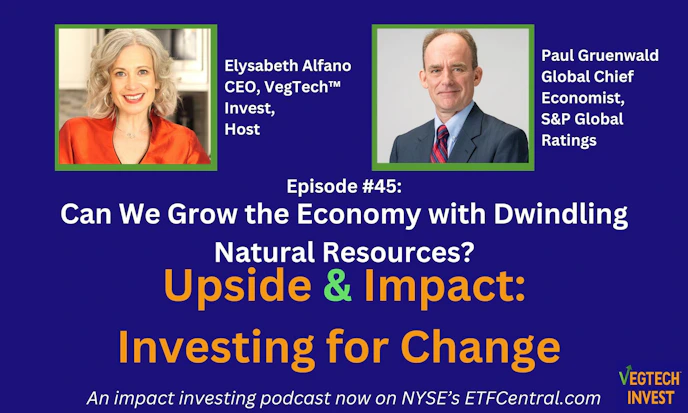
The global economy faces a pivotal challenge: how to grow while managing dwindling natural resources. In a recent episode of Upside & Impact: Investing for Change, Elysabeth Alfano, CEO of VegTech™ Invest hosted Paul Gruenwald, Global Chief Economist of S&P Global, to discuss this pressing issue. Gruenwald’s insights reveal that aligning economic growth with environmental preservation is not only possible but essential.
Indeed, Gruenwald shares in the interview that economic growth is constrained by the state natural resources and that dwindling natural resources could mean dwindling economic growth.
Like what you're reading?
Stay in the loop — get the latest ETF insights: trends, analysis, and expert picks.
Addressing the Externalities of Growth
A central theme of the conversation was the concept of negative externalities—costs imposed on society, the taxpayer, by private enterprises without being reflected in the price of goods or services. Pollution, a textbook example, underscores the inefficiencies in free markets when companies externalize costs, such as environmental damage, to the government and then ultimately the taxpayer.
Introducing mechanisms like pollution taxes brings societal and corporate costs into balance, ensuring that economic growth does not come at the expense of public welfare. Gruenwald emphasized, “The tax equilibrates the social cost with the private cost.”
This framework challenges traditional assumptions that markets function perfectly when left unregulated. Instead, Gruenwald advocates for policy interventions to internalize costs, fostering markets that reflect true value while mitigating harm to natural capital, since economies can’t grow beyond the capacity of their natural resources.
Further, Gruenwald and Alfano underscore that externalizing costs to society render the markets inefficient because the actual information about the costs of goods sold isn’t fully communicated in the product price. This therefore allows detrimental production practices, sometimes extremely costly to society, such as mass deforestation or disproportionate uses of water as is the case with industrialize animal factories, to go unchecked and an imbalance is created. This isn’t good for markets or society.
We are feeling this societal imbalance now in the shape of Climate Change and environmental degradation due, in part, to the extractive practices of certain industries.
Gruenwald explains this further in a clip from the interview here:
From Theory to Practice: Investing in Natural Capital
Requiring that companies internalize their costs can result in less destructive production and could reshape how investors view growth opportunities. By pricing in externalities, and shifting the cost of water and land usage, emissions production, water and air pollution, and healthcare costs, among others, to the producers, the businesses are incentivized to prioritize innovation and resource efficiency to reduce their costs. This results in better run companies with better returns, in addition to less destructive tactics. Of course, better returns is what investors desire.
However, this transition to internalize costs requires broad adoption of policies that align corporate and public interests, and that can be tricky. Still, investors increasingly recognize that unsustainable practices present risks, from regulatory penalties to resource scarcity, that aren’t good for portfolios.
Gruenwald’s insights reinforce the timeliness of the VegTech™ Invest investment strategy: investing in companies that prioritize sustainable practices is not only good stewardship but financially prudent. By investing in businesses that reduce dependency on finite resources, Alfano noted that VegTech™ Invest aims to deliver returns that benefit both portfolios and the planet. A few examples of emerging growth sectors that exemplify this alignment, intending to drive returns while preserving ecological systems, are diversified proteins, electric vehicles, and biotechnology.
The Path Forward & The Investor’s Role
Economic growth does not have to conflict with environmental preservation. Integrating societal costs into corporate decision-making creates a fairer and more efficient marketplace. This paradigm shift is crucial for a thriving economy, especially as natural resources, and thus society at large, face increasing strain.
By supporting innovation and advocating for policies that balance economic and environmental interests, Gruenwald and Alfano discussed that investors can unlock growth opportunities that endure for generations.
Listen to the full audio podcast here.

Watch the full video interview here.

About the author
Elysabeth Alfano is the CEO of VegTech™ Invest, Advisor to a food innovation ETF. She is a consultant to C-Suite of multinational companies and speaks internationally on the intersection of investing, sustainability, and food systems transformation. Elysabeth is also the host of the podcast, Upside & Impact: Investing for Change. This article was co-written by the Fractional Associate Director of Comms & Research at VegTech™ Invest, Gwendolyn Brown.
Please note this article is for information purposes only and does not in any way constitute investment advice. It is essential that you seek advice from a registered financial professional prior to making any investment decision.


Latest ETF News
See all ETF newsForm 4 Has 20 Transaction Codes. None Say "Section 351 ETF Swap"


Who Really Owns a White-Label ETF?


What If a Futures-Based ETF Never Had to Roll Again?

How Do You Build a Winning ETF Business?

Losers Of Q2 2026 REIT Earnings Season


Winners of Q2 2026 REIT Earnings Season


 Advantages of ETFs over Mutual Funds1/6
Lower Costs
In this guide, we'll explore the advantages of ETFs over mutual funds, giving you valuable insights into why ETFs have gained significant popularity among investors like yourself.
Leveraged ETFs: Unlocking the Potential for Amplified Returns1/6
Understanding Leveraged ETFs
Explore leveraged ETFs: potential for amplified returns & risks. 5 ETFs to consider across equities, commodities & fixed income.
What is a Leveraged ETF?1/6
Introducing Leveraged and Inverse ETFs
In this guide, we'll dive into the world of leveraged ETFs, exploring their definition, mechanics, potential risks, and rewards.
Recent educational content

ETF Trends
ETF Industry KPIs September 14, 2026
This week’s KPI data overview highlights key metrics and trends shaping the ETF landscape.

ETF Trends
ETF Industry KPIs September 8, 2026
This week’s KPI data overview highlights key metrics and trends shaping the ETF landscape.
ETF Trends
ETF Industry KPIs August 31, 2026
This week’s KPI data overview highlights key metrics and trends shaping the ETF landscape.
ETF Trends
ETF Industry KPIs August 24, 2026
This week’s KPI data overview highlights key metrics and trends shaping the ETF landscape.
Browse all educational columns



Expert-Built ETF Portfolios, All in One Place
Don’t start from scratch. Discover ready-made ETF portfolios built by professionals to match different goals, timelines, and market views. Use them as inspiration or as a starting point for your own allocation.