ETF model portfolios designed for real investor needs. Discover →



Calamos Autocallable Growth ETF (CAGE): The Next Evolution of Structured Products
Calamos expands its auto-callable lineup with CAGE, a growth-focused ETF that brings structured product exposure into a more accessible, ETF-based format.


Keep up with what matters in ETFs
Get timely ETF insights, market trends, and top ideas straight to your inbox.
Your newsletter subscriptions with us are subject to ETF Central's Privacy Policy and Terms and Conditions.
Whenever a new ETF category launches, there are usually one or two providers that either get there first or shape how the space evolves. In the case of autocallable ETFs, Calamos Investments has managed to do both.
Its flagship, the Calamos Autocallable Income ETF
Both strategies focus on delivering above average income by tracking benchmarks composed of autocallable notes, a type of structured product that historically sat within bank issued notes and advisor driven portfolios.
Prior to the ETF wrapper, access to autocallables was largely limited to private banking channels, often with higher minimums, less transparency, and limited liquidity.
Packaging them into an ETF changes the experience. Investors can now buy and sell exposure on an exchange with visible pricing, while the use of swaps helps deliver that exposure with a more standardized and typically lower expense structure.
That said, not all investors use autocallables purely for income. In practice, many bank advisors have used them to express moderately bullish views while introducing some level of downside buffering or path-dependent payoff structure. They can sit somewhere between equities and traditional fixed income, depending on how they’re structured.
To meet that demand, Calamos launched the Calamos Autocallable Growth ETF
Unlike CAIE and CAIQ, this strategy is not designed to distribute coupons, and Calamos does not anticipate capital gains distributions, which may make it more suitable for taxable accounts focused on growth. Here’s closer look at how this ETF works.
Global ETF Survey 2026 is Live!
With 1,790 new products launched by July 2026, choosing is harder than ever. Our Global ETF Survey 2026, built on 620 professional investors and allocators, shows how active, fixed income, options-based and thematic ETFs are reshaping fund selection.
How autocallable growth works
Traditional autocallable income notes are built to pay coupons when a reference index is above a certain level on periodic observation dates. If conditions are met, you get paid. If not, the coupon is simply missed. The focus is on generating income along the way, with the note potentially being called early if conditions are satisfied.
Autocallable growth flips that idea on its head. Instead of distributing coupons, it accumulates them. According to Calamos, CAGE tracks an options-based strategy where coupons build over time whenever the reference index, in this case the MERQUBE U.S. Large Cap Vol Advantage Autocallable Growth Index, posts positive returns on annual observation dates.
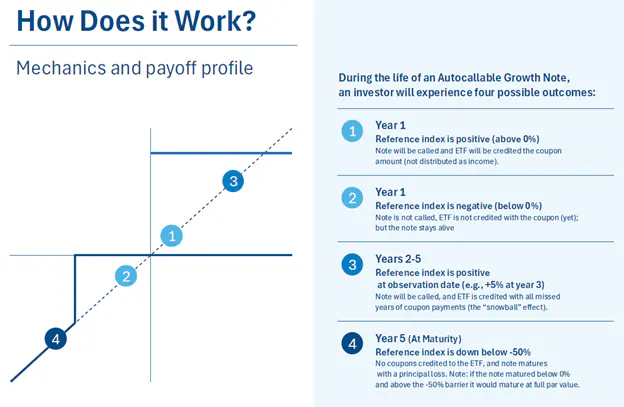
The following chart, provided by Calamos, outlines four typical outcomes, ranging from early call scenarios to full maturity with accumulated coupon payments.
If the index is not positive, the coupon is not lost. It is stored and carried forward. This is where the “memory” feature comes in. Missed coupons are not gone; they stack. That creates a compounding effect in positive markets while preserving the ability to recover missed growth during periods of weakness. The following diagram from Calamos illustrates this mechanism.
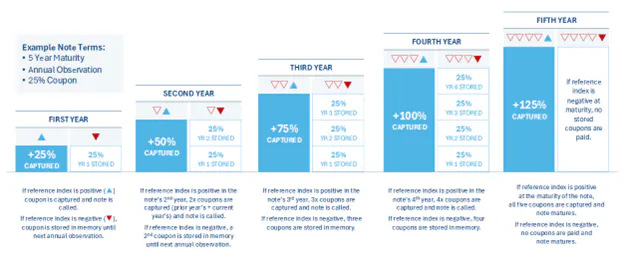
What makes CAGE notable is that it is the first ETF to package this “memory” mechanic into a diversified, liquid vehicle. Instead of a single note with one payoff path, investors are getting exposure to a basket of these structures, each at different stages, which smooths out timing risk across the portfolio.
The result is a payoff profile that aims to compound returns during favorable markets, store potential gains during drawdowns, and release that stored value when conditions improve.
How CAGE is implemented
Like CAIE and CAIQ, CAGE gains its exposure through swaps rather than directly holding autocallable notes to ensure liquidity.
Individual autocallables are bespoke instruments issued by banks. Wrapping them directly into an ETF would be operationally difficult and limit scalability. Using swaps allows the ETF to track a rules-based index of autocallable growth notes in a more standardized and liquid format.
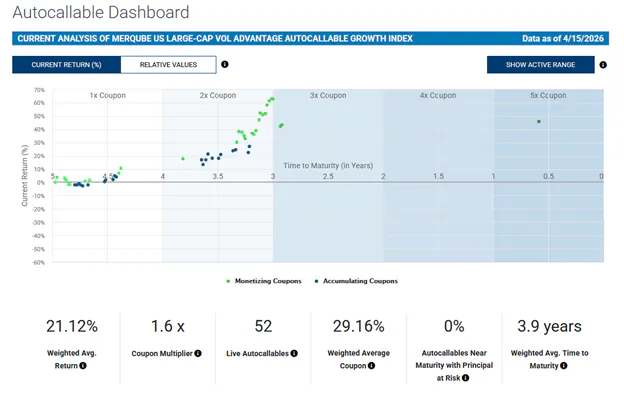
Calamos provides ongoing transparency through a dashboard that breaks down the underlying index. Investors can see metrics such as weighted average return, current coupon multiplier, number of live autocallable notes, weighted average coupon, how many positions are approaching maturity with principal at risk, and the weighted average time to maturity.
The ETF carries a 0.74% management fee. Unlike traditional autocallable notes, there are no embedded dealer markups, commissions, or opaque structuring costs layered into the product.
The main appeal here is tax-efficient growth. With no expected coupon distributions and no anticipated capital gains distributions, CAGE may serve as an alternative to plain long equity exposure.
Instead of relying on daily resetting leveraged ETFs, portfolio margin, or options, the structure allows investors to target a defined payoff profile with built-in downside buffers and path-dependent upside.
It also introduces a degree of capital efficiency. Because the payoff is structured, investors may be able to express a bullish view with a smaller allocation than a traditional equity position.
The trade-off, as always with structured products, is complexity and path dependency, but the ETF wrapper makes the strategy more accessible than it has been historically.
For more information about CAGE, visit www.calamos.com/CAGE.
Before investing, carefully consider the fund's investment objectives, risks, and charges and expenses. Please see the prospectus and summary prospectus containing this and other information which can be obtained by calling 1-866-363-9219. Read it carefully before investing.
Calamos Investments LLC, referred to herein Calamos is a financial services company offering such services through its subsidiaries: Calamos Advisors LLC, Calamos Wealth Management LLC, Calamos Investments LLP, and Calamos Financial Services LLC.
An investment in the Fund(s) is subject to risks, and you could lose money on your investment in the Fund(s). There can be no assurance that the Fund(s) will achieve its investment objective. Your
investment in the Fund(s) is not a deposit in a bank and is not insured or guaranteed by the Federal Deposit Insurance Corporation (FDIC) or any other government agency. The risks associated with an
investment in the Fund(s) can increase during times of significant market volatility. The Fund(s) also has specific principal risks, which are described below. More detailed information regarding these risks can be found in the Fund's prospectus.
Investing involves risks. Loss of principal is possible. The Fund(s) face numerous market trading risks, including authorized participation concentration risk, cap change risk, capital protection risk, capped upside risk, cash holdings risk, clearing member default risk, correlation risk, derivatives risk, equity securities risk, investment timing risk, large-capitalization investing risk, liquidity risk, market maker risk, market risk, non diversification risk, options risk, premium-discount risk, secondary market trading risk, sector risk, tax risk, trading issues risk, underlying ETF risk and valuation risk. For a detailed list of fund risks see the prospectus.
The principal risks of investing in the Calamos Autocallable Income ETF include: autocallable structure risk, contingent income risk, early redemption risk, barrier risk, authorized participant concentration risk, calculation methodology risk, cash holdings risk, correlation risk, costs of buying and selling fund shares, counterparty risk, credit risk, derivatives risk, equity securities risk, index risk, interest rate risk, investment in a subsidiary, laddered portfolio risk, liquidity risk, market maker risk, market risk, new fund risk, non-diversification risk, premium-discount risk, secondary market trading risk, swap agreement risk, tax risk, trading issues risk, valuation risk, and volatility target index risk.
The principal risks of investing in the Calamos Autocallable Growth ETF include: authorized participant concentration risk, autocallable structure risk, contingent income risk, early redemption risk, barrier risk, calculation methodology risk, cash holdings risk, correlation risk, costs of buying and selling fund shares, counterparty risk, credit risk, derivatives risk, equity securities risk, FLEX Options risk, index risk, interest rate risk, investment in a subsidiary, laddered portfolio risk, liquidity risk, market maker risk, market risk, new fund risk, non-diversification risk, other investment companies risk, premium-discount risk, secondary market trading risk, swap agreement risk, tax risk, trading issues risk, valuation risk, and volatility target index risk.
Autocallable Structure Risk: The Fund’s returns are correlated to the performance of a synthetic portfolio of autocallable notes tracked by the Laddered Autocall Index. Autocallable notes have specific structural features that may be unfamiliar to many investors:
Contingent Income Risk: Coupon payments from the Autocalls are not guaranteed and will not be made if the Underlying Index falls below the Coupon Barrier on observation dates. This means the Fund may generate significantly less income than anticipated during market downturns.
Early Redemption Risk: Autocalls in the Portfolio may be called before their scheduled maturity if the Underlying Reference Index reaches or exceeds the Autocall Barrier on observation dates. This automatic early redemption could force reinvestment of that portion of the portfolio at lower rates if market yields have declined.
Barrier Risk: If the Underlying Reference Index falls below the Protection Level Barrier at the maturity of an Autocall in the Portfolio, that portion of the Portfolio will be fully exposed to the negative performance of the Underlying Reference Index from its initial level. This conditional protection creates a binary outcome that can result in sudden, significant losses if barriers are breached
Performance data quoted represents past performance, which is no guarantee of future results. Current performance may be lower or higher than the performance quoted. The principal value of an investment will fluctuate so that your shares, when sold, may be worth more or less than their original cost.
The Fund enters into swap agreements with J.P. Morgan to obtain exposure to the Autocallable Index. J.P. Morgan is not an advisor, promoter, in any way affiliated with the Fund and has no responsibility for the Fund's performance, marketing, or trading, or any responsibility regarding the suitability of the Fund as an investment.
Nasdaq® is a registered trademarks of Nasdaq, Inc. (which with its affiliates is referred to as the "Corporations") and is licensed for use by Calamos Advisors LLC. The Fund has not been passed on by the
Corporations as to their legality or suitability. The Fund is not issued, endorsed, sold, or promoted by the Corporations. THE CORPORATIONS MAKE NO WARRANTIES AND BEAR NO LIABILITY WITH
RESPECT TO THE FUND(S).
The MerQube US Large Cap Vol Advantage Index is designed to provide volatility adjusted exposure to E-Mini S&P 500 futures contracts by targeting an implied volatility of 35%, subject to a 6% decrement per annum. Unlike traditional equity indices that maintain fixed allocations, this index dynamically adjusts exposure based on market volatility conditions. During calm or typical market environments, the Index increases exposure to equity futures while during volatile market periods, the Index reduces exposure to equity futures. Unlike other volatility target indices that rebalance daily based on realized volatility, this Index rebalances weekly (at the end of each week) based on one-week implied volatility derived from SPY weekly options prices. This approach seeks to maintain a more consistent risk profile across varying market conditions while potentially reducing drawdowns during market stress and improving risk-adjusted returns over time. The Index is a rules-based, systematic index designed to provide dynamic exposure to US large-capitalization equities while employing a volatility management methodology that seeks to maintain a target volatility level. The Index dynamically adjusts exposure between the Equity Component and a cash position based on prevailing market volatility conditions.
The MerQube Autocallable Growth Index: The MerQube US Large-Cap Vol Advantage Autocallable Growth Index is designed to reflect the collective performance of a theoretical portfolio ofsynthetic Autocallables arranged in a laddered structure with staggered entry points, referencing large-cap U.S. equity securities. It serves as the underlying reference index for CAGE.
The MerQube Nasdaq-100 Vol Advantage Autocallable Index is designed to reflect the collective performance of a theoretical portfolio of 52 to 260 synthetic Autocallables arranged in a laddered structure with staggered entry points with similar fixed parameters (the “Parameters”) as described below within the section entitled “Autocallable Index Portfolio Characteristics”. The Nasdaq-100 Index® is a stock market index made up of equity securities issued by 100 of the largest non-financial companies listed on the Nasdaq stock exchange. It is a modified capitalization weighted index.
Calamos Financial Services LLC, Distributor
© 2026 Calamos Investments LLC. All Rights Reserved. Calamos® and Calamos Investments® are registered trademarks of Calamos Investments LLC
Please note that this article reflects the author’s personal views and does not represent the opinions of the publication or its affiliates. It is for informational purposes only and does not constitute investment advice. It is essential to seek guidance from a registered financial professional before making any investment decisions.


Latest ETF News
See all ETF newsBeyond Big Tech: The Increasing Specialization of AI ETFs

There's an ETF for That? Humanoid Robotics and Physical AI

How Some ETF Issuers Use Their Own Funds for Cash Management

These Public-Private ETFs Invest in Polymarket and Anduril

There's an ETF for That? Frontier Markets



 Advantages of ETFs over Mutual Funds1/6
Lower Costs
In this guide, we'll explore the advantages of ETFs over mutual funds, giving you valuable insights into why ETFs have gained significant popularity among investors like yourself.
Leveraged ETFs: Unlocking the Potential for Amplified Returns1/6
Understanding Leveraged ETFs
Explore leveraged ETFs: potential for amplified returns & risks. 5 ETFs to consider across equities, commodities & fixed income.
What is a Leveraged ETF?1/6
Introducing Leveraged and Inverse ETFs
In this guide, we'll dive into the world of leveraged ETFs, exploring their definition, mechanics, potential risks, and rewards.
Recent educational content
First Look ETF
First Look ETF: Income, International, and Cash Flow ETFs
In this season 6 episode of First Look ETF, Stephanie Stanton @etfguide examines the latest ETF marketplace trends with NYSE and guests.


ETF Trends
ETF Industry KPIs October 5, 2026
This week’s KPI data overview highlights key metrics and trends shaping the ETF landscape.

ETF Trends
ETF Industry KPIs September 28, 2026
This week’s KPI data overview highlights key metrics and trends shaping the ETF landscape.
ETF Trends
ETF Industry KPIs September 22, 2026
This week’s KPI data overview highlights key metrics and trends shaping the ETF landscape.
Browse all educational columns



ETFs’ Next Act: From Access to Selection
With 1,790 new products launched by July 2026, choosing is harder than ever. Our Global ETF Survey 2026, built on 620 professional investors and allocators, shows how active, fixed income, options-based and thematic ETFs are reshaping fund selection.