Open Now: The Global ETF Survey Take the Survey →



Bloomberg Intelligence's Jen Bartashus on Projections for AgTech and Food Tech
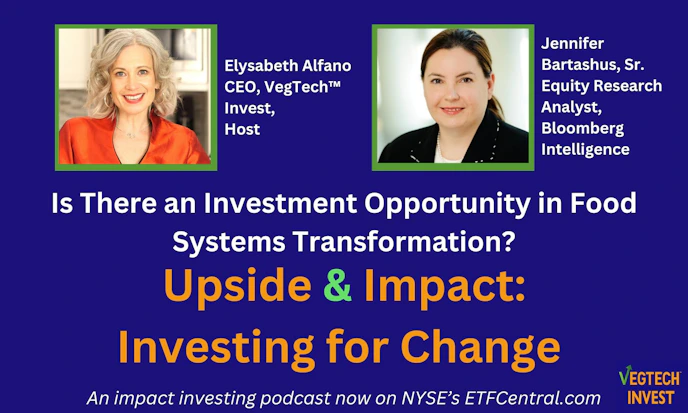
Senior Research Analyst at Bloomberg Intelligence, Jen Bartashus, joins host and CEO of VegTech™ Invest, Elysabeth Alfano, on the Upside & Impact: Investing for Change podcast from the Farm, Food, & Fuel Summit in Kansas City.

Keep up with what matters in ETFs
Get timely ETF insights, market trends, and top ideas straight to your inbox.
Your newsletter subscriptions with us are subject to ETF Central's Privacy Policy and Terms and Conditions.
Senior Research Analyst at Bloomberg Intelligence, Jen Bartashus, joins host and CEO of VegTech™ Invest, Elysabeth Alfano, on the Upside & Impact: Investing for Change podcast from the Farm, Food, & Fuel Summit in Kansas City. They discuss the conference speakers' projections for the AgTech and Food Tech space for the next five to ten years.
Specifically they discuss,
- What are some of the hardships that the animal agriculture industry is facing at the moment?
- Is there a growing interest in protein diversification?
- Are there financial benefits to protein diversification?
- What were some key learnings coming out of the Bloomberg Intelligence Farm, Food & Fuel Summit?
The ETF Industry Is Evolving Fast
From AI infrastructure to active strategies, the ETF landscape is shifting. Share your perspective in the 7th Annual Global ETF Survey and get exclusive early access to the final report.
Full Transcript
Elysabeth: Hey everyone, welcome to the VegTech Invest Upside & Impact podcast. I’m your host, Elysabeth Alfano, the CEO of VegTech Invest, Advisor to the Plant-based Innovation and Climate ETF, EATV. On Upside & Impact I chat with the leaders and movers who are shaping and growing impact investing for meaningful change. We “pull up as we go up” as the expression goes so this podcast is all about making meaningful and productive impact while also managing one’s portfolio for upside. Of course, always managing for upside.
If you’d like more information about VegTech Invest you can visit us at VegTechInvest.com and subscribe to our newsletter. You can also find us on LinkedIn and on Twitter @VegTechInvest. We record live every first and third Wednesday of the month on our LinkedIn page at 1:30pm eastern standard time. So, check us out live and be sure to bring your questions.
Now if you’re listening as part of a podcast, of course subscribe to this podcast right now so that you never miss an episode. And if you’re listening on iTunes, be sure to leave a 5-star review. It really does help.
So now let’s get down to today’s show and thanks for being with me on today’s episode of VegTech Invest’s Upside & Impact. And as always, a reminder, this podcast is for informational purposes only and is not meant to recommend any specific company or investment. Now, onto the show.
Hi everybody, I’m Elysabeth Alfano. Welcome to another episode of Upside & Impact: Investing for Change, the podcast that I do for the New York Stock Exchange platform ETFCentral.com. I’m your host of the podcast and CEO of VegTech Invest.
I’m live today in Kansas City, ouch, at 7:30 in the morning central. That would be 5:30 in the morning pacific time. Okay, I understand that everyone in New York is having coffee right now, but 5:30 in the morning pacific time is early for me. The only reason I would do a podcast live on camera this early in the morning would be because of my guest today. I’m over the moon to have back with me, she’s kind of a regular on this show, Jen Bartashus, Senior Analyst at Bloomberg Intelligence. She covers big box stores and the food industry, particularly the plant-based industry as a sector now that she covers as an analyst. And I wanted to get her feedback from the conference, which is why we’re in Kansas City for Farm, Food, & Fuel. Jen, Thanks for being with me.
Jen Bartashus: Good morning, Elysabeth, I’m so happy to be here.
Elysabeth: Amazingly, she doesn’t drink coffee, if you can believe it. She’s been up and at it for a while. So here we are in Kansas City together for the Farm, Food, & Fuel conference. I’m wondering if you can, before we dive into specifically food and what you’ve been walking about therein and what we’ve been talking about together, if you have any major takeaways from the conference, not specific to food, but just in general of the topic, before we dive in.
Jen Bartashus: Well yeah, this is the first conference of this sort for Bloomberg and one of the things that we really wanted to do was to help fill the gaps between what happens in one sector and how it impacts others. So, showing how things translate from the farm, whether it’s nitrogen or fertilizer into food and the food processing industry and into fuel. And the decisions that are made along that decision tree is really part of what this conference is all about. So, it’s been fascinating to see how all of these topics are interrelated and that people don’t always give enough credit to how much they are dependent upon each other.
Elysabeth: I’ve listened to some wonderful people. The chief of the USDA weather outlook- I didn’t even know that the USDA had a weather outlook department, and it makes so much sense that they would. So, weather being a big part of this conversation, as we are so susceptible to those highs and lows, the vicissitudes of our planet. Sustainability is an ongoing theme here and biofuel and what that looks like and how we can be more natural resource efficient and less intensive. So, the planet really, although not said in those terms, the planet ultimately and its natural resources are a big topic of conversation here.
As we dive in specifically to food, which you and I discuss a lot, before we go into the plant-based innovation sector and the meat sector, we had some interesting conversations with industry leaders here. Perhaps you can tell me about food. In general, you had four major takeaways in one of the presentations that you gave about food, packaged food specifically, and where that’s going and what to look for.
Jen Bartashus: So, we’re looking at sort of four megatrends as we go forward into the next decade. One of those is sustainability, which is at front and foremost for what we’re talking about. The next is AI and generative AI because you can’t really have a conversation without including it these days. Then we’re also talking about food as medicine and personalized nutrition. And these are all things that are starting to really emerge, but we think are going to heavily influence the food system over the next decade or so.
Elysabeth: And I think what’s interesting is I think those topics are going to influence each other. So, I think AI is going to influence personalized nutrition and I’m really excited for that day when people can, on their own phone or maybe even at home, test their own blood and see like, “Today I’m short on niacin, which would be B3” and “what foods and I going to eat to get B3,” as an example. So, AI would be helping in that and then sustainability I think not just for the planet but for the person. So, I think these foods as medicines and sustainability AI and personalized health are all going to weave together. It’s so very exciting.
As you say, this is kind of a ten-year outlook horizon, but we don’t have stability. I mean, I just think of ten years at this point as an eternity. Can you give us maybe a three-year horizon? And this is unfair. She had no preparation so you can say “No, I cannot, and I won’t.”
Jen Bartashus: When I say ten years, I think that these are going to be relevant topics for the next ten years, not that it's going to take ten years to achieve meaningful achievements in these areas. But you know, AI is already here today. It’s already being used. It’s still in its early days and still very early case studies, but there’s a lot to be excited about and a lot to be encouraged around.
With food as medicine, I think there’s a movement underway where people are increasingly understanding the relationship between food and their overall well-being and a desire to get away from medication and use food to help manage health conditions that they have. And you know, we’ve seen even at retailers that they have more nutritionists on staff. They have people who are consulting and looking at food as medicine. So, you know there are things that are happening today but I just think these things are going to be with us for a while.
Elysabeth: Ultimately, I think we might be saying that we’re having a positive conversation in a world of maybe negative. When you tell me that more nutritionists are on staff, I’m over the moon about this since doctors under their very busy schedules usually get only four hours of nutrition in a four-year medical cycle and a four-year intern cycle. That’s eight years of study and learning and only four years of nutrition. We all go to our doctor and say, “Oh my gosh, what’s wrong with me?” “Hey, you know, you should do this, that, and the other.” But the truth is you need to be a bit more specific and nutritionists and hopefully AI might be that for you in the long run. We’ll see.
Now as we kind of rope this in to get specific, we’ll talk about plant-based innovation and then we’ll step out and talk about meat and dairy and plant-based innovation, and how that all comes together. What are you seeing coming out of Q4? Now, we’ve done all the earnings calls. What are you seeing? We’ve talked about Beyond Meat here, but maybe companies like IFF, Givaudan, or Oatly. What are you seeing there?
Jen Bartashus: Especially starting with the ingredients companies, I think the good news is that we seem to have hit kind of the bottom of where they were going through customer destocking. There was some pressure there. There were trends where their customers were slowing down their orders and that’s a supply chain related issue. But the good thing that we saw out of earnings this quarter is that it’s starting to rebuild. And these companies are very heavily invested in diversified protein and alternative protein, depending on what terminology you like to use.
And so even though we’re still seeing slower sales in retail, we’re seeing positive signs out of the ingredients companies that demand is starting to come back to do some more innovation and to get some more traction with these bigger companies and package companies that they serve. So that was really the positive coming out from the ingredients companies that we really see hopefully the beginning of what’s going to rebuild in terms of innovation across the space.
For companies like Oatly, I think we’re seeing all the efforts they’ve taken in the last year and a half, and I know we talked about Beyond Meat before, but Beyond Meat falls in this category too. Where they’ve done massive cost cutting, they’ve restructured their organizations, they’ve taken a hard look at their business, they’ve exited unprofitable product lines or geographies, and so they really seem to have hit the base from which they can now build.
And so, we look at these companies and see that we think they’re very well prepared now to move towards profitability, whereas before it was incredibly volatile. And so, every quarter it was all over the place.
Elysabeth: And usually a new dream, which was not so realistic. We all just want to see the numbers.
Jen Bartashus: Exactly, but it feels like we’ve finally achieved some stability in the baseline operations and that is very encouraging as well.
Elysabeth: Yeah, I’m very excited about that and so I have spoken a lot about Beyond Meat already on this show, so I’ll talk a little bit about Oatly. I think that’s interesting. I want to say maybe nine months or a year ago they decided to be capital infrastructure light, I’ll say. So, they got rid of owning a plant and leased it out to someone else and now they just leased out the manufacturing capacity that they need.
They’ve made some other changes structurally to be more on the path towards profitability and they too, just like Beyond Meat, in Europe showing some nice signs of uptick there in consumer demand, which is something we’ll talk about in a little bit. So, as we look at those ingredient companies that are- we always talk about this at VegTech Invest. We really think the growth is going to happen in the supply chain and the picks and shovels of the industry is really where the money to be made is. And I concur with you that the ingredient companies are looking towards innovation, thinking about R&D, doing some capex spend. That’s very exciting to see. That should play out later in the marketplace. But what about flavor and texture companies? Anything there with IFF, Givaudan? Anything interesting there?
Jen Bartashus: So, in terms of flavor and texture, the nice thing is that as you said, R&D is up ticking. So, there’s investment behind R&D. They’re coming up with new compounds that just enhance the texture and the flavor of food and that can only be good news for the plant-based industry, because that has been one of the largest criticisms leveled at it is that the texture isn’t quite right or the flavor profile needs to improve for some products, not all.
So again, just seeing that spirit of innovation. It’s nice to see that the management teams are going back to investing behind R&D. And the other part is that the supply chain is now stable enough that it’s really unlocking the ability for these companies to go back and start reinvesting.
Elysabeth: We even had a conversation because Jen was kind enough to invite me to a one-on-one panel discussion on the industry and we had this conversation that there was stupid money out there before investing in anything, an idea even with no intended path to profitability and I always think that makes for a bad founder and a bad CEO. Tight money times forces one to be crafty, and that really makes a better CEO. So, in a way I’m not upset by the contraction of investment from VCs, et cetera, but we had a conversation ourselves about what is going to bring consumer demand back, and I would love to hear your thoughts.
Jen Bartashus: So, when it comes to consumer demand, it’s always a little bit of a carton horse sort of thing, but the biggest thing and this is something we’ve talked about in the past is price. The products must be affordable and right now we’re still in an environment where we still have persistent inflation. It is getting better. It is coming down in the food category, but we’re seeing that it’s coming down slower in plant-based than it is in conventional protein. And a lot of that has to do with scale.
These smaller companies might have fabulous products, but they can’t absorb costs as easily as a big company. So, when you’re talking about prices coming down as inflation subsides, the big companies can bring it down faster because even if their costs are still higher, they can absorb it from other parts of their organization. These smaller companies don’t have that same kind of capability and so the price gap between the plant-based and the traditional or conventional products is still quite wide. So, bringing that price closer to, maybe not parity, but at least a little bit further down so that your typical family can afford to go back into the category is one big thing.
And then it’s also about new iterations of products and getting people to try them. So, we’re finally back in an environment in retail, for example, where they can do sampling. That was gone for years, right?
Elysabeth: What’s sampling? I mean, I had forgotten, my gosh.
Jen Bartashus: So, there are strategies at retail that can now come back into play, that can get people excited about the products and the categories. Every time my husband goes to Costco, he tries something, and he comes home with something new. So sampling is a simple strategy, but it’s one example. Those that are the kinds of things that can help get consumers re-engaged with the category and to help it start to grow again.
Elysabeth: That’s why sometimes when folks say, “Oh my gosh, I cannot afford this,” I say, “Well, head to Gardein, owned by Conagra.” Obviously, it’s a very large company. So, when you’re in the frozen aisle I’ll head to something more like Morningstar burgers or Gardein because they’re going to be able to keep those prices lower than let’s say the Beyond Meats or the Impossibles or the others. There are many other startups. And that way you can get your toe into that meatless Monday if you’d like to bring down things like cholesterol or like to add some fiber into that diet and get some cleaner proteins in there for yourself, there are ways and prices will continue to come down.
Let me give you an example of something I feel. I have mixed results or feelings on this. So, when I think of crab, it’s off the charts expensive. So imitation crab, it’s not even a discussion anymore. Imitation crab is in most California rolls, even at restaurants. Maybe not high-end restaurants but in your average sushi restaurant the California roll is made with imitation crab. It’s about given or take off the top of my head, one-third of real crab, which can be in the $30s per pound and I think imitation crab, no quotes here, is about maybe nine dollars a pound, something like that.
Now I too would probably have real crab rather than imitation crab, but I don’t even attempt to buy it. I’m hoping for better innovation on taste and texture than imitation crab. I’m thinking imitation crab is from the 1970s, folks. I think we can do better. But it’s a great example of a mass adoption based on price. What do you think?
Jen Bartashus: I would agree with you. I think that’s a great example. Margarine is the other example, right? Mass adoption, it’s plant-based, and it was a cheaper alternative to butter. Currently I find that a lot of people consider plant-based to be just about meat replacements or especially that category when it’s just so much broader than that. But I would agree that there’s opportunity for products like crab alternatives where there’s some low-hanging fruit that somebody should be able to jump on. And with the improvements in texture and taste that we’ve seen coming out of the ingredients companies all the way into the packaged food companies, it does seem like a good opportunity.
Elysabeth: And just kind of going back to the ingredients portion of this, I think a star for the ingredient companies is going to be protein powder. As we look to get more protein into everything, why can’t your cookie have some protein, for example? Why won’t those chips have some protein? Why can’t your plant-based milks even have higher protein or your Monster beverages or sports drinks. Why can’t those even have more protein?
So, I think protein powders are kind of less conventional than the meat at the center of your plate and still finding a way to get those clean proteins and this sector back into a way that people start trying it and then that’s the gateway drug to getting people to try things. So, it’s very exciting.
Okay, so we had a panel together which was exciting. You presented on packaged foods in general. You also had a panel with the representative from the swine industry and a representative of the cattle industry and your own Bloomberg intelligence representative on the chicken industry. And I talk about this a lot, but I was interested to hear it from those who live it daily. The math doesn’t work, as far as I can tell. From their mouths, and I am paraphrasing, but any volatility with weather, any breakout- we just had a human catch the bird flu via a dairy cow. Yesterday it came in the news or two days ago it came in the news in Texas.
So, you have pandemic risk, antibiotic resistance risk, the damage into water inflows and the EPA forcing stricter regulation on water, and ammonia in the air particularly for large chicken farms. This is a huge societal concern and currently a cost the taxpayer bears. They won’t always bear that cost though. This is a materiality issue to the bottom line. It’s a financial risk to those balance sheets. This goes on and on. Greenhouse gas emissions, deforestation risk, and I just don’t know how to make that math work anymore. What are your thoughts on this?
Jen Bartashus: Well, you know, what I’ll say is that for conventional protein it goes in cycles. So, there are times when they’re highly profitable and there are times when they’re not so profitable. Poultry is a good example where for the last several quarters the margins have been negative and so there are so many factors as you said that go into the raising of animals. It’s the weather, it’s the feed costs, it’s the care for the animals. There are so many factors that go in and any one of them can throw off the entire production cycle.
So, one of the challenges I think that these industries are facing is that they’re not just producing, I’m going to use chicken as an example, they’re not producing chicken just to sell chicken. It’s that they must produce chicken that meets a certain very specific specification that the chicken has to be between 4.9 and 5.1 pounds and it’s such a tight space. It’s so tight that if something happens to disrupt it, they must figure out what to do with that entire flock of chickens. So, part of the issue is the end use where it’s so tight that they don’t just say, “We need chicken.” They say, “We need chicken that meets these criteria” and that’s really changed the industry quite a bit.
But when it comes to the math, it’s becoming harder and harder to be sustainability profitable running some of these businesses because there are so many of these factors in play. One of the things we’ve seen at these bigger companies is just diversification, and this is part of how they’re trying to stabilize their overall earnings. So, you look at Tyson, they call themselves a protein company. Cargill calls itself a protein company. And they’ve added more diversity in terms of the proteins that they’re producing to try to stabilize those earnings. But it is a challenge for the industry and there’s no clear easy answer other than investing in ways to diversify, investing in other areas where there could be good long-term margin potential and sales potential. With the understanding it may take a little time to get to where it has a meaningful impact on the entire company.
Elysabeth: Yeah, one thing coming out of this conference that was underscored for me is that volatility is here to stay. Volatility in the world as we know it, there’s no going back. I know we all have sort of gone back after Covid, but extreme weather will persist, and uncertain political times will persist and we remain at risk. I would say, given our food supply system and the United Nations agrees with me, the top three reasons for the next pandemic are all related to eating meat with the top two being due to the intensification of animal factories.
So, our food system globally plays a large role in keeping us at risk from pandemics and disease. And this is a stressful, volatile world. So, I think those supply chains will remain, or the cost of goods sold will remain at risk for the meat companies. But they do seem open to protein diversification, which is how I always refer to alternative proteins or plant-based innovation.
So, summing up, Jen and I were on a panel. She invited me at the last minute. I didn’t know any of the questions. Everyone on the panel knew all the questions ahead. I was like, “It’s okay, I’ll do it. I’m down.” And I was with the representative of the Cattle Association and of the swine industry. I found them to be very frank about how tough their business is and open to protein diversification. What did you think?
Jen Baratshus: Yeah, I think that there are things to be encouraged about because I’ve always looked at this space as an “and.” It’s a yes, and right? So alternative protein is a “yes and” to conventional protein. We are light years from where alternative protein will be a bigger portion of the world’s food supply than conventional protein. It may happen, but we’re still a long time away. So, what I found really encouraging is that the traditional protein industries are open to listening. You’re seeing them consider new ways of maybe incorporating alternative protein in ways that I hadn’t thought about, whether it’s in terms of feed additives or byproducts or however they may be able to do something.
So, I think that’s encouraging that at least the minds are open, and it seems maybe a little less confrontational than historically it has been. The other thing that I want to make sure that we give some credit to is that there have been a lot of efforts to make their current operations more sustainable or more environmentally friendly. They are still the biggest contributors to our problems, but I was surprised at how much efficiency they’ve been able to achieve so far. So you know I think that we should all congratulate them on the progress that they’re making because it takes a lot of little steps to get to where we need to go and every step counts and so that to me was part of what was most illuminating was the willingness to engage, but also I think I underappreciated some of the effort that they’ve been taking to reduce their impact on the planet right now.
Elysabeth: Yes, what worries me there from a long-term perspective is again this volatility. We don’t really know what we don’t know. So, we don’t know the next thing that’s coming our way that is going to disrupt everything. And what we did see during Covid is a long food supply chain and a long cost of goods equation, so that would be the current meat industry where you cut down trees of deforestation and biodiversity loss to grow crops that have protein. Do you give that food to people? No. You give it to animals, and they need land, water, and time. A cow needs a year and a half. You’re going to have to cut down more trees and start the cycle again.
And then you’re transporting- you know, you transport cattle to feed in Canada or Mexico and then you transport these cattle which is a thousand pounds, back to the United States to slaughter. There are all these energy costs. This is why a Beyond Meat burger, but any kind of plant burger, is going to use 97% less land, 97% less water, 90% fewer greenhouse gas emissions, and 37% less energy.
I love that they have, and a hundred percent, they have made great strides and they’re taking it seriously. I’m talking about the current protein industry, the meat industry, taking it very seriously. But I worry that you know, once you plug one hole in a sinking boat you just must go plug another hole and their list is so long. I’m saying this compassionately. I don’t know how you fix the math. There are too many holes in the sinking boat.
Jen Bartashus: I would agree. There are a lot of places that you must plug, and it is, I think, an ongoing challenge that just isn’t going to go away. You know, the good news is that people are working at it. So hopefully we find better longer-term patches for those holes in the boat, but it’s going to take people working together and I don’t think anyone can achieve what we need to achieve by being in a silo. So, the idea that there’s openness to have discussion, have engagement, understanding where alternative proteins can help fill those gaps can help stabilize supply chains and transform the food system, but nothing can happen in a silo.
So, I think one of the big takeaways for me is just that being able to have a panel where we have the beef association, we have someone who understands the poultry industry, the pork industry, and then alternative protein all together, is a great step forward to having that ongoing conversation of working in a complementary way instead of a confrontational way.
Elysabeth: I thought the audience was a little stunned. So, I was a last-minute addition and I think the audience didn’t quite know what to make of it. I had people pull me aside at the end and say things like, “Wow, brave of you to be on stage with the cattle and pork industry.” I must admit I was a tad nervous. I didn’t know how it would go. But I was complimentary again, really amazed at the openness and I think that’s where real innovation comes from.
Jen Bartashus: Absolutely, and you know, innovation comes from conversation. So, the more that different groups can engage, the more creativity, the more brain power there is, and you’ve got people who have different areas of expertise, and when you start to combine them in different ways amazing things can happen. So hopefully this is only a sign of good things to come.
Elysabeth: Yeah, it was very exciting. I’ll sort of end by saying Kenneth Zuckerberg from CH Research, if I have that right. He talked a lot about national security and how food insecurity is a national security interest as well as innovation being a national security interest. No one wants to be in the back of the bus on food innovation. You think about China, Israel, Singapore, Netherlands, and Germany all investing heavily in diversified proteins, not for the reasons you might think like the animals or the planet, but for a stable food supply to their people.
We saw during Covid how food supply chains fell apart because they’re fragile and too long. A long food supply chain makes you very fragile and we all seek to be antifragile. So, I thought that was interesting as we talked about, you know, there’s just too many holes to plug, and we’re going to have to plug them. And so, we had this great conversation yesterday with the real openness about the progress of the pork and chicken and meat industry, but also the acknowledgement that there’s probably room to let in, work with, innovate on diversified proteins for a better balance sheet in the end. Food security, food supply, and a better balance sheet. Might you have any parting words before we go get coffee?
Jen Bartashus: You know, I think what you just said in terms of food security. We still need to see more investment in the space, right? So, food security is where you get government support coming in and you’re seeing it in countries where there’s less domestic production. We need to see it in all countries, so just the idea that more people acknowledge that food security is a national type of security issue and that we really do need to continue to all work to transform the food supply chain. It’s nice to see people across so many different sectors and segments all looking at the same thing.
Elysabeth: Coming to the same conclusion.
Jen Bartashus: Yes, exactly.
Elysabeth: Whereas a year ago they did not. They were not on the same team.
Jen Bartashus: It’s incredible progress in a very short amount of time.
Elysabeth: It is incredible progress in a short amount of time. For investors out there I’ll leave you with this: According to the World Bank, food tech is now climate tech, and they are anticipating that food tech is going to get $300 to $500 billion investment each year for the next ten to fifteen years. That’s a wonderful investment opportunity for investors and it’s going to come from blended capital.
That means philanthropic capital. Maybe you saw that Jeff Bezos is committing a billion dollars to food systems transformation, starting with the first drop of $60 million for R&D on taste and texture and price reduction. I’ll have an episode on that coming very soon. So philanthropic investment, government investment, VC investment which has tapered off a little bit, and Wall Street investment. That would be you, everyone, Wall Street investment. So, their anticipation that there’s going to be an inflow of capital, food tech as climate tech, helping you bring down your carbon footprint for your investment portfolio.
And I think this is going to be, I’ll end on a happy note, a very exciting time. Where there is innovation, there is job growth, there is wealth growth, and a brighter spirit maybe and a more stable society. So, I look towards that in a volatile world, you?
Jen Bartashus: Absolutely, I’m 100% with you, Elysabeth.
Elysabeth: Okay, we’re on to coffee folks. Thanks for being with us this morning. This has been wonderful. I thank my guest, Jen Bartashus, a senior analyst at Bloomberg Intelligence covering bix box stores and the food industry. She was kind enough to not only have me on a diversified proteins panel for a one-on-one kind of fireside chat, but also to include me with the cattle industry and the pork industry on a- I guess I can call it diversified proteins because it’s meat protein and alternative proteins together for a very interesting panel and this has been a very interesting conference.
Thank you, Bloomberg Intelligence, for having us at the Farm, Food, & Fuel Summit. Have a great day everybody.
Thanks for being with me everyone on today’s episode of VegTech Invest’s Upside & Impact. I hope that you’ve found this to be a knowledge drop and I’m always here to answer any questions so please feel free to reach out to me on LinkedIn. Elysabeth Alfano, you can find me there. I’m also on Twitter @ElysabethAlfano and you can find the VegTech Invest pages on both LinkedIn and Twitter.
Sign up for our newsletter at VegTechInvest.com and share this podcast with your colleagues, friends, and clients. And of course, be sure to subscribe to this podcast to never miss an episode. Remember we record live on the VegTech Invest LinkedIn page every first and third Wednesday of the month at 1:30pm eastern standard time. So come find us there to join the conversation live. Until then, thanks for leaving a 5-star review on this podcast app because it really does help.
If you’d like more information about VegTech Invest you can visit us at VegTechInvest.com and subscribe to our newsletter. Okay everyone, great show today. See you next time on VegTech Invest’s Upside & Impact.
VegTech Invest is a registered investment advisor focused on investing in sustainable food and materials. This podcast is for informational purposes only and should not be relied on as the basis for investment decisions. It does not constitute either explicitly or implicitly any provision of services or products by VegTech Invest. All statements made regarding companies and securities are strictly beliefs and points of view held by VegTech Invest or podcast guests and are not endorsements or recommendations to buy, sell, or hold any security. Clients of VegTech Invest may maintain positions in the securities discussed in this presentation. VegTech Invest believes that the information presented is accurate and was obtained from sources that VegTech Invest believes to be reliable. However, VegTech Invest does not guarantee the accuracy or completeness of any information and such information may be subject to change without notice from VegTech Invest.
Certain statements in this presentation may be statements of future expectations and other forward-looking statements that are based on VegTech Invest’s views and assumptions at the time of publication and involve risks that could cause actual results, performance or even events to differ materially from what is expressed or implied by such statements. VegTech Invest’s strategies are actively managed and not intended to replicate the performance of any cited index which may differ materially. You cannot invest directly in an index.
Segments
See all
No specific market segments were tagged
Mentioned ETFs
No specific ETFs were tagged
Further reading
Latest ETF News
See all ETF newsThis is How Calamos Turned Wall Street’s $100 Billion Secret Into an ETF




From Dot-Com to ETFs: How One Entrepreneur Helped Spark an Investment Revolution

How Blossom Social Is Revolutionizing Retail Investing and ETF Marketing

Is 2025 the Year for Financing Food Fast?

 Advantages of ETFs over Mutual Funds1/6
Lower Costs
In this guide, we'll explore the advantages of ETFs over mutual funds, giving you valuable insights into why ETFs have gained significant popularity among investors like yourself.
Leveraged ETFs: Unlocking the Potential for Amplified Returns1/6
Understanding Leveraged ETFs
Explore leveraged ETFs: potential for amplified returns & risks. 5 ETFs to consider across equities, commodities & fixed income.
What is a Leveraged ETF?1/6
Introducing Leveraged and Inverse ETFs
In this guide, we'll dive into the world of leveraged ETFs, exploring their definition, mechanics, potential risks, and rewards.
Recent educational content
ETF Trends
ETF Industry KPIs July 13, 2026
This week’s KPI data overview highlights key metrics and trends shaping the ETF landscape.

First Look ETF
First Look ETF: Cash Deployment, Bond, and Hedged ETFs
In this season 6 episode of First Look ETF, Stephanie Stanton examines the latest ETF marketplace trends with NYSE and guests.

ETF Trends
ETF Industry KPIs July 6, 2026
This week’s KPI data overview highlights key metrics and trends shaping the ETF landscape.

Asset TV
The ETF Show - The Evolution of Leveraged & Inverse ETFs
Leveraged and inverse ETFs have exploded in popularity over the past decade capturing more assets as retail traders seek to capture volatility.

Browse all educational columns



The ETF Industry Is Evolving Fast
From AI infrastructure to active strategies, the ETF landscape is shifting. Share your perspective in the 7th Annual Global ETF Survey and get exclusive early access to the final report.