Global ETF Survey Is Live! 600+ ETF Professionals Weigh In. See Results →



BKAG: A True Zero-Cost, No Expense Ratio Bond ETF
BKAG offers cost-conscious bond investors a very budget-friendly value proposition.


Keep up with what matters in ETFs
Get timely ETF insights, market trends, and top ideas straight to your inbox.
Your newsletter subscriptions with us are subject to ETF Central's Privacy Policy and Terms and Conditions.
One of the easiest and most controllable sources of risk investors can address in their portfolios are excessive ETF expense ratios. All else being equal, high fees can cause a significant drag on long-term returns and result in excessive tracking error for an ETF compared to its benchmark.
I could go on and on about this, but I figured this timeless quote from the late Chairman and founder of Vanguard, John Bogle sums it up best:
“Investors need to understand not only the magic of compounding long-term returns, but the tyranny of compounding costs; costs that ultimately overwhelm that magic.”
Keeping expense ratios low becomes all the more important when it comes to asset classes with lower expected returns, such as bond ETFs. Given their lower long-term total returns, every basis point saved in terms of fees is another added on to overall performance.
A highly overlooked bond ETF on my radar recently was the BNY Mellon Core Bond ETF (BKAG), which charges a 0% expense ratio. That's right, this ETF costs nothing to hold. Let's take a look at how this ETF works and the use case for it.
Like what you're reading?
Stay in the loop — get the latest ETF insights: trends, analysis, and expert picks.
BKAG breakdown
In terms of strategy, BKAG is as vanilla as it gets. This ETF tracks the Bloomberg US Aggregate Total Return Index, or "Agg", a highly popular benchmark of U.S. fixed-income markets.
The Agg spans not only government Treasurys, but also agency securities, mortgage-backed securities, and investment-grade corporate bonds of all maturities, averaging out to an intermediate duration.
Most of the popular bond ETFs in the U.S. will track the Agg or a variant thereof, with classic examples being the Vanguard Total Bond Market ETF (BND) and the iShares Core U.S. Aggregate Bond ETF (AGG). Both of these ETFs charge a 0.03% expense ratio, which is very low, but still higher than BKAG.
For a 0% expense ratio, investors receive exposure to over 2,500 bond issues, with a weighted average yield to maturity of 4.42% and average effective duration of 6.4 years as of March 31, 2023. For many investors, ETFs like BKAG tend to be a one-size-fits-all bond holding.
BKAG does fall behind BND and AGG in terms of popularity. As of April 20, 2023, BKAG has only attracted $431 million in assets under management, or AUM.
BKAG vs. AGG & BND
The question is, has BKAG's lower expense ratio really made a difference historically compared to its more liquid and well-known counterparts? Well, BKAG hasn't been around too long, so take this backtest with a grain of salt.
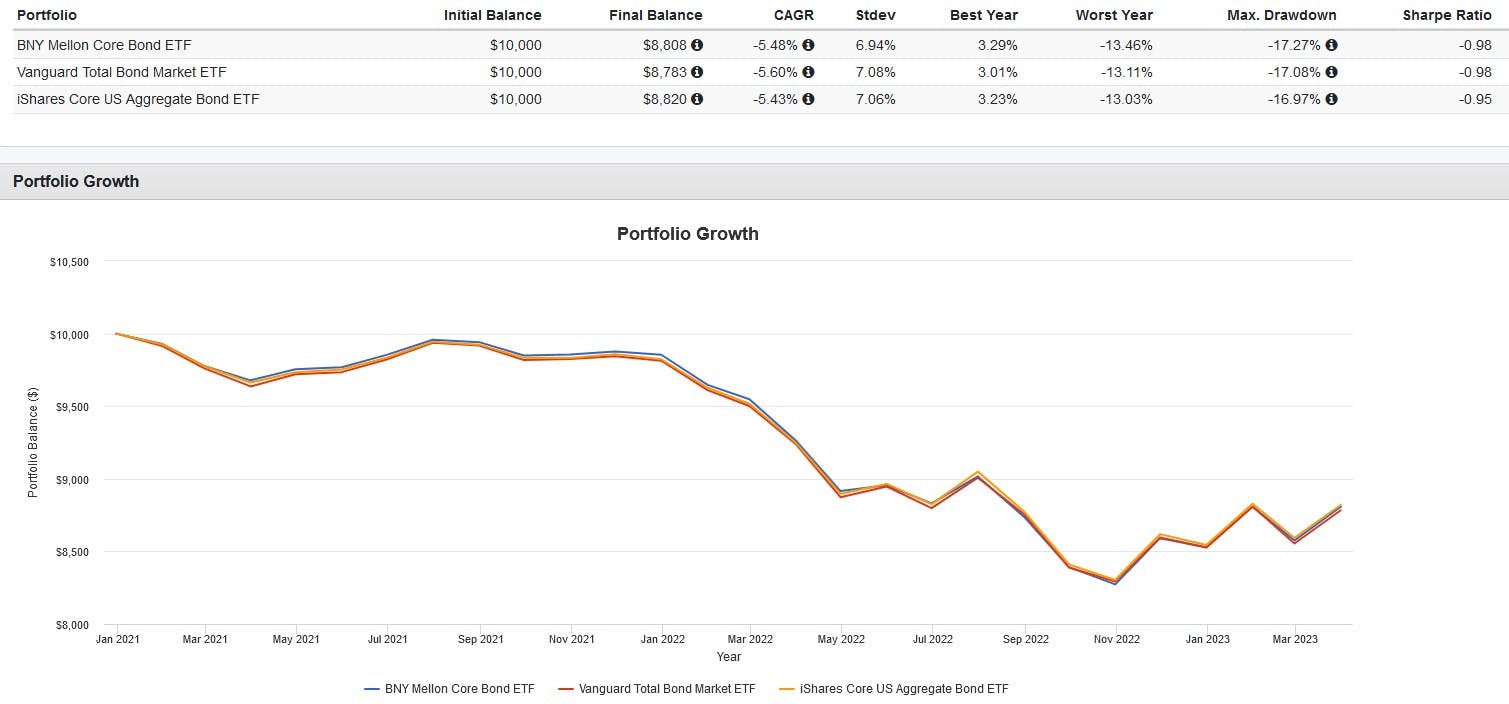
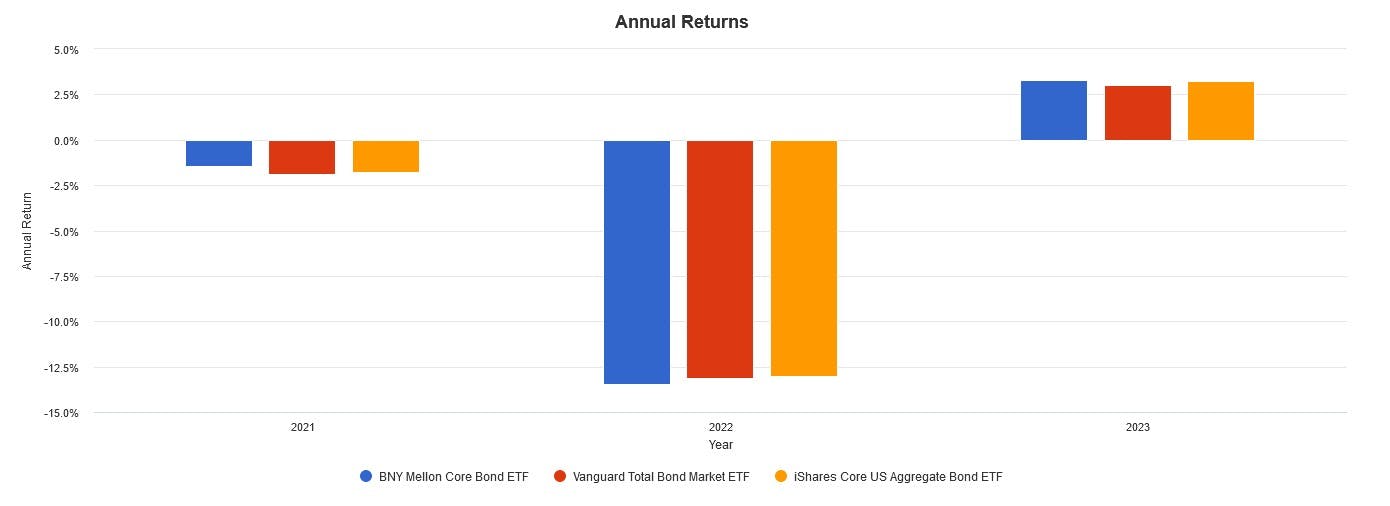
Honestly, whatever variations in returns over this short of a time period are so insignificant. The savings from BKAG's lower expense ratio will likely only make a difference over long periods of time, such as multiple decades. Investors also need to consider the economy of scale that Vanguard and iShares have over BNY Mellon as an ETF issuer, as well as lower bid-ask spreads for BND and AGG.
Still, lower expense ratios are never an unwelcome sight. The fact that BNY Mellon has managed to pull this off despite not being one of the "Big Three" ETF issuers (Vanguard, iShares, SPDR) is impressive on its own. If more ETF issuers follow suit, the resulting competition may benefit investors further.
Please note this article is for information purposes only and does not in any way constitute investment advice. It is essential that you seek advice from a registered financial professional prior to making any investment decision.
Latest ETF News
See all ETF newsBeyond Big Tech: The Increasing Specialization of AI ETFs

There's an ETF for That? Humanoid Robotics and Physical AI

How Some ETF Issuers Use Their Own Funds for Cash Management

These Public-Private ETFs Invest in Polymarket and Anduril

There's an ETF for That? Frontier Markets



 Advantages of ETFs over Mutual Funds1/6
Lower Costs
In this guide, we'll explore the advantages of ETFs over mutual funds, giving you valuable insights into why ETFs have gained significant popularity among investors like yourself.
Leveraged ETFs: Unlocking the Potential for Amplified Returns1/6
Understanding Leveraged ETFs
Explore leveraged ETFs: potential for amplified returns & risks. 5 ETFs to consider across equities, commodities & fixed income.
What is a Leveraged ETF?1/6
Introducing Leveraged and Inverse ETFs
In this guide, we'll dive into the world of leveraged ETFs, exploring their definition, mechanics, potential risks, and rewards.
Recent educational content
First Look ETF
First Look ETF: Income, International, and Cash Flow ETFs
In this season 6 episode of First Look ETF, Stephanie Stanton @etfguide examines the latest ETF marketplace trends with NYSE and guests.


ETF Trends
ETF Industry KPIs October 5, 2026
This week’s KPI data overview highlights key metrics and trends shaping the ETF landscape.

ETF Trends
ETF Industry KPIs September 28, 2026
This week’s KPI data overview highlights key metrics and trends shaping the ETF landscape.
ETF Trends
ETF Industry KPIs September 22, 2026
This week’s KPI data overview highlights key metrics and trends shaping the ETF landscape.