ETF model portfolios designed for real investor needs. Discover →



Bitcoin With Guardrails: Why Advisors Are Rethinking Crypto ETFs
Financial advisors still want Bitcoin exposure—but increasingly, they want it wrapped in risk management rather than raw volatility.

Keep up with what matters in ETFs
Get timely ETF insights, market trends, and top ideas straight to your inbox.
Your newsletter subscriptions with us are subject to ETF Central's Privacy Policy and Terms and Conditions.
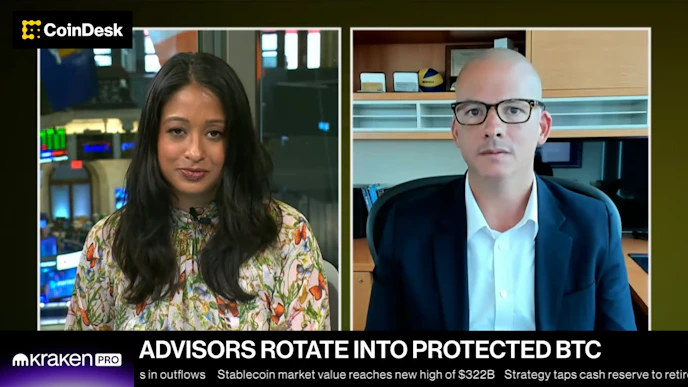
Speaking with CoinDesk's Jennifer Sanasie, Calamos Global Head of ETFs Matt Kaufman explains why advisors are rethinking Bitcoin exposure and why a new generation of crypto ETFs is gaining traction.
Like what you're reading?
Stay in the loop — get the latest ETF insights: trends, analysis, and expert picks.
The Next Phase of Bitcoin Investing
When spot Bitcoin ETFs launched, they solved a major problem: investors finally had a simple, regulated way to buy Bitcoin exposure through their brokerage accounts. But simplicity isn't always the same thing as sophistication.
According to Calamos Global Head of ETFs Matt Kaufman, the industry is already moving into its next phase. Investors and advisors still want access to Bitcoin's upside, but many are becoming less enthusiastic about enduring the stomach-churning drawdowns that have historically accompanied the asset.
That shift is creating demand for a new category of products: protected Bitcoin ETFs.
"The early solution was just adding 1% or 2% of spot Bitcoin," Kaufman explained. "We don't think that's the solution anymore."
Instead, advisors are increasingly exploring structured approaches that aim to improve risk-adjusted returns rather than simply maximizing exposure.
Why Investors Are Moving Beyond Spot Bitcoin
The conversation comes at an interesting moment.
Recent weeks have seen significant outflows from spot Bitcoin ETFs, with more than $1 billion leaving the category.
While that might sound alarming for crypto bulls, Kaufman sees a more nuanced story unfolding.
In his view, some investors aren't abandoning Bitcoin altogether.
They're simply migrating toward products that offer exposure with built-in protections.
Calamos has developed what it describes as the world's first protected Bitcoin ETFs.
Rather than forcing investors to endure every boom and bust cycle, these funds are designed to participate in Bitcoin's upside while limiting downside risk.
The firm offers three primary versions:
- A fully protected strategy with no downside risk.
- A strategy that allows investors to risk up to 10%.
- A strategy that allows investors to risk up to 20%.
As investors assume more downside risk, they gain access to greater upside potential.
The approach appears to be resonating. While many spot Bitcoin products experienced outflows, Kaufman said Calamos saw approximately $10 million to $15 million of inflows over recent weeks and generally maintained stable asset levels.
How Protected Bitcoin ETFs Actually Work
Structured products often sound complicated, but Kaufman broke down the mechanics into fairly straightforward pieces.
The foundation begins with U.S. Treasuries.
In one example, roughly 90% of the portfolio is allocated to Treasuries. That immediately creates a built-in protection layer because most of the investment is sitting in relatively low-risk assets.
The remaining capital, combined with interest earned from those Treasury holdings, creates a budget that can be used to purchase options tied to Bitcoin's performance.
That options exposure is what generates participation in Bitcoin's price movements.
A year ago, implementing this type of strategy was much harder because Bitcoin options markets were still relatively underdeveloped. As spot Bitcoin ETFs gained traction, however, the options ecosystem matured alongside them.
Calamos responded by creating its own index linked to Bitcoin's price and listing FLEX options against that index. Those instruments now serve as the engine powering the firm's protected Bitcoin exposure.
The result is a product that can deliver nearly full participation in Bitcoin's upside while establishing predefined risk limits.
The Rise of More Sophisticated Advisor Questions
One of the biggest changes Kaufman sees isn't in product design—it's in advisor behavior.
A few years ago, financial advisors were still trying to understand Bitcoin itself. The questions were basic: What is it? Why does it matter? How much should clients own?
Today, the conversations are more advanced.
Advisors are now asking how Bitcoin fits into broader portfolio construction and whether different payoff structures can improve overall outcomes.
Kaufman views that evolution as a positive sign for the asset class.
Rather than treating Bitcoin as a standalone speculative bet, advisors are increasingly evaluating it through the same lens they apply to stocks, bonds, and alternative investments.
The focus has shifted toward Sharpe ratios, risk-adjusted returns, and portfolio efficiency.
In other words, the question is no longer whether Bitcoin belongs in a portfolio. The question is how it belongs.
Mapping Bitcoin to Traditional Portfolios
Perhaps the most interesting insight from Kaufman's comments is how advisors are integrating these products into existing allocations.
Historically, adding Bitcoin often meant selling something else—frequently growth stocks or broad equity exposure.
Protected Bitcoin ETFs create more flexibility.
Kaufman said advisors are matching different protection levels to traditional asset categories.
For example:
- Investors moving out of broad equities may choose a 20% protection floor.
- Investors moving out of bonds may prefer a 10% protection floor.
- Investors sitting in cash or money-market products may opt for fully protected Bitcoin exposure.
That last category may be particularly surprising.
Rather than earning only the risk-free rate, investors can potentially capture additional upside linked to Bitcoin's performance while maintaining principal protection.
For advisors building model portfolios, these products create a bridge between traditional asset allocation and digital asset exposure.
What's Next for Crypto ETFs?
Kaufman believes the innovation cycle in crypto ETFs is only beginning.
He points to a broader framework for options-based investing built around three goals:
- Risk management.
- Income generation.
- Growth.
Protected Bitcoin ETFs address the risk-management side of the equation.
Other firms have focused on income-oriented strategies that seek to harvest Bitcoin's high volatility.
Growth-oriented structures represent another area of active exploration.
As crypto markets mature, Kaufman expects investors to gain access to an expanding menu of ETF solutions tailored to different objectives and risk tolerances.
The days of having only a spot Bitcoin ETF may be ending.
Instead, investors may increasingly choose the version of Bitcoin exposure that best aligns with their portfolio goals.
Kaufman's Bitcoin Outlook
Asked for a Bitcoin price target, Kaufman avoided attaching a specific number.
His broader view, however, was clear: he expects Bitcoin to revisit previous highs and continue moving higher over time.
Volatility remains the defining characteristic of the asset. Kaufman offered an interesting comparison between Bitcoin and the S&P 500.
The S&P's volatility profile resembles a bell curve, with most outcomes clustered around the middle.
Bitcoin, by contrast, behaves more like a smile-shaped distribution, with extreme outcomes appearing more frequently on both ends of the spectrum.
That means investors should continue expecting periods of both feast and famine.
For Kaufman, though, that volatility isn't necessarily a flaw. Properly structured, it can become an opportunity.
And increasingly, advisors appear to agree.
Please note this article is for information purposes only and does not in any way constitute investment advice. It is essential that you seek advice from a registered financial professional prior to making any investment decision.


Latest ETF News
See all ETF news






 Advantages of ETFs over Mutual Funds1/6
Lower Costs
In this guide, we'll explore the advantages of ETFs over mutual funds, giving you valuable insights into why ETFs have gained significant popularity among investors like yourself.
Leveraged ETFs: Unlocking the Potential for Amplified Returns1/6
Understanding Leveraged ETFs
Explore leveraged ETFs: potential for amplified returns & risks. 5 ETFs to consider across equities, commodities & fixed income.
What is a Leveraged ETF?1/6
Introducing Leveraged and Inverse ETFs
In this guide, we'll dive into the world of leveraged ETFs, exploring their definition, mechanics, potential risks, and rewards.
Recent educational content

ETF Trends
ETF Industry KPIs October 5, 2026
This week’s KPI data overview highlights key metrics and trends shaping the ETF landscape.

ETF Trends
ETF Industry KPIs September 28, 2026
This week’s KPI data overview highlights key metrics and trends shaping the ETF landscape.
ETF Trends
ETF Industry KPIs September 22, 2026
This week’s KPI data overview highlights key metrics and trends shaping the ETF landscape.

First Look ETF
First Look ETF: Income, Corporate Arbitrage, and Growth and Value Investing
First Look ETF September 2026: iCapital, Mast Investments and North Square unpack new ETFs targeting monthly income, merger arbitrage and complementary growth and value exposure.

Browse all educational columns



ETFs’ Next Act: From Access to Selection
With 1,790 new products launched by July 2026, choosing is harder than ever. Our Global ETF Survey 2026, built on 620 professional investors and allocators, shows how active, fixed income, options-based and thematic ETFs are reshaping fund selection.