Turn ETF ideas into real portfolios. Try the builder now →



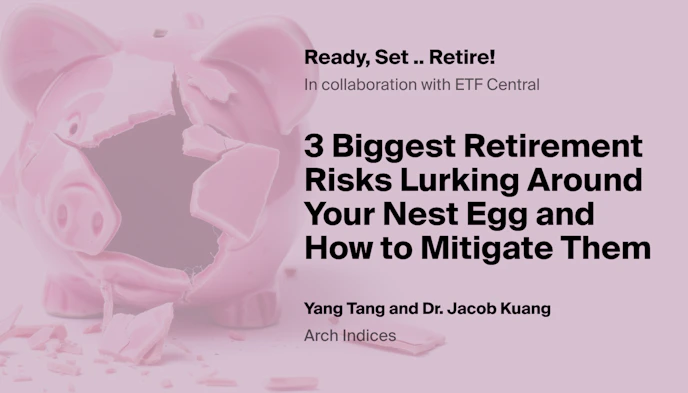
3 Biggest Retirement Risks Lurking Around Your Nest Egg and How to Mitigate Them
Interested in learning key retirement risks and to mitigate them? Yang Tang and Dr. Jacob Kuang from Arch Indices explain longevity, inflation, and market volatility to help you plan better.

Keep up with what matters in ETFs
Get timely ETF insights, market trends, and top ideas straight to your inbox.
Your newsletter subscriptions with us are subject to ETF Central's Privacy Policy and Terms and Conditions.
Retirees face 3 key risks to the nest egg in their golden years:
- Longevity: how long one will live
- Inflation: how much money will be worth in the future
- Sequence of Returns (Volatility): the ability of your portfolio to meet future income
These risks have been well studied over the past several decades along with potential ways to mitigate them. There is no “one size fits all” approach to retirement planning and mitigating these risks: individual circumstances are unique and change over time. Understanding each risk in conjunction with the retirement income portfolio empowers retirees in balancing the risk-reward with the portfolio goal.
There is no fear like outliving your money. Let’s work to ensure that’s not the outcome.
The retirement portfolio has two phases: accumulation and withdrawal. Accumulation is the working years of saving for retirement and withdrawal is the golden years of paying for retirement. Investments in the portfolio should change over time as steady income and paying for retirement becomes the goal.
Like what you're reading?
Stay in the loop — get the latest ETF insights: trends, analysis, and expert picks.
Longevity: How Long Will One Live?
The first risk to retirement is longevity or how long one will live. Living longer is a great problem to have. This extra time requires more income and withdrawals from the portfolio to pay for expenses.
A few sources of income provide for lifetime income: social security, pensions, and annuities. Social security provides for both lifetime income and adjusts for inflation but unfortunately pensions and annuities only provide lifetime income without inflation protection.
Inflation: What is the Cost of Living in the Future?
The second risk to retirement is a much higher cost of living from inflation. This has become a very real problem for retirees in recent years as the Fed struggles to get inflation under control.
Outside of social security, very few sources of income provide protection against inflation. Inflation protection comes from dividend stocks and real assets that can generate increased income and capital appreciation.
Sequence of Returns (Volatility) Risk: When do the Returns Occur?
The last risk to retirement is market volatility or when investment returns occur. Retirees need a mix of investments to generate income and capital appreciation to protect against inflation risk and longevity risk.
Investments have years of positive and negative returns. When returns occur impacts how much a retiree can withdraw for future expenses. The best-case scenario is for high positive returns to occur in early years and the negative returns to occur later for maximum portfolio growth.
One cannot pick when returns occur and market volatility is an unavoidable part of investments. Retirees will have a difficult time protecting against longevity and inflation risk without an investment portfolio.
Mitigating and Managing these Risks
Luckily these risks are well known and studied over the past several decades. There are many ways to mitigate and manage these risks which we will debate and discuss here.
The general playbook consists of:
- Start planning early: the best time to start was yesterday, the second best time is today, and the third best time is tomorrow. This is a daunting task but starting today will lead to better outcomes in the future.
- Finding the right mix of income sources: there are many viewpoints on sources of income and effectiveness for retirement. Some investors are more comfortable with real assets and use securities as a secondary source of income. Others prefer having their retirement income come from liquid stocks and bonds.
- Reducing volatility: retirees don’t have enough time to ride out market volatility when they are withdrawing from the portfolio. The most important action an investor can take to ensure retirement success is to reduce volatility. Reducing volatility allows an investor to greatly reduce the chance of an adverse outcome.
- Rebalancing the portfolio: over time market conditions change. Investors benefit from dynamically rebalancing the portfolio to reflect changing market conditions.
We look forward to sharing our insights and engaging with you on your retirement planning journey.
About the Authors
Yang is the CEO and co-founder of Arch Indices and Arch Indices Investment Advisors. Yang spent over a decade in macro solutions, structuring, and sales roles at Morgan Stanley, Citi, Deutsche Bank, and Credit Agricole CIB. In his most recent role as Head of Solutions Sales Americas, Yang built the solutions sales desk from scratch into one of the most productive and highest-grossing in the organization. Yang has worked with banks, insurers, and asset managers globally on solutions across asset classes for asset liability, yield enhancement, capital, and tactical opportunities.
Jacob is the CPO and co-founder of Arch Indices and Arch Indices Investment Advisors. Jacob spent over two decades at Citi and its predecessor Salomon Brothers in trading, structuring, and quantitative research/analytics. Jacob has deep expertise working with institutional and private bank clients in multi-asset derivative solutions, cash products, and structured notes. Jacob has extensive modeling and analytics knowledge from roles in research, modeling, and quantitative analysis in both cash products and derivatives.
Between his retirement from Citi and co-founding Arch, Jacob worked with his wife Rebecca in financial planning and advisory.
Disclaimer
Please note this article is for information purposes only and does not in any way constitute investment advice. It is essential that you seek advice from a registered financial professional prior to making any investment decision.
Latest ETF News
See all ETF newsHow Much ETF Infrastructure Do You Really Need?


Are ETFs Getting Too Complicated? Not Necessarily, But Complexity Has a Cost

Form 4 Has 20 Transaction Codes. None Say "Section 351 ETF Swap"


Who Really Owns a White-Label ETF?

What If a Futures-Based ETF Never Had to Roll Again?

How Do You Build a Winning ETF Business?


 Advantages of ETFs over Mutual Funds1/6
Lower Costs
In this guide, we'll explore the advantages of ETFs over mutual funds, giving you valuable insights into why ETFs have gained significant popularity among investors like yourself.
Leveraged ETFs: Unlocking the Potential for Amplified Returns1/6
Understanding Leveraged ETFs
Explore leveraged ETFs: potential for amplified returns & risks. 5 ETFs to consider across equities, commodities & fixed income.
What is a Leveraged ETF?1/6
Introducing Leveraged and Inverse ETFs
In this guide, we'll dive into the world of leveraged ETFs, exploring their definition, mechanics, potential risks, and rewards.
Recent educational content

ETF Trends
ETF Industry KPIs October 5, 2026
This week’s KPI data overview highlights key metrics and trends shaping the ETF landscape.

ETF Trends
ETF Industry KPIs September 28, 2026
This week’s KPI data overview highlights key metrics and trends shaping the ETF landscape.
ETF Trends
ETF Industry KPIs September 22, 2026
This week’s KPI data overview highlights key metrics and trends shaping the ETF landscape.
First Look ETF
First Look ETF: Income, Corporate Arbitrage, and Growth and Value Investing
First Look ETF September 2026: iCapital, Mast Investments and North Square unpack new ETFs targeting monthly income, merger arbitrage and complementary growth and value exposure.

Browse all educational columns



Expert-Built ETF Portfolios, All in One Place
Don’t start from scratch. Discover ready-made ETF portfolios built by professionals to match different goals, timelines, and market views. Use them as inspiration or as a starting point for your own allocation.