Create, analyze, optimize your ETF portfolio. Start now →



Betting on Gold Prices: Gold Miner ETFs or Leveraged Gold ETFs?
Both types of gold-based ETFs can provide enhanced exposure, but with varying trade-offs and risks. Here’s a side-by-side comparison of the pros and cons.


Keep up with what matters in ETFs
Get timely ETF insights, market trends, and top ideas straight to your inbox.
Your newsletter subscriptions with us are subject to ETF Central's Privacy Policy and Terms and Conditions.
Gold has continued its dominance into 2025, recently surpassing the $3,000 per ounce mark as investors flock to the precious metal as a safe-haven asset.
Several key factors have fueled this rally, including COMEX removing gold contracts, rising Middle Eastern tensions, instability from Trump administration tariffs, and a broader market sell-off that has driven capital into defensive assets.
Previously, I’ve covered spot gold ETFs like the SPDR Gold Trust
However, for those who are extremely bullish on gold and looking for leveraged upside, there are other ETF options available.
Investors have two primary choices for enhanced gold exposure: gold miner ETFs, which hold companies that extract and refine gold, and leveraged gold ETFs, which provide daily magnified returns on gold prices. Here’s a breakdown of how each works and my assessment of them side by side.
Global ETF Survey 2026 is Live!
With 1,790 new products launched by July 2026, choosing is harder than ever. Our Global ETF Survey 2026, built on 620 professional investors and allocators, shows how active, fixed income, options-based and thematic ETFs are reshaping fund selection.
Gold miner ETFs
Gold miners operate by exploring, extracting, processing, and refining gold ore into pure gold bars or bullion for sale.
A typical mining operation begins with exploration, where geologists survey and drill potential sites to confirm the presence of gold deposits.
Once a commercially viable deposit is identified, the company proceeds with mine development, which includes infrastructure setup, environmental assessments, and securing regulatory approvals.
After the mine is operational, the company begins excavating and crushing ore, then uses chemical or heat-based extraction methods—such as cyanide leaching or smelting—to separate gold from other materials. The final refined gold is then sold to central banks, bullion dealers, and jewelry manufacturers.
From an investment perspective, gold miners offer embedded leverage to gold prices because of their operating structure. Since mining costs are largely fixed, a rise in gold prices significantly expands their profit margins, leading to higher earnings growth relative to the metal itself.
For example, if the cost to mine gold is $1,200 per ounce and the gold price rises from $2,000 to $2,500 per ounce, the miner’s profit per ounce jumps from $800 to $1,300—a 62.5% increase, while gold itself has risen only 25%. This operating leverage makes gold mining stocks more volatile than physical gold.
The most popular gold miner ETF is the VanEck Gold Miners ETF
It tracks the NYSE Arca Gold Miners Index, providing exposure to major gold producers like Newmont, Agnico Eagle, and Barrick Gold, as well as streaming and royalty companies like Wheaton Precious Metals and Franco-Nevada.
Unlike miners, streamers don’t operate mines—instead, they finance mining companies in exchange for a percentage of future gold production at a fixed cost, making them less exposed to operating risks.
Another key difference between gold miner ETFs and physical gold ETFs is that miners pay dividends, whereas gold bullion does not generate income. While yields vary depending on profitability and payout policies, GDX currently offers a modest 0.77% 30-day SEC yield.
Leveraged gold ETFs
Unlike gold miner ETFs, leveraged gold ETFs don’t own equities. Instead, they use derivatives-based strategies to magnify gold price movements. A prime example is the ProShares Ultra Gold ETF
To achieve this, UGL doesn’t hold physical gold. Instead, it relies on a combination of gold futures and swaps with major financial institutions.
In the case of swaps, UGL’s counterparties include Citibank, UBS, and Goldman Sachs. On the futures side, the fund follows a rolling strategy, where 20% of its expiring gold futures contracts are rolled each day over a five-day period, gradually shifting from the current month’s contract to the next.
However, there are significant risks with this type of exposure. Beyond the usual leveraged ETF risks—such as volatility drag and unpredictable compounding over time—there’s also the issue of contango in the futures market.
Contango occurs when longer-dated futures contracts trade at a higher price than the spot price, meaning the ETF sells lower-priced expiring contracts and buys more expensive new ones. This creates negative roll yield, eroding returns over time, especially in a prolonged contango environment.
On top of that, UGL is expensive, with a 0.95% expense ratio, making it one of the priciest gold ETFs available. It also issues a Schedule K-1 tax form, which can be an annoying tax complication for investors compared to the simpler 1099 tax forms issued by standard equity and bullion-backed ETFs.
Which one is better?
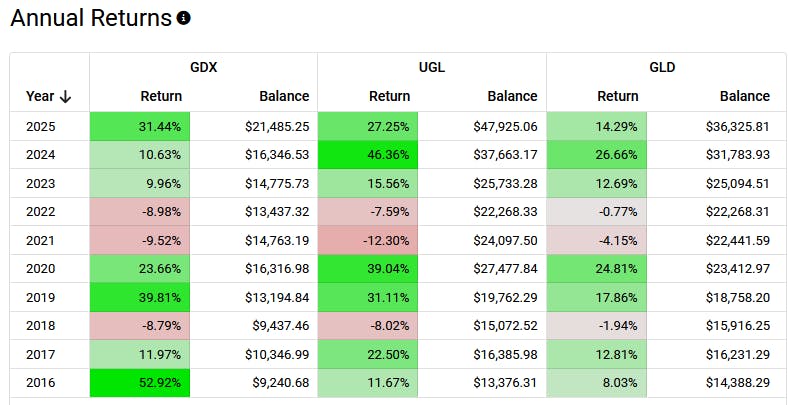
As seen in the comparison of UGL vs. GDX vs. GLD’s annual returns, both leveraged gold ETFs and gold miner ETFs provide amplified exposure to gold price movements. On average, they tend to outperform when gold is rising but underperform more severely when gold declines.
Personally, I prefer GDX over UGL for two main reasons, although your mileage may vary:
- When volatility is high and gold futures are in contango, I would rather own GDX than UGL. High volatility in leveraged ETFs causes compounding decay, while contango in gold futures creates a negative roll yield, leading to a dual drag effect on performance.
- GDX is markedly cheaper with a 0.51% expense ratio versus UGL’s 0.95% and, unlike UGL, it does not issue a Schedule K-1 tax form, making it a more cost-effective and tax-friendly option for most investors.
This article is for informational purposes only and does not in any way constitute investment advice. The author may express their own opinions, which may not represent the opinions of ETF Central or its affiliated partners. It is essential that you seek advice from a registered financial professional prior to making any investment decisions.
Segments
See all
Mentioned ETFs
Further reading
Latest ETF News
See all ETF newsBeyond Big Tech: The Increasing Specialization of AI ETFs

There's an ETF for That? Humanoid Robotics and Physical AI

How Some ETF Issuers Use Their Own Funds for Cash Management

These Public-Private ETFs Invest in Polymarket and Anduril

There's an ETF for That? Frontier Markets



 Advantages of ETFs over Mutual Funds1/6
Lower Costs
In this guide, we'll explore the advantages of ETFs over mutual funds, giving you valuable insights into why ETFs have gained significant popularity among investors like yourself.
Leveraged ETFs: Unlocking the Potential for Amplified Returns1/6
Understanding Leveraged ETFs
Explore leveraged ETFs: potential for amplified returns & risks. 5 ETFs to consider across equities, commodities & fixed income.
What is a Leveraged ETF?1/6
Introducing Leveraged and Inverse ETFs
In this guide, we'll dive into the world of leveraged ETFs, exploring their definition, mechanics, potential risks, and rewards.
Recent educational content

First Look ETF
First Look ETF: Income, International, and Cash Flow ETFs
In this season 6 episode of First Look ETF, Stephanie Stanton @etfguide examines the latest ETF marketplace trends with NYSE and guests.


ETF Trends
ETF Industry KPIs October 5, 2026
This week’s KPI data overview highlights key metrics and trends shaping the ETF landscape.

ETF Trends
ETF Industry KPIs September 28, 2026
This week’s KPI data overview highlights key metrics and trends shaping the ETF landscape.
ETF Trends
ETF Industry KPIs September 22, 2026
This week’s KPI data overview highlights key metrics and trends shaping the ETF landscape.