From idea to ETF portfolio in minutes. Build yours now →



The Better Way to Investing in International Stocks: American Depositary Receipts Hedged (ADRH)
A built-in currency hedge means these new ADRs may face less headwinds during periods of U.S. dollar strength.


Keep up with what matters in ETFs
Get timely ETF insights, market trends, and top ideas straight to your inbox.
Your newsletter subscriptions with us are subject to ETF Central's Privacy Policy and Terms and Conditions.
There’s no shortage of ways to diversify internationally these days. Investors can choose from a wide range of ETFs or opt for American Depositary Receipts (ADRs) to gain exposure to foreign companies through U.S.-listed securities.
For example, when you buy shares of Toyota (TM) on the NYSE, you're purchasing an ADR denominated in U.S. dollars—not the original Japanese stock listed as TYO:7203, which trades in yen.
While ADRs make it easier to access foreign markets, they’ve always come with one major drawback: currency risk. A strong U.S. dollar relative to the local currency can drag down returns, even when the underlying foreign stock performs well in its home market. Historically, this has been a persistent headwind for ADR investors.
But now, a new category called ADRH—short for American Depositary Receipts Hedged—is looking to change that. Launched by Precidian Investments in partnership with Canadian Imperial Bank of Commerce (CIBC), these ADRH listings offer built-in currency hedging. Here’s what you need to know before considering them for your portfolio.
Get data on 14,000+ ETFs
Access Trackinsight's reliable and comprehensive data with 500M+ points on 14,000+ ETFs.
Why Hedge Currency Exposure?
When U.S. investors buy international stocks, whether through traditional ADRs or ETFs, they’re purchasing securities traded in U.S. dollars that wrap underlying equities listed in foreign currencies. The structure gives easy access to global markets, but it also introduces an added layer of risk: currency fluctuations.
Because the underlying stock trades in a foreign currency, but the ETF or ADR is priced in U.S. dollars, any movement in exchange rates can affect performance. If left unhedged, this currency exposure adds an extra source of volatility that has nothing to do with how the company itself performs.
Take a U.S.-listed ETF holding Japanese stocks, for example. All else being equal:
- If the U.S. dollar appreciates against the yen, the value of those Japanese holdings declines in dollar terms. Even if the Japanese stocks rise in yen, U.S. investors may still see muted or even negative returns due to currency drag.
- If the yen appreciates against the dollar, the opposite happens—foreign exchange provides a tailwind. U.S. investors benefit from both stock performance and currency gains.
This dynamic is clearly illustrated by comparing the iShares MSCI EAFE ETF
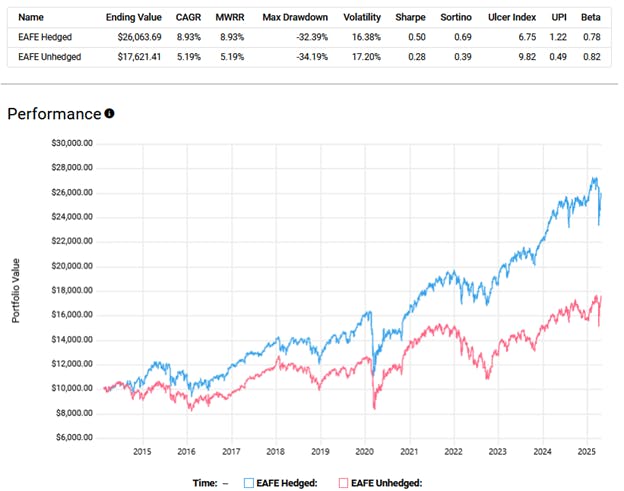
While there’s always debate about the long-term direction of the dollar, it continues to serve as the world’s reserve currency. And despite recent bouts of weakness, dollar dominance is far from over. For U.S. investors looking for cleaner, more stable international equity exposure, hedging currency risk can make a meaningful difference.
ADRs, Hedged: What’s available
Precidian’s partner, CIBC, had great success in Canada by rolling out currency-hedged Canadian Depositary Receipts (CDRs), giving Canadian investors access to major U.S. stocks without exposure to currency swings. Now, they’re bringing that same approach to U.S. investors that come with built-in currency hedging via overnight rolling swaps.
The rationale is simple. When you invest in an international stock, your goal should be to capture the return of the company itself—not introduce uncompensated risks like currency fluctuations. Personally, I’d rather just own the business, not a side bet on a currency pair.
Right now, the current lineup of ADRH listings includes:
- Arm Holdings PLC – British chip design company behind much of the world’s mobile processor architecture.ARMH
- ASML Holding NV – Dutch semiconductor equipment manufacturer and key supplier to global chipmakers.ASMH
- AstraZeneca – UK-based pharmaceutical company focused on oncology, cardiovascular, and respiratory drugs.AZNH
- BP p.l.c. – Multinational oil and gas giant headquartered in the United Kingdom.BPH
- GSK plc – Global pharmaceutical and consumer healthcare company based in the UK.GSKH
- HSBC Holdings – One of the world’s largest banking and financial services organizations.HSBH
- Novo Nordisk A/S – Danish pharmaceutical company specializing in diabetes and obesity treatments.NVOH
- SAP SE – German software firm known for enterprise resource planning (ERP) systems.SAPH
- Shell – Major integrated energy company based in the Netherlands and UK.SHEH
- STMicroelectronics NV – European semiconductor manufacturer serving automotive, industrial, and consumer markets.STHH
- Toyota Motor Corporation – Leading Japanese automaker with a global footprint.TMH
This is just the beginning. Precidian and CIBC plan to expand the lineup with even more ADRH listings in the near future. If you're interested in what’s coming next, you can view the current offerings and bookmark the official page here.
Please note that this article reflects the author’s personal views and does not represent the opinions of the publication or its affiliates. It is for informational purposes only and does not constitute investment advice. It is essential to seek guidance from a registered financial professional before making any investment decisions.
Segments
See all
Mentioned ETFs
Further reading
Latest ETF News
See all ETF newsThere’s an ETF for That? Investing Like University Endowments

Could Water ETFs Be the Next AI Bottleneck Trade?

What is a Boomer Candy ETF?

ETF Comparison: NEOS Nasdaq-100 High Income ETF (QQQI) Versus Goldman Sachs Nasdaq-100 Premium Income ETF (GPIQ)



 Advantages of ETFs over Mutual Funds1/6
Lower Costs
In this guide, we'll explore the advantages of ETFs over mutual funds, giving you valuable insights into why ETFs have gained significant popularity among investors like yourself.
Leveraged ETFs: Unlocking the Potential for Amplified Returns1/6
Understanding Leveraged ETFs
Explore leveraged ETFs: potential for amplified returns & risks. 5 ETFs to consider across equities, commodities & fixed income.
What is a Leveraged ETF?1/6
Introducing Leveraged and Inverse ETFs
In this guide, we'll dive into the world of leveraged ETFs, exploring their definition, mechanics, potential risks, and rewards.
Recent educational content

ETF Trends
ETF Industry KPIs September 14, 2026
This week’s KPI data overview highlights key metrics and trends shaping the ETF landscape.

ETF Trends
ETF Industry KPIs September 8, 2026
This week’s KPI data overview highlights key metrics and trends shaping the ETF landscape.
ETF Trends
ETF Industry KPIs August 31, 2026
This week’s KPI data overview highlights key metrics and trends shaping the ETF landscape.
ETF Trends
ETF Industry KPIs August 24, 2026
This week’s KPI data overview highlights key metrics and trends shaping the ETF landscape.
Browse all educational columns



Build and Analyze Your ETF Portfolio Like a Pro
Create your own ETF portfolio in minutes and instantly see allocations, exposures, performance, and risk. Visualize diversification across asset classes, regions, and sectors. Stress-test ideas, compare benchmarks, and refine your strategy with professional-grade analytics.