Ready-made ETF portfolios built for real investor needs. Explore now →



Avantis U.S. Small-Cap Value ETF (AVUV) Hits $10 Billion AUM Milestone
One of the most popular and well-performing small-cap value ETFs in recent years just got bigger.


Keep up with what matters in ETFs
Get timely ETF insights, market trends, and top ideas straight to your inbox.
Your newsletter subscriptions with us are subject to ETF Central's Privacy Policy and Terms and Conditions.
Among the variety of factor investing strategies available to investors, funds that emphasize a small-cap value tilt have become particularly popular, thanks in part to their decreasing fees.
Standing out in this crowded field, the Avantis U.S. Small-Cap Value ETF (AVUV) recently surpassed a significant milestone, amassing over $10 billion in assets under management (AUM).
This ETF's success can be attributed to its unique rules-based strategy, which focuses on selecting companies by size, valuing undervalued stocks, and prioritizing profitability.
These criteria have historically allowed AVUV to outperform its benchmark significantly, drawing the attention of both do-it-yourself investors and advisors who aim to beat market-cap-weighted indexes.
"
Here's everything you need to understand about AVUV and the reasons behind its impressive growth and performance.
Like what you're reading?
Stay in the loop — get the latest ETF insights: trends, analysis, and expert picks.
What is small-cap value investing?
To fully grasp the concept behind
These factors are key to understanding how certain aspects of the market are targeted for potential outperformance. Here are the five factors:
- Size (Small minus Big, or SmB): Smaller companies, or small-cap stocks, tend to outperform larger companies over time, potentially due to higher risk and growth potential.
- Value (High minus Low, or HmL): Stocks with lower price-to-book ratios or other value metrics are seen as undervalued and may outperform more expensive, or "growth," stocks.
- Market Risk (Market): The overall risk associated with the stock market, indicating that stocks, in general, have higher expected returns than safer investments like Treasury bonds.
- Profitability (Robust minus Weak): Companies that are more profitable, as measured by earnings compared to their book value, tend to outperform those that are less profitable.
- Investment (Conservative minus Aggressive): Firms that invest conservatively are found to outperform those with more aggressive investment strategies.
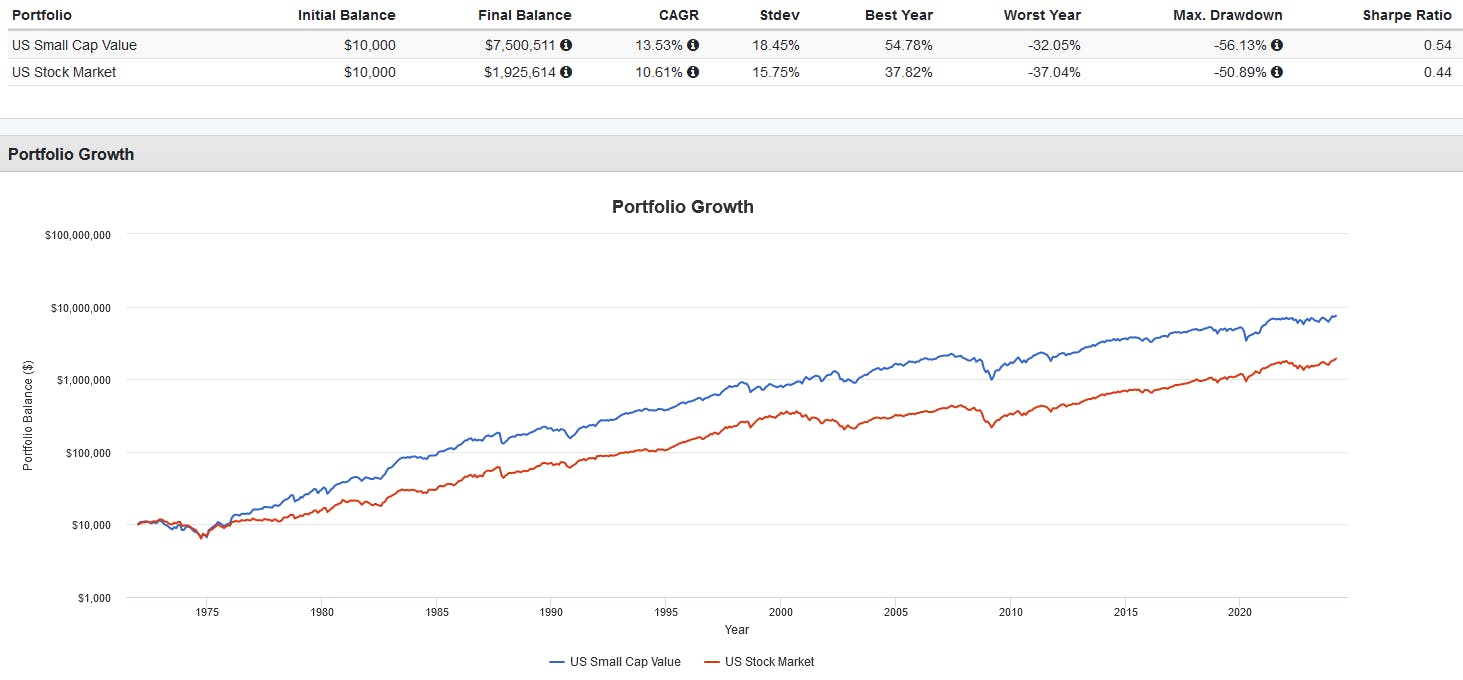
Today, factor ETFs, such as AVUV, target one or more of these factors in combination to gain an edge in the market. A popular combination is small-cap value, which historically has outperformed the total U.S. market by a significant margin, as seen below:
How does AVUV ETF work?
AVUV ETF operates by targeting stocks that exhibit higher profitability, distinct value characteristics, and smaller market capitalizations.
The ETF employs an active, rules-based methodology to evaluate small companies, focusing on adjusted book/price ratios to identify value and adjusted cash from operations to book value ratios to assess profitability.
Importantly, AVUV is not bound to the reconstitution or rebalancing schedule of an index. This allows the portfolio managers significant discretion to sell off securities that no longer align with the fund's desired characteristics for size, value, or profitability.
Despite a 0.25% expense ratio, which might initially appear high, this fee is actually quite competitive for factor ETFs, particularly when considering AVUV's performance.
Since its inception, AVUV has strongly outperformed popular passive ETFs that track benchmarks like the S&P 600 Small-Cap Value Index and the Russell 2000 Value Index.
How does AVUV ETF work?
AVUV ETF operates by targeting stocks that exhibit higher profitability, distinct value characteristics, and smaller market capitalizations.
The ETF employs an active, rules-based methodology to evaluate small companies, focusing on adjusted book/price ratios to identify value and adjusted cash from operations to book value ratios to assess profitability.
Importantly,
Despite a 0.25% expense ratio, which might initially appear high, this fee is actually quite competitive for factor ETFs, particularly when considering AVUV's performance.
Since its inception,
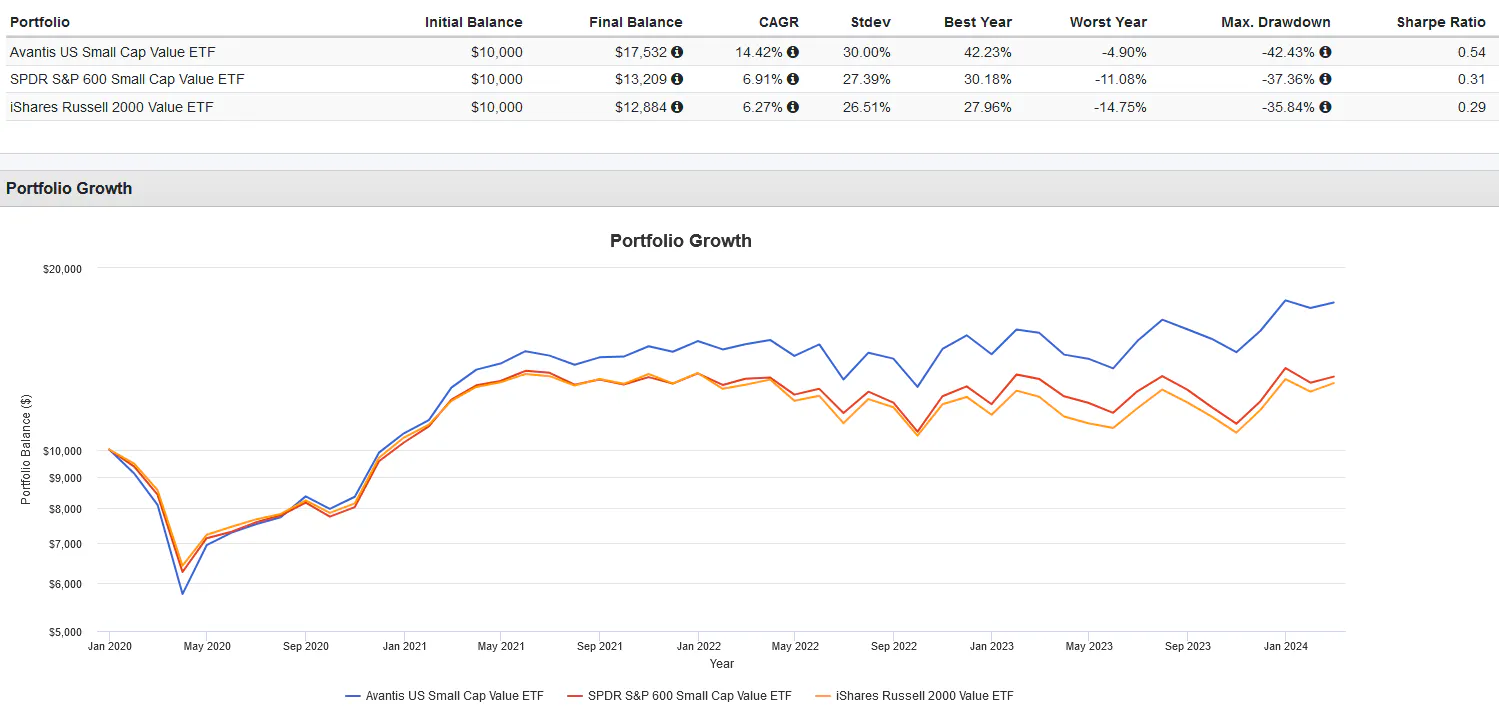
Additionally, AVUV has shown superior loadings to the size, value, and profitability factors, demonstrating its effectiveness in capturing the intended market segments and contributing to its appeal among both DIY investors and advisors looking for an edge over market cap-weighted indexes.
"When we started Avantis, the goal was to combine the benefits of indexing with the potential for outperformance for investors - so far, things are going according to plan," Firestein says. "For the ETFs we have that have a longer than three-year track record, the average annualized excess return net of fees is 1.95% - this has been achieved at fee levels that are very competitive with passive funds."
Please note this article is for information purposes only and does not in any way constitute investment advice. It is essential that you seek advice from a registered financial professional prior to making any investment decision.
Latest ETF News
See all ETF newsMoneyShow Chart of the Day 9/4/26: Don't Just Watch Oil. Watch THESE.


Chart of the Day 8/14/26: The Great "Hot Money" Migration

MoneyShow Chart of the Day 7/29/26: Now, THAT's What I Call Market Rotation!

MoneyShow Chart of the Day 7/16/26: Good News/Bad News on Inflation (and the Fed)




 Advantages of ETFs over Mutual Funds1/6
Lower Costs
In this guide, we'll explore the advantages of ETFs over mutual funds, giving you valuable insights into why ETFs have gained significant popularity among investors like yourself.
Leveraged ETFs: Unlocking the Potential for Amplified Returns1/6
Understanding Leveraged ETFs
Explore leveraged ETFs: potential for amplified returns & risks. 5 ETFs to consider across equities, commodities & fixed income.
What is a Leveraged ETF?1/6
Introducing Leveraged and Inverse ETFs
In this guide, we'll dive into the world of leveraged ETFs, exploring their definition, mechanics, potential risks, and rewards.
Recent educational content

ETF Trends
ETF Industry KPIs September 8, 2026
This week’s KPI data overview highlights key metrics and trends shaping the ETF landscape.

ETF Trends
ETF Industry KPIs August 31, 2026
This week’s KPI data overview highlights key metrics and trends shaping the ETF landscape.
ETF Trends
ETF Industry KPIs August 24, 2026
This week’s KPI data overview highlights key metrics and trends shaping the ETF landscape.
What’sTheFund
What's the Fund | Ocean Park Diversified Income ETF (DUKZ)
James St Aubin, Chief Investment Officer at Ocean Park Asset Management, discuss the DUKZ ETF, exposing investors to the whole spectrum of asset classes in the fixed income markets, through their rules-based process.

Browse all educational columns



Have you tried our ETF Compare tool?
Compare ETFs like a pro. Analyze fees, performance, exposure & holdings side-by-side.