From idea to ETF portfolio in minutes. Build yours now →



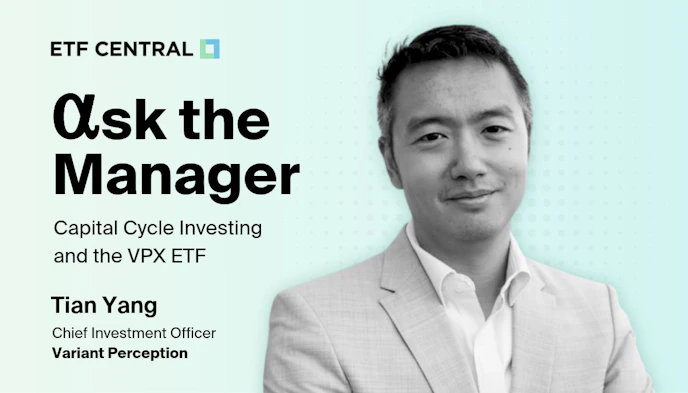
Ask the Manager: Tian Yang on Capital Cycle Investing and the VPX ETF
Tian Yang discusses capital cycle investing, index concentration, and the mechanics behind its Cycle Aware US Equity ETF (VPX).

Keep up with what matters in ETFs
Get timely ETF insights, market trends, and top ideas straight to your inbox.
Your newsletter subscriptions with us are subject to ETF Central's Privacy Policy and Terms and Conditions.
Variant Perception has spent more than fifteen years building macro and capital cycle models for institutional allocators. In March 2026, the firm brought that research into an ETF wrapper with the launch of the Variant Perception Cycle Aware US Equity ETF
Variant Perception has been building models for institutional investors since 2009. What led you to put that into an ETF?
Our allocator clients wanted an alternative to market-cap-weighted equity ETFs and static factor tilts. Neither adapts as the market cycle turns. We believe layering capital cycle, crowding, and leading economic indicators onto traditional quality investing can deliver better upside and downside capture over time.
The ETF wrapper matters too. It offers dynamic long-only equity exposure, with less tax drag on every rebalance.
Capital cycle investing is great in theory, but hard in practice. How do you actually measure it, and what's the most interesting sector today?
The capital cycle is the idea that supply drives returns, not demand. High returns attract competitors, who add capacity, and that capacity erodes the returns that attracted them. The cycle then repeats. We track this directly by aggregating the capital spending data across all industries alongside the marginal returns on that capital.
Energy is the clearest example today. A decade of underinvestment left the sector capital-scarce just as supply tightened, and it's one of our current overweights versus the S&P 500.
Plenty of active ETFs claim a macro overlay. What does "cycle aware" mean in practice that a factor tilt doesn't already provide?
A factor tilt is one decision, held through the cycle. You own value or quality, and hold it even through long periods of underperformance, betting it will mean-revert and outperform over the full market cycle.
A cycle aware approach tries to quantify where we are in the business cycle and the capital cycle, adjusting exposures accordingly. In practice, that means updating our estimates of expected returns as data comes in and rebalancing every month.
Index concentration is what every allocator says worries them, but many have been left behind by the mega caps leading the equity market higher. Is concentration a risk to be managed, or a feature to be owned?
Index concentration is both a feature and a bug of market-cap weighted indices, and should be managed dynamically. The common fix is an equal-weighted index, but that implies every company is equally attractive, which nobody actually believes.
Our approach is to start from the index's own holdings and weights, then deviate based on our estimates of expected returns, with a 5% cap on any single name at rebalance. So you can still own the large companies, just not in whatever size the market has decided.
VPX launched in March. What have you learnt over the past six months about the strategy that you didn't know before?
I would say the last six months have reinforced existing lessons rather than produced brand new ones. The first is the need to be adaptable in this market. Our monthly rebalances produced significant exposure shifts as incoming data changed, against the backdrop of the Iran conflict, a new Fed chair and the AI boom.
The second is how often the right macro call is to do nothing. Our Macro Risk Indicator has stayed risk-on since launch, so we have been fully invested through the noisy headlines.
There's no shorting or leverage in VPX, but there is an active cash component. What must happen for you to move to cash?
Cash isn't a discretionary call in our strategy. It's an output of our Macro Risk Indicator, which aggregates our leading indicators for growth, inflation, policy and liquidity. When those deteriorate together, the indicator turns bearish and the portfolio shifts gradually to a more defensive allocation with more cash. This is built for extremes rather than fine-tuning, so a large cash position should be rare.
What role does VPX play in a portfolio?
We view VPX as an active, cycle-aware complement to standard core equity allocations, designed to adapt as the investment landscape shifts.
Most allocators get their US large-cap exposure from a low-cost index fund. That has worked well, but we don't expect the next decade to repeat the last one. Pairing a 10% VPX sleeve with a 90% passive core adds only a few basis points to your blended expense ratio, while seeking to improve the portfolio's upside and downside capture.
Like what you're reading?
Stay in the loop — get the latest ETF insights: trends, analysis, and expert picks.
About Tian Yang
Tian is Chief Investment Officer at Variant Perception, a macro-quant advisory firm he joined in 2014. His work focuses on turning the firm's proprietary models into investment ideas and strategies. He was previously an equity derivatives trader at Bank of America Merrill Lynch, and holds a BA in Economics from Cambridge University.
Marketing communication. For professional investors only. Capital at risk.
Please note this article is for information purposes only and does not in any way constitute investment advice. It is essential that you seek advice from a registered financial professional prior to making any investment decision.

Latest ETF News
See all ETF news
Ask the Manager: Kenneth Wong on Building the Next Wave of ETF Innovation, from Options to Korea's AI Semiconductor Opportunity
Ask the Manager: Kristof Gleich on Why AI Is Becoming an Asset Class
Ask the Manager: Vince Lorusso on Active Equity in an AI-Driven Market




 Advantages of ETFs over Mutual Funds1/6
Lower Costs
In this guide, we'll explore the advantages of ETFs over mutual funds, giving you valuable insights into why ETFs have gained significant popularity among investors like yourself.
Leveraged ETFs: Unlocking the Potential for Amplified Returns1/6
Understanding Leveraged ETFs
Explore leveraged ETFs: potential for amplified returns & risks. 5 ETFs to consider across equities, commodities & fixed income.
What is a Leveraged ETF?1/6
Introducing Leveraged and Inverse ETFs
In this guide, we'll dive into the world of leveraged ETFs, exploring their definition, mechanics, potential risks, and rewards.
Recent educational content

ETF Trends
ETF Industry KPIs September 14, 2026
This week’s KPI data overview highlights key metrics and trends shaping the ETF landscape.

ETF Trends
ETF Industry KPIs September 8, 2026
This week’s KPI data overview highlights key metrics and trends shaping the ETF landscape.
ETF Trends
ETF Industry KPIs August 31, 2026
This week’s KPI data overview highlights key metrics and trends shaping the ETF landscape.
ETF Trends
ETF Industry KPIs August 24, 2026
This week’s KPI data overview highlights key metrics and trends shaping the ETF landscape.
Browse all educational columns



Expert-Built ETF Portfolios, All in One Place
Don’t start from scratch. Discover ready-made ETF portfolios built by professionals to match different goals, timelines, and market views. Use them as inspiration or as a starting point for your own allocation.