Keep tabs on your favorite ETFs with a personalized weekly tracker. Create a Watchlist now →



Ask the Manager: Ron Gutstein on Why EU Carbon Markets Matter for US Investors
Ron discusses how Europe’s carbon market went from climate policy to a global asset class.

Keep up with what matters in ETFs
Get timely ETF insights, market trends, and top ideas straight to your inbox.
Your newsletter subscriptions with us are subject to ETF Central's Privacy Policy and Terms and Conditions.
In this edition of Ask the Manager, we spoke with Ron Gutstein, Founder of COtwo Advisors, about how the EU Emissions Trading System is turning carbon into both a cost of doing business and a new asset class for investors.
What is the European Union Emissions Trading System?
The European Union Emissions Trading System, or EU ETS, is the world’s first large-scale carbon market and the cornerstone of the EU’s climate policy. Based on a “cap-and-trade” framework, the goal of the EU ETS is to change the economics around industry emissions.
How Cap-and-Trade Works
The premise is straightforward: The EU government sets a cap on the total greenhouse gases that can be emitted by covered sectors such as power generation, heavy industry, aviation, and shipping. Allowances are issued, where each allowance gives a company the right to emit one metric tonne of carbon dioxide.
At year’s end, companies must surrender enough allowances to cover all their verified emissions.
Allocation of Allowances
When the EU issues an allowance, it is either auctioned into the market or freely allocated to certain entities in order to ease the transition period and avoid economic shock. The free allocation of allowances—roughly 500 million in 2025—will decline to zero by 2034.
Carbon as a Cost of Doing Business
Carbon trading via cap-and-trade systems creates a new financial reality. When regulators require companies to turn in allowances for what they emit, emissions become an internalized cost, fundamentally changing the calculus of operational decision-making.
Companies are now incentivized to find ways to produce that create lower emissions.
Shrinking Supply, Rising Scarcity
Importantly, the number of allowances issued shrinks every year, increasing their scarcity value. Recent reforms under the EU’s “Fit for 55” climate package accelerated the pace of reduction, with the supply of allowances now falling by 4.3% annually.
That declining supply, combined with periodic one-off cuts, has made the carbon price a meaningful financial factor for companies. It has also created an investable market with increasing relevance for investors.
Results After 20 Years
After more than 20 years of operation, the plan appears to be working. Emissions from covered sectors have fallen by almost half compared with 2005 levels. For companies, that means carbon is now a cost of doing business. For investors, it means carbon markets are increasingly a space where climate policy and capital allocation meet.
Why should US investors be looking at EUAs right now?
Once you know what an EUA is, the next obvious question is, “Why should I invest?”
There are three investment cases.
1- EUAs for ESG and Impact Investors
The most obvious is the attraction for those with an ESG or impact investing mandate.
For these investors, EUAs represent an evolution in traditional ESG investing. Common critiques of ESG investing often argue that parameters are subjective, results are hard to quantify, and there is too much room for politics and opinions. EUAs are the opposite of this.
They exist inside binding EU law: Each allowance confers a specific legal right (to emit one metric tonne of greenhouse gas), and covered emitters are legally obligated to surrender them.
Covered installations are incentivized to change production methods so that they will be obligated to turn in fewer allowances.
Additionally, when an investor owns a physical EUA, that permit is removed from the marketplace, making it unavailable for a polluter to use.
Each physical EUA held is one metric tonne of emissions taken out of the atmosphere. In addition, revenues from auctioning allowances now run into the tens of billions of euros annually, funding renewable energy, energy efficiency, and technology innovation.
For investors focused on sustainability, the EU ETS is more than just another governmental regulation—it is a mechanism that links corporate behavior and government policy using capital markets.
An investor sitting in their living room can buy physical EUA exposure and impact emissions in Europe.
Because of this, we believe that physical EUA exposure has the potential to be one of the most environmentally impactful investment opportunities available in the public marketplace. (It is also important to note that exposure to EUAs via futures does not carry any of this benefit. If you never take physical delivery, the EUA is not removed from circulation and is still available for an emitter to use.)
2- EUAs as a Commodity
The second case for investment revolves around EUAs as a commodity and price movement based upon standard commodity fundamentals. One’s opinion on greenhouse gas emissions or climate change is irrelevant here; the EU ETS is hard law. As law, climate exposure is no longer an amorphous screen, it is an investment in a government regulated system with supply and demand dynamics.
Unlike other commodities, EUA investors know exactly what the supply is years in advance. The EU publishes how many allowances will be issued each year and reduces the number issued by 4.3% year over year. At the same time, regulators are increasing the scope of industries that are required to surrender EUAs (most recently adding shipping).
EUAs are a commodity where a central regulator sets both the supply and creates the demand to incentivize companies to change their behavior by making the acquisition of EUAs more expensive than investing in new technology.
As in other commodities, ownership of EUAs can be used to hedge portfolios. If your portfolio includes European companies with obligations under EU ETS, you already carry implicit carbon price risk. EUA prices ripple through power spreads, industrial margins, and airfare inputs.
Owning carbon can partially offset that regulatory cost pass-through: When carbon tightens and compliance costs rise, EUA-linked exposure tends to benefit, helping to cushion portfolio P&L.
3- EUAs for Portfolio Diversification
The final argument is about EUAs as an important part of portfolio diversification. EUAs are increasingly recognized as a standalone asset class with low correlation to traditional stocks, bonds, and commodities. Academic research shows that EUA returns are primarily driven by regulatory design and emissions fundamentals, factors distinct from equity earnings or monetary policy. Correlation coefficients between EUA price movements and major equity indices have historically hovered near zero, and the same holds true against oil and gas benchmarks.
For investors, this uncorrelated profile means that carbon exposure can improve diversification and provide potential resilience in portfolios, particularly in environments where conventional asset classes move in lockstep. As the chart below shows, over the past five years, EUAs and the SPX Index show an R2 of 0.039.
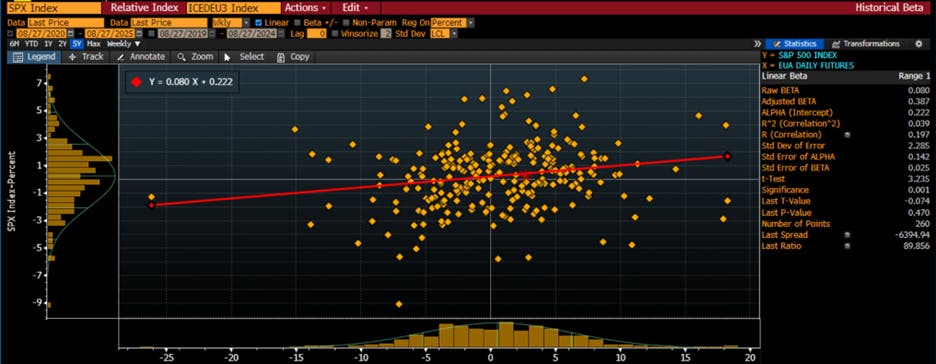
Source: Bloomberg
Carbon exposure in Europe thus sits at the intersection of policy and price. It’s ESG with a measuring stick, a hedge for portfolios already carrying regulatory carbon risk, an uncorrelated diversifier, and a classic commodity story where mandated scarcity meets expanding coverage. Instruments like CTWO—which hold the underlying EUAs in the Union Registry—let investors access that thesis directly within public-market rails. As always, sizing and risk management matter, but the rationale for having some carbon in the toolkit has never been clearer.
How can US investors gain exposure to the EUA market?
There are a few distinct ways investors can gain exposure to the European carbon market: futures contracts, physical allowances, and ETFs/ETPs that use either futures or physical ownership approaches. Each method comes with meaningful differences in cost, convenience, and tax treatment.
1- Futures Contracts
The futures market is the most liquid. EUA futures most actively trade on the ICE Endex (to a much lesser degree, they also trade on the European Energy Exchange and the NASDAQ Oslo) are highly liquid. Futures are not designed for long-term buy-and-hold investors.
Every contract eventually expires, which means investors must keep “rolling” into the next contract to stay invested. That roll introduces two important issues.
First, if the market is in contango, where longer-dated futures are more expensive than the expiring contracts, investors are constantly selling low and buying high.
Over time, this “futures decay,” creates a steady drag on returns. Second, each roll event is effectively a taxable transaction. When futures are held inside an ETF, those realized gains and losses flow through to shareholders as taxable distributions, even if the investor never sold their shares. Over time, the combination of performance drag, and annual tax leakage can add up.
2- Physical Allowances
Physical ownership of allowances works very differently. Once you hold it, you own the asset outright.
That eliminates both the roll cost and the decay that futures investors face, and because there’s no need to continuously sell and repurchase contracts, investors avoid the string of taxable events that come with rolling futures.
Here’s a simple illustration: Suppose the EUA spot price rises 10% per year for five years. An investor in physical allowances would capture that full 10% annually, compounding to about a 61% gain over the period.
But an investor rolling futures annually in a market with a 3% contango would only capture about 7% per year. After five years, that compounds to a roughly 40% gain—already a 20-point lag.
Now add in annual taxable distributions from the roll. If the investor loses even another 1% a year after taxes, the five-year return falls to the mid-30% range, nearly cutting the total return advantage of physical ownership in half.
The challenge to physical ownership, however, is that owning EUAs directly requires an account in the European Union’s registry, which involves significant regulatory oversight and compliance.
That’s manageable for power producers or industrial companies, but not something most investors can realistically do on their own.
3- ETFs and ETPs
This is where ETFs/ETPs come into play.
Some carbon ETFs gain exposure by holding EUA futures. These are straightforward and easy to trade, but they inherit all the drawbacks of the futures market: roll costs, potential decay, and the possibility of taxable distributions when contracts are rolled.
Other ETPs take a different approach by holding the physical allowances themselves in custody. In that case, investors get exposure that more closely mirrors the spot market for EUAs, without the roll decay or recurring taxable events.
The allowances simply sit in the ETP’s registry account, meaning long-term returns more faithfully track the underlying market. In practice, those who are seeking medium- to long-term exposure to the EUA market are better served having physical rather than derivative/future exposure.
Choosing the Right Approach
The choice comes down to what kind of exposure an investor is looking for. Futures are excellent tools for short-term trading or hedging, but less friendly for long-term investors because of the roll dynamics.
Physical allowances, whether held directly or through a physically backed ETP, provide cleaner, roll-free exposure and can be more tax-efficient over time.
For investors seeking to capture the structural supply-demand dynamics of the European carbon market, or the ESG benefits, the physical route may align more closely with their goals.
Like what you're reading?
Stay in the loop — get the latest ETF insights: trends, analysis, and expert picks.
About Ron Gutstein
Over the course of his career, Ron Gutstein has held leadership roles on both the buy and sell sides of the financial industry.
As a sell-side trader, he was responsible for building and maintaining long-term relationships with mutual funds, hedge funds, and private offices. He also contributed to strategic business planning within complex institutional structures.
Ron recently served as the President of Access Securites LLC and prior to that was the Managing Director of North American Trading for Investec Ernst & Co.
As a trustee of a mutual fund, International Value Advisors, from its launch through its closing, Ron gained valuable insight into the priorities and requirements of institutional investors—experience that proved foundational in the creation of COtwo Advisors.
His interest in carbon allowances began during an activist campaign for a board seat at a small timber company in Michigan. This experience sparked a broader vision to create a financial product that would make this emerging asset class accessible to a wider range of investors.
Over the past three years, he has led the development of COtwo Advisors LLC—forming strategic industry partnerships, and building the infrastructure necessary to support an exchange-traded product (ETP) capable of both cash and in-kind creation/redemption.
These efforts culminated in the successful launch of the firm’s flagship ETP on June 20, 2025, with the first trades executed on the NYSE Arca.
Please note this article is for information purposes only and does not in any way constitute investment advice. It is essential that you seek advice from a registered financial professional prior to making any investment decision.


Latest ETF News
See all ETF news
Ask the Manager: Kenneth Wong on Building the Next Wave of ETF Innovation, from Options to Korea's AI Semiconductor Opportunity

Ask the Manager: Kristof Gleich on Why AI Is Becoming an Asset Class

Ask the Manager: Vince Lorusso on Active Equity in an AI-Driven Market





 Advantages of ETFs over Mutual Funds1/6
Lower Costs
In this guide, we'll explore the advantages of ETFs over mutual funds, giving you valuable insights into why ETFs have gained significant popularity among investors like yourself.
Leveraged ETFs: Unlocking the Potential for Amplified Returns1/6
Understanding Leveraged ETFs
Explore leveraged ETFs: potential for amplified returns & risks. 5 ETFs to consider across equities, commodities & fixed income.
What is a Leveraged ETF?1/6
Introducing Leveraged and Inverse ETFs
In this guide, we'll dive into the world of leveraged ETFs, exploring their definition, mechanics, potential risks, and rewards.
Recent educational content

ETF Trends
ETF Industry KPIs September 14, 2026
This week’s KPI data overview highlights key metrics and trends shaping the ETF landscape.

ETF Trends
ETF Industry KPIs September 8, 2026
This week’s KPI data overview highlights key metrics and trends shaping the ETF landscape.
ETF Trends
ETF Industry KPIs August 31, 2026
This week’s KPI data overview highlights key metrics and trends shaping the ETF landscape.
ETF Trends
ETF Industry KPIs August 24, 2026
This week’s KPI data overview highlights key metrics and trends shaping the ETF landscape.
Browse all educational columns



Build and Analyze Your ETF Portfolio Like a Pro
Create your own ETF portfolio in minutes and instantly see allocations, exposures, performance, and risk. Visualize diversification across asset classes, regions, and sectors. Stress-test ideas, compare benchmarks, and refine your strategy with professional-grade analytics.