Global ETF Survey Is Live! 600+ ETF Professionals Weigh In. See Results →



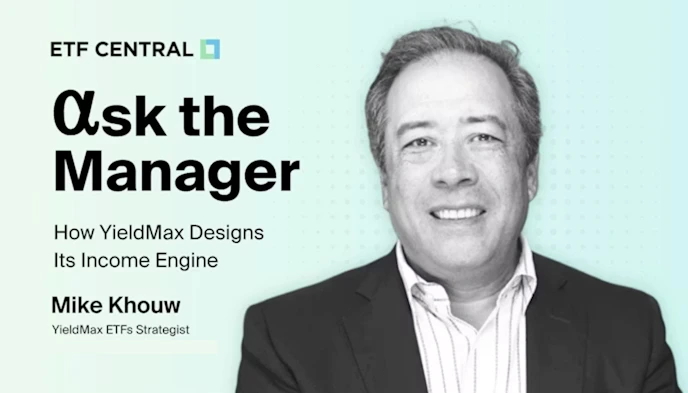
Ask the Manager: Mike Khouw on How YieldMax Designs Its Income Engine
YieldMax explains how its options-based ETFs seek to generate regular income, why total return matters, and how strategies like ULTY fit into modern income portfolios.

Keep up with what matters in ETFs
Get timely ETF insights, market trends, and top ideas straight to your inbox.
Your newsletter subscriptions with us are subject to ETF Central's Privacy Policy and Terms and Conditions.
In this edition of Ask the Manager, we spoke with the YieldMax team—joined by new strategist Mike Khouw—about their fast-growing lineup of options-based income ETFs. Known for generating regular cash flow through option-premium harvesting¹, YieldMax has built a suite of strategies that let investors pair income-generating potential with their market views, whether that’s bullish, bearish, or somewhere in between. We explored how their products work, why total return—not share price alone—is the right way to measure performance, and how funds like YieldMax Ultra Option Income Strategy ETF
For those who may not be familiar, what is YieldMax and what makes your income strategies stand out in today’s ETF market?
YieldMax uses options-based strategies to generate premiums, which we distribute monthly or weekly, depending on the ETF, to investors seeking regular cash flow. YieldMax stands out because we offer a family of ETFs that investors can select from, allowing the core strategy—harvesting options premiums—to be combined with their individual thesis. For example, if an investor is bullish on Nvidia and wants to have regular distributions from a covered call strategy on that stock, they can invest in NVDY. If an investor is bearish on Strategy (ticker MSTR), they can purchase WNTR - the YieldMax MSTR Short Option Income Strategy. If one wants a balance between regular distributions and some participation in large-cap stock price appreciation, one could choose BIGY, which targets 1% monthly (12% annually) in distributions. In a decent year for large-cap equities, one can potentially achieve both capital appreciation and handsome distributions. There are portfolio ETFs that focus on a specific sector or theme, and a fund of funds as well.
YieldMax NVDA Option Income Strategy ETF (NVDY) and YieldMax MSTR Short Option Income Strategy ETF (WNTR) ETFs hold 0% of Nvidia (NVDA) and MicroStrategy (MSTR)
When investors look at performance, why isn’t it the right approach to compare a YieldMax ETF directly to its underlying stock or ETF?
Naturally, the single-stock YieldMax ETFs generate some of their returns from the performance of the underlying stock. A "covered call", also referred to as a "buy-write", involves owning the underlying shares. Thus, an investor in a covered-call or a buy-write is always rooting for the shares to rise, not fall. However, because an investor is selling an upside call, which provides someone else the right to purchase the underlying shares at the strike price, they are forgoing some of the upside potential in the share price in exchange for collecting option premiums. A holder of the shares has unlimited potential upside; a covered-call position does not. Of course, the latter position is essentially equivalent to clipping coupons in the form of options premiums, which the holder of the shares is not. A combination of modest participation in share price appreciation and the collection of premiums drives the option seller's returns.
Many investors notice changes in NAV over time. How can they tell the difference between a normal decline from distributions and true NAV decay?
The value of a fund will always decline by the amount of a distribution when it is made. That's simple arithmetic. If a fund has a net asset value of $100 million and makes a distribution of $2 million the fund's assets will be $98 million after the distribution. This is why, all else equal, whether one is looking at a single-stock dividend or an ETF distribution, the share price declines by the amount of the distribution/dividend on the ex-dividend date. I think what folks are really asking though is whether the share price will be higher or lower for any given period net of any distributions made. Let's use a hypothetical example, we'll call "DETF". If DETF has a share price of $20 when an investor buys it, and the value of the fund appreciates by 4% by a distribution date. In this case the NAV (per share) would now be $20.80. If the fund pays a distribution of $1.00 the share price will fall to $19.80 on the ex-dividend date. The shareholder has a total return of 4%, but collected a distribution of 5% and a share price decline (NAV erosion?) of 1%. So, if a distribution exceeds the total returns for a given period the share price will fall, if it is smaller than the total returns, the share price will rise. However, because registered investment companies have to distribute at least 90% of gains/income or be subject to tax investors should not expect the managers to "retain" or "reinvest" realized gains if and when they get them. This dynamic compels the manager to distribute gains in some cases for tax reasons and the investor must then determine whether some portion of those distributions should be reinvested (sometimes referred to as a "DRIP" an acronym that stands for Dividend (or Distribution) Reinvestment Plan.
When evaluating performance, why is total return a better measure than just focusing on price changes?
For any investment that makes regular distributions to investors it is imperative to calculate the value of those distributions when thinking about the investment's performance. Consider if a bank looked at the performance of a loan only by looking at the remaining principal through time, but ignored the payments they received. Silly right? An investment where one invests $100 at the beginning and receives $100 back over the next two years and has a share price of $50 at the end would look like it lost 50% over two years when in fact the investor had all their initial investment returned to them and still have shares worth $50 and has therefore made 50% over two years. If you don't include distributions in one's performance calculations one isn't calculating anything at all.
Return of capital often gets a bad reputation. What does it actually mean for investors and how should they think about it?
This is a really interesting topic. Return of capital is a characterization of a distribution that has important implications for tax liabilities. It is possible for the net asset value to appreciate by the amount of a distribution within a period and for the distribution to be characterized as a return of capital (a good outcome). It is also possible for the net asset value of a fund to decline, but for a distribution from that fund to be characterized as income, which few would think of as a good outcome. Why does this happen? It has to do with three things really. The performance of the fund is part of it of course, but so is the timing of realized and unrealized gains or losses. A fund cannot distribute unrealized gains, therefore if a distribution is made, even if there are gains in the fund sufficient to support it, the distribution may be characterized as a return of capital due to the timing mismatch between the distribution and realizing profits. Here's a concrete example. Buy 100 shares of stock for $100 at a cost of $10,000. Sell a one week $102 strike call for $1.00. If a week later the stock appreciates to $105 the call will need to be repurchased for $3 resulting in a $2 realized loss. The fund also has a $5 unrealized gain in the underlying shares. If a distribution was made for $3 the NAV of the shares would be $100 - same as it was the week prior. The total return for the week would be 3%, but the 3% distribution would be characterized as return-of-capital because the gains on the underlying shares in this example were unrealized (the shares had not been sold). The shareholder's basis in the shares would be reduced to $97 from $100 - meaning that if they sold the shares at $100 they would have a $3 capital gain. Paradoxically, it is possible to have the NAV decline, but realize profits on a short call² and end up with distributions that are characterized as income! Clearly an investor would prefer the first scenario to the second one, whether distributions are characterized as return of capital or income will depend on the realized gains or losses within the relevant period. Return of capital is almost always a more favorable characterization, all else equal, but it will depend on when/if/how gains and losses are realized. It tends to confuse people most when there is a mismatch in timing of distributions and realizing gains and losses.
Looking at ULTY specifically, how does it fit within the broader YieldMax lineup and what role can it play in a portfolio?
ULTY has greater flexibility in terms of the strategies it may employ at the discretion of the fund's managers. ULTY's managers look for high implied volatility stocks that they believe have good positive momentum to sell premium against, but they have some latitude on how they may go about this and can also be more sophisticated. They can employ hedging strategies via puts, put spreads³ for example. I think of BIGY the target 12 as the most conservative diversified overwriting strategy in the YieldMax lineup, and I think of ULTY as the one with the most latitude for the fund managers allowing them to choose the stocks and the strategy to best take advantage of the market regime at that moment. Because it offers the managers more latitude it will also tend to be somewhat less correlated to the market overall than something like BIGY.
As YieldMax continues to grow, what’s the bigger vision for the firm and how do you hope to shape the conversation around income investing?
We have built a big team of experts in this space, many of whom have decades as professional options traders and investors. We also listen to our investors and listen carefully to the things they love about our ETFs and the things they would like to see us doing. Some investors want the largest possible distributions with the greatest possible frequency, where others are clearly interested in a blend of both income/distributions and potential capital appreciation without the need to DRIP (reinvest distributions to maintain a fixed investment). I think the first suite of ETFs helped show investors what income-focused ETFs can do, and the future offerings will strike a balance between the most desired features of each of the prior ones, sometimes by incorporating them. I'm far more excited about what the future holds because a few years ago these strategies were little known. Now that some of that missionary work has been done products that could not have been launched will now find an audience.
Global ETF Survey 2026 is Live!
With 1,790 new products launched by July 2026, choosing is harder than ever. Our Global ETF Survey 2026, built on 620 professional investors and allocators, shows how active, fixed income, options-based and thematic ETFs are reshaping fund selection.
About Mike Khouw
Mike Khouw is the new YieldMax Strategist with over 25 years of experience in the financial markets. He is one of the industry’s leading voices in options trading, co-founder of OpenInterest.PRO, a long-time contributor on CNBC’s Fast Money and Options Action, and co-author of The Options Edge.
Please note this article is for information purposes only and does not in any way constitute investment advice. It is essential that you seek advice from a registered financial professional prior to making any investment decision.
¹ Option-premium harvesting: Option-premium harvesting refers to an income-generation strategy in which a fund systematically sells options—typically calls, puts, or both—to collect the premiums paid by option buyers. These premiums provide recurring cash flows, though the strategy may limit upside participation or introduce additional risks depending on the type of options sold.
² Short call: A short call refers to an options position created when an investor sells (writes) a call option. The seller receives a premium upfront but takes on the obligation to sell the underlying asset at the strike price if the option is exercised, which limits upside potential and can result in losses if the asset rises significantly above the strike price.
³ Put spread: A put spread is an options strategy in which an investor buys a put option at one strike price while simultaneously selling another put option at a lower strike price. This structure limits both potential losses and potential gains, and is commonly used to hedge downside risk at a lower cost than purchasing a single put option outright.
Before investing you should carefully consider the Funds’ investment objectives, risks, charges and expenses. This and other information are in each Fund’s prospectus and summary prospectus, which may be obtained by clicking here. Please read the prospectuses carefully before you invest.
Investments involve risk. Principal loss is possible.
None of the Fund, the Trust, or Tidal Investments LLC (the “Adviser”) is affiliated, connected, or associated with any underlying issuer.
There is no guarantee that the Fund’s investment strategy will be properly implemented, and an investor may lose some or all of its investment.
Risks Applicable to ULTY, BIGY, NVDY, and WNTR:
Derivatives Risk:
Derivatives are financial instruments deriving value from the underlying reference asset or assets, such as stocks, bonds, or funds (including ETFs), interest rates, or indexes. The Fund’s investments in derivatives may pose risks beyond those associated with directly investing in securities or other ordinary investments. Risks include market-related factors, imperfect correlation with underlying investments or The Fund’s other portfolio holdings, higher price volatility, lack of availability, counterparty risk, liquidity, valuation, and legal restrictions. The Fund’s investment strategies are options-based, and option prices are influenced by various factors.
High Portfolio Turnover Risk. The Fund may actively and frequently trade all or a significant portion of the Fund’s holdings. A high portfolio turnover rate increases transaction costs, which may increase the Fund’s expenses.
Liquidity Risk. Some securities held by the Fund, including options contracts, may be difficult to sell or be illiquid, particularly during times of market turmoil. This risk is greater for the Fund as it will hold options contracts on a single security, and not a broader range of options contracts.
Distribution Risk. As part of the Fund’s investment objective, the Fund seeks to provide current weekly income. There is no assurance that the Fund will make a distribution in any given week. If the Fund does make distributions, the amounts of such distributions will likely vary greatly from one distribution to the next.
Single Issuer Risk:
Each Underlying YieldMax® ETF, focusing on an individual security (Underlying Security), may experience more volatility compared to traditional pooled investments or the market generally due to issuer-specific attributes. Its performance may deviate from that of diversified investments or the overall market, making it potentially more susceptible to the specific performance and risks associated with the Underlying Security.
Non-Diversification Risk. Because the Fund is “non-diversified,” it may invest a greater percentage of its assets in the securities of a single issuer or a smaller number of issuers than if it was a diversified fund.
The Funds are distributed by Foreside Fund Services, LLC. Foreside Fund Services, LLC is not affiliated with the Adviser or YieldMax®.
Risks Applicable Only to NVDY & WNTR
None of the Fund, the Trust, or Tidal Investments LLC (the “Adviser”) is affiliated, connected, or associated with NVDA, Nvidia Corporation, MSTR, or Strategy Inc. The Funds were not developed or created by, and are not sponsored, endorsed, or approved by Nvidia Corporation or Strategy Inc.
Moreover, Nvidia Corporation and Strategy Inc did not participate in the development of the Funds’ investment strategies. Nvidia Corporation and Strategy Inc do not select or approve the Funds’ portfolio holdings, nor do they participate in the construction, design, or implementation of the Funds. Nvidia Corporation and Strategy Inc do not provide any assurances, guarantees, or representations regarding the Funds or their performance. Nothing herein shall be construed as an offer of any security by Nvidia Corporation or Strategy Inc.
An investment in the Fund is NOT an investment in NVDA, MSTR or in any security of Nvidia Corporation or Strategy Inc.
NVDA Risk. The Fund invests in options contracts that are based on the value of NVDA. This subjects the Fund to certain of the same risks as if it owned shares of NVDA, even though it does not. As with any investment, there is a risk that you could lose all or a portion of your investment in the Fund.
MSTR Risk. The Fund invests in options contracts that are based on the value of MSTR. This subjects the Fund to certain of the same risks as if it owned shares of MSTR, even though it does not. As with any investment, there is a risk that you could lose all or a portion of your investment in the Fund.
Counterparty Risk. The Fund is subject to counterparty risk by virtue of its investments in options contracts. Transactions in some types of derivatives, including options, are required to be centrally cleared (“cleared derivatives”). In a transaction involving cleared derivatives, the Fund’s counterparty is a clearing house rather than a bank or broker. Since the Fund is not a member of clearing houses and only members of a clearing house (“clearing members”) can participate directly in the clearing house, the Fund will hold cleared derivatives through accounts at clearing members.
Price Participation Risk. The Fund employs an investment strategy that includes the sale of call option contracts, which limits the degree to which the Fund will participate in increases in value experienced by underlying assets over the Call Period.
Call Writing Strategy Risk. The path dependency (i.e., the continued use) of the Fund’s call writing strategy will impact the extent that the Fund participates in the positive price returns of the underlying and, in turn, the Fund’s returns, both during the term of the sold call options and over longer time periods.
Risks Applicable Only to BIGY & WNTR
New Fund Risk:
The Fund is a recently organized management investment company with no operating history. Prospective investors do not have a track record or history on which to base their investment decisions.
Segments
See all
Mentioned ETFs
Further reading

Latest ETF News
See all ETF newsAsk the Manager: Pieter Vorster on the NICO ETF and the Nicotine Transition

Ask the Manager: Tian Yang on Capital Cycle Investing and the VPX ETF


Ask the Manager: Kenneth Wong on Building the Next Wave of ETF Innovation, from Options to Korea's AI Semiconductor Opportunity




 Advantages of ETFs over Mutual Funds1/6
Lower Costs
In this guide, we'll explore the advantages of ETFs over mutual funds, giving you valuable insights into why ETFs have gained significant popularity among investors like yourself.
Leveraged ETFs: Unlocking the Potential for Amplified Returns1/6
Understanding Leveraged ETFs
Explore leveraged ETFs: potential for amplified returns & risks. 5 ETFs to consider across equities, commodities & fixed income.
What is a Leveraged ETF?1/6
Introducing Leveraged and Inverse ETFs
In this guide, we'll dive into the world of leveraged ETFs, exploring their definition, mechanics, potential risks, and rewards.
Recent educational content
First Look ETF
First Look ETF: Income, International, and Cash Flow ETFs
In this season 6 episode of First Look ETF, Stephanie Stanton @etfguide examines the latest ETF marketplace trends with NYSE and guests.


ETF Trends
ETF Industry KPIs October 5, 2026
This week’s KPI data overview highlights key metrics and trends shaping the ETF landscape.

ETF Trends
ETF Industry KPIs September 28, 2026
This week’s KPI data overview highlights key metrics and trends shaping the ETF landscape.
ETF Trends
ETF Industry KPIs September 22, 2026
This week’s KPI data overview highlights key metrics and trends shaping the ETF landscape.