Create, analyze, optimize your ETF portfolio. Start now →



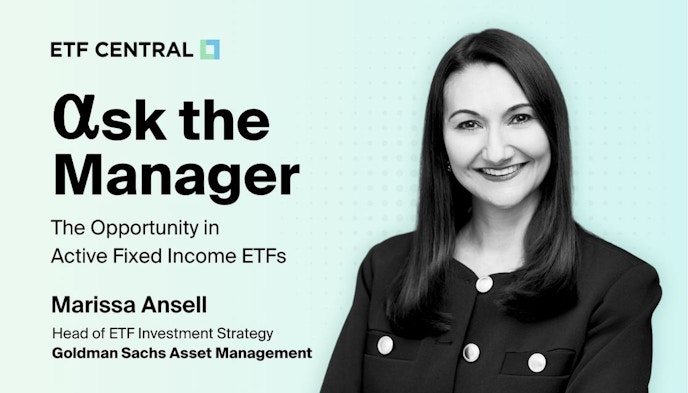
Ask the Manager: Marissa Ansell on the Opportunity in Active Fixed Income ETFs
Goldman Sachs Asset Management’s Marissa Ansell explains why active fixed income ETFs are gaining traction as rates shift and market dispersion creates new opportunities.

Keep up with what matters in ETFs
Get timely ETF insights, market trends, and top ideas straight to your inbox.
Your newsletter subscriptions with us are subject to ETF Central's Privacy Policy and Terms and Conditions.
We sat down with Marissa Ansell, Head of ETF Investment Strategy at Goldman Sachs Asset Management, to discuss the importance of active management in fixed income ETFs, potential growth areas, and the continued expansion of Goldman Sachs Asset Management’s ETF platform.
What is your outlook for the fixed income market over the next few months, and what adjustments might investors need to make to stay ahead of these changes?
Global ETF Survey 2026 is Live!
With 1,790 new products launched by July 2026, choosing is harder than ever. Our Global ETF Survey 2026, built on 620 professional investors and allocators, shows how active, fixed income, options-based and thematic ETFs are reshaping fund selection.
With the Federal Reserve having resumed its rate-cutting path, investors may consider active fixed income ETFs as a tool to help remain nimble and take advantage of potential opportunities as they surface. In our view, selectivity will be critical across sectors, duration, and credit quality.
With policy changes and a shifting yield curve, an active investment approach can help optimize positioning, maximizing the risk-reward ratio. We see value in the short-to-intermediate segments of the credit curve, where the carry and roll-down are particularly attractive compared with recent history. The vast and diverse global investment-grade (IG) corporate credit market offers a wide range of diversification opportunities across sectors and regions, enhancing the resilience of portfolios. Active ETFs provide a flexible and transparent way to access IG credit, with the potential for outperformance and clear visibility on investor holdings.
We see opportunities in emerging markets, which stand to benefit from potential Fed rate cuts. While spread sectors are currently trading at historically tight levels, we see specific areas of value across other sub-sectors, particularly in high-yield and securitized credit, which may offer compelling yields.
We also see income potential in the US municipal bond market, which is characterized by a robust supply of new issues. We continue to believe municipal credit will do well in the next year and investors may be rewarded with additional carry and potential price return in portfolios. Municipal bonds, or "munis," are issued by states, cities, and other government entities to finance public projects and services, such as schools and infrastructure.
In our view, active ETFs have been gaining traction as a preferred vehicle for investing in municipal bonds. These funds combine the advantages of active management, such as navigating market risks and inefficiencies, with the transparency and trading flexibility of ETFs. This multipronged approach positions active ETFs as a tool that investors may consider for fully capitalizing on the muni market's potential.
In our view, achieving optimal risk-adjusted returns in a dynamic market environment necessitates an active investment strategy. We believe this approach allows us to express our convictions across various parts of the curve and markets while seeking to maintain the agility to respond swiftly and decisively to market events.
Goldman Sachs Asset Management has expanded its Active Fixed Income ETF lineup over the past year. Why might investors consider active fixed income ETFs?
We believe active investing and fixed income are a natural fit. The fixed income market is vast and complex. But it can have structural inefficiencies, including fragmentation, pricing information availability, and decentralized trading. Active management using rigorous data-driven, technology-led processes and thoughtful portfolio construction can help investors manage these risks and take advantage of potential opportunities with the goal of outperforming relevant benchmarks. Combined with the benefits of the ETF wrapper (tax efficiency, enhanced transparency, trading flexibility, and potentially lower costs), active fixed income investments can help deliver enhanced returns while helping to manage risk.
Our active ETFs are managed by our experienced fixed income team that supervises over $1.86 trillion in assets across global bond and liquidity markets (as of September 30, 2025).
Earlier this year, we expanded our active fixed income ETF line-up with the addition of the Goldman Sachs Core Bond ETF (GBND) and Goldman Sachs Corporate Bond ETF (GIGL) to help clients take advantage of potential opportunities that lie ahead.
GBND is an actively managed core investment grade bond strategy that has the potential to serve as a foundational source of income and diversification. The ETF will invest primarily across the U.S. investment grade opportunity set including government bonds, securitized assets and corporate bonds.
GIGL is an active corporate credit strategy seeking to deliver a high level of total return consisting of capital appreciation and income, primarily investing in investment grade corporate bonds, diversified across sectors and issuers.
How do your active management strategies in fixed income ETFs help investors navigate changing market conditions?
Combining active management with the ETF wrapper can provide investors with a set of tools for navigating the fixed income market. Active ETFs allow managers to respond to evolving market conditions. They provide investors with the potential benefits of specialist fundamental research and bottom-up security selection that can help managers identify issuers that they believe are well-positioned for cyclical and structural trends and exploit potential mis-pricings.
Our active ETF solutions are thoughtfully designed and reflect the opportunity set for investors today, taking a strategic approach to managing interest rate risk. Our fixed income investment team has been managing investments across the fixed income universe for over three decades and applies its expertise to the ETF platform. Finally, our proprietary research tools across Goldman Sachs Asset Management enhance our ability to identify investment opportunities, execute swiftly, manage risk, and improve operational efficiency.
Which fixed income sectors may offer investors opportunities for attractive returns?
Beyond the sectors already mentioned, one area where we see opportunities for investors is in the municipal bond sector. Municipal bond returns are typically less correlated with those of stocks and corporate bonds, and since they can potentially provide appealing tax-equivalent yields, they may be particularly attractive to high-income investors.
Maintaining an active and flexible approach to investing in munis is crucial in our view. With decades of experience evaluating and investing in municipal opportunities, we provide a range of investment solutions, including ETFs, that aim to meet the diverse needs and goals of investors.
Our suite of active muni ETFs provides investors with cost-effective access to municipal bonds, and all of them aim to generate income that is exempt from regular federal income tax.
- Goldman Sachs Municipal Income ETF (GMUB) has a diversified¹ approach to core municipal investing, focused on investment grade municipal bonds.
- Goldman Sachs Ultra Short Municipal Income ETF (GUMI) seeks income consistent with relatively low volatility of principal with a focus on shorter-dated maturities.
- Goldman Sachs Dynamic California Municipal Income ETF (GCAL) seeks income exempt from California personal income tax.
- Goldman Sachs Dynamic New York Municipal Income ETF (GMNY) seeks income exempt from New York State and City personal income taxes.
What does the future hold for your ETF platform?
We think the future will be active. In our view, demand for active ETFs will continue to grow as investors seek to combine the potential benefits of active management with those of the ETF wrapper. We continue to work to offer a wider spectrum of investors access to Goldman Sachs Asset Management’s active investment capabilities, including our in-depth research, robust risk management, and disciplined portfolio construction.
Marissa Ansell bio:
Marissa is the head ETF Strategy for Goldman Sachs Asset Management. In this role, she and her team are responsible for creating and delivering investment insights, thought leadership, and ETF content to the firm’s clients. Prior to her current role, Marissa was a senior client portfolio manager in the firm’s Fundamental Equity business and head of client portfolio management for thematic investing. In that role, she drove the growth of the thematic franchise by leading the team’s capital raising efforts, client engagement, and business strategy.
Marissa has 23 years of experience and spent 13 years at Goldman Sachs Asset Management in London, before relocating to New York in 2017. She joined Goldman Sachs in 2004.
Marissa is a regular guest on many leading financial and business news networks.
Marissa serves on the Board of Trustees of the Lycée Français de New York and holds a B.A. (Hons) in Economics from Durham University in the U.K.
¹ Diversification does not protect an investor from market risk and does not ensure a profit.
Glossary
Active investing: The process whereby managers use extensive research and human judgement to identify companies that they believe will create long-term value.
Correlation: A measure of the amount to which two investments vary relative to each other. Past correlations are not indicative of future correlations, which may vary.
Credit quality: An assessment of a borrower's or issuer's ability and likelihood to meet their financial obligations, such as repaying debt. It is typically expressed through credit ratings assigned by agencies like Standard & Poor's, Moody's, and Fitch, with higher ratings indicating lower risk of default.
Duration: The weighted-average term-to-maturity of the bond’s cash flows, the weights being the present value of each cash flow as a percentage of the bond’s full prices. The greater the duration of a bond, the greater its price sensitivity. In general, duration rises with maturity, falls with the frequency of coupon payments, and falls as the yield rises (the higher yield reduces the present values of the cash flows). Duration also provides an indication of a bond portfolio’s price sensitivity to changes in interest rates.
Investment grade (IG): A relatively safe bond with a credit rating of BBB or above from an independent rating service such as Standard and Poor’s.
Municipal bond market: Where state and local governments, and their associated entities, issue debt securities (municipal bonds) to finance public projects and operations. Investors lend money to these governmental bodies by purchasing the bonds, receiving periodic interest payments and the return of their principal, often with tax-exempt interest income.
Tax-equivalent yields: The return that is required on a taxable investment to make it equal to the return on a tax-exempt investment.
Transparency: Portfolio holdings are disclosed on a daily basis.
FUND RISK CONSIDERATIONS AND GENERAL DISCLOSURES
The Goldman Sachs Core Bond ETF (the “Fund”) seeks to provide a total return consisting of capital appreciation and income. The Fund is an actively managed exchange-traded fund. The Fund pursues its investment objective by primarily investing in core fixed income securities, including U.S. government securities (including agency mortgage-related securities), corporate debt securities, private mortgage-backed securities and asset-backed securities (including collateralized loan obligations). Core fixed income securities are fixed income securities that are rated investment grade (i.e., securities rated BBB-, Baa3 or higher by a nationally recognized statistical rating organization or, if unrated, determined by the Investment Adviser to be of comparable credit quality). The Fund’s investments in core fixed income securities are subject to the risks associated with debt securities generally, including credit and interest rate risk. Any guarantee on U.S. government securities applies only to the underlying securities of the Fund if held to maturity and not to the value of the Fund’s shares. Investments in mortgage-backed securities and other asset-backed securities are also subject to prepayment risk (i.e., the risk that in a declining interest rate environment, issuers may pay principal more quickly than expected, causing the Fund to reinvest proceeds at lower prevailing interest rates). Foreign and emerging markets investments may be more volatile and less liquid than investments in U.S. securities and are subject to the risks of currency fluctuations and adverse economic, social or political developments, including regional armed conflicts, sanctions, tariffs, counter-sanction, retaliatory tariffs and other retaliatory actions. The Fund’s investments are subject to market risk, which means that the value of the securities in which it invests may go up or down in response to the prospects of individual companies, particular sectors, governments or countries and/or general economic conditions in the U.S. or throughout the world. Derivative instruments may involve a high degree of financial risk. These risks include the risk that a small movement in the price of the underlying security or benchmark may result in a disproportionately large movement, unfavorable or favorable, in the price of the derivative instrument; risks of default by a counterparty; and liquidity risk (i.e., the risk that an investment may not be able to be sold without a substantial drop in price, if at all). Taking short positions and utilizing reverse repurchase agreements involve leverage of the Fund’s assets and present various other risks. Losses on short positions are potentially unlimited as a loss occurs when the value of an asset with respect to which the Fund has a short position increases. The Fund may have a high rate of portfolio turnover, which involves correspondingly greater expenses which must be borne by the Fund and its shareholders, and is also likely to result in short-term capital gains taxable to shareholders. The Fund’s investments in other investment companies (including exchange-traded funds) subject it to additional expenses. The Fund is “non-diversified” and may invest a larger percentage of its assets in one or more issuers or in fewer issuers than “diversified” funds. Accordingly, the Fund may be more susceptible to adverse developments affecting any single issuer held in its portfolio and to greater losses resulting from these developments.
The Goldman Sachs Corporate Bond ETF (the “Fund”) seeks to provide a high level of total return consisting of capital appreciation and income. The Fund is an actively managed exchange-traded fund. The Fund pursues its investment objective by primarily investing in corporate bonds. The Fund’s investments in corporate bonds are subject to the risks associated with debt securities generally, including credit and interest rate risk. Any guarantee on U.S. government securities applies only to the underlying securities of the Fund if held to maturity and not to the value of the Fund’s shares. Foreign investments may be more volatile and less liquid than investments in U.S. securities and are subject to the risks of currency fluctuations and adverse economic, social or political developments, including regional armed conflicts, sanctions, counter-sanctions and other retaliatory actions. The Fund’s investments are subject to market risk, which means that the value of the securities in which it invests may go up or down in response to the prospects of individual companies, particular sectors, governments or countries and/or general economic conditions in the U.S. or throughout the world. Derivative instruments may involve a high degree of financial risk. These risks include the risk that a small movement in the price of the underlying security or benchmark may result in a disproportionately large movement, unfavorable or favorable, in the price of the derivative instrument; the risk of default by a counterparty; and liquidity risk (i.e., the risk that an investment may not be able to be sold without a substantial drop in price, if at all). The Fund may be more sensitive to adverse economic, business or political developments if it invests a substantial portion of its assets in bonds of similar projects or in particular types of municipal securities. The Fund’s investments in other investment companies (including exchange-traded funds) subject it to additional expenses. The Fund is “non-diversified” and may invest a larger percentage of its assets in one or more issuers or in fewer issuers than “diversified” funds. Accordingly, the Fund may be more susceptible to adverse developments affecting any single issuer held in its portfolio and to greater losses resulting from these developments.
The Goldman Sachs Municipal Income ETF (the “Fund”) seeks a high level of current income that is exempt from regular federal income tax. The Fund is an actively managed exchange-traded fund. The Fund pursues its investment objective by primarily investing in Municipal Securities (as defined in the Fund’s Prospectus), private activity bonds, and affiliated or unaffiliated investment companies. The Fund may invest up to 100% of its net assets in private activity bonds, whose income may be subject to the federal alternative minimum tax. Investments in fixed income securities are subject to the risks associated with debt securities generally, including credit, liquidity and interest rate. The Fund may invest in non-investment grade securities, which involve greater price volatility and present greater risks than higher rated fixed income securities. The Fund may make investments that are or may become illiquid. At times, the Fund may be unable to sell illiquid investments without a substantial drop in price, if at all. The Fund may be more sensitive to adverse economic, business or political developments if it invests a substantial portion of its assets in bonds of similar projects or in particular types of Municipal Securities. Because the Fund may invest heavily in investments in particular states and sectors, the Fund is subject to greater risk of loss as a result of adverse events affecting those states and sectors than if its investments were not so focused. The Fund may be adversely impacted by changes in tax rates and policies, and is not suited for IRAs or other tax-exempt or deferred accounts. The Fund’s investments are also subject to market risk, which means that the value of the securities in which it invests may go up or down in response to the prospects of individual companies, particular sectors or governments and/or general economic conditions. The Fund’s investments in other investment companies (including ETFs) subject it to additional expenses. The Fund is “non-diversified” and may invest a larger percentage of its assets in fewer issuers than “diversified” funds. In addition, the Fund may invest in a relatively small number of issuers. Accordingly, the Fund may be more susceptible to adverse developments affecting any single issuer held in its portfolio and to greater losses resulting from these developments.
The Goldman Sachs Ultra Short Municipal Income ETF (the “Fund”) seeks a high level of current income, consistent with relatively low volatility of principal, that is exempt from regular federal income tax. The Fund is an actively managed exchange-traded fund. The Fund pursues its investment objective by investing primarily in Municipal Securities (as defined in the Fund’s Prospectus), private activity bonds, and affiliated or unaffiliated investment companies. The Fund may invest up to 100% of its net assets in private activity bonds, whose income may be subject to the federal alternative minimum tax. Investments in fixed income securities are subject to the risks associated with debt securities generally, including credit, liquidity and interest rate. The Fund may make investments that are or may become illiquid. At times, the Fund may be unable to sell illiquid investments without a substantial drop in price, if at all. The Fund may be more sensitive to adverse economic, business or political developments if it invests a substantial portion of its assets in bonds of similar projects or in particular types of Municipal Securities. Because the Fund may invest heavily in investments in particular states and sectors, the Fund is subject to greater risk of loss as a result of adverse events affecting those states and sectors than if its investments were not so focused. The Fund may be adversely impacted by changes in tax rates and policies, and is not suited for IRAs or other tax-exempt or deferred accounts. The Fund’s investments are also subject to market risk, which means that the value of the securities in which it invests may go up or down in response to the prospects of individual companies, particular sectors or governments and/or general economic conditions. The Fund’s investments in other investment companies (including ETFs) subject it to additional expenses. The Fund is “non-diversified” and may invest a larger percentage of its assets in fewer issuers than “diversified” funds. In addition, the Fund may invest in a relatively small number of issuers. Accordingly, the Fund may be more susceptible to adverse developments affecting any single issuer held in its portfolio and to greater losses resulting from these developments.
The Goldman Sachs Dynamic California Municipal Income ETF (the “Fund”) seeks a high level of current income that is exempt from regular federal income tax and California personal income tax. The Fund is an actively managed exchange-traded fund. The Fund pursues its investment objective by primarily investing in Municipal Securities (as defined in the Fund’s Prospectus), private activity bonds, and affiliated or unaffiliated investment companies. The Fund may invest up to 100% of its net assets in private activity bonds, whose income may be subject to the federal alternative minimum tax. Investments in fixed income securities are subject to the risks associated with debt securities generally, including credit, liquidity and interest rate. The Fund may invest in non-investment grade securities, which involve greater price volatility and present greater risks than higher rated fixed income securities. The Fund may make investments that are or may become illiquid. At times, the Fund may be unable to sell illiquid investments without a substantial drop in price, if at all. The Fund may be more sensitive to adverse economic, business or political developments if it invests a substantial portion of its assets in bonds of similar projects or in particular types of Municipal Securities. Because the Fund may invest heavily in investments in particular states and sectors, the Fund is subject to greater risk of loss as a result of adverse events affecting those states and sectors than if its investments were not so focused. The Fund may be adversely impacted by changes in tax rates and policies, and is not suited for IRAs or other tax-exempt or deferred accounts. The Fund’s investments are also subject to market risk, which means that the value of the securities in which it invests may go up or down in response to the prospects of individual companies, particular sectors or governments and/or general economic conditions. The Fund’s investments in other investment companies (including ETFs) subject it to additional expenses. The Fund is “non-diversified” and may invest a larger percentage of its assets in fewer issuers than “diversified” funds. In addition, the Fund may invest in a relatively small number of issuers. Accordingly, the Fund may be more susceptible to adverse developments affecting any single issuer held in its portfolio and to greater losses resulting from these developments.
The Goldman Sachs Dynamic New York Municipal Income ETF (the “Fund”) seeks a high level of current income that is exempt from regular federal income tax and New York State and City personal income taxes. The Fund is an actively managed exchange-traded fund. The Fund pursues its investment objective by primarily investing in Municipal Securities (as defined in the Fund’s Prospectus), private activity bonds, and affiliated or unaffiliated investment companies. The Fund may invest up to 100% of its net assets in private activity bonds, whose income may be subject to the federal alternative minimum tax. Investments in fixed income securities are subject to the risks associated with debt securities generally, including credit, liquidity and interest rate. The Fund may invest in non-investment grade securities, which involve greater price volatility and present greater risks than higher rated fixed income securities. The Fund may make investments that are or may become illiquid. At times, the Fund may be unable to sell illiquid investments without a substantial drop in price, if at all. The Fund may be more sensitive to adverse economic, business or political developments if it invests a substantial portion of its assets in bonds of similar projects or in particular types of Municipal Securities. Because the Fund may invest heavily in investments in particular states and sectors, the Fund is subject to greater risk of loss as a result of adverse events affecting those states and sectors than if its investments were not so focused. The Fund may be adversely impacted by changes in tax rates and policies, and is not suited for IRAs or other tax-exempt or deferred accounts. The Fund’s investments are also subject to market risk, which means that the value of the securities in which it invests may go up or down in response to the prospects of individual companies, particular sectors or governments and/or general economic conditions. The Fund’s investments in other investment companies (including ETFs) subject it to additional expenses. The Fund is “non-diversified” and may invest a larger percentage of its assets in fewer issuers than “diversified” funds. In addition, the Fund may invest in a relatively small number of issuers. Accordingly, the Fund may be more susceptible to adverse developments affecting any single issuer held in its portfolio and to greater losses resulting from these developments.
Fund shares are not individually redeemable and are issued and redeemed by the Fund at their net asset value (“NAV”) only in large, specified blocks of shares called creation units. Shares otherwise can be bought and sold only through exchange trading at market price (not NAV). Shares may trade at a premium or discount to their NAV in the secondary market. Brokerage commissions will reduce returns.
Diversification does not protect an investor from market risk and does not ensure a profit.
General Disclosures
THIS MATERIAL DOES NOT CONSTITUTE AN OFFER OR SOLICITATION IN ANY JURISDICTION WHERE OR TO ANY PERSON TO WHOM IT WOULD BE UNAUTHORIZED OR UNLAWFUL TO DO SO.
This material is provided for informational purposes only and should not be construed as investment advice or an offer or solicitation to buy or sell securities. This material is not intended to be used as a general guide to investing, or as a source of any specific investment recommendations, and makes no implied or express recommendations concerning the manner in which any client’s account should or would be handled, as appropriate investment strategies depend upon the client’s investment objectives.
Views and opinions expressed are for informational purposes only and do not constitute a recommendation by Goldman Sachs Asset Management to buy, sell, or hold any security. Views and opinions are current as of the date of this presentation and may be subject to change, they should not be construed as investment advice.
A summary prospectus, if available, or a Prospectus for the Fund containing more information may be obtained from your authorized dealer or from Goldman Sachs & Co. LLC by calling (retail - 1-800-526-7384) (institutional – 1-800-621-2550). Please consider a fund's objectives, risks, and charges and expenses, and read the summary prospectus, if available, and the Prospectus carefully before investing. The summary prospectus, if available, and the Prospectus contains this and other information about the Fund.
The Investment Company Act of 1940 (the “Act”) imposes certain limits on investment companies purchasing or acquiring any security issued by another registered investment company. For these purposes the definition of “investment company” includes funds that are unregistered because they are excepted from the definition of investment company by sections 3(c)(1) and 3(c)(7) of the Act. You should consult your legal counsel for more information.
Certain funds are newly organized and do not have operating histories.
There is no guarantee that objectives will be met.
The portfolio risk management process includes an effort to monitor and manage risk, but does not imply low risk.
Past performance does not guarantee future results, which may vary. The value of investments and the income derived from investments will fluctuate and can go down as well as up. A loss of principal may occur.
ALPS Distributors, Inc. is the distributor of the Goldman Sachs ETF Funds. ALPS Distributors, Inc. is unaffiliated with Goldman Sachs Asset Management.
© 2026 Goldman Sachs. All rights reserved.
GST003408
475656-OTU-2435115

Latest ETF News
See all ETF newsAsk the Manager: Pieter Vorster on the NICO ETF and the Nicotine Transition

Ask the Manager: Tian Yang on Capital Cycle Investing and the VPX ETF


Ask the Manager: Kenneth Wong on Building the Next Wave of ETF Innovation, from Options to Korea's AI Semiconductor Opportunity




 Advantages of ETFs over Mutual Funds1/6
Lower Costs
In this guide, we'll explore the advantages of ETFs over mutual funds, giving you valuable insights into why ETFs have gained significant popularity among investors like yourself.
Leveraged ETFs: Unlocking the Potential for Amplified Returns1/6
Understanding Leveraged ETFs
Explore leveraged ETFs: potential for amplified returns & risks. 5 ETFs to consider across equities, commodities & fixed income.
What is a Leveraged ETF?1/6
Introducing Leveraged and Inverse ETFs
In this guide, we'll dive into the world of leveraged ETFs, exploring their definition, mechanics, potential risks, and rewards.
Recent educational content

First Look ETF
First Look ETF: Income, International, and Cash Flow ETFs
In this season 6 episode of First Look ETF, Stephanie Stanton @etfguide examines the latest ETF marketplace trends with NYSE and guests.


ETF Trends
ETF Industry KPIs October 5, 2026
This week’s KPI data overview highlights key metrics and trends shaping the ETF landscape.

ETF Trends
ETF Industry KPIs September 28, 2026
This week’s KPI data overview highlights key metrics and trends shaping the ETF landscape.
ETF Trends
ETF Industry KPIs September 22, 2026
This week’s KPI data overview highlights key metrics and trends shaping the ETF landscape.