Keep tabs on your favorite ETFs with a personalized weekly tracker. Create a Watchlist now →



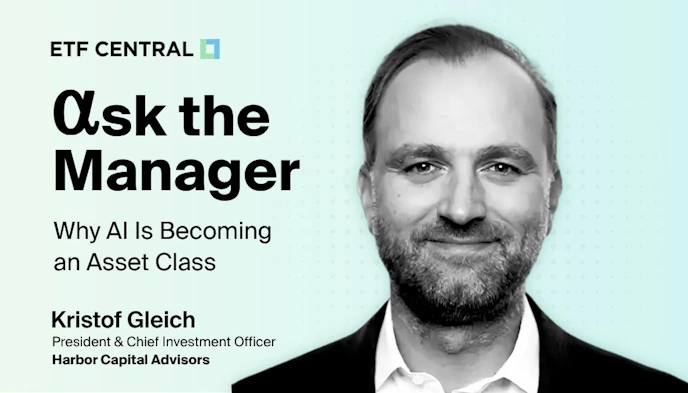
Ask the Manager: Kristof Gleich on Why AI Is Becoming an Asset Class
Kristof Gleich explains why AI is moving beyond a technology theme and emerging as a new framework for investing across the ecosystems reshaping the global economy.

Keep up with what matters in ETFs
Get timely ETF insights, market trends, and top ideas straight to your inbox.
Your newsletter subscriptions with us are subject to ETF Central's Privacy Policy and Terms and Conditions.
In this new edition of Ask the Manager, we speak with Kristof Gleich, President and CIO at Harbor Capital Advisors, about why AI is evolving from an investment theme into what the firm sees as a new asset class, and how investors can gain exposure to the competing ecosystems shaping its next phase.
For the past few years, many investors have treated AI as a single investment theme. At Harbor, you are saying this is the year it is declared an asset class. What has changed in the AI landscape that makes you believe we're entering a new phase of the opportunity?
Like what you're reading?
Stay in the loop — get the latest ETF insights: trends, analysis, and expert picks.
I think we've crossed an important threshold.
For the last several years, AI was viewed as a technology trend, something that would enhance productivity or create opportunities within software.
Today, we believe AI is increasingly becoming an organizing force behind capital allocation across the global economy.
When you look at where companies are investing, where governments are directing resources, and where private capital is flowing, AI appears to be influencing decisions well beyond the technology sector.
It may be reshaping infrastructure, energy, networking, enterprise software, industrial automation, and even how businesses think about labor.
I strongly believe investors should increasingly think about AI as an asset class rather than simply another investment theme.
As investors, we've historically relied on economic indicators like the Purchasing Managers’ Index, or PMI, to understand where growth is occurring.
I think we'll increasingly need new frameworks to measure the AI economy itself—tracking investment, adoption, and ecosystem development.
As an example, we’re already created our own AI PMI’s, to complement the more traditional services PMI’s and manufacturing PMI’s to help us measure the AI Economy with a different lens.
AI has become large enough that in my opinion traditional benchmarks alone may not fully capture what's driving markets.
The investment buildout we're seeing today is unlike anything we've experienced and I believe we're still in the early innings. That’s not to say that’s without risks of course and July 2026 was a healthy reminder of that.
Much of the discussion around AI focuses on the major labs and models themselves. From an investment perspective, why is it important to look beyond the headline companies and consider the broader ecosystem supporting AI development?
The labs are obviously where much of the innovation begins, but no AI lab succeeds in isolation.
Every breakthrough depends on an entire network of companies providing the computing infrastructure, cloud services, networking, power, software, implementation, and specialized tools required to bring these models into the real economy.
Sector classifications were originally created to organize companies into different groupings that may have a similar purpose, product or position in the economy.
Some AI Labs themselves are now trillion-dollar enterprises that I believe are deserving of their own sectors as they impact so many downstream suppliers and partners.
The Harbor AI Labs Ecosystem ETFs offer investors a way to gain targeted exposure to those distinct AI ecosystems much like investors have traditionally approached sectors.
History tells us that transformational technologies rarely create value in just one company.
Think about smartphones.
While consumers focused on Apple, the investment opportunity extended across semiconductor manufacturers, suppliers, wireless infrastructure, software developers, and countless businesses that enabled the ecosystem to flourish.
I believe AI follows the same pattern.
The ecosystem surrounding each leading lab may ultimately create a broader and more diversified opportunity set than the labs themselves. These new AI Lab sector ETFs are where public market investors can participate today.
As competition between leading AI labs accelerates, what do you think will ultimately determine the winners? Will it be the best models, distribution, enterprise adoption, infrastructure, or something else?
I don't think there will be a single winner, and that could be one of the biggest misconceptions investors have today.
Each of the leading AI labs is pursuing a different strategy.
Some are focused on enterprise adoption and trusted AI. Others emphasize consumer distribution, open-source development, deep research capabilities, or building massive computing infrastructure.
Those aren't small differences—they represent fundamentally different competitive advantages.
Ultimately, I think the winners will be determined by who builds the strongest ecosystem.
The best model alone may not necessarily win if developers, enterprises, infrastructure providers, and application builders choose another platform.
We've seen this dynamic before in operating systems, cloud computing, and mobile technology.
Platform businesses succeed because they attract partners, developers, and customers who reinforce one another over time.
To me the AI race increasingly looks less like a technology competition and more like an ecosystem competition.
Many investors think about AI primarily in terms of semiconductors. How do you see the opportunity expanding across other parts of the economy, such as cloud infrastructure, energy, networking, software, and services?
Semiconductors have been the obvious beneficiaries because AI can't exist without computing power.
But as the technology matures, I think the opportunity naturally broadens.
Building AI at scale requires enormous investments in data centers, electricity generation, cooling systems, networking equipment, cloud infrastructure, cybersecurity, enterprise software, and consulting services that help organizations deploy AI effectively. Every new model generally requires an increasingly sophisticated supply chain to support it.
The next phase of AI won't simply be about training larger models. It may be about integrating AI into every industry.
That could mean value creation shifts beyond hardware into the companies enabling adoption across the economy. In many ways, I believe we are beginning to move from the infrastructure buildout phase toward the implementation phase, where software, services, and business transformation become increasingly important.
How does the Harbor AI Lab Ecosystem ETF suite help investors express a view on the AI race differently than a traditional broad AI or technology ETF?
Most AI ETFs ask investors to buy the entire theme in one basket.
We think the AI landscape has evolved beyond that.
Today, investors already have opinions about the leading AI labs.
They debate whether OpenAI maintains its leadership, whether Anthropic becomes the enterprise standard, whether Meta's open-source strategy prevails, whether Google DeepMind leverages its data advantage, or whether SpaceXAI disrupts the market through speed and compute.
Until now, we don’t think there has been a simple way to express those views in public markets.
The Harbor AI Lab Ecosystem ETFs are designed around the idea that each lab is building its own ecosystem of partners, suppliers, infrastructure providers, and software companies.
The portfolios invest primarily in publicly traded companies Harbor identifies as linked to the respective ecosystems as having meaningful relationships with those ecosystems. We think that gives investors a more nuanced way to participate in the AI economy as it evolves.
For investors who believe AI will continue reshaping the economy but aren't trying to predict a single winner, how can the Harbor AI Lab Ecosystem ETFs fit into a broader portfolio?
One of the interesting aspects of the AI economy is that you don't necessarily have to make an all-or-nothing bet.
Some investors may have strong conviction in a particular ecosystem and want targeted exposure. Others may believe several AI labs will succeed, each serving different markets or use cases.
The ETF suite allows investors to gain exposure across multiple ecosystems based on their own convictions, rather than relying on a traditional index to make those decisions for them.
More broadly, I think these funds can complement existing technology or broad equity allocations by providing a different lens on AI.
Instead of organizing investments by traditional sector or market capitalization, they're organized around the ecosystems competing to help shape the future of artificial intelligence, offering a new framework for investing in the AI economy that we believe investors may come to think about much like sectors.
As AI continues to become a defining force in the global economy, I believe investors will increasingly think about allocating capital based on those ecosystems rather than viewing AI as just another subset of technology.
Important Information
Investors should carefully consider the investment objectives, risks, charges and expenses of a fund before investing. To obtain a summary prospectus or prospectus for this and other information, call 800-422-1050. Read it carefully before investing.
Investing involves risk, principal loss is possible. Unlike mutual funds, ETFs may trade at a premium or discount to their net asset value. Harbor ETFs are new and have limited operating history to judge.
There is no guarantee the Fund will achieve its investment objective. Equity and foreign securities, particularly those in emerging markets, are subject to market volatility and political, regulatory, economic, and foreign currency risks that may cause the Fund’s value to decline. The Fund’s performance depends on the success, adoption, and growth of the company identified in the Fund’s name and companies most directly linked to that company’s artificial intelligence (“AI”) ecosystem. The Fund and such companies may be adversely affected by competition, technological disruption, cybersecurity incidents, supply chain constraints, regulation, reputational events, or shifts in market and investor sentiment. AI-related companies face rapid technological change and evolving legal and regulatory scrutiny that could negatively impact their business, profitability, and market value. The Fund relies on third-party data and quantitative models that may be inaccurate, incomplete, delayed, or ineffective, and such models may not perform as expected under all market conditions. American Depository Receipts (ADRs), Initial Public Offerings (IPOs), and private company investments involve additional risks, including heightened volatility, limited liquidity, reduced transparency, foreign currency exposure, and uncertain operating histories or valuations. Because the Fund may invest a greater percentage of its assets in a single issuer or a limited number of issuers, it may be more susceptible to risks associated with a particular economic, political, or regulatory event than a more diversified portfolio.
The views expressed herein are as of August 2026 and may not be reflective of current opinions, are subject to change without prior notice, and should not be considered investment advice.
The Funds are not affiliated with, connected to, or associated with the companies identified in their respective names and were not developed or created by, or sponsored, endorsed, or approved by, those companies.
Copyright © 2026 Harbor Capital Advisors, Inc. All rights reserved.
Foreside Fund Services, LLC is the Distributor of the Harbor ETFs.
5815107
Please note this article is for information purposes only and does not in any way constitute investment advice. It is essential that you seek advice from a registered financial professional prior to making any investment decision.
Segments
See all
No specific market segments were tagged
Mentioned ETFs
No specific ETFs were tagged
Further reading

Latest ETF News
See all ETF newsAsk the Manager: Tian Yang on Capital Cycle Investing and the VPX ETF

Ask the Manager: Kenneth Wong on Building the Next Wave of ETF Innovation, from Options to Korea's AI Semiconductor Opportunity
Ask the Manager: Vince Lorusso on Active Equity in an AI-Driven Market





 Advantages of ETFs over Mutual Funds1/6
Lower Costs
In this guide, we'll explore the advantages of ETFs over mutual funds, giving you valuable insights into why ETFs have gained significant popularity among investors like yourself.
Leveraged ETFs: Unlocking the Potential for Amplified Returns1/6
Understanding Leveraged ETFs
Explore leveraged ETFs: potential for amplified returns & risks. 5 ETFs to consider across equities, commodities & fixed income.
What is a Leveraged ETF?1/6
Introducing Leveraged and Inverse ETFs
In this guide, we'll dive into the world of leveraged ETFs, exploring their definition, mechanics, potential risks, and rewards.
Recent educational content

ETF Trends
ETF Industry KPIs September 22, 2026
This week’s KPI data overview highlights key metrics and trends shaping the ETF landscape.

First Look ETF
First Look ETF: Income, Corporate Arbitrage, and Growth and Value Investing
First Look ETF September 2026: iCapital, Mast Investments and North Square unpack new ETFs targeting monthly income, merger arbitrage and complementary growth and value exposure.

ETF Trends
ETF Industry KPIs September 14, 2026
This week’s KPI data overview highlights key metrics and trends shaping the ETF landscape.
ETF Trends
ETF Industry KPIs September 8, 2026
This week’s KPI data overview highlights key metrics and trends shaping the ETF landscape.
Browse all educational columns



Build and Analyze Your ETF Portfolio Like a Pro
Create your own ETF portfolio in minutes and instantly see allocations, exposures, performance, and risk. Visualize diversification across asset classes, regions, and sectors. Stress-test ideas, compare benchmarks, and refine your strategy with professional-grade analytics.