Keep tabs on your favorite ETFs with a personalized weekly tracker. Create a Watchlist now →



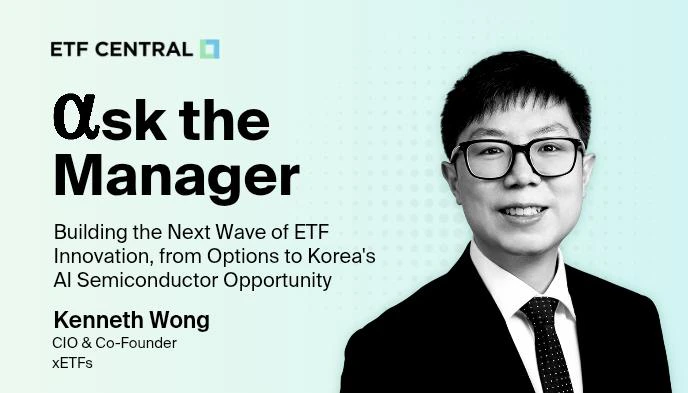
Ask the Manager: Kenneth Wong on Building the Next Wave of ETF Innovation, from Options to Korea's AI Semiconductor Opportunity
Kenneth Wong, CIO and Co-Founder of xETFs, discusses the firm's approach to ETF innovation and how the xETFs Korea AI Semiconductor ETF (KSMH) targets the broader ecosystem behind the AI-driven memory upcycle.

Keep up with what matters in ETFs
Get timely ETF insights, market trends, and top ideas straight to your inbox.
Your newsletter subscriptions with us are subject to ETF Central's Privacy Policy and Terms and Conditions.
As exchange-traded funds continue to expand the range of strategies available to individual investors, some firms are focused on translating tools long used by institutions into more accessible formats. Kenneth Wong, CIO and Co-Founder of xETFs, has built his firm around that idea, drawing on his background at BlackRock's ETF innovation team to identify areas of the market still underserved by existing products. In this edition of Ask the Manager, Wong discusses xETFs' approach to product development across options-based and thematic strategies, and details the thesis behind the firm's first fund, the xETFs Korea AI Semiconductor ETF
Like what you're reading?
Stay in the loop — get the latest ETF insights: trends, analysis, and expert picks.
Tell us about xETFs and what led you to start the firm?
xETFs was built around the idea that a lot of investment strategies today are still much easier for institutions to access than for individual investors. We wanted to close that gap with ETFs that make these strategies easier to understand and to own.
I spent a number of years in finance, including the last six at BlackRock on the ETF innovation team. That gave me a front row seat to how quickly the ETF market was evolving, but also how much white space was still out there. That ultimately drove me to start xETFs and to build a firm that could move quickly, build innovative products, and bring them to a broad group of investors.
What kinds of products do you want xETFs to build?
Two areas stand out for us today. The first is options-based ETFs. It’s already a more than $200 billion category¹, but we think there is still a lot of room beyond traditional covered calls - new payoffs, new underlyings, and new approaches to trading options.
The second is thematics, particularly emerging themes that aren’t captured by the ETFs out there today. AI is a great example, and the xETFs Korea AI Semiconductor ETF (KSMH) is our first fund in this area. It takes a very specific theme around Korea and AI semis and makes it accessible in a single ETF.
How do you think about the ETF development process and which ETF ideas to bring to market?
We start with the investment thesis and the investor use case. There has to be a reason for someone to own the fund and a place for it in the portfolio. We then think about differentiation and white space. Is this an exposure investors want but don’t currently have a good way to access? Is this something meaningfully different from what’s already out there?
And finally, it has to be clear. An investor should be able to understand pretty quickly what the fund owns, why it exists, and how they might use it. We don’t want to launch products just to add another ticker to the market.
Where do you see the biggest white space for ETF innovation from here?
I think we’re still relatively early in using the ETF wrapper to deliver strategies that traditionally have been used by institutions. Options and quantitative strategies are two of the biggest areas of opportunity, but that extends into fixed income, alternatives and other parts of the market as well.
On the thematic side, AI is creating a lot of new investable subthemes today, but I think new industries and new themes will continue to emerge where investors don’t have a targeted way to get exposure.
What is KSMH?
KSMH is built around the thesis that AI is creating a new memory upcycle, and Korea sits at a critical center of it.
SK Hynix and Samsung are obviously the anchors of this fund, but the opportunity goes well beyond those two companies. KSMH also seeks to invest across the businesses providing the equipment, materials, packaging, and testing needed to produce and scale that memory. So you’re targeting exposure to the broader Korean semiconductor ecosystem behind the AI buildout.
Why go beyond SK Hynix and Samsung?
Because the AI upcycle doesn’t stop with the companies that sell the memory. As SK Hynix and Samsung expand production, there is an entire group of suppliers and partners that benefit from that investment.
Hanmi Semiconductor, for example, provides equipment used to assemble the advanced memory chips. Samsung Electro-Mechanics makes components used to connect those chips into the broader system. There are a lot of companies like these in Korea that are important parts of the AI supply chain but aren’t necessarily familiar names to U.S. investors, nor are they available on the U.S. stock market. KSMH is designed to bring that whole ecosystem together in a single ticker.
How is KSMH different from a broad Korea ETF or a traditional semiconductor ETF?
A broad Korea ETF gives you Korea, but it also gives you banks, autos, healthcare, and a lot of other sectors. As much as half of the basket can be in areas outside of semiconductors. A traditional semiconductor ETF gives you semiconductors, but those funds tend to be dominated by U.S. names and have little, if any, Korea exposure.
KSMH sits at the intersection of those two, combining the geographic exposure of a Korea ETF with the sector focus of a semiconductor ETF.
Why Korea, and why now?
AI has created extraordinary demand for memory, and Korea is at a critical center of that market. We’ve seen forecasts of memory revenue growing almost 300% this year², and even the CEO of SK Hynix said that he expects demand to outweigh supply beyond 2030³.
What makes that especially exciting to us is that this isn’t just a two-company story. If investment in memory continues at this scale, it translates into more demand for the materials, equipment, and other infrastructure around it. That broader ecosystem is what KSMH is designed to capture.
About Kenneth Wong
Kenneth Wong joined xETFs in 2025 as Co-Founder and Chief Investment Officer. Previously, Kenneth was at BlackRock where he focused on researching and developing new ETF products across Equities, Derivatives, and Alternatives. Before joining BlackRock he worked in Equity Capital Markets at Lazard, advising corporate clients on capital structure and strategic financing solutions. Prior to that, Kenneth was part of Deutsche Bank’s Equity Derivatives Structuring team designing bespoke investment strategies for both retail and institutional investors.
Kenneth has a B.A. from Stanford University and is a CFA charterholder.
¹ Source: xETFs, Bloomberg, as of June 30, 2026
² Source: TrendForce
³ Source: Reuters
Carefully consider the Fund’s investment objectives, risk factors, charges and expenses before investing. This and additional information can be found in the Fund’s Prospectus and Summary Prospectus, which may be obtained by visiting www.xetfs.com/ksmh.
Read the Prospectus and Summary Prospectus carefully before investing.
New Fund Risk. The Fund is a recently organized investment company with no operating history. As a result, prospective investors have no track record or history on which to base their investment decision; Single Country Risk. Because the Fund may invest a significant portion of its assets in companies in a specific country and region, the Fund is subject to greater risks of adverse developments in that country, region and/or the surrounding regions than a fund that is more broadly diversified geographically. Political, social or economic disruptions in the country or region, even in countries in which the Fund is not invested, may adversely affect the value of investments held by the Fund.
Semiconductor Industry Risk. Competitive pressures may have a significant effect on the financial condition of companies in the semiconductor industry. The Fund is subject to the risk that companies that are in the semiconductor industry may be similarly affected by particular economic or market events.
An investment in the fund involves risk, including possible loss of principal. Exchange-traded funds (ETFs) trade like stocks, are subject to investment risk, fluctuate in market value, and may trade at prices above or below the ETF’s net asset value (NAV), and are not individually redeemable directly with the ETF. Brokerage commissions and ETF expenses will reduce returns. ETFs are subject to specific risks, depending on the nature of the underlying strategy of the fund. These risks also include value stocks risk, market disruption and geopolitical risk, inflation risk, issuer risk, small and mid cap companies risk, other investment companies or real estate investment trust risk, focus risk, concentration policy risk, market price risk, small fund risk, and authorized participant concentration risk. For a complete description of the fund’s principal investment risks, please refer to the prospectus.
Teucrium Investment Advisors, LLC serves as the Fund’s investment adviser and WallStreetX ETFs, Inc. DBA xETFs serves as the Fund’s sub-adviser. The Fund is distributed by PINE Distributors LLC, which is not affiliated with Teucrium Investment Advisors, LLC, xETFs, or any of their respective affiliates.
TUCRM-5843285-8/26
Segments
See all
No specific market segments were tagged
Mentioned ETFs
Further reading

Latest ETF News
See all ETF newsAsk the Manager: Pieter Vorster on the NICO ETF and the Nicotine Transition
Ask the Manager: Tian Yang on Capital Cycle Investing and the VPX ETF
Ask the Manager: Kristof Gleich on Why AI Is Becoming an Asset Class




 Advantages of ETFs over Mutual Funds1/6
Lower Costs
In this guide, we'll explore the advantages of ETFs over mutual funds, giving you valuable insights into why ETFs have gained significant popularity among investors like yourself.
Leveraged ETFs: Unlocking the Potential for Amplified Returns1/6
Understanding Leveraged ETFs
Explore leveraged ETFs: potential for amplified returns & risks. 5 ETFs to consider across equities, commodities & fixed income.
What is a Leveraged ETF?1/6
Introducing Leveraged and Inverse ETFs
In this guide, we'll dive into the world of leveraged ETFs, exploring their definition, mechanics, potential risks, and rewards.
Recent educational content

ETF Trends
ETF Industry KPIs October 5, 2026
This week’s KPI data overview highlights key metrics and trends shaping the ETF landscape.

ETF Trends
ETF Industry KPIs September 28, 2026
This week’s KPI data overview highlights key metrics and trends shaping the ETF landscape.
ETF Trends
ETF Industry KPIs September 22, 2026
This week’s KPI data overview highlights key metrics and trends shaping the ETF landscape.
First Look ETF
First Look ETF: Income, Corporate Arbitrage, and Growth and Value Investing
First Look ETF September 2026: iCapital, Mast Investments and North Square unpack new ETFs targeting monthly income, merger arbitrage and complementary growth and value exposure.

Browse all educational columns



Build and Analyze Your ETF Portfolio Like a Pro
Create your own ETF portfolio in minutes and instantly see allocations, exposures, performance, and risk. Visualize diversification across asset classes, regions, and sectors. Stress-test ideas, compare benchmarks, and refine your strategy with professional-grade analytics.