Open Now: The Global ETF Survey Take the Survey →



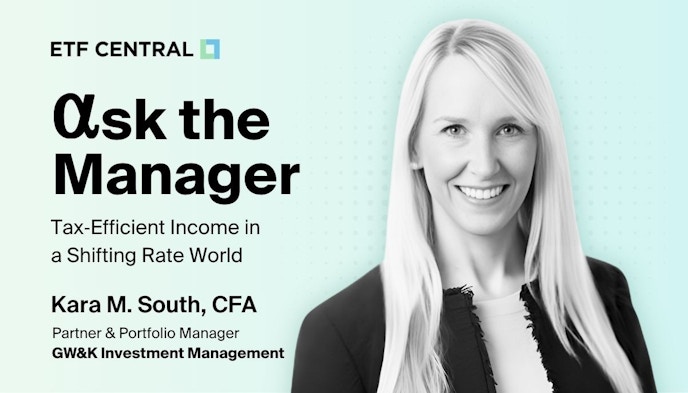
Ask the Manager: Kara South on Tax‑Efficient Income in a Shifting Rate World
GW&K’s Kara South discusses how MUNX, an actively managed core intermediate bond solution with ability to invest across the municipal bond spectrum, aims to deliver tax-efficient income in today’s market environment.

Keep up with what matters in ETFs
Get timely ETF insights, market trends, and top ideas straight to your inbox.
Your newsletter subscriptions with us are subject to ETF Central's Privacy Policy and Terms and Conditions.
For this edition of Ask the Manager, we speak with GW&K Investment Management’s Portfolio Manager Kara South, from the team behind the AMG GW&K Muni Income ETF
What is your outlook for the municipal bond market?
We have a favorable outlook for the municipal bond market with attractive tax-equivalent yields, a steeper curve, and solid fundamentals. The broader rate direction remains in flux, leaving investors to balance expectations for further policy easing against lingering questions around growth, inflation, and fiscal policy. Despite these uncertainties, demand for tax-exempt municipal bonds remains well supported by historically attractive yields coupled with solid trailing performance, a combination that usually provides a powerful tailwind in this retail-investor-driven asset class. The muni curve remains significantly steeper than where we were at the start of 2025, enhancing expected return going forward. Credit conditions also remain constructive, even as revenue growth normalizes from the unusually strong post-COVID-19 pandemic period. Volatility and uncertainty in the market should provide plenty of opportunity for active managers to add value through security selection and relative-value trading in the year ahead.
Municipal bonds play an important role for investors, especially those in higher tax brackets who want steady, tax-efficient income. MUNX is designed to be a simple, “one‑ticket” way to get that tax‑efficient municipal bond exposure in a diversified, actively managed ETF.
Are there particular sectors or states where you see the most opportunity—or risk—right now?
States enter 2026 with record-high budget surpluses (also known as rainy day funds), providing ample flexibility to navigate soft economic growth, cost pressures, and federal uncertainty. Many states anticipate decelerating revenue growth and have implemented spending cuts, suggesting that they are bracing for tighter fiscal conditions. However, with the resources at their disposal, we expect most states to effectively manage financial challenges that may arise.
To date, federal policy actions have been largely concentrated in two sectors: higher education and health care. For higher education, the impact has been more headline-driven than financially material. For health care, Medicaid reductions are expected to reach $1 trillion over the next decade, but the cuts are back-end loaded, providing time for hospitals to adjust. Smaller hospitals with limited resources and high Medicaid exposure are likely to be the most affected.
Regardless of the ultimate impact, negative headlines in a retail‑investor-driven asset class like municipal bonds often create opportunities to purchase bonds at attractive levels—opportunities we seek to capitalize on through active management and deep credit expertise.
What are the biggest risks facing municipal bonds in the current environment?
The biggest risk facing the municipal bond market outlook is broader interest-rate volatility. Expectations for additional Federal Reserve rate cuts will need to be balanced against incoming data on inflation and fiscal policy. In addition, headlines related to Federal Reserve independence and the upcoming transition of the Federal Chair introduce another source of potential market volatility. Relative value ratios (muni/Treasury ratios) remain tight on a historical basis, providing less of a cushion against a sell-off in the Treasury market. However, ratios have remained at tight levels since pre-COVID-19 and the market continues to be balanced in terms of supply and demand.
What are the benefits of active management in the municipal bond market?
The municipal bond market is large, fragmented, and dominated by retail investors, which can leave many bonds mispriced or overlooked. That environment tends to reward active managers who can dig into individual securities rather than simply owning the market in index form. Active management can add value in several ways: selecting stronger credits in challenged sectors, avoiding weaker structures, shifting along the yield curve as rate and valuation relationships change, and taking advantage of attractive pricing in new issues. It also provides a risk‑management benefit. When fundamentals deteriorate or policy winds shift, an active team can adjust exposure, whereas a purely passive portfolio is required to hold whatever the index includes. We manage our client portfolios for total return with a goal of not only protecting principal, but income as well.
How does MUNX differentiate itself from other municipal bond solutions in the market?
MUNX offers investors an actively managed, intermediate‑duration muni ETF solution leveraging GW&K’s long‑standing expertise and scale in managing more than $33 billion in municipal bonds (as of December 31, 2025). The strategy focuses primarily on investment‑grade tax‑exempt bonds and targets an intermediate duration “core” profile, rather than a narrowly defined high‑yield or state‑specific mandate. GW&K’s philosophy emphasizes intensive, bottom‑up credit research, structure analysis, and relative‑value opportunities across the yield curve. That includes taking advantage of primary‑market concessions and dislocations caused by retail‑driven flows. We launched MUNX in collaboration with our long‑standing partner, AMG, which helps support and coordinate the ETF’s operations and distribution, along with our broader mutual fund offerings.
What role can municipal bonds—and MUNX specifically—play in investor portfolios today?
Tax‑exempt municipal bonds can function as the core fixed income anchor in taxable accounts, delivering attractive after‑tax income with historically low defaults, and lower volatility than equities or credit‑heavy taxable bonds. In today’s environment, intermediate municipal bonds offer the potential to lock in elevated tax‑equivalent yields while exhibiting less volatility than long‑duration strategies. MUNX is designed to be that core allocation: an actively managed, diversified intermediate muni ETF that can sit alongside Treasuries, taxable core, and credit in a broader fixed income mix. For many clients, MUNX can replace the complexity of a large individual‑bond account—eliminating the need to build and manage a ladder—while giving advisors an institutionally managed, model‑friendly vehicle that fits neatly into a unified portfolio construction framework.
How should investors think about muni ETFs versus buying individual municipal bonds?
For most investors, a fund or an SMA solution are typically more scalable than building large individual‑bond ladders. A diversified ETF like MUNX can hold hundreds of securities across sectors, states, and structures, spreading idiosyncratic risk and benefiting from professional management paired with stringent oversight and risk controls. ETFs also provide daily liquidity and holdings transparency, making them easier to integrate into model portfolios and risk systems. Conceptually, an all‑in‑one active ETF allows the portfolio management team to manage curve positioning, sector exposure, and trading opportunities, while the investor focuses on asset allocation, tax planning, and client outcomes rather than bond‑by‑bond decisions.
Get data on 14,000+ ETFs
Access Trackinsight's reliable and comprehensive data with 500M+ points on 14,000+ ETFs.
About Kara South
Kara is a partner of the firm and a portfolio manager for all of the firm’s municipal bond strategies. She is a member of GW&K’s Investment Committee and ESG Committee. As a seasoned fixed income manager with deep knowledge of the market, including experience managing taxable municipal bonds and ESG strategies, she is able to draw on her extensive research and management expertise in the evaluation of market risks, opportunities, and strategic portfolio positioning. Kara joins GW&K from Income Research + Management (IR+M), where she was a senior portfolio manager, co-director of credit research, and a member of the Investment Committee. Prior to IR+M, she was a securities valuation analyst at John Hancock Financial. She began her career at Wachovia Corporation (now Wells Fargo) as an interest rate derivative analyst. Kara earned a Bachelor of Arts in Economics and Psychology from Cornell University. She is a CFA® charterholder and is a member of the CFA® Institute, the CFA Society Boston, the Boston Municipal Analysts Forum, and the National Federation of Municipal Analysts. In addition, she holds the Fundamentals of Sustainability Accounting (FSA) certificate.
Investing involves risk, including the possible loss of principal. Diversification does not ensure a profit or protect against a loss.
Investors should carefully consider the Fund’s investment objectives, risks, charges and expenses before investing. For a prospectus or a summary prospectus (if available), visit amgetfs.com. Read it carefully before investing or sending money.
ETFs may trade at a premium or discount to net asset value (NAV). Shares of any ETF are bought and sold at market prices (not NAV) and are not individually redeemed from the Fund.
The views expressed represent the opinions of GW&K Investment Management, are not intended as a forecast or guarantee of future results, and are subject to change without notice. Any discussion of holdings or sectors should not be construed as a recommendation of individual holdings or market sectors, but as an illustration of broader themes. There is no guarantee that any investment strategy will work under all market conditions, and each investor should evaluate their ability to invest for a long term, especially during periods of downturns in the market.
Factors unique to the municipal bond market may negatively affect the value of municipal bonds. These factors include political or legislative changes and uncertainties related to the tax status of the securities and the rights of investors in the securities. The Fund may invest in a group of municipal obligations that are related in such a way that an economic, business, or political development affecting one would also affect the others. The value of a debt security changes in response to various factors, including, for example, market-related factors, such as changes in interest rates or changes in the actual or perceived ability of an issuer to meet its obligations. Investments in debt securities are subject to, among other risks, credit risk, interest rate risk, extension risk, prepayment risk, and liquidity risk. Investors should refer to the prospectus for a detailed description of risks relating to investing in the fund and evaluate those described risks before making an investment in the fund.
The AMG ETF Trust funds are distributed by Foreside Fund Services, LLC, a registered broker/dealer and member of the Financial Industry Regulatory Authority (FINRA). Foreside Fund Services, LLC is not affiliated with AMG Funds LLC or AMG Distributors, Inc.


Latest ETF News
See all ETF newsAsk the Manager: Vince Lorusso on Active Equity in an AI-Driven Market


Ask the Manager: Michelle Cluver on Using Model Portfolios to Scale Your Business


Ask the Manager: Dr. Maria Milina on Artificial Intelligence and What to expect in 2026




 Advantages of ETFs over Mutual Funds1/6
Lower Costs
In this guide, we'll explore the advantages of ETFs over mutual funds, giving you valuable insights into why ETFs have gained significant popularity among investors like yourself.
Leveraged ETFs: Unlocking the Potential for Amplified Returns1/6
Understanding Leveraged ETFs
Explore leveraged ETFs: potential for amplified returns & risks. 5 ETFs to consider across equities, commodities & fixed income.
What is a Leveraged ETF?1/6
Introducing Leveraged and Inverse ETFs
In this guide, we'll dive into the world of leveraged ETFs, exploring their definition, mechanics, potential risks, and rewards.
Recent educational content

ETF Trends
ETF Industry KPIs July 20, 2026
This week’s KPI data overview highlights key metrics and trends shaping the ETF landscape.

ETF Trends
ETF Industry KPIs July 13, 2026
This week’s KPI data overview highlights key metrics and trends shaping the ETF landscape.

First Look ETF
First Look ETF: Cash Deployment, Bond, and Hedged ETFs
In this season 6 episode of First Look ETF, Stephanie Stanton examines the latest ETF marketplace trends with NYSE and guests.

ETF Trends
ETF Industry KPIs July 6, 2026
This week’s KPI data overview highlights key metrics and trends shaping the ETF landscape.
Browse all educational columns



Expert-Built ETF Portfolios, All in One Place
Don’t start from scratch. Discover ready-made ETF portfolios built by professionals to match different goals, timelines, and market views. Use them as inspiration or as a starting point for your own allocation.