Global ETF Survey Is Live! 600+ ETF Professionals Weigh In. See Results →



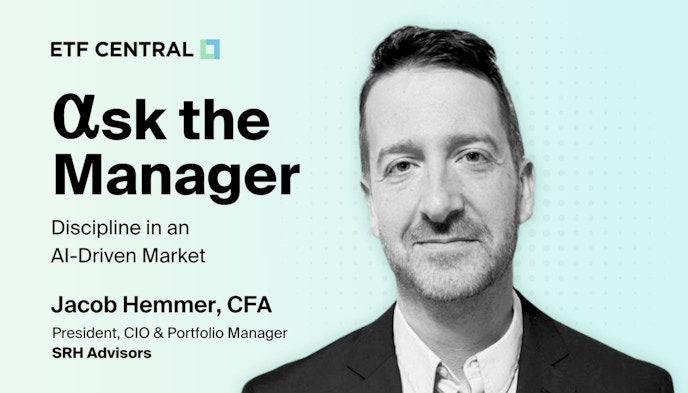
Ask the Manager: Jacob Hemmer on Discipline in an AI-Driven Market
Jacob Hemmer argues that in today’s AI-dominated market—marked by concentrated index leadership and surging capex—investors must prioritize valuation discipline and capital cycle awareness over compelling narratives.

Keep up with what matters in ETFs
Get timely ETF insights, market trends, and top ideas straight to your inbox.
Your newsletter subscriptions with us are subject to ETF Central's Privacy Policy and Terms and Conditions.
Artificial intelligence dominates earnings calls, index leadership is concentrated, and capital spending is accelerating at historic levels. Yet history suggests that innovation cycles are rarely linear. We spoke with Jacob about how he’s navigating today’s AI-driven environment, and why discipline may matter more than narrative.
We’re in the middle of earnings season and it feels like nearly every management team is emphasizing AI investment or disruption. At the same time, we’re seeing sharp post-earnings moves, even when results look solid. How are you thinking about that?
It’s a fascinating moment. The surge in AI commentary isn’t surprising as management teams want to demonstrate alignment with structural change. But markets aren’t rewarding participation. They’re rewarding proof.
What we’re seeing in these sharp post-earnings reactions is extreme sensitivity to incremental information. A company can report strong numbers, but if forward expectations don’t move higher, the stock sells off. That tells you something important: expectations were already ambitious.
We’ve seen versions of this before. In the late 1990s, every company had an internet strategy. In the early 2010s, cloud infrastructure dominated calls. In prior capital spending cycles, expansion plans drove enthusiasm.
The pattern tends to repeat: early capital deployment excites markets. Later, returns on that capital determine outcomes.
In the short term, markets vote. In the long term, they weigh. What’s easy to forget is how long the voting phase can last — and how abrupt the weighing phase can feel when it arrives.
You mentioned expectations getting embedded in prices. Another dynamic investors are aware of is how interconnected many of the AI leaders are. Why does that matter right now?
The interconnection itself isn’t new. What’s changed is the scale and capital intensity.
When capital deployment accelerates within an ecosystem, interdependence increases. If one participant adjusts spending or demand assumptions, others feel it — sometimes quickly.
That doesn’t predict decline. It explains volatility.
History provides perspective. During the early 2000s telecom buildout, infrastructure providers were tightly linked to one another’s expansion plans. When expectations recalibrated, volatility rose even though long-term technological progress continued.
The lesson isn’t that innovation fails. It’s that interconnection amplifies outcomes as capital cycles mature.
As dominant themes mature and volatility increases, we’ve also seen quieter participation from other parts of the market. You’ve suggested opportunities may lie outside the spotlight. Where does that show up today?
When capital crowds into a dominant narrative, it often leaves other areas less examined — and sometimes less demanding.
Over time, returns come down to two variables: earnings growth and the multiple you pay. When expectations are elevated, growth has to exceed already high assumptions. That’s a difficult hurdle.
In many mid-cap businesses — industrial firms, housing-linked companies, transportation names — the expectations embedded in price can be more measured.
This isn’t a short-term call about immediate outperformance. It’s about structural resilience. Diversified earnings drivers reduce dependence on a single theme continuing uninterrupted.
Frankly, investing directly in the dominant trend is often the hardest way to generate excess returns. Everyone is studying the same companies, building the same models, reacting to the same headlines. That’s where the emotional pull is strongest — and so is the competition.
How does your philosophy help you stay disciplined when markets feel this urgent?
Our foundation is straightforward: durable businesses, strong balance sheets, rational capital allocation, and prices that don’t require perfection. There’s an old Buffett line that investing is a no-called-strike game. You don’t have to swing at every pitch — even when the crowd is urging you to. In fact, sometimes waiting is the edge.
Being based in Salina, Kansas probably helps more than people realize. We’re not immersed in daily market noise. That distance allows us to step back and ask:
What are the economics of this business? What assumptions are we underwriting? What does the weighing machine say?
The market’s job is to create urgency. Our job is to remain steady. Over time, valuation still determines return.
Global ETF Survey 2026 is Live!
With 1,790 new products launched by July 2026, choosing is harder than ever. Our Global ETF Survey 2026, built on 620 professional investors and allocators, shows how active, fixed income, options-based and thematic ETFs are reshaping fund selection.
Key Takeaway
Innovation cycles are real. Capital deployment is real. Opportunity is real. But so are digestion phases and expectation resets.
You don’t need an AI opinion to invest well. You need a disciplined framework — one grounded in capital allocation, return on invested capital, and the price paid.
About Jacob Hemmer
Jacob Hemmer, CFA, serves as President, Chief Investment Officer, and Portfolio Manager at SRH Advisors. In these roles, Mr. Hemmer oversees the firm’s investment strategy, portfolio management, and risk oversight. He is responsible for the day-to-day management of the SRH Total Return Fund and the SRH REIT Covered Call ETF, as well as the management and administration of the index underlying the SRH U.S. Quality GARP ETF. In addition, Mr. Hemmer is also an investment adviser representative and provides investment management services to a group of SRH Advisors’ private clients.
Prior to joining SRH Advisors in 2018, Mr. Hemmer was a Financial Advisor at Raymond James Financial Services, Inc., doing business as Hampton Financial, from 2012 to 2018.
Mr. Hemmer holds a B.S. in Business Administration from Colorado State University and is a CFA® charterholder.
Please note this article is for information purposes only and does not in any way constitute investment advice. It is essential that you seek advice from a registered financial professional prior to making any investment decision.
Segments
See all
No specific market segments were tagged
Mentioned ETFs
No specific ETFs were tagged
Further reading

Latest ETF News
See all ETF newsAsk the Manager: Pieter Vorster on the NICO ETF and the Nicotine Transition
Ask the Manager: Tian Yang on Capital Cycle Investing and the VPX ETF
Ask the Manager: Kenneth Wong on Building the Next Wave of ETF Innovation, from Options to Korea's AI Semiconductor Opportunity


 Advantages of ETFs over Mutual Funds1/6
Lower Costs
In this guide, we'll explore the advantages of ETFs over mutual funds, giving you valuable insights into why ETFs have gained significant popularity among investors like yourself.
Leveraged ETFs: Unlocking the Potential for Amplified Returns1/6
Understanding Leveraged ETFs
Explore leveraged ETFs: potential for amplified returns & risks. 5 ETFs to consider across equities, commodities & fixed income.
What is a Leveraged ETF?1/6
Introducing Leveraged and Inverse ETFs
In this guide, we'll dive into the world of leveraged ETFs, exploring their definition, mechanics, potential risks, and rewards.
Recent educational content
First Look ETF
First Look ETF: Income, International, and Cash Flow ETFs
In this season 6 episode of First Look ETF, Stephanie Stanton @etfguide examines the latest ETF marketplace trends with NYSE and guests.


ETF Trends
ETF Industry KPIs October 5, 2026
This week’s KPI data overview highlights key metrics and trends shaping the ETF landscape.

ETF Trends
ETF Industry KPIs September 28, 2026
This week’s KPI data overview highlights key metrics and trends shaping the ETF landscape.
ETF Trends
ETF Industry KPIs September 22, 2026
This week’s KPI data overview highlights key metrics and trends shaping the ETF landscape.