Ready-made ETF portfolios built for real investor needs. Explore now →



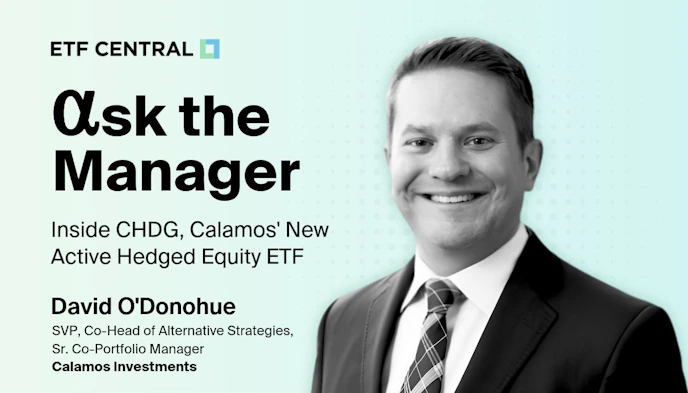
Ask the Manager: Inside CHDG, Calamos' New Active Hedged Equity ETF
Dave O'Donohue of Calamos Investments discusses how CHDG brings the firm's decades of dynamic hedging experience into an actively managed ETF built for a changing market environment.

Keep up with what matters in ETFs
Get timely ETF insights, market trends, and top ideas straight to your inbox.
Your newsletter subscriptions with us are subject to ETF Central's Privacy Policy and Terms and Conditions.
Hedged equity strategies have long appealed to investors seeking equity market exposure with a smoother return profile. Calamos Investments, a firm with a multi-decade history in options-based risk management, has now brought that expertise to the ETF market with the August 2026 launch of the Calamos Active Hedged Equity ETF
We spoke with Dave O'Donohue, Co-Head of Alternative Strategies and Senior Co-Portfolio Manager at Calamos, about the fund's design, what sets its approach apart, and how the strategy is positioned in the current market environment.
What is CHDG designed to do?
CHDG aims to give investors equity market participation and meaningful total return potential, while seeking to reduce downside risk and volatility relative to a full equity allocation.
Is hedged equity a new strategy for Calamos?
While CHDG is Calamos' first hedged equity strategy delivered in an ETF wrapper, options-based equity hedging has been part of the firm's approach since its earliest days. Global CIO John Calamos, Sr. was using options before founding Calamos Investments in the 1970s. More recently, the team has run a related strategy in the open-end Calamos Hedged Equity Fund (CIHEX) for nearly 12 years now, and a slightly different octane version in the Calamos Market Neutral Income Fund (CMNIX) for more than 20 years. Together, those two funds hold more than $19 billion in assets, with over $10 billion specifically allocated to hedged equity — experience the team is now extending into the ETF wrapper.
Given how many hedged equity strategies exist, what differentiates Calamos' approach?
Most hedged equity strategies in the market are highly systematic, applying the same hedge structure on a fixed schedule regardless of market conditions. Calamos takes a different view: no single hedge structure works best in every environment, since volatility and market conditions shift over time. Rather than committing to a predetermined structure, the team evaluates what today's market makes possible and adapts the hedge accordingly.
How often is the hedge adjusted?
The hedge is treated as a living structure rather than a fixed position, with adjustments made as market conditions and volatility evolve. The team may add or adjust hedge components opportunistically — for example, when market moves create more attractive pricing for puts or calls — rather than being required to transact on a single, predetermined day regardless of prevailing conditions.
How would you summarize the benefits of this active approach?
Shaping the hedge to current conditions, combined with ongoing active management, is intended to support two goals: a more efficient hedge that may contribute to returns over time, and a comparatively steadier ride by avoiding the swings in equity sensitivity that can occur with systematic strategies between reset periods.
What does CHDG's hedge look like right now?
Current interest rate and volatility conditions have created what the team views as a comparatively favorable opportunity to structure CHDG's payout profile to target capturing approximately 65% of market upside alongside approximately 35% of downside exposure. This type of asymmetry has not been consistently available over the past 25 years, and Calamos has moved to implement it across both CIHEX and CHDG where conditions allow.
Note: The 65%/35% upside/downside targeting reflects current portfolio positioning as described by Calamos and is not a guaranteed outcome; it should be reviewed against fund documentation and is subject to change with market conditions.
Closing thoughts?
Our team has a long history working together on the Calamos Market Neutral Income Fund and Calamos Hedged Equity Fund, and Calamos Investments has long been at the forefront of alternatives. We're excited to bring what we believe is a best-in-class hedged equity strategy to ETF investors.
Like what you're reading?
Stay in the loop — get the latest ETF insights: trends, analysis, and expert picks.
About David O'Donohue
David O’Donohue is responsible for portfolio management and investment research, focusing on the Market Neutral Income, Hedged Equity, and Merger Arbitrage strategies, as well as the Calamos Structured Protection ETFs®. He joined the firm in 2014. His investment industry experience of more than 25 years includes co-manager responsibilities at Hard Eight Futures, Forty4 Asset Management, Chicago Fundamental Investment Partners, Mulligan Partners LLC, and Ritchie Capital. He began his career as a trader at SAM Investments. David graduated from the University of Illinois with a BS in Finance.
Marketing communication. For professional investors only. Capital at risk.
Please note this article is for information purposes only and does not in any way constitute investment advice. It is essential that you seek advice from a registered financial professional prior to making any investment decision.
Before investing, carefully consider the fund’s investment objectives, risks, charges and expenses. Please see the prospectus and summary prospectus containing this and other information which can be obtained by calling 1-866-363-9219. Read it carefully before investing.
AUM data as of June 30, 2026.
Beta is a measure of equity sensitivity, where 1.0 equals the beta of the market, in this case, the US equity market, as measured by the S&P 500 Index. Indexes are unmanaged, do not include fees or expenses and are not available for direct investment.
An investment in the Fund(s) is subject to risks, and you could lose money on your investment in the Fund(s). There can be no assurance that the Fund(s) will achieve its investment objective. Your investment in the Fund(s) is not a deposit in a bank and is not insured or guaranteed by the Federal Deposit Insurance Corporation (FDIC) or any other government agency. The risks associated with an investment in the Fund(s) can increase during times of significant market volatility. The Fund(s)
The principal risks of investing in the Calamos Active Hedged Equity ETF include: American depository receipts risk, authorized participant concentration risk, cash holdings risk, costs of buying and selling fund shares, correlation risk, covered call writing risk, currency risk, debt securities risk, interest rate risk, credit risk, default risk, derivatives risk, equity securities risk, FLEX options risk, foreign securities risk, forward foreign currency contract risk, futures and forward contracts risk, liquidity risk, market maker risk, market risk, new fund risk, options risk, other investment companies risk, portfolio selection risk, portfolio turnover risk, premium-discount risk, secondary market trading risk, sector risk, tax risk, trading issues risk, uncovered call writing risk.
Other Investment Companies Risk: The Fund may invest in the securities of other investment companies to the extent that such investments are consistent with the Fund’s investment objectives and permissible under the 1940 Act.
FLEX Options Risk: The Fund will utilize FLEX Options issued and guaranteed for settlement by the Options Clearing Corporation (OCC). In the unlikely event that the OCC becomes insolvent or is otherwise unable to meet its settlement obligations, the Fund(s) could suffer significant losses. Additionally, FLEX Options may be less liquid than standard options. In a less liquid market for the FLEX Options, the Fund(s) may have difficulty closing out certain FLEX Options positions at desired times and prices. The values of FLEX Options do not increase or decrease at the same rate as the reference asset and may vary due to factors other than the price of reference asset. Shares are bought and sold at market price, not net asset value (NAV), and are not individually redeemable from the fund. NAV represents the value of each share’s portion of the fund’s underlying assets and cash at the end of the trading day. Market price returns reflect the midpoint of the bid/ask spread as of the close of trading on the exchange where fund shares are listed.
Calamos Investments LLC, referred to herein Calamos is a financial services company offering such services through its subsidiaries: Calamos Advisors LLC, Calamos Wealth Management LLC, Calamos Investments LLP, and Calamos Financial Services LLC.
NOT FDIC INSURED | MAY LOSE VALUE | NO BANK GUARANTEE
Segments
See all
Mentioned ETFs
Further reading

Latest ETF News
See all ETF newsAsk the Manager: Pieter Vorster on the NICO ETF and the Nicotine Transition

Ask the Manager: Tian Yang on Capital Cycle Investing and the VPX ETF

Ask the Manager: Kenneth Wong on Building the Next Wave of ETF Innovation, from Options to Korea's AI Semiconductor Opportunity

Ask the Manager: Kristof Gleich on Why AI Is Becoming an Asset Class





 Advantages of ETFs over Mutual Funds1/6
Lower Costs
In this guide, we'll explore the advantages of ETFs over mutual funds, giving you valuable insights into why ETFs have gained significant popularity among investors like yourself.
Leveraged ETFs: Unlocking the Potential for Amplified Returns1/6
Understanding Leveraged ETFs
Explore leveraged ETFs: potential for amplified returns & risks. 5 ETFs to consider across equities, commodities & fixed income.
What is a Leveraged ETF?1/6
Introducing Leveraged and Inverse ETFs
In this guide, we'll dive into the world of leveraged ETFs, exploring their definition, mechanics, potential risks, and rewards.
Recent educational content

ETF Trends
ETF Industry KPIs October 5, 2026
This week’s KPI data overview highlights key metrics and trends shaping the ETF landscape.

ETF Trends
ETF Industry KPIs September 28, 2026
This week’s KPI data overview highlights key metrics and trends shaping the ETF landscape.
ETF Trends
ETF Industry KPIs September 22, 2026
This week’s KPI data overview highlights key metrics and trends shaping the ETF landscape.
First Look ETF
First Look ETF: Income, Corporate Arbitrage, and Growth and Value Investing
First Look ETF September 2026: iCapital, Mast Investments and North Square unpack new ETFs targeting monthly income, merger arbitrage and complementary growth and value exposure.

Browse all educational columns



Expert-Built ETF Portfolios, All in One Place
Don’t start from scratch. Discover ready-made ETF portfolios built by professionals to match different goals, timelines, and market views. Use them as inspiration or as a starting point for your own allocation.