Open Now: The Global ETF Survey Take the Survey →



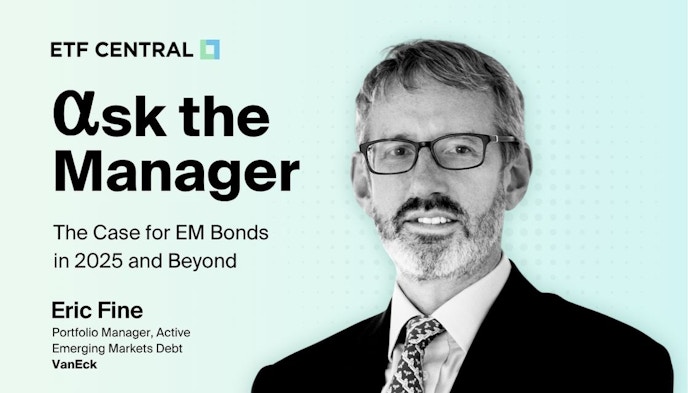
Ask the Manager: Eric Fine on the Case for EM Bonds in 2025 and Beyond
Emerging market debt has quietly outperformed for decades. VanEck's Eric Fine explains why 2025 could be just the beginning.

Keep up with what matters in ETFs
Get timely ETF insights, market trends, and top ideas straight to your inbox.
Your newsletter subscriptions with us are subject to ETF Central's Privacy Policy and Terms and Conditions.
In this edition of Ask the Manager, we spoke with Eric Fine, Portfolio Manager and Head of Emerging Markets Bond Strategy at VanEck, about why EM bonds have outpaced Treasuries and the Global Agg, what’s fueling this year’s rally, and how his team is positioning the Emerging Markets Bond ETF.
Why have EM bonds outperformed treasuries and the Global Agg over the past 20 years?
EM bonds have low debt loads, pay higher carry, have no sanctions risk, and nobody owns them.
Why are EM bonds rallying so much this year in particular?
The cool kids all said EM was going to get destroyed by tariffs and uncertainty at the start of 2025, so nobody owned EM, that’s first.
And then there’s the basic game theory around tariff discussions. There is a currency chapter in these trade discussions – to put it crudely, “Don’t devalue after a trade negotiation, maybe even revalue.” OK, so you’re told the USD has to be stable or down versus your currency.
Now add to that the fact that China and most EMs are already up to their neck in USD (as measured by NIIP or net creditor status). So, you’re net long USD and told it will go down…what do you do?
At a minimum, you hedge your USD risk, which is exactly what happened in the market this year.
Is this going to continue? Why or why not?
The US may be entering stagflation, while China and many EMs have deflation or lower. Econ 101 says that the higher inflation trading partner should see its currency weaken relative to the low inflation partner.
That’s just depreciation, not loss of status, which is an overdone story on the USD in our view. But that looks set to continue.
Who are the biggest winners in the portfolio this year?
Local currency, especially that with beta to CNY, like Brazil, Colombia, but also Korea. There were also idiosyncratic USD-denominated bonds that had very high spreads but very positive fundamental developments, like Ecuador.
There’s a lot of discussion in the markets about the status of the USD and treasuries’ reserve status. What do you think about this?
The USD will not lose its reserve status.
There is simply too much debt in USD, and the system is too established and deep. But it is also proper to predict that the USD will share its status with other deserving currencies such as CNY.
When you saw all those headlines over the years about China, Brazil, India, Saudi, etc. agreeing to trade using each other’s currencies, that’s always the start – no central bank wants a pile of cash, they eventually open lines to buy bonds from the respective trading partner…and they don’t send the world a press release, it happens quietly.
What are the currencies that you think will gain most from the current market and interest rate environment?
Latin America has the highest beta and is a key hunting ground for us. Brazil, Colombia, and Chile are key winners. But Korea and Malaysia can exhibit great defensive and thus simple repricing characteristics. Asian EM bonds will become reserve assets before the Latins, generally speaking (with Mexico being a possible early winner/exception).
Can you walk us through your investment process?
Step 1 – For the VanEck Emerging Markets Bond ETF (EMBX), we use a 100% quantitative process to compare country and company fundamentals to how much their bonds pay. The output of step 1 is a list of the cheapest bonds in EM, whether they are local currency or hard currency, sovereign or corporate.
Step 2 – The world doesn’t work that way always. You have non-systematic risk. This is where we kick things out of the portfolio via three subjective tests to capture non-systematic risks such as policy/politics, technical, and idiosyncratic economic risks. And we document/explain why every month.
That’s it.
We obviously have risk management.
The principle is that the cheaper an issuer, the more we can own, but there are strict limits that both tie us to the benchmark but also give flexibility.
For example, we were a bit famous for being the only EM bond fund that didn’t own Russia or Ukraine prior to the invasion, even though it was very cheap and popular.
How do you balance the exposure between hard, local, and corporate bonds in the VanEck Emerging Markets Bond ETF (EMBX)?
We try not to do that explicitly, as that is a top-down concept, and think about it…which USD cross? We have over a dozen with different fundamentals and mostly higher yields, but each one is its own thing. Everything is bottom-up. We never say we like or don’t like a country or even their “local” or “USD” bonds…it is issuer-by-issuer, tenor by tenor.
The maximum we are allowed is 60% in local, typical for funds like ours. We’ve been maxxed local for the past year because our process told us to. But, thank goodness we had very little local in earlier years, as local had been a dog for a long time.
The ETF Industry Is Evolving Fast
From AI infrastructure to active strategies, the ETF landscape is shifting. Share your perspective in the 7th Annual Global ETF Survey and get exclusive early access to the final report.
About Eric Fine
Eric Fine joined VanEck in 2009. He serves as the Portfolio Manager for the VanEck Emerging Markets Bond Strategy and oversees the Emerging Markets Fixed Income team. He is responsible for portfolio strategy, credit and market analysis, and security selection.
Important Disclosures
Global Agg is represented by the ICE BofA Global Broad Market Index.
ICE BofA Global Broad Market Index tracks the performance of investment grade debt publicly issued in the major domestic and eurobond markets, including sovereign, quasi-government, corporate, securitized and collateralized securities.
This is not an offer to buy or sell, or a recommendation to buy or sell any of the securities, financial instruments or digital assets mentioned herein. The information presented does not involve the rendering of personalized investment, financial, legal, tax advice, or any call to action. Certain statements contained herein may constitute projections, forecasts and other forward-looking statements, which do not reflect actual results, are for illustrative purposes only, are valid as of the date of this communication, and are subject to change without notice. Actual future performance of any assets or industries mentioned are unknown. Information provided by third party sources are believed to be reliable and have not been independently verified for accuracy or completeness and cannot be guaranteed. VanEck does not guarantee the accuracy of third party data. The information herein represents the opinion of the author(s), but not necessarily those of VanEck or its other employees.
All indices are unmanaged and include the reinvestment of all dividends, but do not reflect the payment of transaction costs, advisory fees or expenses that are associated with an investment in the Fund. Certain indices may take into account withholding taxes. An index's performance is not illustrative of the Fund's performance. Indices are not securities in which investments can be made.
An investment in the VanEck Emerging Markets Bond ETF may be subject to risks which include, among others, risks related to active management, credit, credit-linked notes, currency management strategies, derivatives, emerging market issuers, ESG investing, foreign currency, foreign securities, hedging, high portfolio turnover, high yield securities, interest rate, market, non-diversified, operational, restricted securities, investing in other funds, sovereign bond, special risk considerations of investing in African, Asian, and Latin American issuers, authorized participant concentration, no guarantee of active trading market, trading issues, fund shares trading, premium/discount and liquidity of fund shares, and cash transactions risks, all of which may adversely affect the Fund. Emerging market issuers and foreign securities may be subject to securities markets, political and economic, investment and repatriation restrictions, different rules and regulations, less publicly available financial information, foreign currency and exchange rates, operational and settlement, and corporate and securities laws risks.
Investing involves substantial risk and high volatility, including possible loss of principal. An investor should consider the investment objective, risks, charges and expenses of a Fund carefully before investing. To obtain a prospectus and summary prospectus, which contain this and other information, call 800.826.2333 or visit vaneck.com. Please read the prospectus and summary prospectus carefully before investing.
© 2025 Van Eck Securities Corporation, Distributor, a wholly-owned subsidiary of Van Eck Associates Corporation.
Please note this article is for information purposes only and does not in any way constitute investment advice. It is essential that you seek advice from a registered financial professional prior to making any investment decision.

Latest ETF News
See all ETF newsAsk the Manager: Vince Lorusso on Active Equity in an AI-Driven Market


Ask the Manager: Michelle Cluver on Using Model Portfolios to Scale Your Business


Ask the Manager: Dr. Maria Milina on Artificial Intelligence and What to expect in 2026



 Advantages of ETFs over Mutual Funds1/6
Lower Costs
In this guide, we'll explore the advantages of ETFs over mutual funds, giving you valuable insights into why ETFs have gained significant popularity among investors like yourself.
Leveraged ETFs: Unlocking the Potential for Amplified Returns1/6
Understanding Leveraged ETFs
Explore leveraged ETFs: potential for amplified returns & risks. 5 ETFs to consider across equities, commodities & fixed income.
What is a Leveraged ETF?1/6
Introducing Leveraged and Inverse ETFs
In this guide, we'll dive into the world of leveraged ETFs, exploring their definition, mechanics, potential risks, and rewards.
Recent educational content
ETF Trends
ETF Industry KPIs July 20, 2026
This week’s KPI data overview highlights key metrics and trends shaping the ETF landscape.

ETF Trends
ETF Industry KPIs July 13, 2026
This week’s KPI data overview highlights key metrics and trends shaping the ETF landscape.
First Look ETF
First Look ETF: Cash Deployment, Bond, and Hedged ETFs
In this season 6 episode of First Look ETF, Stephanie Stanton examines the latest ETF marketplace trends with NYSE and guests.

ETF Trends
ETF Industry KPIs July 6, 2026
This week’s KPI data overview highlights key metrics and trends shaping the ETF landscape.
Browse all educational columns



The ETF Industry Is Evolving Fast
From AI infrastructure to active strategies, the ETF landscape is shifting. Share your perspective in the 7th Annual Global ETF Survey and get exclusive early access to the final report.