Global ETF Survey Is Live! 600+ ETF Professionals Weigh In. See Results →



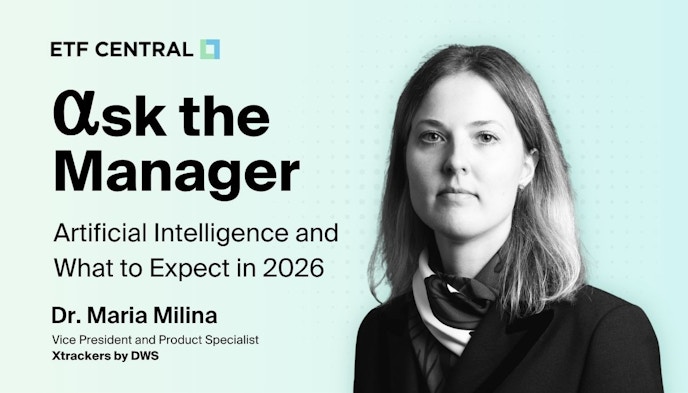
Ask the Manager: Dr. Maria Milina on Artificial Intelligence and What to expect in 2026
A Conversation with Dr. Maria Milina, Vice President and Product Specialist, Xtrackers by DWS.

Keep up with what matters in ETFs
Get timely ETF insights, market trends, and top ideas straight to your inbox.
Your newsletter subscriptions with us are subject to ETF Central's Privacy Policy and Terms and Conditions.
Artificial intelligence is rapidly moving beyond experimentation and into large-scale deployment, reshaping how companies operate, compete, and create value. But as the technology matures, the constraints surrounding its growth are evolving just as quickly—shifting from semiconductor availability to the massive energy demands required to power increasingly complex AI systems. At the same time, real-world adoption is accelerating, with automation already transforming routine administrative and analytical work while laying the foundation for broader productivity gains across industries. In this conversation, Dr. Maria Milina explores how these structural shifts are redefining the AI investment landscape—and how targeted ETF strategies can help investors access the companies building the infrastructure behind this next phase of technological transformation.
Like what you're reading?
Stay in the loop — get the latest ETF insights: trends, analysis, and expert picks.
For all the capital now directed towards AI models, when will Corporate America achieve a meaningful Return on Investment (ROI)?
It’s easy to look at current capital expenditure and see a bubble, but I believe we are entering the Great Implementation phase. To understand why a meaningful ROI hasn't yet shown up in earnings, we must distinguish between AI as a gadget and AI as a core operating system.
Consumers adopted ChatGPT at record speeds because it’s a gadget—a simple, intuitive, and frictionless. For Corporate America, the hurdle is higher because AI isn't just a plug-and-play solution; it’s a plug-and-reengineer solution. This has created a GenAI Divide. On one side, companies use AI for basic optimization—automating single tasks. While this saves time, the upfront cost of implementation often offsets any immediate financial benefit.
The significant ROI is found on the other side of that divide: transformation. This is where a company asks how AI can fundamentally redefine its competitive advantage. We saw this during the dot-com era; the winners weren't those who just put a catalog online, but those who rebuilt their entire supply chains around the internet.
We are now entering a similar phase in AI. Micro-ROIs—small but compounding efficiency gains in legal, accounting, and customer service—are starting to aggregate. General-purpose technologies always follow a J-curve. We are moving through the necessary investment valley where companies must re-architect workflows, data infrastructure, and processes before the productivity spike occurs. I believe that the inflection point is closer than the skeptics realize.
Billions have gone into AI infrastructure. Is this pace of investment sustainable?
While the scale of investment is historic—with hyperscaler Capex projected to exceed $600 billion this year, the underlying driver is fundamentally different from the dot-com era. Back then, companies built infrastructure in anticipation that demand would materialize. Today, the world’s most profitable companies are spending aggressively to keep pace with a tangible demand for compute that is already outstripping supply.
However, we are reaching a physical constraint often described as the Power Wall. For the last few years, the primary bottleneck was chips. In 2026, the conversation has shifted to the grid. We have the silicon, but we need the megawatts. U.S. data center electricity load is on a trajectory to triple, and in certain regions, utilities are citing interconnection delays of five to seven years.
This is why investment is evolving from buying hardware to securing energy sovereignty. We see major players investing in on-site modular nuclear reactors, substantial battery storage, and advanced liquid cooling. The supercycle isn’t ending; it’s becoming more focused on the efficiency and quality of the infrastructure. The winners won't just be the ones with the most GPUs, but the ones that can reliably power them at scale.
What is the potential impact AI could have on employment?
The impact is far more nuanced than a simple job-killer narrative, though we should expect significant short-term friction. I believe that as adoption accelerates, we will see labor displacement in routine administrative tasks and basic analytical functions. For those workers, the disruption is real and immediate.
However, I view AI as a labor-augmenting technology. Historically, major technological shifts trigger a period of dislocation followed by a substantial expansion of the labor market. A useful data point to remember is that roughly 60% of the jobs people do today didn't exist in 1940.
Professional roles are always evolving from gatherers of information to strategic decision-makers. A software developer uses AI to handle boilerplate code so they can focus on high-level logic. In finance, value shifts from the person who builds the spreadsheet to the person who interprets the output, contextualizes it, and manages the risk. The challenge for the next decade isn't widespread job loss—but a mismatch of skills. The labor market is resilient, but the transition requires a serious commitment to upskilling at every level of workforce.
Does the interconnectedness of AI firms amplify systemic risk to a portfolio?
The AI ecosystem is undeniably interconnected, creating what is effectively a circular financing model where technology firms fund AI developers, who then use those funds to purchase hardware back from those same firms. While this capital loop provides liquidity and accelerates innovation, it also introduces concentration risk.
A shock at any single node—a dominant chip designer or a foundational model provider—could send ripple effects across the entire value chain. We are also confronting the emerging risk of model uniformity. If a substantial portion of the economy relies on the same few models, we risk creating correlated behaviors that can amplify volatility during periods of stress. For an investor, this doesn’t imply the sector should be avoided; it means the approach to risk management must evolve. In a market defined by rapid innovation and concentration, selecting a single winner increases idiosyncratic risk. A more prudent approach is to seek broad exposure across the entire value chain—from hardware and power to software integrators. By spreading exposure, an investor can capture the structural growth of AI while mitigating the impact of a potential failure at any one specific point.
What differentiates the Xtrackers Artificial Intelligence and Big Data ETF XAIX+0.64%?
Many AI-focused funds rely on rearview mirror data—past revenues or keywords in earnings calls that can be influenced by corporate hype. XAIX takes a fundamentally different approach. It tracks the Nasdaq Global Artificial Intelligence and Big Data Index, which uses a patent-based methodology to identify innovation leaders. It focuses on companies not just using AI but actively building and legally protecting the intellectual property behind the technology.
This matters for three key reasons:
- Forward-Looking Signal: Patents indicate where a company is investing today for products that will hit the market in two or three years.
- Objective Filtering: We use AI-driven processing to distinguish between companies merely using AI and those developing the core technologies.
- Capturing Hidden Leaders: Innovation isn’t confined to traditional tech. Our methodology highlights companies in non‑tech sectors—such as a bank with substantial machine‑learning patents for fraud detection—that might otherwise be overlooked.
Each company receives an Intensity Score based on involvement in themes like deep learning, natural language processing, and cybersecurity. The result is a targeted portfolio built around the architects laying the foundation for digital transformation—not just the adapters.
What other Xtrackers solutions intersect with the AI theme?
AI requires high-performance architecture and a secure geopolitical environment. We view CHPS and CRTC as essential complements to an AI portfolio.
If AI is the brain, semiconductors are the neurons—the circuitry that makes intelligence possible. Our Xtrackers Semiconductor Select Equity ETF
Then there is the geostrategic layer. The Xtrackers US National Critical Technologies ETF
Ten years into the future, what does AI look like in daily life?
Predicting a decade ahead is always a humbling exercise; the most profound changes often come from applications we have yet to imagine. But one trend feels clear: AI will evolve into a nearly invisible layer of global infrastructure.
By 2036, I project that the most significant shift will be the rise of Physical AI. While the last few years were defined by digital agents—systems that write code, analyze data, generate content, and automate knowledge work. The next decade is about AI moving into the physical world—transforming logistics, transport, and robotics. Moving from manipulating pixels to manipulating atoms is where the real societal impact will unfold.
We will also likely see the early stages of a transition toward Artificial General Intelligence (AGI). This won't emerge simply from larger models; it will require fundamental breakthroughs in how machines reason and interact with the physical world. AGI won’t arrive as a single moment or a switch being flipped, but as a gradual integration.
From my perspective, the long-term winners will be traditional industries that successfully re-engineer around these capabilities, specifically healthcare, energy, and manufacturing. We are entering a new reality where AI isn't a temporary trend, but the fundamental operating system of the century.
About Dr. Maria Milina
Maria Milina is a member of the Xtrackers Product team at DWS in the U.S., where she drives product development and management across the ETF platform. She focuses on delivering innovative, forward-looking investment solutions that meet evolving market needs.
Maria previously worked as a Research Analyst at the DWS Research Institute, focusing on megatrends like AI, energy transition, and electrification in public and private markets.
Before joining DWS in 2022, she held roles in Equity Research at Jefferies and in corporate strategy and R&D at ExxonMobil.
She holds a Ph.D. degree from ETH Zurich (Swiss Federal Institute of Technology).
Please note this article is for information purposes only and does not in any way constitute investment advice. It is essential that you seek advice from a registered financial professional prior to making any investment decision.
Glossary
Artificial General Intelligence: A form of AI that can learn, understand, and apply knowledge across a wide range of tasks, performing at a level comparable to human intelligence.
Artificial Intelligence (AI): The theory and development of computer systems able to perform task normally requiring human intelligence.
Concentration Risk: The potential for financial loss due to an overexposure to a single asset, sector or geographic region.
GPU: Acronym for Graphics Processing Unit, a specialized processor designed to accelerate image rendering and handle parallel computations for graphics and other data-intensive tasks.
J-Curve: A trendline that shows an initial loss immediately followed by a dramatic gain.
Model Uniformity: Refers to the high degree of similarity in operational strategies, resource dependency, and value creation methods observed across companies within a specific industry sector.
Nasdaq Global Artificial Intelligence and Big Data Index: Designed to track the performance of companies engaged in the following themes: Deep Learning, NLP, Image Recognition, Speech Recognition & Chatbots, Cloud Computing, Cybersecurity and Big Data.
Return on Investment (ROI): A performance measure used to evaluate the efficiency or profitability of an investment.
Systemic Risk: The potential for an investment to experience losses due to factors that affect the overall performance of financial markets.
Xtrackers Artificial Intelligence and Big Data ETF (XAIX): The fund seeks investment results that correspond generally to the performance, before fees and expenses, of the Nasdaq Global Artificial Intelligence and Big Data Index.
Xtrackers Semiconductor Select Equity ETF (CHPS): The fund seeks investment results that correspond generally to the performance, before fees and expenses, of the Solactive Semiconductor ESG Screened Index.
Xtrackers US National Critical Technologies ETF (CRTC): The fund seeks investment results that correspond generally to the performance, before fees and expenses, of the Solactive Whitney U.S. Critical Technologies Index.
Important Disclosures
War, terrorism, sanctions, economic uncertainty, trade disputes, public health crises and related geopolitical events have led, and, in the future, may lead to significant disruptions in U.S. and world economies and markets, which may lead to increased market volatility and may have significant adverse effects on the fund and its investments.
View a prospectus
Carefully consider the fund’s investment objectives, risk factors, and charges and expenses before investing. This and other important information can be found in the Fund’s prospectus, which may be obtained by calling 1-844-851-4255 or downloading a prospectus at www.Xtrackers.com. Please read it carefully before investing.
Investing involves risk, including the possible loss of principal. Stocks may decline in value. Returns on investments in securities of large companies could trail the returns on investments in securities of smaller and mid-sized companies. An investment in this fund should be considered only as a supplement to a complete investment program for those investors willing to accept the risks associated with the fund. Please read the prospectus for more information.
CHPS: Companies in the semiconductor field face intense competition, both domestically and internationally, which may have an adverse effect on profit margins. Cybersecurity companies also face heightened risk due to their dependence on the availability of materials that meet exacting standards, to reliance on a limited number of suppliers and by potential loss or impairment of patent and intellectual property rights.
Incorporation of ESG criteria in the fund’s investment strategy does not guarantee a return or protect against a loss, limits the types and number of investment opportunities available to the fund and, as a result, the fund may underperform other funds that do not have an ESG focus. Regulatory changes or interpretations regarding the definitions and/or use of ESG criteria could have a material adverse effect on the fund’s ability to invest in accordance with its investment policies and/or achieve its investment objective, as well as the ability of certain classes of investors to invest in funds following an ESG strategy such as the fund. Foreign investing involves greater and different risks than investing in US companies, including currency fluctuations, less liquidity, less developed or less efficient trading markets, lack of comprehensive company information, political instability and differing auditing and legal standards. Any fund that focuses in a particular segment of the market or region of the world will generally be more volatile than a fund that invests more broadly. This fund is non-diversified and can take larger positions in fewer issues, increasing its potential risk. An investment in the fund should be considered only as a supplement to a complete investment program for those investors willing to accept the risks associated with the fund. Please read the prospectus for more information.
XAIX: Companies involved in artificial intelligence and big data face intense competition, may have limited product lines, markets, financial resources and personnel. Artificial intelligence and big data companies are also subject to risks of new technologies and are heavily dependent on patents and intellectual property rights and the products of these companies may face obsolescence due to rapid technological developments. Incorporation of ESG criteria in the fund’s investment strategy does not guarantee a return or protect against a loss, limits the types and number of investment opportunities available to the fund and, as a result, the fund may underperform other funds that do not have an ESG focus. This fund is non-diversified and can take larger positions in fewer issues, increasing its potential risk. An investment in this fund should be considered only as a supplement to a complete investment program for those investors willing to accept the risks associated with the fund. Please read the prospectus for more information.
CRTC: Critical technologies are technologies that are deemed to be vital to maintaining the national security of the U.S. now and in the future. Companies involved in critical technologies may be subject to a significant amount of governmental regulation, and changes in governmental policies and the need for regulatory approvals may have a material adverse effect on the critical technologies and the companies involved with them. Critical technologies companies are heavily dependent on patent and intellectual property rights which may be difficult to protect. Investing involves risk, including the possible loss of principal. Stocks may decline in value. This fund is non-diversified and can take larger positions in fewer issues, increasing its potential risk. An investment in the fund should be considered only as a supplement to a complete investment program for those investors willing to accept the risks associated with the fund. Please read the prospectus for more information.
Nasdaq Global Artificial Intelligence and Big Data Index is a registered trademark of Nasdaq, Inc, (which with its affiliates is referred to as the “Corporations”) and is licensed for use by DBX Advisors LLC. The Fund has not been passed on by the Corporations as to their legality or suitability. The Fund is not issued, endorsed, sold, or promoted by the Corporations. THE CORPORATIONS MAKE NO WARRANTIES AND BEAR NO LIABILITY WITH RESPECT TO THE FUND.
Solactive AG (“Solactive”) is the licensor of the Solactive Whitney U.S. Critical Technologies Index (the “Index”). The Index has been developed in cooperation with J.H. Whitney Data Services, LLC (“J.H. Whitney”). The financial instruments that are based on the Index are not sponsored, endorsed, promoted or sold by Solactive or J.H. Whitney in any way and Solactive or J.H. Whitney make no express or implied representation, guarantee or assurance with regard to: (a) the advisability of investing in the financial instruments; (b) the quality, accuracy and/or completeness of the Index; and/or (c) the results obtained or to be obtained by any person or entity from the use of the Index. Solactive or J.H. Whitney do not guarantee the accuracy and/or the completeness of the Index and shall not have any liability for any errors or omissions with respect thereto. The Index has not been designed to achieve positive returns and neither Solactive nor J.H. Whitney is acting as a fiduciary or investment adviser for any user of the Index or investor in any financial instrument based on the Index. Notwithstanding Solactive’s obligations to its licensees, Solactive reserves the right to change the methods of calculation or publication with respect to the Index and Solactive or J.H. Whitney shall not be liable for any miscalculation of or any incorrect, delayed or interrupted publication with respect to the Index. Solactive or J.H. Whitney shall not be liable for any damages, including, without limitation, any loss of profits or business, or any special, incidental, punitive, indirect or consequential damages suffered or incurred as a result of the use of (or inability to use) the Index.
Investment products: No bank guarantee I Not FDIC insured I May lose value
The brand Xtrackers represents all systematic investment solutions. Xtrackers ETFs ("ETFs") are managed by DBX Advisors LLC (the "Adviser") and distributed by ALPS Distributors, Inc. (“ALPS”). The Adviser is a subsidiary of DWS Group GmbH & Co. KGaA and is not affiliated with ALPS.
The brand DWS represents DWS Group GmbH & Co. KGaA and any of its subsidiaries, such as DWS Distributors, Inc., which offers investment products, or DWS Investment Management Americas Inc. and RREEF America L.L.C., which offer advisory services.
© 2026 DWS Group GmbH & Co. KGaA. All rights reserved. 109487-1 (2/26) DBX007182 (2/27)

Latest ETF News
See all ETF newsAsk the Manager: Pieter Vorster on the NICO ETF and the Nicotine Transition

Ask the Manager: Tian Yang on Capital Cycle Investing and the VPX ETF


Ask the Manager: Kenneth Wong on Building the Next Wave of ETF Innovation, from Options to Korea's AI Semiconductor Opportunity




 Advantages of ETFs over Mutual Funds1/6
Lower Costs
In this guide, we'll explore the advantages of ETFs over mutual funds, giving you valuable insights into why ETFs have gained significant popularity among investors like yourself.
Leveraged ETFs: Unlocking the Potential for Amplified Returns1/6
Understanding Leveraged ETFs
Explore leveraged ETFs: potential for amplified returns & risks. 5 ETFs to consider across equities, commodities & fixed income.
What is a Leveraged ETF?1/6
Introducing Leveraged and Inverse ETFs
In this guide, we'll dive into the world of leveraged ETFs, exploring their definition, mechanics, potential risks, and rewards.
Recent educational content
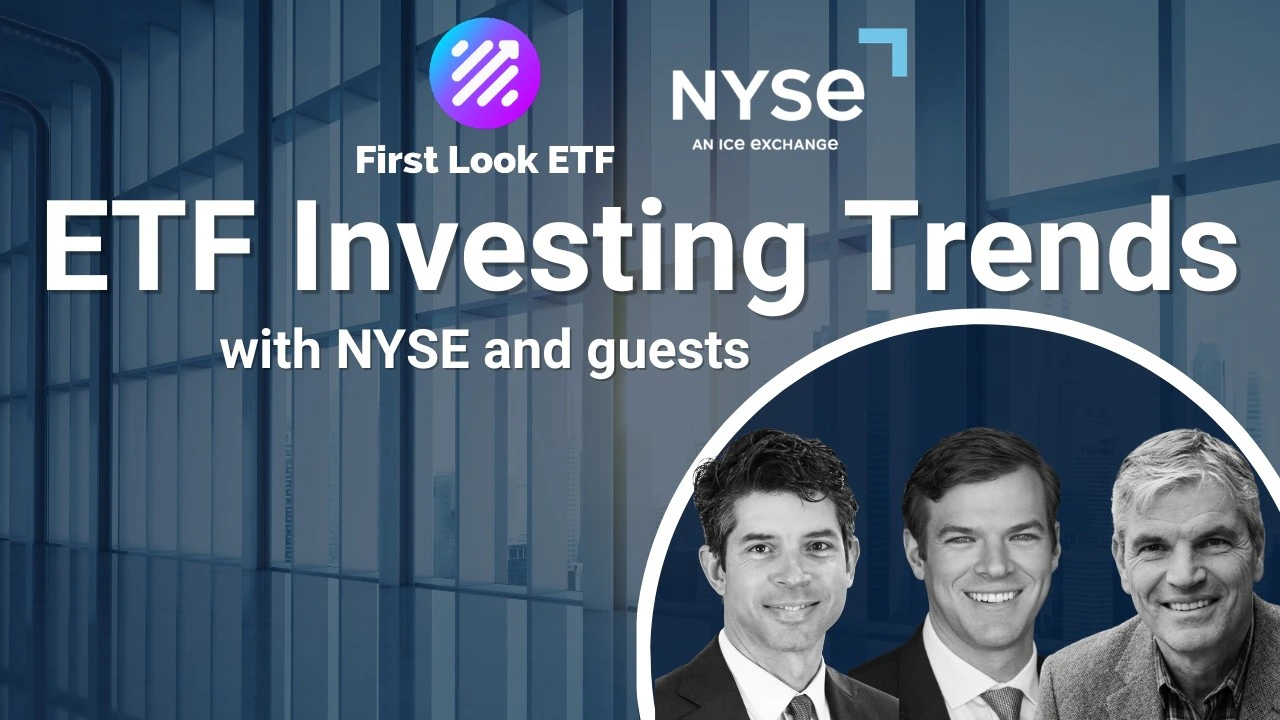
First Look ETF
First Look ETF: Income, International, and Cash Flow ETFs
In this season 6 episode of First Look ETF, Stephanie Stanton @etfguide examines the latest ETF marketplace trends with NYSE and guests.


ETF Trends
ETF Industry KPIs October 5, 2026
This week’s KPI data overview highlights key metrics and trends shaping the ETF landscape.

ETF Trends
ETF Industry KPIs September 28, 2026
This week’s KPI data overview highlights key metrics and trends shaping the ETF landscape.
ETF Trends
ETF Industry KPIs September 22, 2026
This week’s KPI data overview highlights key metrics and trends shaping the ETF landscape.