Turn ETF ideas into real portfolios. Try the builder now →



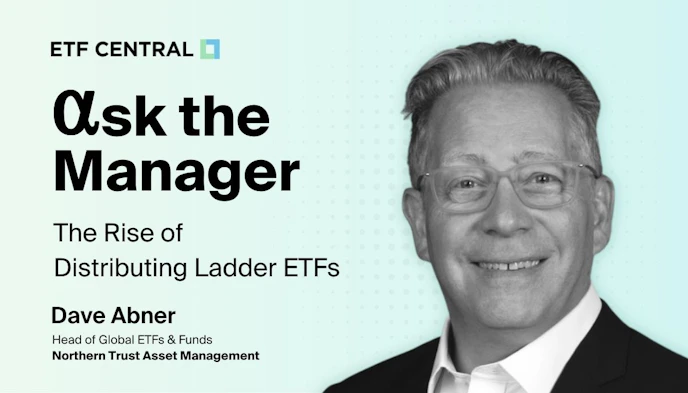
Ask the Manager: Dave Abner on the Rise of Distributing Ladder ETFs
Dave Abner explains Northern Trust Asset Management’s Distributing Ladder ETFs, covering cash flow planning, retirement use cases, muni and TIPS ladders, and ETF industry trends.

Keep up with what matters in ETFs
Get timely ETF insights, market trends, and top ideas straight to your inbox.
Your newsletter subscriptions with us are subject to ETF Central's Privacy Policy and Terms and Conditions.
In this Ask the Manager interview, Dave Abner, Head of Global ETFs & Funds at Northern Trust Asset Management, discusses the firm’s 2025 launch of Distributing Ladder ETFs and the thinking behind this new product structure. Designed to return matured bond capital to investors rather than reinvesting it, these ETFs aim to simplify cash flow planning while preserving the risk-management benefits of traditional bond ladders. Abner also explores the rationale for targeting municipal and Treasury Inflation-Protected Securities (TIPS) exposures, emerging use cases in retirement planning, and how these launches fit into NTAM’s broader ETF strategy amid rapid industry growth.
In 2025, Northern Trust Asset Management introduced Distributing Ladder ETFs. How does this new product structure differ from traditional bond ladders?
Distributing ladders return matured bond capital to shareholders rather than reinvesting it, making them a convenient tool for cash flow planning. Both structures buy bonds across several rungs and hold them to maturity to help mitigate interest rate risk. By distributing capital instead of reinvesting, these ladders support lifestyle and financial goals.
They’re also offered in the ETF structure, providing benefits investors expect like liquidity, transparency, and tax efficiency.
The launch included ladders in Tax-Aware (municipal) and Inflation-Protected (TIPS) formats. What was the thinking behind targeting these specific investor goals?
To help investors with financial planning and cash flow needs, we focused on five key risks: liquidity, interest rate, default, inflation, and tax. Distributing ladders are built to address the first two by returning capital when liquidity is needed and holding bonds to maturity to manage interest rate risk.
TIPS and high-credit municipal bonds help mitigate default risk by concentrating on historically lower-default areas. Inflation risk and taxes are addressed through TIPS, which track CPI changes, and municipal bonds, which generally provide federally tax-exempt income. Investors can combine both ladders to manage all five risks.
What use cases have emerged for Distributing Ladder ETFs since launch, and what investor needs do they address?
The most popular use case is retirement spending. Monthly coupon interest and annual return-of-capital payments make ladders an easy tool for lifestyle spending.
Another common use for 5-year and 10-year ladders is optimizing Social Security benefits. Investing a portion of a nest egg in a 5-year ladder can provide cash flow for five years, allowing retirement now but delaying Social Security until 70 for full benefits.
Beyond retirement, ladders have been used for annual obligations like tax payments, vacations, and charitable giving. Investors continue to find creative uses beyond what we envisioned.
Alongside the ladders, you rolled out a suite of Tax-Exempt Bond ETFs. What sets these municipal offerings apart from competitors?
Our goal is to help clients address all their investment needs. In addition to solutions for cash flow management, clients wanted more traditional options in the municipal bond market. We introduced a suite of ETFs that allow investors to choose where on the municipal bond curve they want to invest while benefiting from federally tax-exempt income opportunities.
We are excited to offer three ETFs that track Intercontinental Exchange (ICE) indices, providing exposure to short maturity, intermediate maturity, and the full municipal bond curve, all at competitive fees.
Both suites debuted under the new Northern Trust ETFs brand. What does this milestone mean for NTAM’s ETF strategy and FlexShares?
In 2026, all current FlexShares funds will transition to the Northern Trust ETFs brand, and the FlexShares name will be retired. This launch marks an exciting new chapter in the growth of our ETF platform. By unifying under Northern Trust ETFs, we’re reinforcing our commitment to expanding our offerings and delivering dynamic, outcome-driven tools for today’s investors. We’re energized by the evolution and excited for the road ahead.
The ETF industry crossed $13 trillion in assets in 2025. How do you see growth trends shaping the next phase for ETFs?
The ETF industry is accelerating its growth rate. In 2025, we saw records in the number of funds listed, volume traded, and assets gained in a single year. It’s still remarkable how small ETFs’ share of investor portfolios remains, particularly among older investors—so there’s plenty of growth ahead.
Younger investors are using a wider range of products, including crypto, derivatives, and leverage, while older investors tend to stick with core products like large passive index funds. Growth will continue across the spectrum.
ETFs also excel at making hard-to-access assets investable for average investors. As strategies traditionally reserved for hedge funds or private equity become available in ETF form, the investor base will keep expanding.
With active ETFs gaining traction and direct indexing on the rise, will the traditional passive ETF model remain dominant, or are we entering a new era of personalization?
The acceptance and growth of active ETFs can be traced to several factors. Investors have shown a strong preference for the ETF vehicle and value the blend of active management with daily holding transparency. ETF sponsors are increasingly using active structures for innovative ideas that index-based approaches can’t match. At the same time, large mutual fund providers have responded to investor demand by converting their actively managed strategies into ETFs.
That said, traditional passive ETFs aren’t going anywhere. Sponsors will continue to choose the structure that best fits their investment approach.
With so many new ETFs available, how can advisors balance offering innovative strategies with maintaining portfolio simplicity for clients?
Advisors have more tools than ever, but their core mission remains the same: help clients meet their goals through financial planning and investment management. ETFs simplify advisors’ jobs. For example, a one-ticket product like a distributing ladder saves advisors from sourcing individual bonds or finding the right SMA for a client’s cash needs. This frees advisors to focus on what matters most to clients while we handle the operational details.
How do you see tokenization and digital asset infrastructure reshaping the ETF ecosystem over the next decade?
The next decade will bring tremendous technological change to financial markets: 24/7 trading, faster settlement, and everything running on digital rails. We’ll see convergence among asset classes, including crypto, equities, bonds, and even event markets, allowing investors to optimize portfolios in new ways.
Just as stock trading evolved from paper tickets to digital records, the next step is tokenization. While this shift may not be obvious to investors, they’ll experience enhanced functionality and efficiency across systems.
Looking ahead to 2026, what are your three bold predictions for the ETF industry?
One year is short in ETF markets, but we expect several trends to take shape in 2026. First, crypto and digital asset ETFs will continue to proliferate. Second, private market assets will increasingly be wrapped in ETF vehicles. Third, money market ETFs will gain traction as investors discover this under-the-radar category.
In addition, we anticipate the emergence of ETF share classes for mutual funds, ongoing mutual fund-to-ETF conversions, and SMAs converting to ETFs using 351 exchange* functionality.
*A Section 351 exchange is a U.S. tax code provision allowing individuals or entities to transfer property (such as appreciated stocks, real estate, or other assets) to a corporation solely in exchange for stock without recognizing immediate capital gains or losses.
Like what you're reading?
Stay in the loop — get the latest ETF insights: trends, analysis, and expert picks.
About Dave Abner
Dave Abner is Head of Global ETFs & Funds at Northern Trust Asset Management (NTAM), overseeing mutual fund and ETF product strategy, research, development, and management.
Before joining NTAM, Dave served as Global Head of Business Development at Gemini, where he led the creation of Gemini Fund Solutions, and as CEO of WisdomTree Europe Ltd. Prior to those positions, he held roles at Bear Stearns, culminating in the creation of their ETF trading business, and managed global ETF trading at BNP Paribas.
Dave is the author of “The ETF Handbook” and “The Visual Guide to ETFs” and is credited with creating the widely used ETF Implied Liquidity function that revolutionized daily portfolio management for ETFs.
Please note this article is for information purposes only and does not in any way constitute investment advice. It is essential that you seek advice from a registered financial professional prior to making any investment decision.
IMPORTANT INFORMATION
Before investing, carefully consider the investment objectives, risks, charges and expenses. This and other information are in the prospectus and a summary prospectus, copies of which may be obtained by visiting www.flexshares.com or calling 855 -353 -9383. Read the prospectus carefully before you invest. Northern Funds Distributors, LLC, distributor. Northern Funds Distributors, LLC are not affiliated with Northern Trust.
All investments are subject to investment risk, including the possible loss of principal amount invested. Investments do not typically grow at an even rate of return and may experience negative growth. As with any type of portfolio structuring, attempting to reduce risk and increase return could, at certain times, unintentionally reduce returns.
Individual bonds carry an obligation to fully return principal to investors at maturity, however ETFs have no such obligation. The net asset value of the ETFs will decline over time as income payments are made to shareholders.
NOT FDIC INSURED | MAY LOSE VALUE | NO BANK GUARANTEE
As with any fund, it is possible to lose money on an investment in the Fund. An investment in the Fund is not a deposit of any bank and is not insured or guaranteed by the Federal Deposit Insurance Corporation, any other government agency, or The Northern Trust Company, its affiliates, subsidiaries or any other bank.
ETFs are subject to additional risks that do not apply to conventional mutual funds, including the risks that the market price of an ETF's shares may trade at a premium or discount to its net asset value, an active secondary trading market may not develop or be maintained, or trading may be halted by the exchange in which they trade, which may impact an ETF's ability to sell its shares. Shares of any ETF are bought and sold at market price (not NAV) and are not individually redeemed from the ETF. Brokerage commissions will reduce returns.
RISKS APPLICABLE TO BOTH TAX -EXEMPT AND INFLATION -LINKED DISTRIBUTING LADDER ETFs
Credit (or Default) Risk is the risk that the inability or unwillingness of an issuer or guarantor of a fixed -income security, or a counterparty to a repurchase or other transaction, to meet its principal or interest payments or other financial obligations in a timely manner will adversely affect the value of the Fund’s investments and its returns.
Fluctuation of Yield and Principal Payment Risk is the risk that the Fund, unlike a direct investment in a bond that has a level coupon payment and a fixed payment at maturity, will make distributions of income that vary over time. Unlike a direct investment in bonds, the breakdown of returns between Fund distributions are not predictable at the time of your investment. Fund Termination Risk is the risk that, unlike an investment in a traditional investment company with perpetual existence, the Fund is designed to liquidate in the terminal year and thus a shareholder of the Fund will not receive distributions from the Fund beyond the terminal year. Liquidity Risk is the risk that certain securities may be less liquid than others, which may make them difficult or impossible to sell at the time and the price that the Fund would like, and the Fund may have to lower the price, sell other securities instead or forgo an investment opportunity, adversely affecting the value of the Fund’s investments and its returns. Non-Diversification Risk is the risk that a nondiversified fund may invest a larger portion of its assets in securities issued by or representing a smaller number of issuers than a diversified fund. As a result, a Fund may be more susceptible to the risks associated with these particular issuers, or to a single economic, political or regulatory occurrence affecting these issuers. Return of Capital/Distribution Risk is the risk that the Fund’s distributions will involve a return of capital, which, although not generally taxable, may lower a shareholder’s basis in the Fund’s shares, thus potentially subjecting the shareholder to future tax consequences in connection with the sale of Fund shares, even if sold at a loss to the shareholder’s original investment. A portion of each distribution may be recharacterized as either income or return of capital for tax purposes at year-end. Small Fund Risk is the risk that the Fund will not grow to or maintain an economically viable size, in which case it may liquidate prior to the anticipated liquidation date in the terminal year, thus impacting the Fund’s ability to achieve its investment objective.
RISKS APPLICABLE TO NORTHERN TRUST TAX -EXEMPT DISTRIBUTING LADDER ETFS
Municipal Investments Risk is the risk that the value of a municipal security generally depends on the financial and credit status of the issuer. Constitutional amendments, legislative enactments, executive orders, administrative regulations, voter initiatives, and the issuer’s regional economic conditions may affect a municipal security’s value, interest payments, repayment of principal and the Fund’s ability to sell the security. Municipal Market Volatility Risk is the risk that the Fund may be adversely affected by volatility in the municipal market. The municipal market can be significantly affected by adverse tax, legislative, political or public health changes and the financial condition of the issuers of municipal securities. Municipal Tax Liability Risk is the risk that shareholders of the Fund could be subject to tax liabilities. The Fund will invest in municipal securities in reliance at the time of purchase on an opinion of bond counsel to the issuer that the interest paid on those securities will be excludable from gross income for regular federal income tax purposes.
RISKS APPLICABLE TO NORTHERN TRUST INFLATION-LINKED DISTRIBUTING LADDER ETFS
Inflation-Indexed Securities Risk is the risk that the value of inflation protected securities, such as TIPS, generally will fluctuate in response to changes in real interest rates, generally decreasing when real interest rates rise and increasing when real interest rates fall. In addition, interest payments on inflation-protected securities will generally vary up or down along with the rate of inflation.
NTAC:3NS-20

Latest ETF News
See all ETF news
Ask the Manager: Kenneth Wong on Building the Next Wave of ETF Innovation, from Options to Korea's AI Semiconductor Opportunity

Ask the Manager: Kristof Gleich on Why AI Is Becoming an Asset Class

Ask the Manager: Vince Lorusso on Active Equity in an AI-Driven Market





 Advantages of ETFs over Mutual Funds1/6
Lower Costs
In this guide, we'll explore the advantages of ETFs over mutual funds, giving you valuable insights into why ETFs have gained significant popularity among investors like yourself.
Leveraged ETFs: Unlocking the Potential for Amplified Returns1/6
Understanding Leveraged ETFs
Explore leveraged ETFs: potential for amplified returns & risks. 5 ETFs to consider across equities, commodities & fixed income.
What is a Leveraged ETF?1/6
Introducing Leveraged and Inverse ETFs
In this guide, we'll dive into the world of leveraged ETFs, exploring their definition, mechanics, potential risks, and rewards.
Recent educational content

ETF Trends
ETF Industry KPIs September 8, 2026
This week’s KPI data overview highlights key metrics and trends shaping the ETF landscape.

ETF Trends
ETF Industry KPIs August 31, 2026
This week’s KPI data overview highlights key metrics and trends shaping the ETF landscape.
ETF Trends
ETF Industry KPIs August 24, 2026
This week’s KPI data overview highlights key metrics and trends shaping the ETF landscape.
What’sTheFund
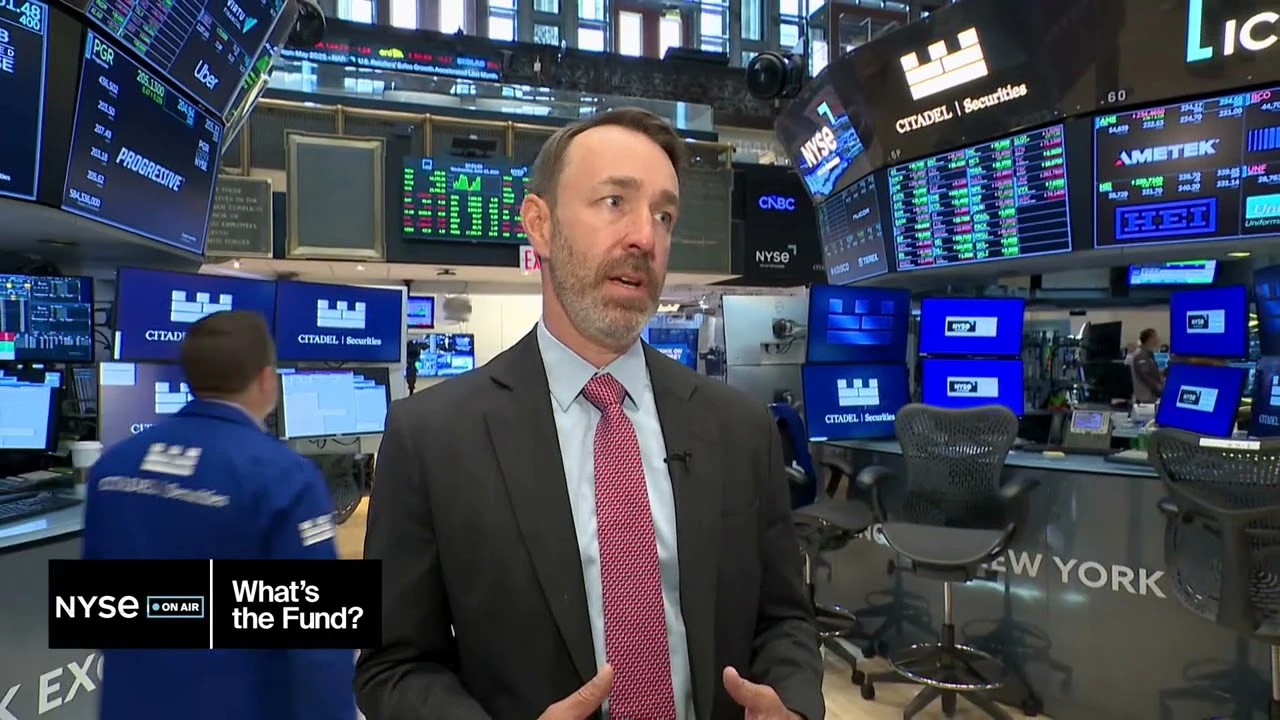
What's the Fund | Ocean Park Diversified Income ETF (DUKZ)
James St Aubin, Chief Investment Officer at Ocean Park Asset Management, discuss the DUKZ ETF, exposing investors to the whole spectrum of asset classes in the fixed income markets, through their rules-based process.

Browse all educational columns



Active Trader Report: Use of Leveraged & Inverse ETFs Way Up
Direxion partnered with Compound Insights and Vanda to explore what’s driving the evolution of active trading — and how active traders are using leveraged and inverse funds across equities, single stocks, commodities, and volatility.