Ready-made ETF portfolios built for real investor needs. Explore now →



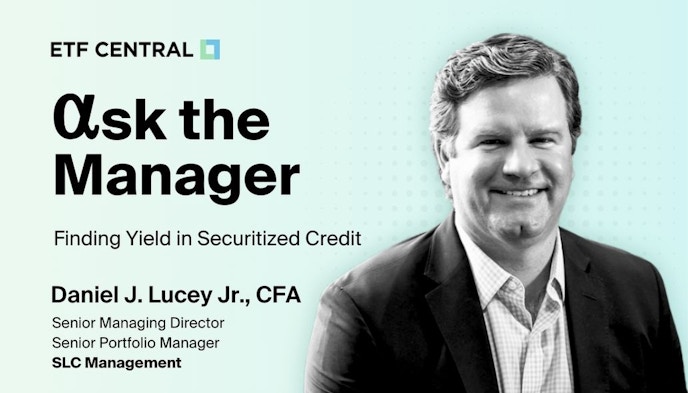
Ask the Manager: Daniel Lucey Jr. on How to Find Yield in Securitized Credit
Daniel J. Lucey Jr. shares his perspective on Fed policy, macro themes, and the role of securitized assets in diversified portfolios.

Keep up with what matters in ETFs
Get timely ETF insights, market trends, and top ideas straight to your inbox.
Your newsletter subscriptions with us are subject to ETF Central's Privacy Policy and Terms and Conditions.
In this edition of Ask the Manager, we spoke with Daniel J. Lucey Jr., CFA, Senior Managing Director and Senior Portfolio Manager at SLC Management about how Fed policy, macro themes, and securitized assets shape their outlook—and where they see opportunities in short duration fixed income.
How are you interpreting recent Fed communications in terms of the path forward for interest rates, and what does that mean for fixed income investors?
We view recent commentary indicates a more dovish outlook for front end rates and likely a 25-basis point (0.01% of 1%) rate cut in September, particularly through comments made by Fed Chair Jay Powell at Jackson Hole.
Though inflation remains persistent, markets predict the Fed may cut rates 2-3 times in the coming six months.
How do macro themes like deglobalization, fiscal expansion, and reshoring influence your fixed income outlook moving forward?
SLC Management’s U.S. Total Return Fixed Income team concentrates on deep value opportunities through bottom-up analysis.
The team continues to see relative value through securitized sectors, particularly within asset backed securities (“ABS”), commercial mortgage-backed securities (“CMBS”), and collateralized loan obligations (“CLOs”) while considering all macroeconomic factors.
Particularly, we work to source attractive securitized debt with favorable collateral valuation and a spread/yield pickup versus comparable corporates and treasuries held within the Bloomberg U.S. 1-3 Year Gov/Credit Index, the benchmark against which the AAM SLC Low Duration Income ETF (Ticker: LODI) is managed.
What are some misconceptions investors might have about securitized assets?
Many investors may vividly recall 2008 and the events that led to the Global Financial Crisis, resulting in a sense of trepidation surrounding securitized sectors.
This environment serves as a strong cautionary tale as the 2000s were marked by overleverage in banks and securitized subsectors alike, particularly within non-agency residential mortgage-backed securities (“RMBS”).
However, what is often omitted from this narrative is that the events of 2008 triggered a restructuring of the sector to withstand much higher levels of loan distress with higher loss cushions, resulting in significant mitigation during the market volatility that occurred as a result of the COVID pandemic.
Though COVID placed immense pressure on credit markets, securitized credit markets held in very well from a principal protection standpoint.
While there was extreme price volatility as expected, there was relatively little ultimate principal losses across the major securitized subsectors within investment grade tranches, including CLOs, ABS, Non-Agency RMBS, and even CMBS.
Looking ahead, where do you see opportunities (or risks) in the short duration credit space over the next 6-12 months?
Given existing market conditions, we anticipate continuing to favor CMBS and ABS over the next 6-12 months, as these sectors currently exhibit the most attractive spreads and relative value in the short duration space.
Can you walk us through the process SLC Management uses to identify attractive relative value opportunities in the corporate and securitized sectors?
Our philosophy in identifying attractive relative value is rooted in three pillars of analysis as follows:
- Bottom-up fundamental analysis: We start by evaluating the underlying credit fundamentals at the issuer and security level, including collateral strength, quality of underwriting (ie. leverage, cash flow stability) and structural protections embedded in the trust. This allows us to identify securities where risk adjusted value may be underappreciated by the market.
- Marrying credit fundamentals with bond valuation: We combine our credit assessment with rigorous pricing analysis by evaluating relative spreads on an issuer, subsector, and cross-sector basis to identify mispriced opportunities.
- Mean reversion analysis: We analyze historical relationships of subsector credit spreads to identify dislocated areas of the market that have attractive risk adjusted yield profiles and are pricing wide to their historical trading patterns.
Relative Value Example:
In late 2022/early 2023, we identified the ABS sector as trading wide relative to its own historical range and increased our exposure across strategies in the +400bps yield spread over Treasuries area for BBB rated classes.
A year later, those spreads had tightened roughly 150-200 bps. As these bonds deleverage, they get upgraded and their spreads tighten. When that occurs, we look to sell and rotate into positions at wider spreads. Additionally, these bonds typically trade wide relative to corporate bonds comparable by either duration or ratings.
Global ETF Survey 2026 is Live!
With 1,790 new products launched by July 2026, choosing is harder than ever. Our Global ETF Survey 2026, built on 620 professional investors and allocators, shows how active, fixed income, options-based and thematic ETFs are reshaping fund selection.
Disclosures
For informational purposes only. Click here for the LODI prospectus.
Past performance does not guarantee future results.
Investing involves risk, including the possible loss of principal. Shares of any ETF are bought and sold at market price (not NAV) and may trade at a discount or premium to NAV. Shares are not individually redeemable from the Fund and may only be acquired or redeemed from the fund in creation units. Brokerage commissions will reduce returns.
Principal Risks: Cash flow refers to the net cash and cash equivalents moving in and out of a business, generated from a company’s core business activities, taking into account money spent on expenses related to producing the business goods and services. Duration is a measure of an investment's (typically a bond's) sensitivity to changes in interest rates and it represents the weighted average time an investor must wait (in years) to receive their cash flows. Fixed-income securities are subject to the ability of an issuer to make timely principal and interest payments (credit risk), changes in interest rates (interest-rate risk), the creditworthiness of the issuer and general market liquidity (market risk). In a rising interest-rate environment, bond prices may fall and may result in periods of volatility and increased portfolio redemptions. In a declining interest-rate environment, the portfolio may generate less income. Mortgage-backed and asset-backed securities are subject to higher interest rate and prepayment risk; the value of these investments may be reduced or become worthless if they are “subordinated” and receive interest or income payments only after other interests in the same mortgage or asset pool are satisfied. Active trading may increase the Fund’s transaction costs, affect performance, and increase your taxable distributions. New Fund Risk: The Fund is a recently organized investment company with no operating history. As a result, prospective investors have no track record or history on which to base their investment decision. Management Risk: The Fund is actively managed and may not meet its investment objective based on the Adviser’s success or failure to implement investment strategies for the Fund. CLO Risk: CLOs are securities backed by an underlying portfolio of loan obligations. CLOs issue classes or “tranches” that vary in risk and yield and may experience substantial losses due to actual defaults, decrease of market value due to collateral defaults and removal of subordinate tranches, market anticipation of defaults and investor aversion to CLO securities as a class. High-Yield Securities Risk: High-yield securities (also known as “junk bonds”) carry a greater degree of risk and are considered speculative by the major credit rating agencies. Privately Issued Securities Risk: The Fund may invest in privately issued securities issued under Rule 144A or Regulation S under the Securities Act of 1933, as amended. Sales of privately issued securities are subject to numerous restrictions including, but not limited to, that sales of privately issued securities may typically be made only to qualified institutional buyers, in privately negotiated transactions, to a limited number of purchasers, or in limited quantities after being held for a specific period of time.
Bloomberg 1-3 Year Government/Credit Index is an unmanaged index comprised of the US Government/Credit component of the US Aggregate Index. It is not possible to invest directly in an index. Indices do not include cash.
©2025 Advisors Asset Management. Advisors Asset Management, Inc. (AAM) is an SEC-registered investment advisor and member FINRA/SIPC. Registration does not imply a certain level of skill or training.
AAM ETFs are distributed by Quasar Distributors, LLC. Quasar and AAM are not affiliated.
18925 Base Camp Road • Monument, CO 80132 • www.aamlive.com
CRN: 2025-0908-12834 R
Please note this article is for information purposes only and does not in any way constitute investment advice. It is essential that you seek advice from a registered financial professional prior to making any investment decision.


Latest ETF News
See all ETF newsAsk the Manager: Pieter Vorster on the NICO ETF and the Nicotine Transition

Ask the Manager: Tian Yang on Capital Cycle Investing and the VPX ETF


Ask the Manager: Kenneth Wong on Building the Next Wave of ETF Innovation, from Options to Korea's AI Semiconductor Opportunity





 Advantages of ETFs over Mutual Funds1/6
Lower Costs
In this guide, we'll explore the advantages of ETFs over mutual funds, giving you valuable insights into why ETFs have gained significant popularity among investors like yourself.
Leveraged ETFs: Unlocking the Potential for Amplified Returns1/6
Understanding Leveraged ETFs
Explore leveraged ETFs: potential for amplified returns & risks. 5 ETFs to consider across equities, commodities & fixed income.
What is a Leveraged ETF?1/6
Introducing Leveraged and Inverse ETFs
In this guide, we'll dive into the world of leveraged ETFs, exploring their definition, mechanics, potential risks, and rewards.
Recent educational content

First Look ETF
First Look ETF: Income, International, and Cash Flow ETFs
In this season 6 episode of First Look ETF, Stephanie Stanton @etfguide examines the latest ETF marketplace trends with NYSE and guests.


ETF Trends
ETF Industry KPIs October 5, 2026
This week’s KPI data overview highlights key metrics and trends shaping the ETF landscape.

ETF Trends
ETF Industry KPIs September 28, 2026
This week’s KPI data overview highlights key metrics and trends shaping the ETF landscape.
ETF Trends
ETF Industry KPIs September 22, 2026
This week’s KPI data overview highlights key metrics and trends shaping the ETF landscape.