ETF model portfolios designed for real investor needs. Discover →



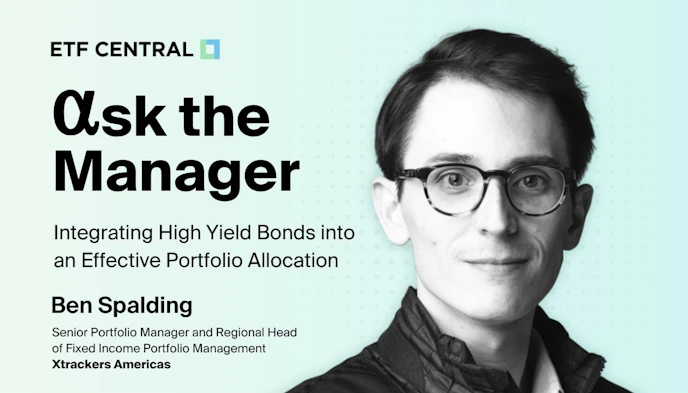
Ask the Manager: Ben Spalding on Integrating High Yield Bonds into an Effective Portfolio Allocation
DWS’s Ben Spalding discusses the benefits of including high yield bonds in a balanced portfolio strategy in this edition of Ask the Manager.

Keep up with what matters in ETFs
Get timely ETF insights, market trends, and top ideas straight to your inbox.
Your newsletter subscriptions with us are subject to ETF Central's Privacy Policy and Terms and Conditions.
In this edition of Ask the Manager, we spoke with Ben Spalding, Senior Portfolio Manager and regional Head of Fixed Income Portfolio Management for Xtrackers Americas and discussed capitalizing on opportunities in high yield and how to access this market with the Xtrackers USD High Yield Corporate Bond ETF
High yield bond spreads are historically tight. Is the potential payoff still there for investors?
Get data on 14,000+ ETFs
Access Trackinsight's reliable and comprehensive data with 500M+ points on 14,000+ ETFs.
It’s true that credit spreads on high yield bonds are currently quite tight by historical standards. Spreads are presently around 300 basis points based on the Bloomberg U.S. High Yield Index, while the 15-year average is closer to 450 basis points. This indicates that the market is pricing in lower expected defaults compared to historical averages and, therefore, requires less risk premium above the “risk-free” rate of U.S. Treasuries. Currently, high yield bonds are yielding about 7%, which is an enticing level for income-oriented investors.
What is the effect of private credit funds on the (public) high yield market? Is it reducing supply to the market?
Risker, smaller, or otherwise more complex deals are increasingly going to private credit instead of being issued in the public high yield market. As a result, the public market is skewing more toward higher-quality issuers. This has likely contributed to some of the tighter spreads we’re seeing compared to historical averages.
Despite the emergence of private credit, we still see a healthy supply of high yield debt coming to public markets. Through the end of September 2025, year-to-date gross new-issue volume totaled $268 billion, up 12% from the $240 billion recorded over the same period in 2024.
How should investors think of high yield bonds as a portfolio diversifier?
High yield bonds, especially in a broad-based ETF context, are a strong asset class for providing portfolio diversification. Historically, high yield bonds have had a moderate correlation with the S&P 500 Index and a very low correlation with Treasuries. This means that high yield allocations can often help smooth out returns in a multi-asset portfolio. Furthermore, high yield has historically delivered Sharpe ratios similar to those of equities and investment-grade bonds, but with lower volatility than equities. My colleague Jason Chen from the DWS Research Institute conducted excellent analysis on this topic in his paper “High Yield Bonds for Allocators”, if you’d like to learn more.
How should investors utilize Xtrackers High Yield ETFs
At Xtrackers, our high yield offerings range from broad market exposure to short duration, as well as more tailored exposures that target either the higher- or lower-rated credit buckets within the high yield space. By using a combination of Xtrackers high yield ETFs, investors can fine-tune their credit exposure and adjust their preferred credit risk up or down depending on their particular view.
Our flagship product is the Xtrackers USD High Yield Corporate Bond ETF
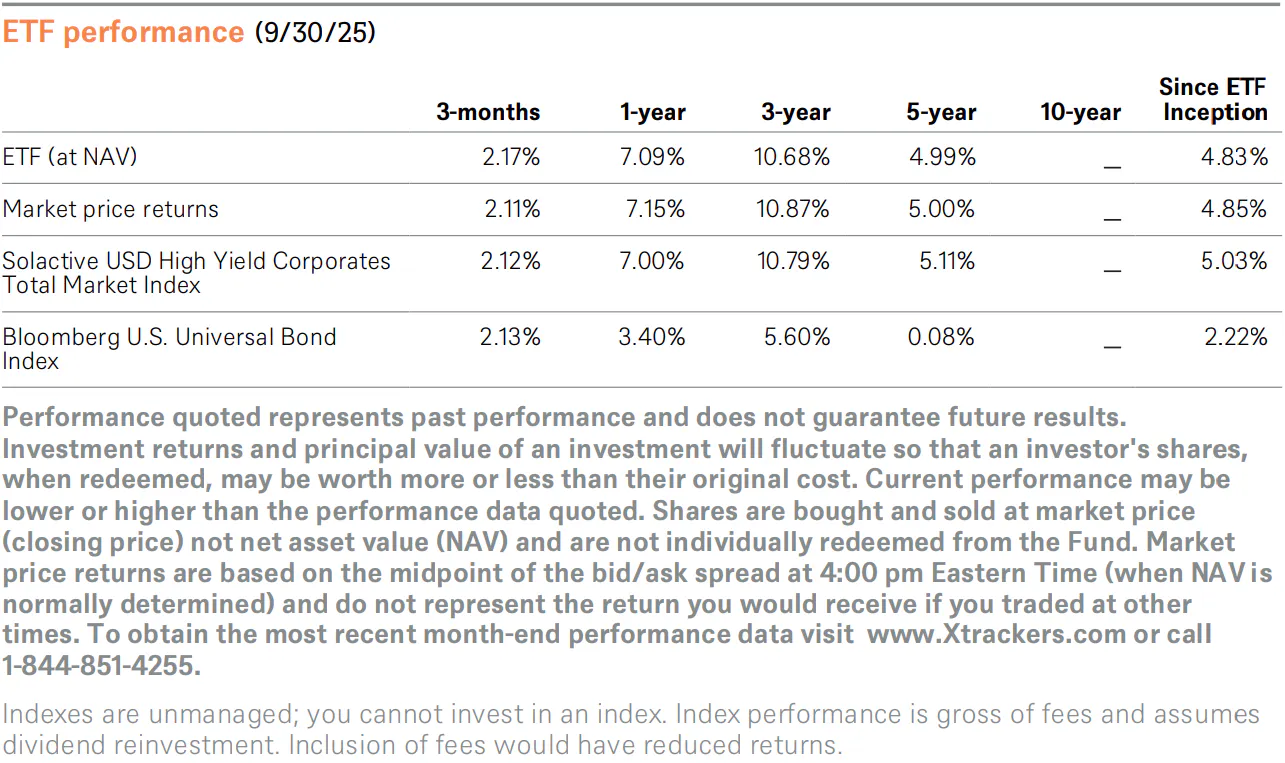
ETF Inception Date: 12/7/2016
Glossary
Basis Point: A basis point is one hundredth of a percent, so 100 basis points is equivalent to 1%.
Bloomberg U.S. High Yield Index: A benchmark that tracks the performance of below investment-grade corporate bonds issued in the U.S. dollar-denominated market.
Correlation: The relationship between two financial assets, indicating how they move in relation to each other.
Risk-Free Rate: The theoretical return on an investment with zero risk, often represented by the yield on government securities such as U.S. Treasury bills.
S&P 500 Index: An index that includes 500 leading companies spanning all sectors of the U.S. stock market, covering approximately 80% of the U.S. equity market.
Important Disclosures
The brand Xtrackers represents all systematic investment solutions. Xtrackers ETFs ("ETFs") are managed by DBX Advisors LLC (the "Adviser") and distributed by ALPS Distributors, Inc. (“ALPS”). The Adviser is a subsidiary of DWS Group GmbH & Co. KGaA and is not affiliated with ALPS. Shares are not individually redeemable, and owners of Shares may acquire those Shares from the Fund, or tender such Shares for redemption to the Fund, in Creation Units only. The brand DWS represents DWS Group GmbH & Co. KGaA and any of its subsidiaries such as DWS Distributors, Inc., which offers investment products, or DWS Investment Management Americas, Inc., and RREEF America L.L.C., which offer advisory services.
Carefully consider the fund's investment objectives, risk factors, and charges and expenses before investing. This and other information can be found in the fund's prospectus, which may be obtained by calling 1-844-851-4255, or by viewing or downloading a prospectus from www.Xtrackers.com.
Read the prospectus carefully before investing. War, terrorism, sanctions, economic uncertainty, trade disputes, public health crises and related geopolitical events have led and, in the future, may lead to significant disruptions in U.S. and world economies and markets, which may lead to increased market volatility and may have significant adverse effects on the fund and its investments.
Risk: Bond investments are subject to interest rate, credit, liquidity and market risks to varying degrees. When interest rates rise, bond prices generally fall. Credit risk refers to the ability of an issuer to make timely payments of principal and interest. Foreign investing involves greater and different risks than investing in U.S. companies, including currency fluctuations, less liquidity, less developed or less efficient trading markets, lack of comprehensive company information, political instability and differing auditing and legal standards. Funds investing in a single industry (or group of industries), country or in a limited geographic region generally are more volatile than more diversified funds. Investments in lower-quality ("junk bonds") and non-rated securities present greater risk of loss than investments in higher-quality securities. Performance of the Fund may diverge from that of the Underlying Index due to operating expenses, transaction costs, cash flows, use of sampling strategies or operational inefficiencies. An investment in this fund should be considered only as a supplement to a complete investment program for those investors willing to accept the risks associated with that fund. Please read the prospectus for more information.
Investment products: No bank guarantee I Not FDIC insured I May lose value
ALPS Distributors, Inc., 1290 Broadway, Suite 1100, Denver, CO 80203
© 2025 DWS Group GmbH & Co. KGaA. All rights reserved. R- 108535-1 (12/25) DBX007038 (12/26)

Latest ETF News
See all ETF newsAsk the Manager: Tian Yang on Capital Cycle Investing and the VPX ETF


Ask the Manager: Kenneth Wong on Building the Next Wave of ETF Innovation, from Options to Korea's AI Semiconductor Opportunity

Ask the Manager: Kristof Gleich on Why AI Is Becoming an Asset Class





 Advantages of ETFs over Mutual Funds1/6
Lower Costs
In this guide, we'll explore the advantages of ETFs over mutual funds, giving you valuable insights into why ETFs have gained significant popularity among investors like yourself.
Leveraged ETFs: Unlocking the Potential for Amplified Returns1/6
Understanding Leveraged ETFs
Explore leveraged ETFs: potential for amplified returns & risks. 5 ETFs to consider across equities, commodities & fixed income.
What is a Leveraged ETF?1/6
Introducing Leveraged and Inverse ETFs
In this guide, we'll dive into the world of leveraged ETFs, exploring their definition, mechanics, potential risks, and rewards.
Recent educational content

ETF Trends
ETF Industry KPIs September 28, 2026
This week’s KPI data overview highlights key metrics and trends shaping the ETF landscape.

ETF Trends
ETF Industry KPIs September 22, 2026
This week’s KPI data overview highlights key metrics and trends shaping the ETF landscape.
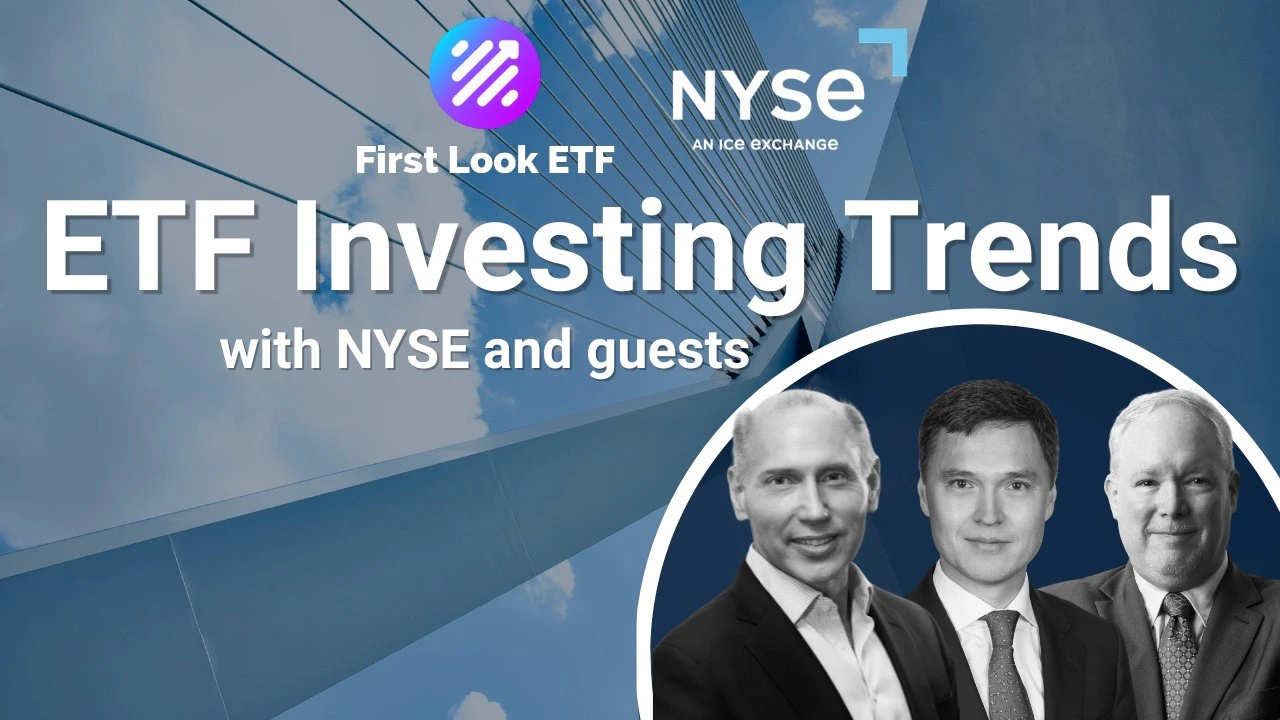
First Look ETF
First Look ETF: Income, Corporate Arbitrage, and Growth and Value Investing
First Look ETF September 2026: iCapital, Mast Investments and North Square unpack new ETFs targeting monthly income, merger arbitrage and complementary growth and value exposure.

ETF Trends
ETF Industry KPIs September 14, 2026
This week’s KPI data overview highlights key metrics and trends shaping the ETF landscape.
Browse all educational columns



Expert-Built ETF Portfolios, All in One Place
Don’t start from scratch. Discover ready-made ETF portfolios built by professionals to match different goals, timelines, and market views. Use them as inspiration or as a starting point for your own allocation.