ETF model portfolios designed for real investor needs. Discover →



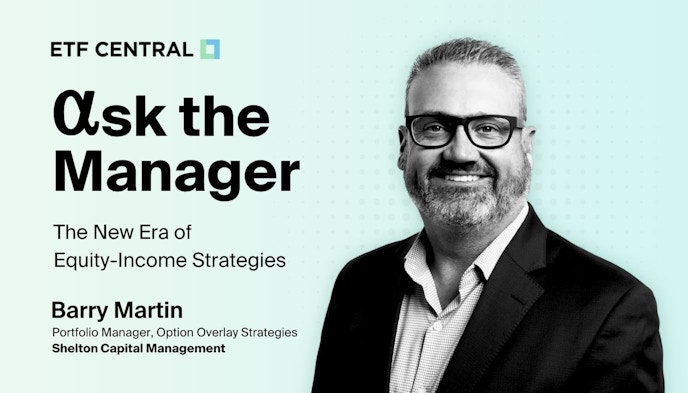
Ask the Manager: Barry Martin on the New Era of Equity-Income Strategies
Barry Martin, CFA, explains how rising dispersion and single-stock volatility are reshaping equity-income strategies and fueling demand for covered call ETFs like SEPI.

Keep up with what matters in ETFs
Get timely ETF insights, market trends, and top ideas straight to your inbox.
Your newsletter subscriptions with us are subject to ETF Central's Privacy Policy and Terms and Conditions.
For this edition of Ask the Manager, we speak with Barry Martin, CFA, Portfolio Manager for Shelton Capital Management’s option overlay strategies and a 20-year veteran of the options market. Martin, who oversees the investment process behind the Shelton Equity Premium Income ETF
Equity markets remain highly concentrated in large-cap names, while volatility has become uneven across sectors and individual stocks. How is this shaping demand for equity-income strategies and single-stock covered call approaches like SEPI?
Like what you're reading?
Stay in the loop — get the latest ETF insights: trends, analysis, and expert picks.
The Shelton Equity Premium Income ETF (SEPI) targets an environment where market leadership is increasingly concentrated, and volatility is driven more by individual company dynamics. This mix of top-heavy indexes and widening dispersion creates stock-level movements that can support cash-flow–focused approaches.
Interest in these types of solutions has skyrocketed—the Morningstar Derivative Income category expanded from roughly 10 ETFs in 2018 to more than 100 today, now representing over 100 billion dollars in assets¹. SEPI applies the same stock-level research that supports Shelton’s flagship Morningstar 5-star equity income mutual fund (EQTIX)*, combining selected equities with covered calls on those individual names. The result is an equity income approach that seeks to convert market movement into transparent, understandable cash-flow potential.
*EQTIX received an Overall Morningstar Rating of 5 stars among 77 Derivative Income funds, based on risk-adjusted returns, as of 9/30/2025. The fund’s Morningstar three-,five-, ten-year ratings respectively, 4 stars, 4 stars, 5 stars among 77, 66, 33 funds. The ETF is not a mutual fund and may not achieve the same results.
With interest rates likely to stay higher for longer and dispersion rising across individual names, how has the opportunity set for option-based income strategies evolved?
Higher-for-longer interest rates and wider gaps in company performance have reshaped where option income can come from. As dispersion increases, single-stock options often reflect higher implied volatility than broad index options, which can enhance cash flow opportunity when managed selectively.
Options-based strategies have seen impressive growth across vehicles. According to CBOE, total assets in “derivative income” funds – including ETFs, mutual funds, and separately managed accounts – have increased roughly eightfold since 2019, from about 20 billion dollars to now over 160 billion dollars². SEPI’s process evaluates fundamentals, volatility patterns, and dividend characteristics before writing each call, allowing the strategy to seek cash-flow potential that reflects real-time differences across individual stocks. This approach aligns with the research-driven philosophy behind Shelton’s long-standing equity income solutions.
SEPI is entering a fast-growing but crowded ETF category. What investor gaps or misperceptions was Shelton looking to address, and how does SEPI differentiate itself against passive covered call ETFs tied to indexes?
Rapid growth in the derivative-income ETF category has created confusion for investors trying to understand how these strategies are built and what truly differentiates them. With more than 100 derivative-income ETFs now holding over 100 billion dollars in assets³, many products appear similar even though their structures differ meaningfully. A common misperception is that all covered call ETFs function the same way. In reality, there is a wide range of approaches, from index-based overlays to fundamental, single-stock call writing.
SEPI was designed to clarify the distinction through a fundamentals-first approach that structurally aligns equity selection with option positioning, ensuring that each decision is part of a coordinated, research-driven portfolio strategy rather than driven by preset, index-only calls.
By focusing on individual stocks, SEPI can evaluate individual specific company characteristics including volatility, valuation, and dividend potential. Single stocks can exhibit greater volatility than broad market indexes, which may lead to higher option premiums, and potentially more compelling opportunities for cash-flow–oriented strategies. For investors navigating an increasingly crowded landscape, SEPI provides a transparent, stock-by-stock approach grounded in long-standing equity income expertise.
The 60/40 portfolio is being reimagined. How should advisors think about strategies like SEPI—are they still a tactical sleeve, or part of a broader shift toward core equity income allocations?
Investors today are looking beyond traditional approaches, seeking broader diversification through alternatives as well as more dependable income and cash-flow solutions. The familiar 60/40 framework that worked for decades is increasingly challenged by the speed and complexity of today’s market environment.⁴
Against this backdrop, covered call strategies are being used in a variety of portfolio roles: as a dedicated income-oriented equity sleeve, as a diversifier alongside fixed income, or as a potential tool for smoothing volatility within multi-asset allocations. What we see most consistently, however, is adoption from investors aiming to strategically dial down equity risk without stepping away from market participation.
A 60/20/20 portfolio of 60% stocks (SPX Index), 20% bonds (Bloomberg US Agg Index), (20% to an Options-Based Strategy) Portfolio. The S&P 500, is a stock market index tracking the stock performance of 500 leading companies listed on stock exchanges in the United States. The Bloomberg US Aggregate Index (or “Agg”) is a flagship benchmark for the US investment-grade, fixed-rate, taxable bond market, representing over $50 trillion in securities. The CBOE S&P 500 BuyWrite Index or BMX is a benchmark index designed to show the hypothetical performance of a portfolio that engages in a buy-write strategy using S&P 500 index call options. One cannot invest directly into an index. Click here for the whitepaper and more details on Option Strategies.
Shelton has a long-standing reputation in options-based strategies. How does that pedigree shape the active management decisions behind SEPI—particularly around volatility?
Shelton’s nearly two decades of experience managing options-based equity income strategies directly influences how SEPI is managed. That depth of experience informs how the team interprets volatility, evaluates option pricing, and integrates call-writing decisions with the underlying equity research. Understanding how implied and realized volatility behaves across different market cycles helps guide when calls are written when the overlay is executed.
This institutional process is the foundation of Shelton’s broader equity income offering which includes EQTIX and the firm’s Equity Income Separately Managed Account (SMA). SEPI extends that same research-driven framework into an ETF structure, providing a transparent way to apply selective covered call techniques within diversified portfolios while maintaining alignment with Shelton’s established approach to equity income and risk management.
Covered call ETFs often appeal across demographics. Who’s gravitating toward SEPI, and what kinds of allocation conversations are advisors having today?
Interest in SEPI has come from a wide range of investors, those seeking cash flow, investors looking for more moderated equity exposure, and allocators who appreciate transparency into how option income is generated. Advisors are increasingly discussing how SEPI may complement dividend-oriented equities, traditional fixed income, or core equity exposure, especially in periods of market uncertainty. SEPI’s individual covered call approach gives advisors an additional tool to pursue consistent cash flow while tailoring portfolios to different objectives and risk preferences.
Please note this article is for information purposes only and does not in any way constitute investment advice. It is essential that you seek advice from a registered financial professional prior to making any investment decision.
Important Information
Sources
¹ ETF Trends – “Hunt for Yield: Enhanced Income ETFs Thrive in Low-Upward-Mobility Market”
² CBOE – “Beyond 60/40: Using Options-Based Strategies in Portfolios”
³ ETF Trends – “Hunt for Yield: Enhanced Income ETFs Thrive in Low-Upward-Mobility Market”
⁴ CBOE – Beyond 60/40: Using Options-Based Strategies in Portfolios
SEPI Fund Disclosures
An investor should consider the investment objectives, risks, charges, and expenses of the Fund carefully before investing. To obtain a prospectus containing this and other information, please call (800) 955-9988 or visit www.sheltoncap.com/sepi. Read the prospectus carefully before investing.
Exchange Traded Funds (“ETFs”) are subject to the possible loss of principal. The value of the ETFs will fluctuate with the value of the underlying securities. ETF Shares may trade at prices above or below NAV. Liquidity isn’t guaranteed, and trading may be halted due to market-wide or security-specific events, delisting, or exchange actions.
Diversification does not eliminate the risk of experiencing investment loss.
The Fund is new with a limited operating history.
The value of the Fund’s equity holdings may decline, sometimes unpredictably, due to broader economic, political, or market conditions not specific to individual companies. Because the Fund is primarily invested in US stocks, its value will fluctuate with overall market movements and may decline during market downturns, potentially resulting in losses. The Fund’s use of call and put options can limit upside potential and increase costs, particularly if market movements render the options ineffective or result in expired contracts without value.
Investments in derivatives may be riskier than other types of investments. They may be more sensitive to changes in economic or market conditions than other types of investments. Many derivatives create leverage, which could lead to greater volatility and losses that significantly exceed the original investment. Positions in equity options can reduce equity market risk, but can limit the opportunity to profit from an increase in the market value of stocks in exchange for upfront cash as the time of selling the call option. Unusual market conditions or the lack of a ready market for any particular option at a specific time may reduce the effectiveness of option strategies and could result in losses.
EQTIX received an Overall Morningstar Rating of 5 stars among 77 funds in the Derivative Income funds category based on risk adjusted returns as of 9/30/2025. The fund’s Morningstar three-, five-, ten-year ratings respectively, 4 stars, 4 stars, 5 stars among 77, 66, 33 funds. The ETF is not a mutual fund and may not achieve the same result.
© 2025 Morningstar, Inc. All rights reserved. The information contained herein relating to Morningstar: (1) is proprietary to Morningstar and/or its content providers; (2) may not be copied or distributed; and (3) is not warranted to be accurate, complete, or timely. Neither Morningstar nor its content providers are responsible for any damages or losses arising from any use of this information. Past performance is no guarantee of future results.
The Morningstar Rating™ for funds, or “star rating”, is calculated for managed products (including mutual funds, variable annuity and variable life subaccounts, exchange-traded funds, closed-end funds, and separate accounts) with at least a three-year history. Exchange-traded funds and open-ended mutual funds are considered a single population for comparative purposes. It is calculated based on a Morningstar Risk-Adjusted Return measure that accounts for variation in a managed product’s monthly excess performance, placing more emphasis on downward variations and rewarding consistent performance. The Morningstar Rating does not include any adjustment for sales loads. The top 10% of products in each product category receive 5 stars, the next 22.5% receive 4 stars, the next 35% receive 3 stars, the next 22.5% receive 2 stars, and the bottom 10% receive 1 star. The Overall Morningstar Rating for a managed product is derived from a weighted average of the performance figures associated with its three-, five-, and 10-year (if applicable) Morningstar Rating metrics. The weights are: 100% three-year rating for 36-59 months of total returns, 60% five-year rating/40% three-year rating for 60-119 months of total returns, and 50% 10-year rating/30% five-year rating/20% three-year rating for 120 or more months of total returns. While the 10-year overall star rating formula seems to give the most weight to the 10-year period, the most recent three-year period actually has the greatest impact because it is included in all three rating periods.
Cash flow is the money generated or available to distribute to shareholders. Distributions may include option premium, ordinary dividends, interest income, capital gains, or return of capital. Distributions may coincide with a decline in NAV. Distribution levels may vary and no minimum distribution amount can be guaranteed.
Covered Call: A covered call is an options strategy where an investor owns shares of an underlying stock and sells (or “writes”) a call option on that same stock. By selling the call, the investor collects income (called the “premium”) from the option buyer. The “covered” aspect means the investor holds enough shares of the underlying stock to fulfill their obligation if the call option is exercised.
INVESTMENTS ARE NOT FDIC INSURED OR BANK GUARANTEED AND MAY LOSE VALUE.
SEPI62
Latest ETF News
See all ETF news
Ask the Manager: Kenneth Wong on Building the Next Wave of ETF Innovation, from Options to Korea's AI Semiconductor Opportunity

Ask the Manager: Kristof Gleich on Why AI Is Becoming an Asset Class

Ask the Manager: Vince Lorusso on Active Equity in an AI-Driven Market





 Advantages of ETFs over Mutual Funds1/6
Lower Costs
In this guide, we'll explore the advantages of ETFs over mutual funds, giving you valuable insights into why ETFs have gained significant popularity among investors like yourself.
Leveraged ETFs: Unlocking the Potential for Amplified Returns1/6
Understanding Leveraged ETFs
Explore leveraged ETFs: potential for amplified returns & risks. 5 ETFs to consider across equities, commodities & fixed income.
What is a Leveraged ETF?1/6
Introducing Leveraged and Inverse ETFs
In this guide, we'll dive into the world of leveraged ETFs, exploring their definition, mechanics, potential risks, and rewards.
Recent educational content

ETF Trends
ETF Industry KPIs September 14, 2026
This week’s KPI data overview highlights key metrics and trends shaping the ETF landscape.

ETF Trends
ETF Industry KPIs September 8, 2026
This week’s KPI data overview highlights key metrics and trends shaping the ETF landscape.
ETF Trends
ETF Industry KPIs August 31, 2026
This week’s KPI data overview highlights key metrics and trends shaping the ETF landscape.
ETF Trends
ETF Industry KPIs August 24, 2026
This week’s KPI data overview highlights key metrics and trends shaping the ETF landscape.
Browse all educational columns



Expert-Built ETF Portfolios, All in One Place
Don’t start from scratch. Discover ready-made ETF portfolios built by professionals to match different goals, timelines, and market views. Use them as inspiration or as a starting point for your own allocation.