ETF model portfolios designed for real investor needs. Discover →



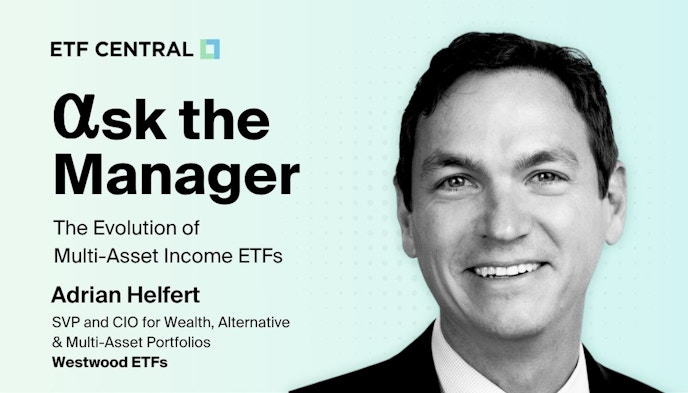
Ask the Manager: Adrian Helfert on the Evolution of Multi-Asset Income ETFs
Westwood CIO Adrian Helfert discusses how regulatory change, tactical multi-asset allocation, and covered calls are seeking to reshape income ETFs through YLDW.

Keep up with what matters in ETFs
Get timely ETF insights, market trends, and top ideas straight to your inbox.
Your newsletter subscriptions with us are subject to ETF Central's Privacy Policy and Terms and Conditions.
As the ETF wrapper continues to reshape how investors access active and outcome-oriented strategies, multi-asset income has emerged as a key area of innovation. Regulatory changes, growing demand for sustainable yield, and increased flexibility around derivatives have enabled managers to build more dynamic portfolios inside an ETF structure. We spoke with Adrian Helfert, Senior Vice President and Chief Investment Officer for Wealth, Alternative and Multi-Asset Portfolios at Westwood, to discuss how multi-asset ETFs have evolved, the role of tactical allocation and covered calls, and what differentiates Westwood’s YLDW strategy in a crowded income landscape.
How has the ETF structure evolved and changed the way investors and advisors access tactical strategies like multi asset strategies, especially compared to traditional mutual funds or separately managed accounts?
Global ETF Survey 2026 is Live!
With 1,790 new products launched by July 2026, choosing is harder than ever. Our Global ETF Survey 2026, built on 620 professional investors and allocators, shows how active, fixed income, options-based and thematic ETFs are reshaping fund selection.
The game changed in 2019–2020 with the SEC's ETF Rule and Derivatives Rule. Before that, launching an ETF meant a lengthy exemptive relief process with the SEC — case by case, sponsor by sponsor. Now there's a uniform framework, which we believe has helped shorten time to market for active managers.
More importantly, the derivatives rule gave us a workable framework for using options and other instruments within an ETF structure. That opened the door for products like YLDW, where we're not just holding a basket of other ETFs to get multi-asset exposure — at scale we're owning individual securities across equities, fixed income, preferreds, and other income sources, plus running a disciplined covered-call overlay. Most multi-asset ETFs are essentially funds of funds. We're doing the work at the security level, which gives us more flexibility to find income where it's actually available.
How can tactical flexibility in asset classes like preferreds, convertibles, or other hybrid securities enhance a traditional stock-and-bond mix in an ETF?
Yield doesn't sit still. Where you find attractive income today — whether that's investment-grade corporates, preferreds, or MLPs — may look very different six months from now depending on Fed policy, credit spreads, or what's happening globally. A static 60/40 portfolio can't adapt to that.
With tactical flexibility, we can lean into areas where we're being compensated for the risk and pull back when valuations get stretched. Preferreds are a great example — there are times when they offer equity-like yields with bond-like characteristics, and other times when the risk-reward just isn't there. Having the latitude to move across hybrid securities lets us find income opportunities that a rigid stock-and-bond mix would miss entirely.
Covered-call strategies have gained popularity — what should investors understand about the trade-offs between income generation and upside participation and how can investors use these in their portfolio?
The trade-off is straightforward: you're selling some upside in exchange for current income. When you write a call, you collect premium, but if the stock rallies through your strike price, you've capped your participation. In a strong bull market, that's a drag.
What often gets missed is that most markets are not persistent bull markets. They tend to be range-bound or modestly positive. In those environments, covered calls can generate repeatable income that does not rely on dividends or interest rates. Within a diversified multi-asset framework like YLDW, the covered-call component is one of several income drivers rather than the entire strategy. For investors prioritizing income consistency, it can be an effective tool.
Income remains a top priority for many investors. In your view, what makes a sustainable income stream in a diversified portfolio?
Sustainable income means avoiding reliance on a single source. If income is driven entirely by dividends, it depends on corporate payout decisions. If it comes solely from fixed income, it is fully exposed to interest-rate movements. Each approach has limitations.
A more durable income profile comes from diversifying the sources of income themselves. That includes dividends, option premiums from covered calls, distributions from preferreds and MLPs, and interest across the fixed income spectrum. YLDW is structured around that principle. When one source becomes less attractive, others can contribute, helping maintain income across different market environments.
With investors increasingly seeking reliable income, how can a multi-asset approach help enhance yield without taking concentrated risk in a single asset class?
The diversification principle is just as important during decumulation as it is during accumulation — arguably more so. Concentrating income in one asset class ties cash flow to the performance of that segment of the market.
A multi-asset income approach spreads that risk. In YLDW, income is generated from equities, fixed income, hybrid securities, and options. If credit spreads widen, the portfolio is not entirely dependent on corporate bonds. If dividend equities lag, other income sources remain in place. The objective is to reduce reliance on any single driver of income.
What is YLDW’s investment strategy?
YLDW
The strategy is actively and tactically managed rather than constrained by a static allocation. Positioning is adjusted based on relative valuations and risk-adjusted income opportunities. The covered-call component is integrated into portfolio construction rather than added opportunistically, with the goal of delivering a consistent income profile across market conditions.
What sets you apart from your peers?
Many income ETFs are single-asset or single-strategy products — dividend equity funds, bond funds, or standalone covered-call strategies. Multi-asset offerings are often structured as funds of funds, which limits flexibility and adds another layer of fees.
YLDW combines tactical multi-asset allocation, systematic covered-call income, and an income-first objective within a single structure. The portfolio primarily holds individual securities rather than other ETFs, allowing for security-level positioning across asset classes. The covered-call approach is rules-based and repeatable, integrated into the overall portfolio design. That combination of diversification, flexibility, and systematic income generation can be difficult to replicate in a single ETF.
About Adrian Helfert
Adrian Helfert is Senior Vice President and Chief Investment Officer for Wealth, Alternative and Multi-Asset Portfolios at Westwood. He leads the firm’s multi-asset strategies group, overseeing the Income Opportunity and Flexible Income strategies, as well as Global Convertibles and Fixed Income strategies.
Prior to joining Westwood, Adiran Helfert served as Managing Director and Senior Multi-Asset Portfolio Manager at Amundi in London, where he was responsible for Global Fixed Income strategies and worked on absolute return, unconstrained, and total return portfolios over a 13-year tenure. He was a member of Amundi’s Architect Committee, contributing to the strategic direction of Global Fixed Income Investments. Earlier in his career, he held roles at Royal Bank of Scotland and JPMorgan Asset Management.
He holds an MBA from Duke University’s Fuqua School of Business and a bachelor’s degree in physics from the University of Virginia, where he received a fellowship in Solid State Physics. He also served as a Combat Medic in the U.S. Navy / Marine Corps.
Please note this article is for information purposes only and does not in any way constitute investment advice. It is essential that you seek advice from a registered financial professional prior to making any investment decision.
To determine if this Fund is an appropriate investment for you, carefully consider the Fund’s
investment objectives, risk factors and charges and expenses before investing. This and other information can be found in the Fund’s prospectus which may be obtained by downloading at westwoodetfs.com or calling 800.994.0755. Please read the prospectus carefully before investing.
For illustrative purposes only. No investment strategy or process can guarantee performance results.
Exchange Traded Funds (ETFs) are subject to market risk, including the possible loss of principal. The value of the portfolio will fluctuate with the value of the underlying securities. ETFs trade like a stock, and there will be brokerage commissions associated with buying and selling exchange traded funds unless trading occurs in a fee-based account. ETFs may trade for less than their net asset value.
Investors should consider an ETF’s investment objective, risks, charges, and expenses carefully before investing. The prospectus, which contains this and other important information, is available from your Financial Advisor and should be read carefully before investing. Investing in ETFs may not be suitable for all investors. ETFs are subject to loss of principal and there is no guarantee the holdings will continue to pay dividends.
Diversification does not ensure a profit and may not protect against loss in declining markets. Investors should refer to the individual ETF prospectus for a more detailed discussion of the specific risks and considerations for an individual ETF.
Covered Call Strategy Risk: This risk arises when an investor holds a long position in a stock and simultaneously sells a call option against it. While this strategy can generate income, it limits potential upside gains if the stock price rises significantly above the strike price of the option. Counterparty Risk: This is the risk that a counterparty to a financial transaction will
default on their obligations. In the context of options trading, counterparty risk arises from the possibility that the option seller (writer) may not be able to fulfill their obligation to deliver the underlying asset if the option expires in-the-money. Options Risk/Flex Options Risk: This refers to the inherent risks associated with trading options, such as the risk of losing the
entire premium paid for an option if it expires out-of-the-money. Flex options risk is a specific type of options risk that arises from the flexibility of flex options, which can be adjusted or exercised under certain conditions. Portfolio Turnover Risk: This is the risk associated with frequent buying and selling of assets within a portfolio. High portfolio turnover can lead to increased transaction costs, potential capital gains taxes, and the possibility of missing out on potential gains from assets that are sold too early.
Westwood ETFs does not provide tax advice. Please consult your tax advisor before making any decisions or taking any action based on this information.
Westwood ETFs are distributed by Northern Lights Distributors, LLC. (Member FINRA) Northern Lights Distributors and Westwood ETFs (or Westwood Holdings Group, Inc.) are separate and unaffiliated.

Latest ETF News
See all ETF newsAsk the Manager: Pieter Vorster on the NICO ETF and the Nicotine Transition
Ask the Manager: Tian Yang on Capital Cycle Investing and the VPX ETF


Ask the Manager: Kenneth Wong on Building the Next Wave of ETF Innovation, from Options to Korea's AI Semiconductor Opportunity





 Advantages of ETFs over Mutual Funds1/6
Lower Costs
In this guide, we'll explore the advantages of ETFs over mutual funds, giving you valuable insights into why ETFs have gained significant popularity among investors like yourself.
Leveraged ETFs: Unlocking the Potential for Amplified Returns1/6
Understanding Leveraged ETFs
Explore leveraged ETFs: potential for amplified returns & risks. 5 ETFs to consider across equities, commodities & fixed income.
What is a Leveraged ETF?1/6
Introducing Leveraged and Inverse ETFs
In this guide, we'll dive into the world of leveraged ETFs, exploring their definition, mechanics, potential risks, and rewards.
Recent educational content
First Look ETF
First Look ETF: Income, International, and Cash Flow ETFs
In this season 6 episode of First Look ETF, Stephanie Stanton @etfguide examines the latest ETF marketplace trends with NYSE and guests.


ETF Trends
ETF Industry KPIs October 5, 2026
This week’s KPI data overview highlights key metrics and trends shaping the ETF landscape.

ETF Trends
ETF Industry KPIs September 28, 2026
This week’s KPI data overview highlights key metrics and trends shaping the ETF landscape.
ETF Trends
ETF Industry KPIs September 22, 2026
This week’s KPI data overview highlights key metrics and trends shaping the ETF landscape.
Browse all educational columns



ETFs’ Next Act: From Access to Selection
With 1,790 new products launched by July 2026, choosing is harder than ever. Our Global ETF Survey 2026, built on 620 professional investors and allocators, shows how active, fixed income, options-based and thematic ETFs are reshaping fund selection.