Explore professionally built ETF model portfolios. Discover now →



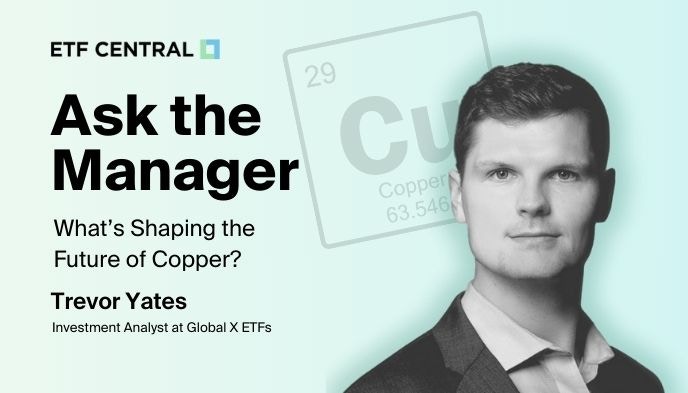
Ask the Manager: What’s Shaping the Future of Copper?
Global X Investment Analyst Trevor Yates breaks down copper’s investment case in this edition of Ask the Manager.

Keep up with what matters in ETFs
Get timely ETF insights, market trends, and top ideas straight to your inbox.
Your newsletter subscriptions with us are subject to ETF Central's Privacy Policy and Terms and Conditions.
Welcome to Ask the Manager, ETF Central's exciting new series where we sit down with top experts, analysts and portfolio managers to dive into the hottest investment trends, market updates, and economic insights.
This week, we sat down with Trevor Yates, Investment Analyst at Global X ETFs, to chat about what’s going on in the copper market.
Trevor breaks down the trends shaping its future, the opportunities for investors, and some challenges to keep an eye on.
Copper prices have come under pressure since the U.S. election. What are you expecting to see in the copper market heading into 2025?
We continue to see any short-term volatility in the copper price as a potentially interesting entry point for longer-term investors. The market’s recent focus has been mainly on the impact of tariffs, which, if implemented, are widely expected to slow global GDP growth and in turn weigh on cyclical demand for copper.
The strong move higher in Treasury yields and the US Dollar have also weighed on the metal. This comes despite physical market fundamentals improving, with this activity seen as prebuying ahead of potential tariffs.
Looking ahead, the market remains uncertain in the short term, with the impact of expected tariffs on global growth hard to forecast. At the end of the day we believe that tariffs will be primarily used as a means for negotiation, likely proving to be more temporary in nature. We also see the possibility of a larger stimulus out of China if tougher trade policies are put in place, which will help support the copper price as China remains the largest buyer of the metal.
Beyond this scenario analysis, we continue to wait for a meaningful recovery in the global manufacturing and industrial sectors before we see prolonged momentum in the copper price.
We also see demand from more structural drivers, such as electrification, decarbonization, and now investments in artificial intelligence, to remain very resilient regardless of the above outcomes, helping support the price during any short-term periods of volatility.
How is the copper demand profile set to change over the coming decades and what does that mean for the market?
Copper’s long-term demand outlook remains robust, underpinned by structural global megatrends such as electrification, decarbonization, and artificial intelligence.
This portion currently only represents 15-20% of the global mix, with the other 80-85% of copper demand remaining heavily tied to cyclical sectors, such as construction, machinery and transportation. Looking ahead we do expect this mix to continue to shift, over time reducing the metal’s cyclicality and supporting prices during times of weaker economic growth.
We see this expected shift in the copper market as particularly important for miners, with this already bearing fruit for current producers. This faster growing structural demand has helped support the copper price amid the cyclical demand weakness experienced over recent years, absorbing all the incremental supply over that time period.
This has resulted in copper prices remaining above the cost curve throughout the business cycle, allowing miners to generate a record level of cash in 2024.
How big of a role does China play in the global copper market and what risks or opportunities does this present?
China remains the largest player in the global copper market, representing more than half of global demand. However, it is worth noting the evolution in Chinese demand over recent years. The weakness in the country’s property sector is well known and shows up in the data, with the construction sector demand declining from 25% of the mix to just 15% in 2023.
Despite this weakness, China’s total copper demand grew over 80% during that time period. What occurred was the property sector weakness was offset by robust investments in the country’s electrical grid infrastructure, automotive sector, and renewables, all areas that remain very well aligned with the long-term goals of the Chinese Communist Party.
All this to say, prolonged weakness in the Chinese housing and construction sectors presents a moderate risk to demand, but we expect continued growth in other segments offsetting this impact while a larger stimulus in 2025 remains an additional short-term catalyst.
The Global X Copper Miners ETF (COPX) takes a slightly different approach to exposing investors to copper and prioritizes exposure to copper mining companies. What factors informed the decision to hone in on mining companies?
We view copper miners as the best way for investors to capitalize on the metal’s longer-term bullish price outlook. Copper miners have historically provided higher leverage to a change in copper prices while also offering a dividend as a margin of safety. Therefore, our bullish long-term outlook on copper pushes us to own miners in order to fully capitalize on the expected price appreciation.
We also favor existing producers due to the lack of new high-quality projects, increasing jurisdictional risk, and the deteriorating economics around investing in greenfield projects, which all point to growing scarcity value for miners with existing longer-term production profiles.
Finally, the copper market has been unique throughout the current business cycle, with the supply-demand balance keeping the metal’s price well above the cost curve during the current period of weak global industrial growth.
We expect, barring any significant slowdown in global growth, this trend to continue, positioning copper miners to generate cash throughout the cycle and in turn reducing balance sheet concerns and risks surrounding capital allocation.
As a result, we see COPX constituents as not only being beneficiaries of rising copper prices but also becoming increasingly scarce assets over time, both of which should support earnings growth as well as multiples.
What drove inflows for COPX in 2024 and what tailwinds are you looking for in the new year?
The inflows into COPX in 2024 show that investors understand and appreciate the compelling long-term structural investment case for copper mining equities. Beyond the rally witnessed in the second quarter of 2024, investors built their positions towards the latter part of the year given the weakness in copper prices.
Investors saw tariff related risks priced into the commodity and related equities, a global industrial and manufacturing cyclical trough nearing, and speculation over incremental stimulus out of China growing, representing a key catalyst. Investors also value the diversification qualities COPX adds to a portfolio, with it acting as an effective inflation hedge.
What investments make up the Global X COPX fund? How is it structured?
The Global X Copper Miners ETF (
The fund’s structure provides investors with the liquidity, tax efficiency, transparency, and low-fee benefits of an ETF, while the fund holds the diverse set of names to help protect investors from any idiosyncratic operational risks associated with individual companies.
What are miners’ valuations today compared to historical levels?
COPX’s underlying index trades at a forward PE ratio of ~13x and an EV/EBITDA ratio below 6x, within one standard deviation of its five-year historical average. The index is also forecasted to offer a ~2.3% dividend yield as a margin of safety for investors.
It is important to note that copper miners have historically traded at higher multiples during periods of low copper prices and at lower multiples during periods of elevated copper prices, given the implied terminal value and mean reversion tendencies of commodities.
Therefore, it is important for investors to not only look at multiples when valuing copper miners, but also look at the implied medium to long-term copper price assumptions imbedded in those valuations and weigh it against their own outlook for the underlying commodity.
What global factors are you monitoring that could catalyze further tailwinds for the copper market?
Copper showed tremendous resiliency in 2023 and 2024 in the face of the sharp slowdown in global manufacturing and industrial activity, remaining above the cost curve despite the global PMIs being in contractionary territory for 23 of the last 28 months. Therefore, the main opportunity we see for copper prices in the short-term is a reversal of this trend, with any cyclical upswing expected to push the price meaningfully higher.
And we got a glimpse of this in the second quarter or 2024, with copper prices rising above the $11k level when global PMIs expanded, albeit for a short six-month period. We see increased levels of stimulus out of China representing a potential key catalyst to spark this rebound.
Beyond this cyclical upswing opportunity, a weaker US Dollar, lower interest rates, and faster structural demand growth could all act as further potential tailwinds for copper in the new year.
How may the incoming administration in the US impact copper prices?
This is the key question when looking at the short-term outlook, with the Trump administration’s impact very uncertain. Although we recognize that tariffs could potentially weigh on global growth, we continue to believe these policies will be used more as a means for negotiation and therefore prove to be temporary in nature.
We also recognize the potential for China, the world’s largest consumer of copper, to announce new stimulus measures in response to these tariffs, helping offset any impact. Beyond tariffs, we continue to monitor the impact possible policy changes have on the trajectory of growth and inflation, as well as the US Dollar.
Looking past this potential short-term volatility, the incoming administration doesn’t alter our view on the structural demand drivers for copper, with the long-term outlook remaining very much intact. As a result, we remain positive on copper heading to 2025, with this short-term volatility potentially representing an interesting entry point for longer-term investors.
Where is the downside to an investment in copper?
We believe the main risk to investing in copper is associated with global growth, with any sharp slowdown in the global economy set to weigh on the copper price. Investors need to understand that the copper price and their related equities will come under pressure if we do see a slowdown, which could potentially push prices below the cost curve, causing miners to burn cash and possibly lead to balance sheet and liquidity concerns.
However, it is worth noting that copper prices have remained well above the cost curve despite the current weak demand environment, with the quickly growing structural demand absorbing the incremental supply and allowing miners to generate record cash in 2024.
Beyond global growth, incremental supply as well as macro variables, such as the USD and interest rates, could also weigh on the copper price.
How should investors think about copper compared to other metals like gold – which has had a very strong year – silver, or platinum?
Copper should be seen as an industrial metal, with its demand, and therefore price, remaining very correlated to the global industrial and manufacturing cycle. This aspect of copper makes the metal’s correlation to traditional assets higher, while it also trades with higher levels of volatility.
This is very much in contrast to gold, which is far less volatile than industrial metals, while its demand characteristics are less correlated to those of traditional assets.
Silver and platinum possess cyclical drivers akin to copper but also share similar safe-haven demand as gold, putting them somewhat in the middle of the spectrum between gold and copper in terms of cyclicality.
Global ETF Survey 2026 is Live!
With 1,790 new products launched by July 2026, choosing is harder than ever. Our Global ETF Survey 2026, built on 620 professional investors and allocators, shows how active, fixed income, options-based and thematic ETFs are reshaping fund selection.
About Trevor Yates
Trevor Yates joined Global X in 2023 as an Investment Analyst on the Emerging Markets team. Trevor spent the previous two years working at Mirae Asset with the same team. Before breaking into finance, Trevor was a professional hockey player in the AHL and ECHL. He graduated from Cornell with a degree in Applied Economics and Management in 2018. Trevor was born in Germany and raised in Montreal, Canada.
Please note this article is for information purposes only and does not in any way constitute investment advice. It is essential that you seek advice from a registered financial professional prior to making any investment decision.

Latest ETF News
See all ETF newsAsk the Manager: Pieter Vorster on the NICO ETF and the Nicotine Transition

Ask the Manager: Tian Yang on Capital Cycle Investing and the VPX ETF


Ask the Manager: Kenneth Wong on Building the Next Wave of ETF Innovation, from Options to Korea's AI Semiconductor Opportunity





 Advantages of ETFs over Mutual Funds1/6
Lower Costs
In this guide, we'll explore the advantages of ETFs over mutual funds, giving you valuable insights into why ETFs have gained significant popularity among investors like yourself.
Leveraged ETFs: Unlocking the Potential for Amplified Returns1/6
Understanding Leveraged ETFs
Explore leveraged ETFs: potential for amplified returns & risks. 5 ETFs to consider across equities, commodities & fixed income.
What is a Leveraged ETF?1/6
Introducing Leveraged and Inverse ETFs
In this guide, we'll dive into the world of leveraged ETFs, exploring their definition, mechanics, potential risks, and rewards.
Recent educational content

First Look ETF
First Look ETF: Income, International, and Cash Flow ETFs
In this season 6 episode of First Look ETF, Stephanie Stanton @etfguide examines the latest ETF marketplace trends with NYSE and guests.


ETF Trends
ETF Industry KPIs October 5, 2026
This week’s KPI data overview highlights key metrics and trends shaping the ETF landscape.

ETF Trends
ETF Industry KPIs September 28, 2026
This week’s KPI data overview highlights key metrics and trends shaping the ETF landscape.
ETF Trends
ETF Industry KPIs September 22, 2026
This week’s KPI data overview highlights key metrics and trends shaping the ETF landscape.