Explore professionally built ETF model portfolios. Discover now →



Ask the Manager: Why the Restaurant Industry Deserves a Look
Managing Director and COO at AdvisorShares Dan Ahrens sheds light on how restaurants are adapting to changing consumer trends, creating opportunities for investors.


Keep up with what matters in ETFs
Get timely ETF insights, market trends, and top ideas straight to your inbox.
Your newsletter subscriptions with us are subject to ETF Central's Privacy Policy and Terms and Conditions.
Welcome to Ask the Manager, ETF Central's exciting new series where we sit down with top experts and portfolio managers to dive into the hottest investment trends, market updates, and economic insights.
This week, we sat down with Dan Ahrens, Managing Director and the Chief Operating Officer of AdvisorShares to explore the investment potential within the restaurant industry.
Dan discusses key factors driving this sector's growth, including evolving consumer preferences and the transformative impact of technology.
Why is the Restaurant Industry an Attractive Investment Opportunity for Investors?
The restaurant industry is a vital part of global consumption, offering a blend of resilience and growth potential. It’s defined by steady demand, flexibility in adapting to changing consumer preferences, and opportunities in areas such as convenience options, technology, and premium products.
Over the past six years, most restaurant spending shifted toward mid-tier establishments, reducing the market share of both high-end and budget-friendly options, according to internal data from Bank of America.
However, since the fall of 2023, this trend has reversed, with value-tier restaurants gaining market share, high-end establishments declining, and mid-tier restaurants stabilizing. (2)
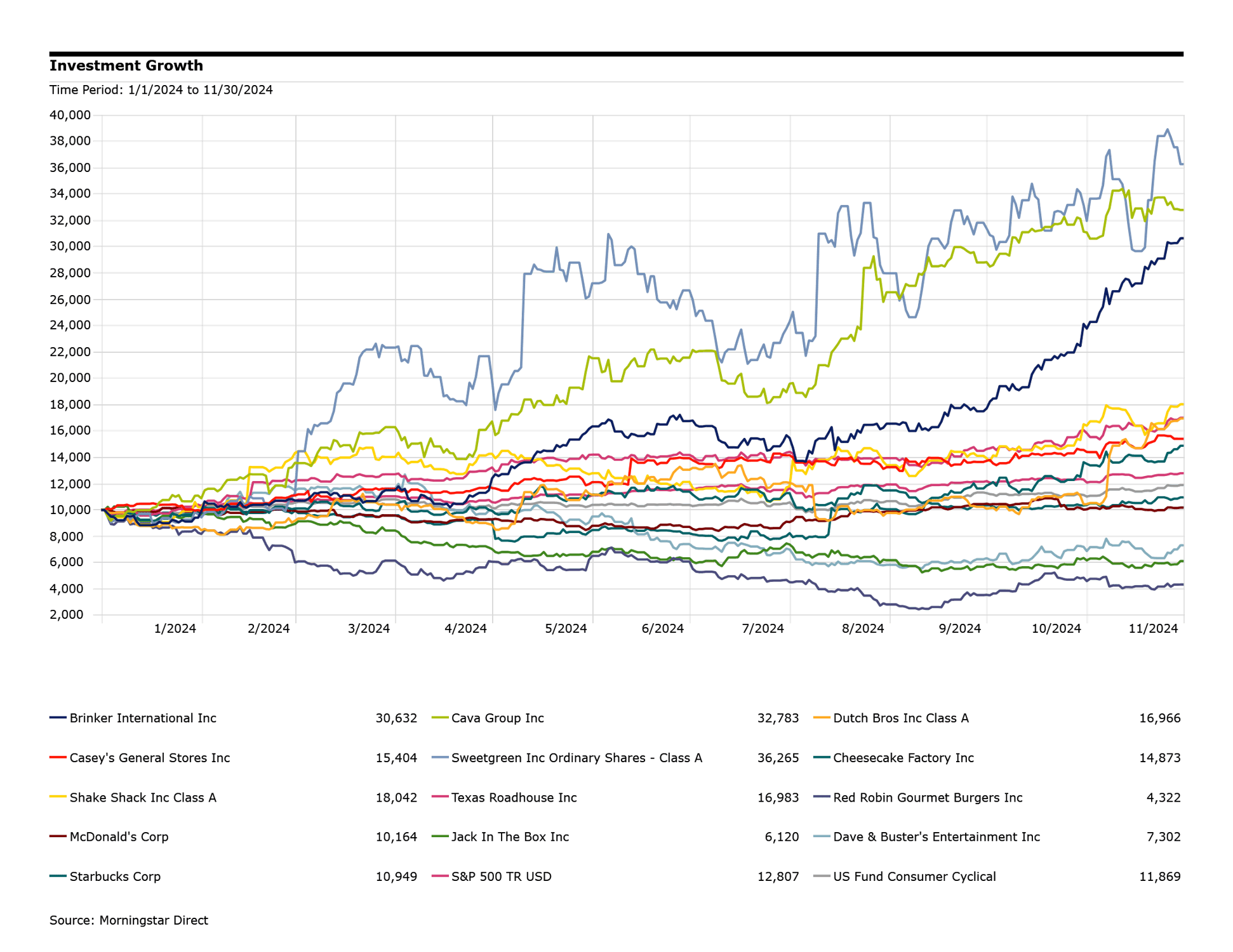
This shift is mirrored in the broader restaurant market, where some establishments are outperforming in the S&P 500 and Consumer Cyclicals, while others lag behind—underscoring the importance of careful stock selection in the restaurant sector.
What Are the Key Challenges Facing the Restaurant Industry Today?
The restaurant industry faces a key challenge post-pandemic: a stretched consumer base dealing with inflation across various sectors. As consumers become more price-conscious, restaurants must deliver compelling value propositions to attract and retain customers.
Restaurants have responded by raising prices significantly and while this has bolstered revenue, it has also increased price sensitivity among customers. This has been particularly felt in the fast-food segment, which has struggled more than other categories.
While some areas have struggled, mid-tier chains like Chili’s (Brinker) and Texas Roadhouse have managed to maintain consumer interest by offering an appealing balance of value and experience. These brands provide a comparable price point to fast food but with the added benefits of a fuller dining experience, which seem to resonate well with consumers.
Broadly, the industry as a whole has embraced technology and social media to drive engagement, allowing restaurants to connect with consumers in new and innovative ways.
Why Should Investors Consider Focused Exposure to the Restaurant Industry?
Investing in the restaurant industry allows investors to capitalize on long-term consumption trends and emerging growth opportunities. Unlike broader consumer-focused funds, which may include unrelated industries, a focused investment approach hones in on businesses directly tied to food production, dining trends, and distribution.
This targeted strategy leverages the stability of essential food demand alongside growth opportunities fueled by innovation, such as plant-based alternatives, direct-to-consumer models, and the rising appeal of high-quality, value-added products. It also potentially allows investors to benefit from the industry's defensive nature during market downturns while capitalizing on growth during periods of expansion.
In 2023, Americans allocated just 44.3% of their food budget to groceries for home cooking, marking a historic low. Meanwhile, spending on dining out and takeout soared to a record-high 55.7%, a trend that has continued through 2024. (1)
How Do Broader Market Trends Impact the Restaurant Industry?
Broader market trends, such as inflationary pressures, economic cycles, and technological advancements, significantly influence the restaurant industry. Rising commodity prices can affect profit margins, while economic uncertainty may push consumers toward affordable yet high-quality dining experiences, including fast-casual and quick-service restaurants.
Additionally, the growing popularity of plant-based diets, sustainable packaging solutions, and the integration of AI in restaurant management are creating new growth opportunities for industry leaders and disruptors alike. The increasing reliance on third-party delivery platforms and the expansion of digital loyalty programs also signal a shift in how businesses connect with consumers.
What Are You Watching Closely in this Industry for the Short Term?
Key factors to monitor include:
- Commodity Prices: Changes in the cost of key inputs like grains, dairy, and packaging materials, which affect profitability.
- Consumer Behavior: Shifts in spending patterns, particularly in response to inflation and seasonal demand, such as increased spending on experiential dining and the growing appeal of digital ordering platforms.
- Regulatory Changes: New policies related to health, nutrition labeling, and environmental impact that could influence industry practices.
- Industry Innovation: The emergence of subscription-based meal services, digital loyalty programs, and sustainable practices as drivers of growth and differentiation.
- Industry Consolidation: Mergers and acquisitions as companies seek to expand their portfolios or acquire innovative startups.
By keeping an eye on these developments, investors can better position themselves to capture both the stability and the innovation driving the restaurant industry forward.
Get data on 14,000+ ETFs
Access Trackinsight's reliable and comprehensive data with 500M+ points on 14,000+ ETFs.
Investing in Restaurants with EATZ ETF
With Dan's insights, we can highlight that investors can gain exposure to the restaurant industry through the EATZ ETF. The AdvisorShares Restaurant ETF (EATZ) is the only actively managed ETF dedicated to the restaurant and food service sector. This unique fund allows investors to invest in alignment with their personal dining preferences, encompassing a wide array of establishments such as restaurants, bars, pubs, fast-food outlets, takeout services, and catering businesses.
As of November 30, 2024, EATZ has achieved an impressive 5-star Overall Morningstar Rating, reflecting its strong risk-adjusted returns among 48 funds in the Consumer Cyclical category.
The fund is heavily weighted towards U.S. companies, with more than 90% of its assets allocated to American firms as of the same date.
Its market capitalization distribution includes 11% large-cap, 40% mid-cap, and 48% small-cap stocks.
As of December 24, 2024, EATZ consists of 23 holdings, with the top ten making up 57% of the total portfolio:
- Brinker International Inc (EAT): 8.52%
- Dutch Bros Inc-Class A (BROS): 7.43%
- Texas Roadhouse Inc (TXRH): 6.04%
- Yum China Holdings Inc (YUMC): 5.68%
- Darden Restaurants Inc (DRI): 5.40%
- US Foods Holding Corp (USFD): 5.03%
- El Pollo Loco Holdings Inc (LOCO): 4.80%
- Cheesecake Factory Inc/The (CAKE): 4.67%
- Performance Food Group Co (PFGC): 4.67%
- Aramark (ARMK): 4.61%
EATZ trades on the NYSE and features an expense ratio of 0.99%, following fee waivers and expense reimbursements.
About Dan Ahrens
Dan Ahrens is a Managing Director and the Chief Operating Officer of AdvisorShares. He is the portfolio manager of several AdvisorShares ETFs, including the AdvisorShares Restaurant ETF (EATZ) and manages over one billion in assets across several investment strategies. In addition, Dan has been recognized several times as a top performing Morningstar manager in various categories.
He carries over 20 years of experience in the financial services industry serving in a variety of senior-level capacities and is the author of several books on investing. Additionally, Mr. Ahrens has appeared on numerous financial programs including CNBC, CNN, Fox Business, ABC News and Bloomberg and has been featured, along with funds under his management in major national and trade publications including The Economist, the New York Times, Financial Times, and The Wall Street Journal.
Sources:
- https://www.escoffier.edu/blog/world-food-drink/consumer-dining-trend-statistics/
- https://institute.bankofamerica.com/economic-insights/restaurants-quantity-the-new-quality.html
- Morningstar Direct
Please note this article is for information purposes only and does not in any way constitute investment advice. It is essential that you seek advice from a registered financial professional prior to making any investment decision.


Latest ETF News
See all ETF news
Ask the Manager: Kenneth Wong on Building the Next Wave of ETF Innovation, from Options to Korea's AI Semiconductor Opportunity

Ask the Manager: Kristof Gleich on Why AI Is Becoming an Asset Class

Ask the Manager: Vince Lorusso on Active Equity in an AI-Driven Market





 Advantages of ETFs over Mutual Funds1/6
Lower Costs
In this guide, we'll explore the advantages of ETFs over mutual funds, giving you valuable insights into why ETFs have gained significant popularity among investors like yourself.
Leveraged ETFs: Unlocking the Potential for Amplified Returns1/6
Understanding Leveraged ETFs
Explore leveraged ETFs: potential for amplified returns & risks. 5 ETFs to consider across equities, commodities & fixed income.
What is a Leveraged ETF?1/6
Introducing Leveraged and Inverse ETFs
In this guide, we'll dive into the world of leveraged ETFs, exploring their definition, mechanics, potential risks, and rewards.
Recent educational content

ETF Trends
ETF Industry KPIs September 8, 2026
This week’s KPI data overview highlights key metrics and trends shaping the ETF landscape.

ETF Trends
ETF Industry KPIs August 31, 2026
This week’s KPI data overview highlights key metrics and trends shaping the ETF landscape.
ETF Trends
ETF Industry KPIs August 24, 2026
This week’s KPI data overview highlights key metrics and trends shaping the ETF landscape.
What’sTheFund
What's the Fund | Ocean Park Diversified Income ETF (DUKZ)
James St Aubin, Chief Investment Officer at Ocean Park Asset Management, discuss the DUKZ ETF, exposing investors to the whole spectrum of asset classes in the fixed income markets, through their rules-based process.

Browse all educational columns



Active Trader Report: Use of Leveraged & Inverse ETFs Way Up
Direxion partnered with Compound Insights and Vanda to explore what’s driving the evolution of active trading — and how active traders are using leveraged and inverse funds across equities, single stocks, commodities, and volatility.