NYSE CRTR Economy Event Watch the replay →



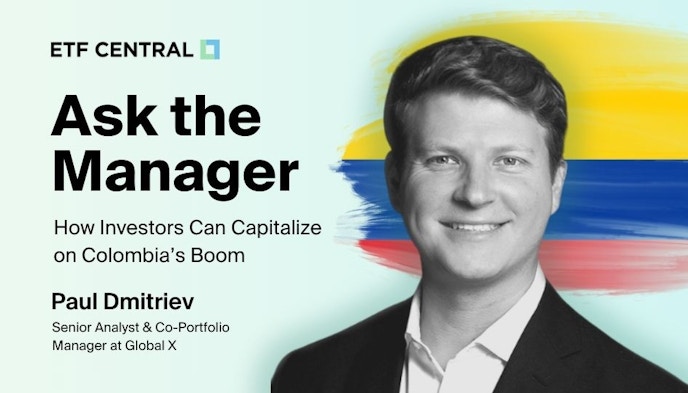
Ask the Manager: Paul Dmitriev on How Investors Can Capitalize on Colombia’s Boom
Paul Dmitriev explains why Colombia is 2025’s top-performing market, what’s driving its rally, and how investors can capitalize on its economic resurgence.

Keep up with what matters in ETFs
Get timely ETF insights, market trends, and top ideas straight to your inbox.
Your newsletter subscriptions with us are subject to ETF Central's Privacy Policy and Terms and Conditions.
In this edition of Ask the Manager, we caught up with Paul Dmitriev, Senior Analyst & Co-Portfolio Manager at Global X, to discuss the recent strong performance of Colombia’s stock market and its positioning as an attractive deep value opportunity in emerging markets.
Dmitriev shares insights into the factors driving Colombia’s growth, investor sentiment, and the outlook for the country’s economy and political landscape.
Colombia is the best performing country so far in 2025 and Global X noted that Colombia is an attractive deep value play in its 2025 Emerging Markets Outlook. What factors have spurred economic growth for the country?
Colombia is up just over 28% YTD, with the rally only starting after the weekend spat between President Petro of Colombia and President Trump over accepting deportations. Importantly the incident had two main impacts.
First, it led to a derisking on the political front, and second, it put the market’s focus back on Colombia’s improving fundamentals and macro outlook. At 7x P/E, 1x P/Bk, and with a ~7% dividend yield, Colombia was always an interesting deep value play, it just lacked a catalyst.
On the political front we’ve seen investors looking for other potential reform stories that might rhyme with the Argentina case. President Petro’s popularity has remained low below 40% for some time now, but nearly 80% of Colombian’s disagreed with his handling of the incident with the United States.
The acceptance of deportations led to an improvement in market sentiment, and allowed investors to begin looking at the upcoming May 2026 Presidential election as Petro is unable to run again (by law) and signals a return to the center-right politically.
Historically, Colombia has had a very credible policy framework, and a return to orthodox economic policies could lead to a market re-rating similar to Argentina’s, especially given the market was trading at 33% discount to its 10yr P/Bk ratio.
Improvement in the underlying drivers of the economy had also gone under the radar. A credible policy framework combined with a high interest rate environment over the past two years has helped reign in inflation down to 5.2% at YE24 (from 9.46% at YE23), while supporting a reduction in domestic and external imbalances.
The CB has already started a rate cutting cycle since December 2023, cutting 375bps to 9.5% with room for another 100-200bps of cuts. High energy (oil) prices have also supported the economy.
After several years of decreasing FDI and domestic investment, companies are finally starting to discuss the potential for a new capex cycle ahead of 2026 elections – this is a stark change from the last time I visited Colombia.
Tax reform that was announced at year-end is also aiming to support infrastructure investment rather than social spending and wealth transfers. In turn, Colombia’s 1.7% growth rate in 2024 is forecast to accelerate to 2.5% in 2025 and I see further upside risk.
Global X’s MSCI Colombia ETF (GXG) has seen significant inflows since the beginning of this year. What’s driving inflows and how does GXG’s performance reflect broader investor sentiment towards Colombia right now?
GXG is the first and only Colombia focused ETF listed in the US. But GXG is more than that – Global X’s first fund was in Colombia (HCOLSEL), and we have boots on the ground to this day. In turn, our relationship and roots run deep in the Colombian market, and that helps differentiate the fund as well.
Bigger picture, not only has GXG outperformed locally listed funds, but the broad rally has reflected a deep desire to find another Argentina 2.0 story. Furthermore, the 3-4% FX appreciation has been another tailwind for the market.
Which industries are most important to Colombia’s economy and how can investors capitalize on them?
Broadly, we view energy and agriculture as the two main industries in Colombia, while construction, manufacturing, and mining are also relevant. Oil revenues are an especially important source of income for the country’s fiscal accounts, especially given the high level of external debt that needs a source of dollars.
Financials are another important sector of the economy and we are seeing banks show signs of stabilization in asset quality coupled with improving costs of risk, while loan demand should also begin to grow. At the same time, banks are benefiting from the higher for longer interest rate environment.
Given the difficulty accessing individual names in Colombia, I believe GXG is the best instrument for broad exposure to the positive drivers behind Colombia. The fund is roughly 45% financials, 19% utilities, and 17% energy, which gives you exposure to the largest most liquid and fastest improving segments of the economy.
What investments make up your GXG fund? How is it structured?
GXG is a passive ETF listed on the NYSE that invests in the largest and most liquid Colombian blue-chip securities. The fund seeks to provide results that generally correspond to the performance of the MSCI All Colombia Select 25/50 index. There are currently 24 holdings. Bancolombia, Ecopetrol, and ISA are the three largest holdings.
What internal and external factors are you monitoring that could catalyze further tailwinds for Colombia?
First and foremost, the US is Colombia’s main trading partner representing 29% of exports and 26% of imports so it is vital that Colombia continues playing ball. Petro has shown he is willing and we believe the next administration will be even more US friendly.
We believe markets will continue to price in positive change, and elections will be the main market focus. Second, the Country’s external debt is sizeable at nearly 50% of GDP, so the outlook for oil revenues will matter for the country’s fiscal balances.
Higher for longer energy prices or any positive changes in policy or announcements from Ecopetrol or the Government would drive the market higher. The Current Account Deficit is projected to have narrowed and should continue to do so as foreign trade share normalizes and services exports remain above pre-pandemic levels.
The outlook from the Central Bank also matters. Given Colombia imports ~50% of goods, the CB closely tracks the level of the peso. There is still room for a further narrow easing cycle of another 100-200bps ahead, which would support investment and consumption growth.
Two other areas we are monitoring include the push from the Government for more structural reforms – although they will likely be very targeted or watered down – and the improvement in treatment of minority shareholders since 2021. On the former, weak popularity and losses in regional elections have tempered Petro’s ability to implement draconian changes.
On the latter, we have seen two important changes from corporates since 2021 driven by the Gilinski takeover attempt of a Grupo Empresarial Antioqueno (GEA) company. The first is increased transparency from corporates and willingness to speak with the market. The second has been a gradual increase in dividends, which provides an additional cushion for investing in Colombia.
How could upcoming elections in 2026 impact Colombia’s trajectory?
Petro’s popularity has declined, and he cannot run for re-election so markets are starting to price in a return toward economic orthodoxy. After years of underinvestment firms are starting to discuss capex plans again, which would be positive for growth and consumption.
The last time our team visited Colombia every CEO we met with was looking for investments outside of Colombia given low visibility on domestic growth and Government policy; now the mindset is starting to change for the first time in several years. Improving sentiment would also drive a recovery in FDI, which had been declining.
Although we do not have clear candidates from either side, the most important fact remains – Petro will have to leave office as he cannot run again, and Colombia’s strong institutional framework under a center-right leader could rapidly unlock the country’s full growth potential.
Do you believe Colombia’s economic growth is sustainable? Is there still time for investors to profit on the trade?
Yes, we believe Colombia’s economic growth is sustainable, with further room for upside based on the following:
Midterm election losses and low popularity imply limited ability for further reforms from Petro, capex investment is just starting, the country’s current and fiscal balances continue to improve, additional rate cuts ahead as inflation ebbs, higher oil prices for longer, and a significant improvement in underlying financial system indicators with loan just starting to pick up.
Furthermore, the continued integration of Venezuelan migrants provides additional upside to potential GDP growth as the overall increase in the labor force has been a net positive for both investment and consumption.
The World Bank estimates they could boost GDP by 0.7-0.9% p.a. over the medium to long-term. Finally, remittances have grown to represent a meaningful 3.5% of GDP from just above 1% in 2014, which we believe can be sustainable.
What could go wrong? Where is the downside in an investment in Colombia?
Although we continue to see a strong margin of safety in Colombia given deeply discounted valuations, worsening fiscal balances, declining oil prices, and low investor sentiment and corporate confidence are the main risks we are following. However, that is not our base case and we remain optimistic on the outlook for Colombia.
Get data on 14,000+ ETFs
Access Trackinsight's reliable and comprehensive data with 500M+ points on 14,000+ ETFs.
About Paul Dmitriev
Paul is a Senior Analyst & Co-Portfolio Manager at Global X. Paul joined Global X in 2023 as a Senior Analyst on the global EM strategies and co-portfolio manager on the EM regional funds. Paul spent the previous six years at Mirae Asset working on the Emerging Market equity strategies focused on Latin America and EEMEA. Paul began his career in 2013 at HSBC as a research analyst covering credit and equity across Industrials, Energy, and Utilities. Paul holds a Bachelor of Science from NYU Stern School of business, where he focused on economics, finance, and political science. Paul was born in Ukraine and grew up in Boston.
Please note this article is for information purposes only and does not in any way constitute investment advice. It is essential that you seek advice from a registered financial professional prior to making any investment decision.
Segments
See all
Mentioned ETFs
No specific ETFs were tagged
Further reading


Latest ETF News
See all ETF newsAsk the Manager: Vince Lorusso on Active Equity in an AI-Driven Market

Ask the Manager: Michelle Cluver on Using Model Portfolios to Scale Your Business

Ask the Manager: Jacob Hemmer on Discipline in an AI-Driven Market

Ask the Manager: Dr. Maria Milina on Artificial Intelligence and What to expect in 2026



 Advantages of ETFs over Mutual Funds1/6
Lower Costs
In this guide, we'll explore the advantages of ETFs over mutual funds, giving you valuable insights into why ETFs have gained significant popularity among investors like yourself.
Leveraged ETFs: Unlocking the Potential for Amplified Returns1/6
Understanding Leveraged ETFs
Explore leveraged ETFs: potential for amplified returns & risks. 5 ETFs to consider across equities, commodities & fixed income.
What is a Leveraged ETF?1/6
Introducing Leveraged and Inverse ETFs
In this guide, we'll dive into the world of leveraged ETFs, exploring their definition, mechanics, potential risks, and rewards.
Recent educational content
ETF Trends
ETF Industry KPIs May 20, 2026
The ETF Industry saw 44 New Launches, 3 Mutual Fund Conversions and 9 closures last week.

Asset TV
The ETF Show - Politics Becomes Investable Trade through ETFs
Dan Weiskopf, Senior Portfolio Manager at Tidal Financial Group spoke with the ETF Show about Subversive ETFs that help investors trade like politicians.

First Look ETF
First Look ETF: Healthcare Inflation, Emerging Markets, and Bitcoin ETFs
In this season 6 episode of First Look ETF, Stephanie Stanton @etfguide examines the latest ETF marketplace trends with NYSE and guests.

Asset TV
The ETF Show - Upcoming SpaceX IPO Fuels Space Exploration ETF Boom
The anticipated SpaceX IPO has fueled a boom of space exploration ETFs and investors have poured hundreds of millions into these funds to gain access to the space economy.
Browse all educational columns



Expert-Built ETF Portfolios, All in One Place
Don’t start from scratch. Discover ready-made ETF portfolios built by professionals to match different goals, timelines, and market views. Use them as inspiration or as a starting point for your own allocation.