Keep tabs on your favorite ETFs with a personalized weekly tracker. Create a Watchlist now →



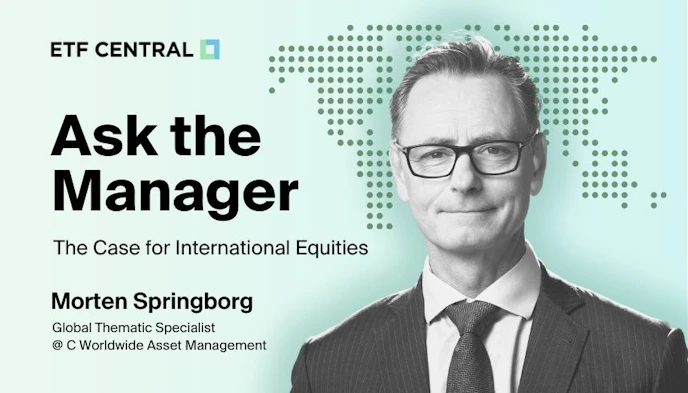
Ask the Manager: Morten Springborg on the Case for International Equities
Is U.S. equity dominance peaking? Morten Springborg says it’s time for investors to look abroad.

Keep up with what matters in ETFs
Get timely ETF insights, market trends, and top ideas straight to your inbox.
Your newsletter subscriptions with us are subject to ETF Central's Privacy Policy and Terms and Conditions.
Welcome to Ask the Manager, ETF Central's new series where we sit down with top experts, analysts and portfolio managers to dive into the latest investment trends, market updates, and economic insights.
This week, we sat down with Morten Springborg, Global Thematic Specialist at C WorldWide Asset Management, to explore why U.S. investors should consider international equities right now.
With U.S. market dominance stretched by years of outperformance, rising fiscal risks, and policy uncertainty, Springborg argues that the tide may be turning—and that long-term opportunities lie abroad.
From navigating volatility to building high-conviction portfolios, Springborg shares how his team invests through change with a focus on predictability and structural growth.
If you were a U.S. investor, why would you be looking at International Equities right now?
The U.S. constitutes 4% of the world population, 25% of the world GDP, and 35-40% of world corporate profits, but years of outperformance have taken the U.S. to 66% of world equity market capitalization.
The Trump administration is seeking to completely rewrite the global security, trading, and reserve asset framework while at the same time restructuring the domestic economy away from government-driven growth towards the growth of the private sector.
Unprecedented changes like this have the capacity to also drive unprecedented changes to capital markets with significant regional effects.
The growth of the U.S. economy and corporate profitability have been unsustainably boosted by high fiscal deficits. Large fiscal deficits inject liquidity into the economy, stimulating demand and thereby increasing corporate revenues and profits.
This dynamic has been a significant driver of the U.S. equity market's outperformance over the past decade, as no other large economy has been a more prolificate spender than the U.S. However, should policies aimed at reducing the federal deficit, such as those advocated by the "DOGE” succeed, the impact on corporate profits could be substantial.
A reduction in deficits would decrease the liquidity injected into the economy, potentially in the short to medium term, leading to lower aggregate demand and, consequently, reduced corporate profits.
In addition, the unpredictability of tariffs has eroded business and consumer confidence. Falling asset prices, particularly equity markets, could lead to significant consumer retrenchment because of wealth effects. As reported in a recent Wall Street News article, 10% of the wealthiest are responsible for 50% of U.S. consumption¹.
Finally, the overvaluation of the USD plays a central role in the MAGA view on the reasons for the U.S. predicament. The USD needs to depreciate to balance trade and move manufacturing back to the States. And this analysis has its merits.
The USD is as strong (overvalued) as it has ever been since 1985 when we saw the Plaza Accord. Adding up these factors, one can easily imagine a future where lower earnings, lower capital flows into the US and therefore at lower USD combined with a lower equity market multiple, reverses the flywheel that was the basis for the US exceptionalism.
US equity market share relative to global equity markets could be in the early innings of a “reversing to the mean”, which could take the share closer to 50% than 70% currently.
This is an opportune time for the long-term focused U.S. investor to allocate to assets outside the U.S.
With market volatility and heightened economic uncertainty, how do you navigate this complex and dynamic investment environment?
We knew that the election of President Trump would stir equity markets, and we have now learned that unpredictability is a key instrument in his political toolbox. As international equity investors, we need to navigate this new reality, and it creates a more uncertain market outlook, at least in the short term.
However, we see our long-term mindset with a focus on structural growth themes and trends of particular value in this environment. You can say that the value of predictability goes up when uncertainty increases, and we have always prioritized investments with high predictability of growth over the magnitude of growth.
In this uncertain policy regime, owning companies that are difficult to replicate or replace is the clearest margin of safety. Our job is not to predict the next move in tariffs, elections, or geopolitics. It’s to build a portfolio centered on durable businesses where:
- Thematic trends and themes are tailwinds
- Pricing power is structural
- Demand is inelastic
- Strategic positioning is clear and resilient
We focus on areas where we have differentiated insight and can underwrite long-term outcomes with confidence—and we avoid areas that require guessing.
Passive investments have continued to gain market share to around 50%, with a trendline growth of around 2-3% per year. How do these rising passive investment flows impact the equity market?
Allocating capital based on market cap (and not risk-adjusted return expectations) is dangerously close to the operating system of the former Soviet Union, where capital was allocated to the most significant (employers) to support the system’s stability, not to grow the system. We know how that ended.
As flows are increasingly being allocated to market cap-based investment structures and because the bigger the market cap, the lower the relative liquidity, this will have a more significant pricing impact for larger companies, where the inelasticity is greatest, see the chart below:
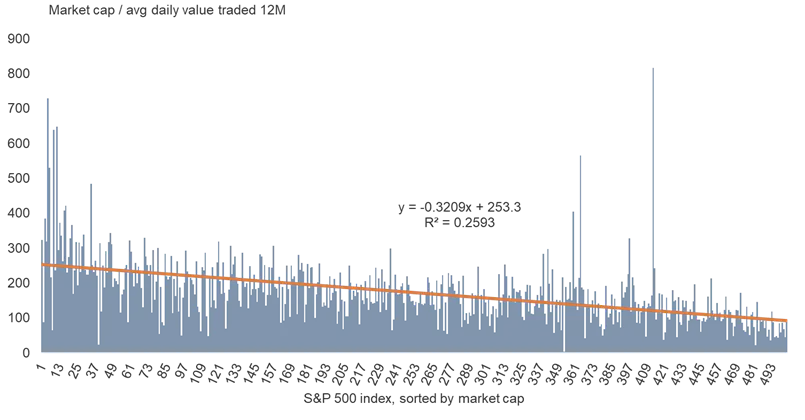
Source: C WorldWide Asset Management, January 2025
This needs to be repeated because we were amazed when we learned this: the relative liquidity of large market capitalization stocks is lower than that of lower market cap stocks. For example, Apple’s market cap is 187 times larger than Clorox’s. Still, the difference in average daily traded volumes is only 35 times, i.e., in relative terms, Clorox is 5 times more liquid than Apple.
This is an essential explanation for the rising concentration of indices in the US. When passive (free float-adjusted) market cap flows hit the market, they impact the largest stocks the most. While passive investment flows have democratized access to the equity markets and provided cost-effective diversification, their long-term implications could lead to significant market distortions, increased volatility, and systemic risks. Passive investment flows have led to increased market concentration and self-inflated returns, making it both a challenge and an opportunity for active managers to outperform, as returns are concentrated in a few large stocks.
What qualities do you look for in a company?
We look for sustainable compounders with resilient business models, pricing power, robust balance sheets, stable free cash flows, high returns on invested capital and a compounding growth outlook.
We favor companies that plan to maintain their relevance for decades and emphasis is placed on identifying quality companies with strong moats around their business models that enable them to compound earnings over time.
While we insist that the companies we own will grow free cash flow over time driven by top-line and bottom-line results, we also emphasize sustainability over the magnitude of growth. We reject the notion that a more rapid grower will by definition generate higher returns. We generally reject the very aggressive growth stocks, and we avoid the non-growers.
Our sweet spot is predominantly the sustainable growers of earnings and free cash flow in the 5% to 25% range while emphasizing companies with a high level of existing and potential cash conversion abilities.
It gets back to our emphasis on the predictability of growth. The most aggressive companies are the most vulnerable to earnings disappointments, overvaluation, multiple fades, and competitive business pressures.
We assess companies based on their expected risk/reward profile, our understanding of their long-term strategy, competitive advantages, and alignment with structural themes - all through the lens of sustainability.
What are your views on the merits of portfolio concentration?
Owning a high-conviction portfolio has been deeply rooted in our philosophy and the backbone of our day-to-day work for over 30 years. There are many reasons for this, but we will focus on three:
- The client gets better value for their active management fees. As we see it, the only reasons a manager would opt for high levels of stock diversification would be based on a lack of knowledge about the companies they own, or to protect their business risk at the expense of client returns.
- We own a maximum of 30 companies and apply a one-in-one-out methodology. This requires consistent prioritization of relative risk and return projections and assures that our best thinking finds its way into portfolios.
- It is a terrific approach to risk control. If we were forced to own more stocks, we would have a riskier portfolio because we would not understand our holdings as well. There is a natural limit to the number of companies a decision maker or a decision team can truly understand and follow.
We have chosen 30 companies because we believe it provides the optimal combination of return potential, specialized knowledge, and diversification to control absolute volatility.
Footnotes
¹ America's Richest 10% Now Account for Nearly Half of All Consumer Spending (https://www.wsj.com/livecoverage/stock-market-today-dow-sp500-nasdaq-02-24-2025/card/america-s-richest-10-now-account-for-nearly-half-of-all-consumer-spending-ShGXpvc48BvPigHjkKyu)
Get data on 14,000+ ETFs
Access Trackinsight's reliable and comprehensive data with 500M+ points on 14,000+ ETFs.
About Morten Springborg
Morten Springborg is a Global Thematic Specialist at C WorldWide Asset Management with more than 30 years of investment experience. With his 20 years of experience as a portfolio manager, Morten works with trends and themes that support compounding-based investment in carefully selected companies with responsible and sustainable business models - companies that improve over time.
Please note this article is for information purposes only and does not in any way constitute investment advice. It is essential that you seek advice from a registered financial professional prior to making any investment decision.
Segments
See all
Mentioned ETFs
No specific ETFs were tagged
Further reading

Latest ETF News
See all ETF newsAsk the Manager: Pieter Vorster on the NICO ETF and the Nicotine Transition

Ask the Manager: Tian Yang on Capital Cycle Investing and the VPX ETF

Ask the Manager: Kenneth Wong on Building the Next Wave of ETF Innovation, from Options to Korea's AI Semiconductor Opportunity




 Advantages of ETFs over Mutual Funds1/6
Lower Costs
In this guide, we'll explore the advantages of ETFs over mutual funds, giving you valuable insights into why ETFs have gained significant popularity among investors like yourself.
Leveraged ETFs: Unlocking the Potential for Amplified Returns1/6
Understanding Leveraged ETFs
Explore leveraged ETFs: potential for amplified returns & risks. 5 ETFs to consider across equities, commodities & fixed income.
What is a Leveraged ETF?1/6
Introducing Leveraged and Inverse ETFs
In this guide, we'll dive into the world of leveraged ETFs, exploring their definition, mechanics, potential risks, and rewards.
Recent educational content

ETF Trends
ETF Industry KPIs October 5, 2026
This week’s KPI data overview highlights key metrics and trends shaping the ETF landscape.

ETF Trends
ETF Industry KPIs September 28, 2026
This week’s KPI data overview highlights key metrics and trends shaping the ETF landscape.
ETF Trends
ETF Industry KPIs September 22, 2026
This week’s KPI data overview highlights key metrics and trends shaping the ETF landscape.
First Look ETF
First Look ETF: Income, Corporate Arbitrage, and Growth and Value Investing
First Look ETF September 2026: iCapital, Mast Investments and North Square unpack new ETFs targeting monthly income, merger arbitrage and complementary growth and value exposure.

Browse all educational columns



Expert-Built ETF Portfolios, All in One Place
Don’t start from scratch. Discover ready-made ETF portfolios built by professionals to match different goals, timelines, and market views. Use them as inspiration or as a starting point for your own allocation.