Create, analyze, optimize your ETF portfolio. Start now →



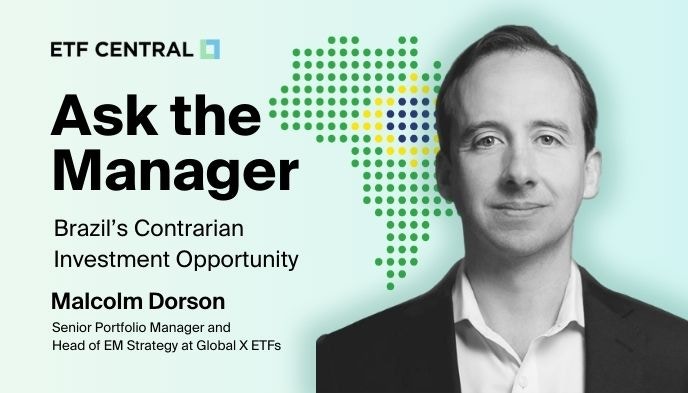
Ask the Manager: Malcolm Dorson on Brazil’s Contrarian Investment Opportunity
Senior Portfolio Manager and Head of Emerging Markets Strategy Malcolm Dorson shares his outlook on Brazil, key investment opportunities, and how BRAZ is positioned for growth.

Keep up with what matters in ETFs
Get timely ETF insights, market trends, and top ideas straight to your inbox.
Your newsletter subscriptions with us are subject to ETF Central's Privacy Policy and Terms and Conditions.
Malcolm Dorson, Senior Portfolio Manager and Head of Emerging Markets Strategy at Global X is back for another round of the "Ask the Manager" series.
In our last discussion, Malcolm shared insights on Argentina’s economic transformation under President Milei’s reforms and how these changes are making the country a compelling investment destination.
Today we talk we discuss Brazil—why it’s personal for him, where he sees opportunity, and how the BRAZ ETF is positioned to potentially benefit.
Can you introduce a bit of your background and connection to Brazil?
Brazil is a significant part of my personal, academic, and professional life. Though born in New York, I moved to Sao Paulo shortly thereafter and spent the first seven years of my life in the country. This was a seamless move for our family, as my mother was born and raised in Brazil as well.
Academically, I minored in Latin American studies as an undergrad at the University of Pennsylvania and then earned my Masters in International Studies with a focus on Brazil, from the Lauder Institute, while I was also earning my MBA at The Wharton School of Business.
Since grad school, I have been 100% focused on Emerging Markets, first as a Latin America analyst at Ashmore Group and then as a portfolio manager at Mirae and Global X, where I have been managing Brazil and other Emerging Market funds since 2015.
Given the above, managing BRAZ, the first actively managed Brazil ETF on the market, is a dream come true.
Global X tracks Brazilian equities through its Brazil Active ETF (BRAZ). What is the fund’s investment philosophy and how does it differentiate vs. other Brazil funds?
The Global X Brazil Active ETF (
The fund charges a low 75bp management fee and 0% performance fee, which we think compares well with local actively managed hedge funds.
Additionally, BRAZ benefits from the beauty of the ETF structure in that it offers intraday transparency, intraday liquidity, low minimums, and the potential for tax efficiency. The structure also allows for prospects to come in and out of the fund regardless of size, as liquidity is determined by underlying shares and not by the ETFs daily volume.
You recently published a 2025 Emerging Markets Outlook which highlights Brazil as a contrarian idea. Where do you see opportunities for investment in the country, considering that the Brazilian economy has struggled to flourish under its current executive branch?
After delivering some of the worst 2024 returns in Emerging Markets, Brazil couldn’t be more interesting right now. The market has hit peak pessimism, which could set it up for a dynamic 2025 rally. Despite an attractive backdrop of low unemployment, mid-single-digit inflation, and better-than-expected GDP data, the executive branch continues to get in the way of the country’s potential economic strength via a lack of fiscal orthodoxy.
By not making progress towards a balanced budget, the government has put the onus on the Central Bank. We believe Brazil needs fiscal consolidation much more than monetary tightening, but the government has failed to deliver, which means the Central Bank has been forced to pick up the slack.
This means higher interest rates, more capital moving from equities to bonds, and more redemptions in the local investment community. On the bright side, this could be creating a generational opportunity to buy high quality companies at distressed valuations.
Interest rates will likely peak around 15% this summer, just at the time when the market begins to focus on 2026 elections. It appears less likely that the current administration will stay in office, and the two other front-runners are centered politicians with more orthodox economic views and respect from the market. The combination of the above could unleash a violent rally and investors can be paid a healthy dividend to wait for it.
How do you see the next two years playing out in Brazil?
The beauty of our bottom-up investment process is that we don’t need a crystal ball, but need to be sure we’re with the right compounders. However, if forced to predict 2025 and 2026 I would forecast that first the Central Bank will keep raising the SELIC rate to somewhere between 15-16%, which will give Brazil the highest real rate in the world. This will not only crush inflation, but it will also begin to draw in international flows looking to benefit from a carry trade.
These flows should support the currency to well below 6 again, which will also help reduce inflation expectations and allow the Central Bank to begin cutting interest rates again. Towards the end of the year, I believe we could see President Lula announce that he will step aside for the 2026 elections, which would put current Finance Minister Haddad and governor of Sao Paulo, Tarcisio de Freitas, in-line as front-runners for 2026.
The market will digest this as the end of fiscal radicalism and a return towards pragmatism, and a chance for Brazil to unleash its true economic potential. The biggest risk to this thesis is the current administration picking up spending into 2026 in order to increase the party’s popularity, but with a centered congress and senate, I think it will be difficult to be too disruptive.
How will Brazil’s part in the growing BRICS bloc impact the country’s future? Could we see some of their goals like de-dollarization and common currency plans come to fruition?
I don’t see a common BRICs currency as any kind of realistic framework within the next decade. The process of forming the Euro and the EU took over thirty years, its success as an economic entity is still very much a question mark.
When you look at the countries joining the BRICS block, a common currency will be much more challenging than anything we saw in Europe. This is due to drastic political swings, dependence on different commodities, fiscal deficits, inflation, and more.
Why would a stable country like the UAE want to tie its currency to Ethiopia? Why would India rely on Iran for any kind of economic stability? US politics aside, I just don’t see this coming to fruition.
What does history suggest about buying Brazilian equities at today’s levels, and how should that impact how investors are thinking about putting money into a fund like BRAZ?
Looking at an analysis from one week ago, buying Brazil at last Friday’s levels historically yielded about 9% over the next month with a hit ratio of 74%. 7.5x earnings with a dividend yield of 6.7% sounds like a good entry point.
How is investing in Brazil different than investing in other Emerging Markets? Brazil is unique for a few reasons.
First, it offers a dynamic US dollar hedge. Looking at history, the MSCI Brazil Index rallies roughly 5% for every 1% decline in the U.S. Dollar Index (DXY). Second, Brazil comes with low geopolitical risk. The country has been and should continue to be isolated from headwinds in Russia, Ukraine, Palestine, and the South China Sea. Last, Brazil is a commodity powerhouse.
The country has a U.S. dollar buffer from its diversified commodity exports across iron ore, soybeans, cattle, and oil. Brazil boasts a trade surplus and is the second largest exporter of food in the word (number one on a net basis). Brazil is also a key exporter of fossil fuels. The country plans to expand oil production to the point of being the fourth largest oil producer in the world by 2029.
Can you highlight a few names in the fund that one won’t find in the normal benchmarks?
Absolutely. BRAZ holds various names overlooked by the benchmark including Arcos Dorados - the largest McDonalds franchiser in Latin America, Mercado Libre – Latin America’s dominant e-commerce provider, Vivara – Brazil’s leading jewelry retailer, Dirrecional – a real estate company with a roughly 14% dividend yield. The fund also holds ERO Copper, a Brazilian Copper miner that trades on the Toronto exchange. We can go on with others, but I encourage you to check out the fund directly as well!
What are the risks associated with investment in Brazil?
Like many Emerging Markets, investing Brazil comes with various risks including government debt, a fiscal burden, and more. We currently believe that most risks are priced in and that Brazil looks like an interesting contrarian opportunity.
Like what you're reading?
Stay in the loop — get the latest ETF insights: trends, analysis, and expert picks.
About Malcolm Dorson
Malcolm Dorson is a senior portfolio manager for Emerging Market equities and head of EM Strategy at Global X Management Company. Malcolm has been managing global, regional, and country specific EM strategies within Mirae Asset Global Investments (Global X parent company) since 2015. Prior to joining Mirae, Malcolm was the lead Latin America investment analyst at Ashmore Group from 2013 to 2015. From 2009 to 2011, Malcolm was an assistant Vice President within Citigroup’s Private Bank focusing on asset management. Malcolm began his career in 2006 as an analyst on the convertible securities team at Deutsche Bank. Malcolm holds an M.B.A. from the Wharton School (concentration in Finance), an M.A. in International Studies (concentration in Latin America) from the Lauder Institute, and a Bachelor of Arts degree from the University of Pennsylvania. Malcolm is a US and Brazilian citizen and spent his childhood in Sao Paulo, Brazil.
Please note this article is for information purposes only and does not in any way constitute investment advice. It is essential that you seek advice from a registered financial professional prior to making any investment decision.


Latest ETF News
See all ETF newsAsk the Manager: Pieter Vorster on the NICO ETF and the Nicotine Transition
Ask the Manager: Tian Yang on Capital Cycle Investing and the VPX ETF

Ask the Manager: Kenneth Wong on Building the Next Wave of ETF Innovation, from Options to Korea's AI Semiconductor Opportunity



 Advantages of ETFs over Mutual Funds1/6
Lower Costs
In this guide, we'll explore the advantages of ETFs over mutual funds, giving you valuable insights into why ETFs have gained significant popularity among investors like yourself.
Leveraged ETFs: Unlocking the Potential for Amplified Returns1/6
Understanding Leveraged ETFs
Explore leveraged ETFs: potential for amplified returns & risks. 5 ETFs to consider across equities, commodities & fixed income.
What is a Leveraged ETF?1/6
Introducing Leveraged and Inverse ETFs
In this guide, we'll dive into the world of leveraged ETFs, exploring their definition, mechanics, potential risks, and rewards.
Recent educational content

First Look ETF
First Look ETF: Income, International, and Cash Flow ETFs
In this season 6 episode of First Look ETF, Stephanie Stanton @etfguide examines the latest ETF marketplace trends with NYSE and guests.


ETF Trends
ETF Industry KPIs October 5, 2026
This week’s KPI data overview highlights key metrics and trends shaping the ETF landscape.

ETF Trends
ETF Industry KPIs September 28, 2026
This week’s KPI data overview highlights key metrics and trends shaping the ETF landscape.
ETF Trends
ETF Industry KPIs September 22, 2026
This week’s KPI data overview highlights key metrics and trends shaping the ETF landscape.