Create, analyze, optimize your ETF portfolio. Start now →



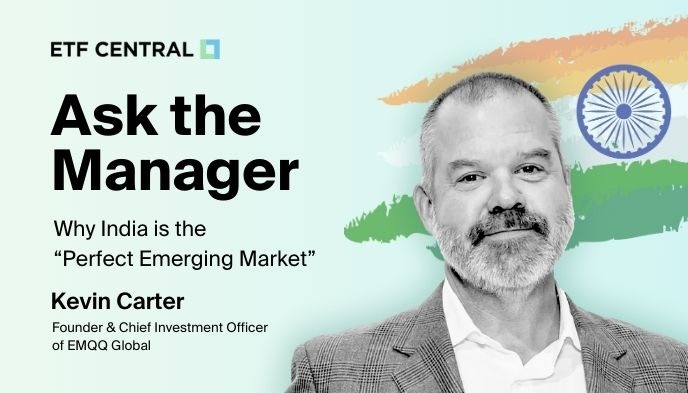
Ask the Manager: Kevin Carter on Why India is the "Perfect Emerging Market"
Founder & CIO of EMQQ Global, Kevin Carter, shares insights on the digital revolution in Emerging Markets and why India is at the forefront of this transformation.

Keep up with what matters in ETFs
Get timely ETF insights, market trends, and top ideas straight to your inbox.
Your newsletter subscriptions with us are subject to ETF Central's Privacy Policy and Terms and Conditions.
In this edition of Ask the Manager, we caught up with Kevin Carter, Founder & Chief Investment Officer of EMQQ Global, to explore how internet-driven businesses are revolutionizing Emerging Markets and why India might be the biggest opportunity yet.
Your team focuses exclusively on the Internet sector in Emerging Markets. Why?
We believe the Emerging Markets internet sector is the fastest growing part of Emerging Markets. There are 6.5 billion new consumers who are getting their first ever smartphone and internet access.
Because many have also never had a bank account, credit card, debit card, automobile, or even direct access to a supermarket, people living in Emerging Markets are leapfrogging traditional consumption and are in many ways more digital than we are in the U.S.
Additionally, almost all of the Emerging Market internet companies are led by founders who went to the best colleges in the world and have been funded by U.S. institutional investors - creating a strong foundation of corporate governance, especially relative to the legacy companies and state-owned enterprises that often dominate traditional indexes.
You often refer to India as the “perfect emerging market.” What makes you think this?
The reason investors are interested in Emerging Markets is because those countries have larger, younger populations, driving a boom in consumption and faster growth than developed countries. India is not just number one in most of those but it's number one by a long way. India has the largest population in the world.
Each day it is setting a new record as the largest population ever. India’s demographics are fantastic, with nearly 750 million people under the age of 30. India has the world's fastest GDP growth at 6.5%. When you add all of these things together, it will appear that India will have higher consumption than China in about 20 years.
What’s your outlook for India over the next few years and beyond?
We don't make any predictions about the Indian stock market in the short term, but in the long term, we believe the Indian internet sector is poised for significant growth. As discussed, it really appears to be the perfect Emerging Market on paper.
India also has a strong leader in Prime Minister Modi, who has invested significantly in the country's physical infrastructure. On top of that, India has incredible human capital and a 50 year old tech sector that includes giants like Infosys and TCS, which have developed India's technology sector for decades.
What are the biggest similarities and differences between India and China? Is India like China 15 years ago when it was just taking off?
The main similarities between China 15 years ago and India today are the size of the population. India has about 1.4 billion people today, many of which are youth. The per capita GDP numbers in India are similar to what China's were 15 years ago.
In comparison, India, of course, is also not just a democracy but the world's largest and well functioning democracy. Another important difference is that 15 years ago, nearly no one in the world had a smartphone, and today, in India, you can get a brand new smartphone for $12.
You spent a month in India last November, traveling and meeting with companies. What were your main takeaways from that trip?
The first takeaway is the growth of e-commerce and wealth in second and third-tier cities - beyond India's mega cities like Delhi and Bombay - is growing at over 50%. In these areas, there are massive infrastructure projects currently underway, making the location much more connected.
To appreciate the scale and scope of India's infrastructure efforts, you really have to see it with your own eyes. Finally, India's digital public infrastructure, aka the India stack, really is a secret weapon that investors have yet to fully understand or appreciate. The digitization of India is happening everywhere, especially when it comes to mobile phone payments.
What is the “India Stack,” and why is it transforming India's digital economy?
The India stack is India's proprietary digital public infrastructure. It includes several layers that operate together to digitize the country. The foundation is a digital identification system called Aadhaar. Today, 95% of the country is in the database and by having had their fingers and eyes scanned.
This allows citizens to open bank accounts, get mobile phones and do other things in minutes rather than hours or days. The second layer is a payments layer that allows for real-time instant digital payments with no cost or friction called the unified payments interface or UPI. Using this system India's economy has gone from 95% paper-based currency to about 80% digital in only seven years.
You are particularly excited about “quick commerce” in India. What is quick commerce, and why is it disrupting the local e-commerce market in India?
Quick Commerce is the delivery of almost anything you want in ten minutes or less. This service is exploding in popularity in India. Quick commerce works particularly well in large cities with dense populations where rather than needing a giant distribution center every 10 miles, there are now mini warehouses packed with 10,000 items every mile.
Delivery drivers on mopeds and scooters pick up items from the mini warehouse and drop them at the consumer store.
The leading companies are Zomato and Swiggy, both of which are included in all three of our strategies.
The Indian IPO market has been very active, particularly in the tech space. What’s driving that?
The Indian IPO Market was the most active in the world in 2024. This is being driven by a number of factors, including a very vibrant domestic base of both individual and institutional investors.
Are there any downside risks to India?
Like all Emerging Market, investing in India can come with risks. There is a key man risk in Prime Minister Modi who really is the embodiment of the India growth story today. Its growing population of young people will require a lot of job creation.
The country has also had a history of religious and ethnic conflicts along with significant climate exposure as heat and flooding (like in many other areas of the world) have been a problem.
Get data on 14,000+ ETFs
Access Trackinsight's reliable and comprehensive data with 500M+ points on 14,000+ ETFs.
About Kevin Carter
Kevin T. Carter is the Founder & Chief Investment Officer of EMQQ Global. While he principally considers himself an active “value” investor, he has collaborated with Princeton economist and indexing legend, Dr. Burton G. Malkiel, for more than 20 years. Their work together began in 1999 when Carter founded eInvesting, a pioneer firm in fractional share brokerage acquired by ETRADE in 2000. In 2002 they co-founded Active Index Advisors, a pioneer in “direct indexing” acquired by Natixis Asset Management in 2005. In 2006, their efforts turned to China and Emerging Markets as they launched several China-focused ETFs on the NYSE with Guggenheim Partners. Mr. Carter founded EMQQ Global in 2014 and launched The Emerging Markets Internet ETF on the NYSE on November 12, 2014. Since then, EMQQ Global has launched the India Internet ETF (INQQ) and Next Frontier Internet ETF (FMQQ).
Please note this article is for information purposes only and does not in any way constitute investment advice. It is essential that you seek advice from a registered financial professional prior to making any investment decision.


Latest ETF News
See all ETF news
Ask the Manager: Kenneth Wong on Building the Next Wave of ETF Innovation, from Options to Korea's AI Semiconductor Opportunity
Ask the Manager: Kristof Gleich on Why AI Is Becoming an Asset Class

Ask the Manager: Vince Lorusso on Active Equity in an AI-Driven Market





 Advantages of ETFs over Mutual Funds1/6
Lower Costs
In this guide, we'll explore the advantages of ETFs over mutual funds, giving you valuable insights into why ETFs have gained significant popularity among investors like yourself.
Leveraged ETFs: Unlocking the Potential for Amplified Returns1/6
Understanding Leveraged ETFs
Explore leveraged ETFs: potential for amplified returns & risks. 5 ETFs to consider across equities, commodities & fixed income.
What is a Leveraged ETF?1/6
Introducing Leveraged and Inverse ETFs
In this guide, we'll dive into the world of leveraged ETFs, exploring their definition, mechanics, potential risks, and rewards.
Recent educational content

ETF Trends
ETF Industry KPIs September 8, 2026
This week’s KPI data overview highlights key metrics and trends shaping the ETF landscape.

ETF Trends
ETF Industry KPIs August 31, 2026
This week’s KPI data overview highlights key metrics and trends shaping the ETF landscape.
ETF Trends
ETF Industry KPIs August 24, 2026
This week’s KPI data overview highlights key metrics and trends shaping the ETF landscape.
What’sTheFund
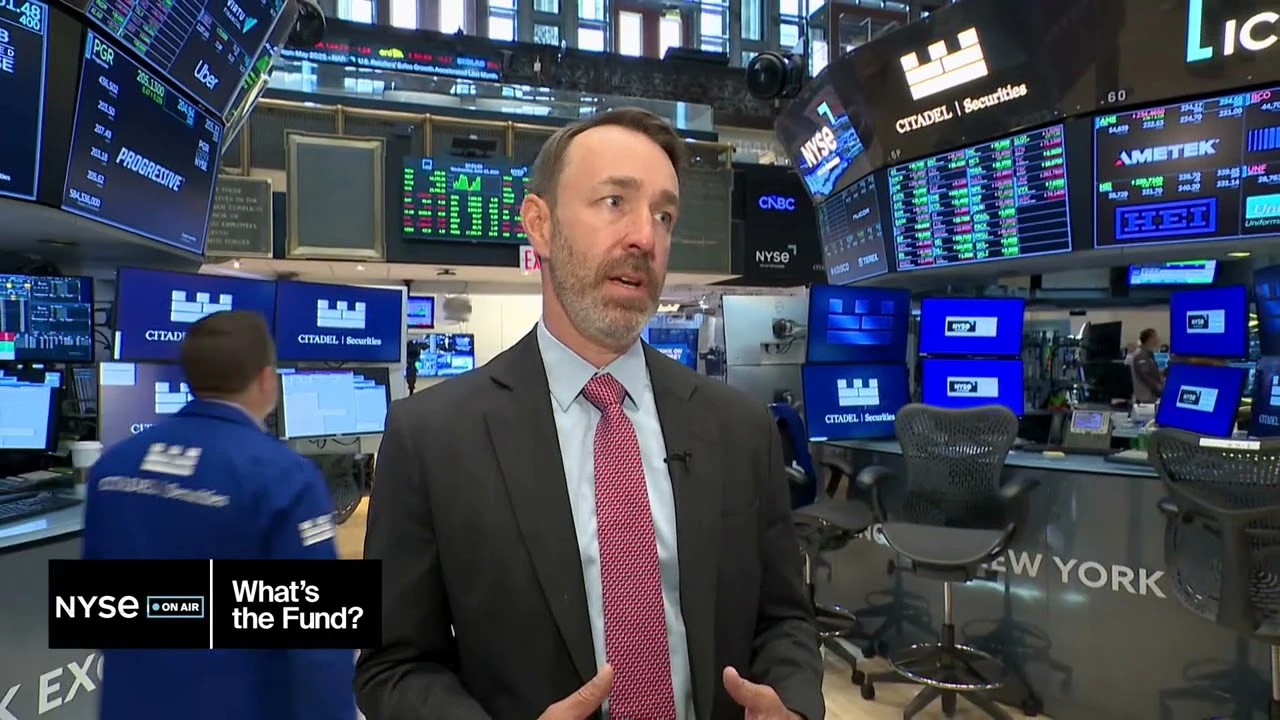
What's the Fund | Ocean Park Diversified Income ETF (DUKZ)
James St Aubin, Chief Investment Officer at Ocean Park Asset Management, discuss the DUKZ ETF, exposing investors to the whole spectrum of asset classes in the fixed income markets, through their rules-based process.

Browse all educational columns



Active Trader Report: Use of Leveraged & Inverse ETFs Way Up
Direxion partnered with Compound Insights and Vanda to explore what’s driving the evolution of active trading — and how active traders are using leveraged and inverse funds across equities, single stocks, commodities, and volatility.