Keep tabs on your favorite ETFs with a personalized weekly tracker. Create a Watchlist now →



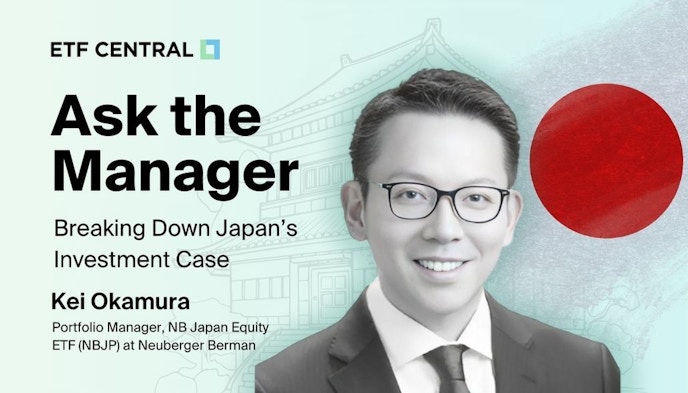
Ask the Manager: Kei Okamura Breaks Down Japan’s Investment Case
Portfolio Manager at Neuberger Berman, Kei Okamura, shares his insights on Japan’s economic revival, corporate reforms, and investment opportunities.

Keep up with what matters in ETFs
Get timely ETF insights, market trends, and top ideas straight to your inbox.
Your newsletter subscriptions with us are subject to ETF Central's Privacy Policy and Terms and Conditions.
In this edition of Ask the Manager, we caught up with Kei Okamura, Portfolio Manager, NB Japan Equity ETF (
You live and work in Japan, what is the sense you’re getting from the home market?
For the first time in over 30 years, we’re seeing strong signals that Japan is nearing the end of its deflationary “lost decades.” Inflation has stabilized above 2%, and wages are rising across not only large-cap companies but also small- and mid-sized enterprises.
This broad-based shift is pivotal for the Japanese economy. On the corporate front, companies are enhancing value by improving balance sheet efficiency, divesting underutilized assets, and reinvesting in growth. Regulatory reforms are also driving corporate governance improvements, encouraging foreign capital inflows.
These factors contributed to strong performance in Japanese equities in late 2023 and early 2024, and we anticipate further opportunities in the near to mid-term.
If you were a U.S. investor, why would you be looking at Japan right now?
While U.S. investors often exhibit home bias due to the strong track record of U.S. equities, diversification is critical. U.S. equity valuations are elevated, and cracks in earnings growth have emerged, prompting investors to explore opportunities abroad.
Japan offers compelling alpha opportunities, with under-researched, under-owned global companies benefiting from the same megatrends as their Western peers but trading at significantly lower multiples. Furthermore, macroeconomic shifts, corporate governance enhancements, and regulatory reforms are driving a revaluation of Japanese equities.
When combined with attractive valuations, Japan presents a strong case for investment diversification.
Part of understanding Japan is the history lesson… Can you speak to some of the reforms that have shaped the current investing landscape in Japan?
Japan’s corporate governance reforms date back to the early 2010s under Prime Minister Shinzo Abe’s “three arrows” economic strategy. These reforms initially focused on improving boardroom effectiveness, addressing low board independence, and enhancing directors’ skillsets. Over time, the focus shifted to improving capital efficiency, addressing issues like underutilized assets and cross-shareholdings.
While reforms stalled in the late 2010s, renewed emphasis on governance and capital management in the early 2020s reignited global interest in Japanese equities. These efforts have driven significant re-ratings in the market, with companies increasingly prioritizing shareholder value creation.
One of your talking points is on engagement…. Tell us about that.
Corporate engagement involves constructive dialogue between shareholders, like Neuberger Berman, and corporate management. In Japan, this engagement is particularly impactful given the low representation of foreign investors in this segment of the market as many firms are under-researched and undervalued.
For example, roughly 70% of companies in the MSCI Japan Small Cap Index are covered by fewer than five analysts, with 15% having no coverage at all. By engaging on issues like capital management and governance, we help companies address issues weighing on their valuations and strengthen disclosure, which would help attract more long-term investors like Neuberger Berman.
This approach has historically generated significant value for our investors, with 10-20% of performance attributed to such engagement efforts.
Can you explain the fund's strategy and why its current sector allocation is structured as it is today?
Our strategy focuses on “quality at a reasonable price.” We seek companies with strong fundamentals, such as pricing power, technology, or brand strength, which are attractively valued for mid- to long-term growth. Currently, we are overweight in industrials and consumer discretionary sectors, which include globally competitive companies with strong market share and pricing power.
Conversely, we avoid heavily regulated sectors like utilities and energy, as they face challenges like government intervention and commodity price volatility that can limit earnings visibility, which we see as crucial for mid- to long-term business and capital management planning. But this is a benchmark agnostic strategy and this approach allows us to focus on fundamentals and identify opportunities driven by sustainable growth trends.
How is the portfolio positioned to handle volatility amid tariffs, trade wars, and President Trump’s policy moves?
While Japan is not immune to market volatility stemming from U.S. trade policies, its strategic positioning in the Asia-Pacific region and strong ties with the U.S. and Europe provide resilience.
Trade tensions have driven currency fluctuations, particularly the yen, but we think the currency will gradually appreciate over the mid-term which would benefit domestically focused companies by reducing imported cost inflation.
We expect 2025 to be pivotal for domestic companies, as rising wages and increasing consumer demand should bolster margins.
Exporters, too, are adapting by localizing production, reducing the impact of tariffs and currency shifts. This balanced positioning supports the portfolio through both domestic and external challenges.
Can you list a few headwinds and tailwinds for the Japan investment opportunity?
A key headwind is the Bank of Japan’s rate hiking cycle, which contrasts with easing policies in other regions.
However, Japan’s unique circumstances, including decades of monetary easing, mean rate hikes are likely to remain gradual and capped at modest levels (1-2%).
Tailwinds include stable inflation, rising wages, and corporate reforms addressing capital inefficiencies, which are driving revaluation opportunities.
Exporters have adapted to trade challenges by localizing production, while domestic-focused companies benefit from stronger consumer demand. Together, these factors position Japan favorably amid global uncertainty.
Fun question: Can you tell us more about the largest names in the fund today and why they sit at the top?
One of our top holdings is a global leader in internal combustion engine spark plugs, controlling 70% of the market. While EV adoption is growing, we believe internal combustion engine vehicles will remain relevant over the next few years, supporting the company’s growth. The firm has leveraged industry consolidation to strengthen its market position and pricing power.
Additionally, it is addressing capital inefficiencies and enhancing shareholder returns through constructive dialogue with investors. These strong fundamentals, coupled with attractive valuations, make it a top holding in our portfolio.
Fun question: Tell us about one of your smallest positions in the portfolio that you're particularly excited about.
A smaller position we’re excited about is a high-end department store operator in Japan. The company has successfully revitalized its stores, targeting younger demographics while attracting affluent tourists. Inbound tourism, supported by a weaker yen, has driven strong growth, alongside rising domestic consumption from younger Japanese consumers experiencing wage increases.
Additionally, events like the upcoming Osaka World Expo should further boost footfall and sales. With ongoing improvements in capital management and governance, we see significant mid- to long-term potential for this position.
Like what you're reading?
Stay in the loop — get the latest ETF insights: trends, analysis, and expert picks.
About Kei Okamura
Kei Okamura, Managing Director, joined the firm in 2020. Kei is a Portfolio Manager on the Japanese Equities team at Neuberger Berman. Before joining Neuberger Berman, he was a Vice President of Stewardship at Goldman Sachs Asset Management in Tokyo overseeing company engagement campaigns on capital management and corporate governance to Japanese firms on behalf of public and corporate pension funds. Prior to GSAM, Kei was a Fund Manager at Amundi Asset Management and an Assistant Investment Manager at Aberdeen Asset Management where he helped to manage concentrated Japanese equities portfolios. Kei began his career covering Japanese and Asian companies for Reuters and Bloomberg as a Reporter and Producer. Kei graduated magna cum laude from Tufts University with a Bachelor's degree in International Relations and French. Kei also serves as the Chair of the Asian Corporate Governance Association’s Japan Working Group.
Please note this article is for information purposes only and does not in any way constitute investment advice. It is essential that you seek advice from a registered financial professional prior to making any investment decision.

Latest ETF News
See all ETF news
Ask the Manager: Kenneth Wong on Building the Next Wave of ETF Innovation, from Options to Korea's AI Semiconductor Opportunity
Ask the Manager: Kristof Gleich on Why AI Is Becoming an Asset Class

Ask the Manager: Vince Lorusso on Active Equity in an AI-Driven Market





 Advantages of ETFs over Mutual Funds1/6
Lower Costs
In this guide, we'll explore the advantages of ETFs over mutual funds, giving you valuable insights into why ETFs have gained significant popularity among investors like yourself.
Leveraged ETFs: Unlocking the Potential for Amplified Returns1/6
Understanding Leveraged ETFs
Explore leveraged ETFs: potential for amplified returns & risks. 5 ETFs to consider across equities, commodities & fixed income.
What is a Leveraged ETF?1/6
Introducing Leveraged and Inverse ETFs
In this guide, we'll dive into the world of leveraged ETFs, exploring their definition, mechanics, potential risks, and rewards.
Recent educational content

ETF Trends
ETF Industry KPIs September 8, 2026
This week’s KPI data overview highlights key metrics and trends shaping the ETF landscape.

ETF Trends
ETF Industry KPIs August 31, 2026
This week’s KPI data overview highlights key metrics and trends shaping the ETF landscape.
ETF Trends
ETF Industry KPIs August 24, 2026
This week’s KPI data overview highlights key metrics and trends shaping the ETF landscape.
What’sTheFund
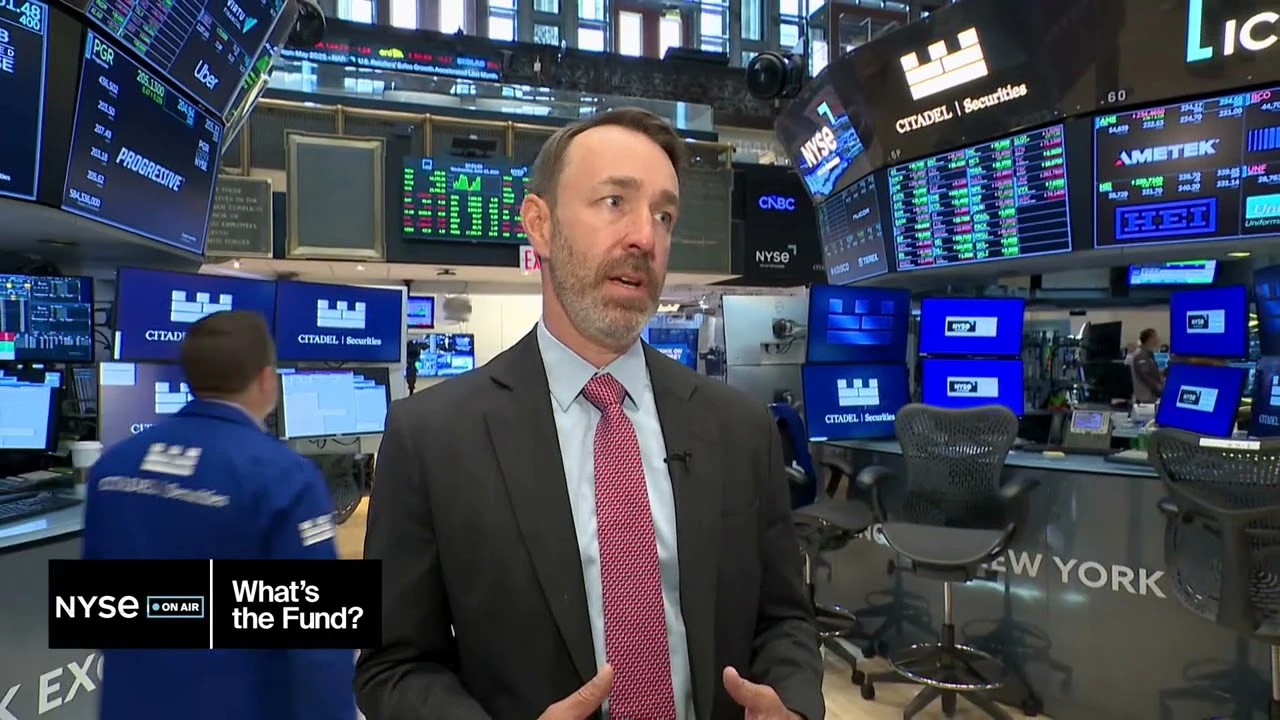
What's the Fund | Ocean Park Diversified Income ETF (DUKZ)
James St Aubin, Chief Investment Officer at Ocean Park Asset Management, discuss the DUKZ ETF, exposing investors to the whole spectrum of asset classes in the fixed income markets, through their rules-based process.

Browse all educational columns



Build and Analyze Your ETF Portfolio Like a Pro
Create your own ETF portfolio in minutes and instantly see allocations, exposures, performance, and risk. Visualize diversification across asset classes, regions, and sectors. Stress-test ideas, compare benchmarks, and refine your strategy with professional-grade analytics.