Ready-made ETF portfolios built for real investor needs. Explore now →



Ask the Manager: Dan Ahrens on Investing in Comfort and the HVAC Industry Outlook
Managing Director and COO at AdvisorShares, Dan Ahrens, sheds light on the investment potential and key trends driving the HVAC industry.

Keep up with what matters in ETFs
Get timely ETF insights, market trends, and top ideas straight to your inbox.
Your newsletter subscriptions with us are subject to ETF Central's Privacy Policy and Terms and Conditions.
In this edition of Ask the Manager, we caught up with Dan Ahrens, Managing Director and COO of AdvisorShares, to explore why the HVAC industry stands out as a compelling investment opportunity. From rising demand and technological advancements to key market trends shaping the sector, he shares valuable insights on what investors should watch.
Here's what we talked about:
Why is the HVAC industry an attractive investment opportunity for investors?
The HVAC industry—spanning heating, ventilation, and air conditioning—plays an essential role in modern living, providing comfort and energy efficiency to homes, businesses, and institutions. As a cornerstone of residential, commercial, and industrial infrastructure, we believe HVAC combines long-term demand stability with significant growth potential driven by technological innovation and global trends.
The industry is seeing expansion across several fronts, including the replacement of aging systems, rising construction activity, and growing awareness of indoor air quality. At the same time, the rapid expansion of digital infrastructure such as data centers, 5G networks, and cloud computing has created an increasing need for high-performance cooling solutions to maintain system efficiency and prevent overheating.
Simultaneously, innovation in smart technologies and energy efficiency is shaping the future of HVAC, creating opportunities for companies that can adapt and lead in this evolving landscape.
How do broader market trends impact the HVAC industry?
Several key trends are driving innovation and demand in HVAC:
- Energy Efficiency: Rising energy costs and environmental concerns are accelerating the shift toward systems that consume less power and reduce emissions.
- Technological Integration: Smart technologies, AI, and IoT are transforming HVAC, making systems more efficient, user-friendly, and customizable.
- Global Urbanization: Growing urban populations and rising middle classes in developing countries are expanding the HVAC market into new territories. By 2050, nearly two-thirds of households worldwide could have air conditioning, with China, India, and Indonesia accounting for half of these units.
- Indoor Air Quality: Post-pandemic, there’s an increased focus on systems that enhance air filtration and ventilation, spurring demand for high-quality solutions.
- Digital Infrastructure: The growth of the digital economy driven by AI, cryptocurrency, and cloud storage is increasing demand for HVAC systems in digital infrastructure, where efficient cooling solutions are essential for continuous 24/7 operations. The rapid expansion of digitalization and AI technologies is driving a global surge in data centers, with the U.S. at the forefront, accounting for over 32% of global facilities and expected to be the fastest-growing market through 2030. However, cooling systems, which consume 40% of a data center's energy, are critical for managing the substantial heat generated. Consequently, U.S. electricity demand for data centers is projected to rise by 23% between 2024 and 2030, reaching 606 terawatt-hours from 147 terawatt-hours².
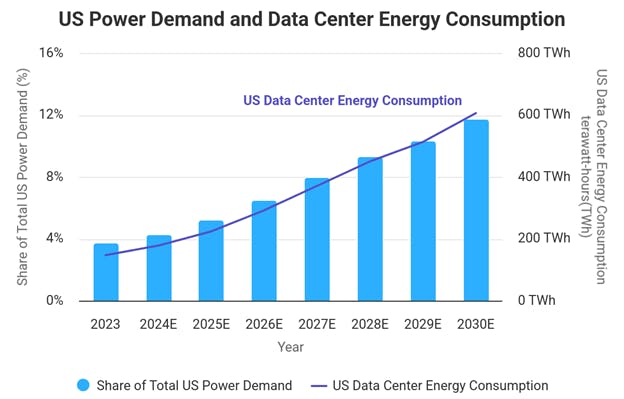
Source: McKinsey & Company. For illustrative purposes only. Revenue estimates are not a guarantee and may not be relied upon. Favorable revenue growth may not translate to favorable fund performance.
Why should investors consider focused exposure to the HVAC industry?
Investing in the HVAC industry provides exposure to a dynamic market with long-term demand fundamentals. Unlike broader industrial funds, a targeted approach hones in on businesses that are indispensable to modern life while capitalizing on trends like energy efficiency, smart technologies, and sustainability.
The industry is also relatively resilient to economic downturns. Heating and cooling are non-discretionary services, and even during challenging economic periods, the demand for maintenance, repair, and replacement persists. HVAC installation and repair account for around 60% of industry revenue. The average lifespan of an HVAC unit ranges between 10 and 20 years and it is recommended that units be serviced at least once per year³.
This creates ongoing diverse revenue streams within the HVAC industry benefiting from spanning residential, commercial, and institutional markets, and offering services such as installation, maintenance, and hardware innovation. This variety supports consistent demand and positions the industry for sustained growth.
What are the key challenges facing the HVAC industry today?
The HVAC industry faces challenges tied to economic pressures, supply chain disruptions, and environmental regulations. As global markets adapt to inflation and fluctuating energy costs, HVAC companies must balance offering cost-effective solutions with delivering innovative, energy-efficient and environmentally friendly systems.
Regulatory changes aimed at reducing emissions are pushing HVAC manufacturers to rethink product designs and adopt greener technologies. While this can create short-term hurdles, it also presents an opportunity for companies to differentiate themselves by meeting or exceeding these standards.
Rapid pace of technological advancement means that companies must continually innovate to stay competitive. From smart thermostats to AI-driven energy management, the race to deliver cutting-edge solutions will likely define the next phase of growth in the HVAC sector.
What are you watching closely in this industry for the short term?
To navigate the HVAC market effectively, key areas of focus include:
- Regulatory Changes: Monitoring emissions standards and energy policies to identify companies ahead of compliance requirements.
- Technological Advancements: Evaluating the adoption of smart and energy-efficient technologies that could define market leaders.
- Construction Activity: Tracking trends in residential, commercial, and industrial construction, which directly impact HVAC demand.
- Aging Infrastructure: Keeping an eye on the replacement cycle for outdated systems in developed markets, where modernization offers significant growth potential.
- Data Center Expansion: Following investments in data centers, which are major consumers of HVAC cooling solutions.
By focusing on these drivers we believe investors can position themselves to capitalize on the growth and innovation shaping the HVAC industry while benefiting from its fundamental stability.
Get data on 14,000+ ETFs
Access Trackinsight's reliable and comprehensive data with 500M+ points on 14,000+ ETFs.
About Dan Ahrens
Dan Ahrens is a Managing Director and the Chief Operating Officer of AdvisorShares. He manages multiple AdvisorShares ETFs, including the newly launched AdvisorShares HVAC & Industrial ETF (HVAC), overseeing over $1 billion in assets across diverse investment strategies.
In addition, Dan has been recognized several times as a top performing Morningstar manager in various categories.
He carries over 20 years of experience in the financial services industry serving in a variety of senior-level capacities and is the author of several books on investing.
Additionally, Mr. Ahrens has appeared on numerous financial programs including CNBC, CNN, Fox Business, ABC News and Bloomberg and has been featured, along with funds under his management in major national and trade publications including The Economist, the New York Times, Financial Times, and The Wall Street Journal.
Sources:
- “2024 Electricity,” Jan. 2024, International Energy Agency
- Science Direct, Projected global demand for air conditioning associated with extreme heat and implications for electricity grids in poorer countries, August 2022.
- Terry’s A/C & Heating, HVAC Replacement: When Should I Replace My HVAC Unit?
Please note this article is for information purposes only and does not in any way constitute investment advice. It is essential that you seek advice from a registered financial professional prior to making any investment decision.


Latest ETF News
See all ETF news
Ask the Manager: Kenneth Wong on Building the Next Wave of ETF Innovation, from Options to Korea's AI Semiconductor Opportunity

Ask the Manager: Kristof Gleich on Why AI Is Becoming an Asset Class

Ask the Manager: Vince Lorusso on Active Equity in an AI-Driven Market





 Advantages of ETFs over Mutual Funds1/6
Lower Costs
In this guide, we'll explore the advantages of ETFs over mutual funds, giving you valuable insights into why ETFs have gained significant popularity among investors like yourself.
Leveraged ETFs: Unlocking the Potential for Amplified Returns1/6
Understanding Leveraged ETFs
Explore leveraged ETFs: potential for amplified returns & risks. 5 ETFs to consider across equities, commodities & fixed income.
What is a Leveraged ETF?1/6
Introducing Leveraged and Inverse ETFs
In this guide, we'll dive into the world of leveraged ETFs, exploring their definition, mechanics, potential risks, and rewards.
Recent educational content

ETF Trends
ETF Industry KPIs September 14, 2026
This week’s KPI data overview highlights key metrics and trends shaping the ETF landscape.

ETF Trends
ETF Industry KPIs September 8, 2026
This week’s KPI data overview highlights key metrics and trends shaping the ETF landscape.
ETF Trends
ETF Industry KPIs August 31, 2026
This week’s KPI data overview highlights key metrics and trends shaping the ETF landscape.
ETF Trends
ETF Industry KPIs August 24, 2026
This week’s KPI data overview highlights key metrics and trends shaping the ETF landscape.
Browse all educational columns



Build and Analyze Your ETF Portfolio Like a Pro
Create your own ETF portfolio in minutes and instantly see allocations, exposures, performance, and risk. Visualize diversification across asset classes, regions, and sectors. Stress-test ideas, compare benchmarks, and refine your strategy with professional-grade analytics.