ETF model portfolios designed for real investor needs. Discover →



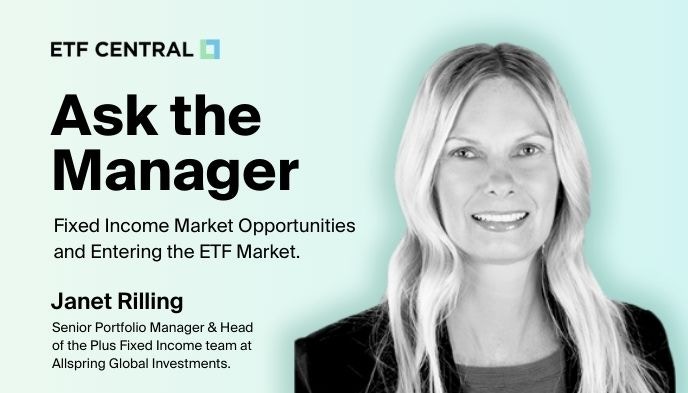
Ask the Manager: Allspring’s Janet Rilling on Fixed Income Market Opportunities and Entering the ETF Market
Allspring's Portfolio Manager Janet Rilling shares insights on fixed income markets, active management, and portfolio positioning in this edition of Ask the Manager.

Keep up with what matters in ETFs
Get timely ETF insights, market trends, and top ideas straight to your inbox.
Your newsletter subscriptions with us are subject to ETF Central's Privacy Policy and Terms and Conditions.
In this new series, "Ask the Manager", on ETF Central, we’re chatting with experts and portfolio managers to dive into trending investment topics, market updates, and the economy—giving you insights to make informed investment decisions and find new opportunities with ETFs.
We recently spoke with Janet Rilling, CFA, a repeated name on Morningstar’s list of top female portfolio managers in the U.S., and Senior Portfolio Manager/Head of the Plus Fixed Income team at Allspring Global Investments.
Janet shares insights on the current market environment, how her team is positioning portfolios, the advantages of active management in fixed income, and Allspring’s recent entry into the ETF market.
Allspring Global Investments is a leading independent asset management firm, operating across twenty offices globally with approximately $605 billion in assets under advisement.¹ What else can you tell us about Allspring?
What’s unique about our story is that Allspring, as an independent entity, is only a few years old. However, we have a rich history of active investing that spans decades, originating from our time as Wells Fargo Asset Management. What this means is that Allspring has the flexibility to operate in a modern and nimble capacity like a start-up, but with the experience and scale of a seasoned investment firm. We see this combination as a significant advantage as we look to the future, reach into new markets and capabilities, and prioritize how we can best serve our clients.
What was your career path to becoming a fixed income portfolio manager?
I started as an accountant on the audit side at a public accounting firm. That really taught me the importance of understanding financial statements and how to properly evaluate the risk in individual companies.
What’s their track record? Do they have the proper checks and balances in place? Do they have the hallmarks of a successful business? It was during that time that I got increasingly excited about investing.
The catalyst for my move to investing was a shared experience I had with my father. He loved watching the markets. He’d share magazine articles with me about investing and together we watched Wall Street Week with Louis Rukeyser on Friday nights. So as my interest in investing grew, I went back to business school and completed an applied securities investment program. I was part of a student group that ran an actual stock portfolio, which showed me a path to portfolio management.
We had to develop our own philosophy and process, implement it in a portfolio, get results, and report those to our board. Those meetings were tough, but it really gave me a full look at what it means to run a portfolio.
Allspring’s heritage is in active management. How important is active management to bond investing?
The short answer is active management can offer significant advantages in the fixed income space. When you look at the Bloomberg U.S. Aggregate Bond Index for example, it’s mostly made up of just three sectors: U.S. Treasuries, mortgage-backed securities (MBS), and investment grade corporates. In comparison to the broad categories of fixed-income investing, the index represents only about one-third of global opportunities.
For passive investors, this leaves significant opportunity on the table. Also, fixed income indices are often debt weighted and are beholden to rigid index rules which can result in forced buying and selling of bonds at potentially inopportune times.
An active approach can allow for enhanced exposures with the flexibility to be nimble and take advantage of value opportunities. For example, our active approach allows us to cast a wider net and take advantage of opportunities across the globe.
We have enhanced flexibility to be nimble, utilizing a six-month outlook. We do this because we think it's better to identify turning points in the market by looking ahead 2 to 3 quarters, rather than a much longer 3- to 5-year outlook, which is often used by other strategies. We also take an unbiased approach to managing our portfolios.
We don't want to be anchored or have biases built into the portfolio. This affords us the flexibility to move to where we see value and not get stuck in any one position. Of course, active management requires active expertise. We are fortunate in that our strategies are backed by a seasoned team of 19 investment professionals with 25 years of average industry experience.
What are your thoughts on the current environment in fixed income? How are you positioning portfolios and where do you see opportunity?
The available yield being produced by global public fixed income markets is at a cyclical high. However, the proportion of yield from credit spread compensation is lower than it has been for most of the past 15 years. This presents attractive opportunities to potentially earn generous income, but it also presents risks to those who invest indiscriminately.
Yields on the front end of the curve are particularly attractive today, but they are likely to move lower through 2025. In our opinion, cash investors should consider extending duration to potentially increase the income their portfolios produce while benefiting from duration as yields decline over time. Similarly, credit spreads may stay tight given the supportive fundamental and technical backdrop. Waiting for a better entry point may cause investors to miss out on attractive carry.
We believe it is this combination of higher yields and tighter spreads that makes a compelling case for broad diversification. Diversification across credits and along the yield curve combined with the flexibility offered by active multi-sector and “plus” bond portfolios are particularly attractive given the current environment.
As a result, we are positioning multi-sector “plus” portfolios with a high degree of diversification and flexibility. This includes exposures beyond the U.S. and tilting allocations toward sectors where spread compensation is closer to long-term averages.
We currently favor securitized sectors, including agency mortgage-backed securities (MBS), and a variety of asset-backed subsector exposures.
We believe value exists in the higher-rated portion of high yield sector, helping to drive enhanced income in portfolios. The opportunity to exploit substantial yield break-evens while earning attractive real income offers resiliency to a diversified fixed income portfolio.
What do you see as a common challenge amongst investors in the current market?
Investors are still heavily focused on the level of interest rates and how to invest as the Federal Reserve moves to adjust the policy rate.
While the peak in rates for the cycle may be behind us, the good news is that rates are still elevated compared with the decade averages. If you start with higher income and higher yield, it puts you in a better spot.
Sometimes investors want to know about adding duration to their portfolio. Higher rates have made front-end yields quite enticing, and many investors have stayed put in money market accounts and other short-duration fixed income options even though the Federal Reserve is no longer focused on rate hikes.
We believe this helps make the case to lock in higher yields as rates potentially drift lower. We’ve talked with some investors about moving part of their allocations out along the yield curve. Post an interest-rate-hiking cycle, duration has the potential to add balance to a portfolio.
Can you elaborate on this idea?
We call it riding the yield curve. The idea is to diversify across the yield curve. It’s possible to add diversification by reallocating some cash across several buckets of different durations. And that doesn’t have to be all at once—it can be in small or incremental amounts every month or two, continuing to move out the curve without trying to time interest rate changes. Ultimately, more diversified exposure across the yield curve could add more of a cushion to the portfolio for a wider range of outcomes.
For example, in a risk-off environment, having that extra duration could be helpful in a portfolio. However, added duration could end up being less favorable if interest rates were to move up significantly. When rates were close to zero, any move up in rates was generally negative across the board. It’s a different environment today. Bonds are generally producing greater levels of income, which can help to build resiliency into portfolios through the potential to help offset the impact of an upward move in rates.
You recently launched your first ETFs, leveraging established fixed income strategies that also exist in other vehicles like mutual funds and SMAs. Why did you choose these strategies? What are your plans for launching more ETFs?
As you mentioned, the strategies behind our ETFs are well established and have been in existence for years. These are popular strategies with our clients, and we were often asked, “do you offer this strategy as an ETF?” Now, I’m happy to share that we do.
The Allspring Broad Market Core Bond ETF (AFIX) is managed by Galliard Capital Management, a subsidiary of Allspring with 29 years of exclusive focus on fixed income investing and more than $80 billion¹ in AUM. The ETF brings a long-standing institutional core bond strategy to individual investors, while the Allspring Core Plus ETF (APLU) and the Allspring Income Plus ETF (AINP) are managed by Allspring’s Plus Fixed Income team. The ETFs use a broad array of fixed income securities designed to deliver enhanced total return and income for investors.
As a follow-up to the recent launch of our active fixed income offerings, we have plans to launch three active equity ETFs in early 2025.
Like what you're reading?
Stay in the loop — get the latest ETF insights: trends, analysis, and expert picks.
About Janet Rilling
Janet Rilling is a senior portfolio manager and the head of the Plus Fixed Income team at Allspring Global Investments. In this capacity, she has oversight and portfolio management responsibilities for separate accounts, mutual funds, and commingled vehicles across a range of strategies. Janet joined Allspring from its predecessor firm, Wells Fargo Asset Management (WFAM). She joined WFAM from Strong Capital Management. Prior to joining WFAM, she was a high-yield and investment-grade credit research analyst and a portfolio manager. Janet began her investment industry career in 1990 as an auditor with Coopers & Lybrand, specializing in the manufacturing and financial services industries. She earned a bachelor’s degree in accounting and finance and a master’s degree in finance from the University of Wisconsin, Madison. Janet is a certified public accountant and has earned the right to use the Chartered Financial Analyst® (CFA®) designation.
----------------------------------------------------------------------------------
¹As of December 31, 2024. Figures include discretionary and non-discretionary assets.
Please note this article is for information purposes only and does not in any way constitute investment advice. It is essential that you seek advice from a registered financial professional prior to making any investment decision.
Carefully consider a fund’s investment objectives, risks, charges, and expenses before investing. For a current prospectus and, if available, a summary prospectus, containing this and other information, visit allspringglobal.com. Read it carefully before investing.
It is possible that an active trading market for ETF shares will not develop, which may hurt your ability to buy or sell shares, particularly in times of market stress. Shares may trade at a premium or discount to their net asset value in the secondary market. These variations may be greater when markets are volatile or subject to unusual conditions. There can be no assurance that active trading markets for the shares will develop or be maintained by market makers or authorized participants. Shares of the ETFs are not redeemable with the ETF other than in creation unit aggregations. Instead, investors must buy or sell the ETF shares in the secondary market at market price (not net asset value) through a broker-dealer. In doing so, the investor may incur brokerage commissions and may pay more than net asset value when buying and may receive less than net asset value when selling. Investing involves risk, including the possible loss of principal. Bond values fluctuate in response to the financial condition of individual issuers, general market and economic conditions, and changes in interest rates. Changes in market conditions and government policies may lead to periods of heightened volatility in the bond market and reduced liquidity for certain bonds held by the fund. In general, when interest rates rise, bond values fall and investors may lose principal value. Interest rate changes and their impact on the fund and its share price can be sudden and unpredictable. High yield securities and junk bonds have a greater risk of default and tend to be more volatile than higher-rated securities with similar maturities. Mortgage- and asset-backed securities may decline in value and become less liquid when defaults on the underlying mortgages or asset occur and may become volatile in periods of rising interest rates. Foreign investments are especially volatile and can rise or fall dramatically due to differences in the political and economic conditions of the host country. These risks are generally intensified in emerging markets. Consult the fund’s prospectus for additional information on these and other risks.
This material is for general informational and educational purposes only and is NOT intended to provide investment advice or a recommendation of any kind—including a recommendation for any specific investment, strategy, or plan.
Allspring Global Investmentsᵀᴹ is the trade name for the asset management firms of Allspring Global Investments Holdings, LLC, a holding company indirectly owned by certain private funds of GTCR LLC and Reverence Capital Partners, L.P. These firms include but are not limited to Allspring Global Investments, LLC, and Allspring Funds Management, LLC and Galliard Capital Management. Certain products managed by Allspring entities are distributed by Allspring Funds Distributor, LLC (a broker-dealer and Member FINRA/SIPC).
The Bloomberg U.S. Aggregate Bond Index is a broad-based benchmark that measures the investment-grade, U.S.-dollar-denominated, fixed-rate taxable bond market, including Treasuries, government-related and corporate securities, mortgage-backed securities (agency fixed-rate and hybrid adjustable-rate mortgage pass-throughs), asset-backed securities, and commercial mortgage-backed securities. You cannot invest directly in an index.
Diversification does not ensure or guarantee better performance and cannot eliminate the risk of investment losses.
© 2025 Allspring Global Investments Holdings, LLC. All rights reserved
ALL-01172025-fqveaoia


Latest ETF News
See all ETF newsAsk the Manager: Pieter Vorster on the NICO ETF and the Nicotine Transition
Ask the Manager: Tian Yang on Capital Cycle Investing and the VPX ETF


Ask the Manager: Kenneth Wong on Building the Next Wave of ETF Innovation, from Options to Korea's AI Semiconductor Opportunity




 Advantages of ETFs over Mutual Funds1/6
Lower Costs
In this guide, we'll explore the advantages of ETFs over mutual funds, giving you valuable insights into why ETFs have gained significant popularity among investors like yourself.
Leveraged ETFs: Unlocking the Potential for Amplified Returns1/6
Understanding Leveraged ETFs
Explore leveraged ETFs: potential for amplified returns & risks. 5 ETFs to consider across equities, commodities & fixed income.
What is a Leveraged ETF?1/6
Introducing Leveraged and Inverse ETFs
In this guide, we'll dive into the world of leveraged ETFs, exploring their definition, mechanics, potential risks, and rewards.
Recent educational content

ETF Trends
ETF Industry KPIs October 5, 2026
This week’s KPI data overview highlights key metrics and trends shaping the ETF landscape.

ETF Trends
ETF Industry KPIs September 28, 2026
This week’s KPI data overview highlights key metrics and trends shaping the ETF landscape.
ETF Trends
ETF Industry KPIs September 22, 2026
This week’s KPI data overview highlights key metrics and trends shaping the ETF landscape.
First Look ETF
First Look ETF: Income, Corporate Arbitrage, and Growth and Value Investing
First Look ETF September 2026: iCapital, Mast Investments and North Square unpack new ETFs targeting monthly income, merger arbitrage and complementary growth and value exposure.

Browse all educational columns



Expert-Built ETF Portfolios, All in One Place
Don’t start from scratch. Discover ready-made ETF portfolios built by professionals to match different goals, timelines, and market views. Use them as inspiration or as a starting point for your own allocation.