Turn ETF ideas into real portfolios. Try the builder now →



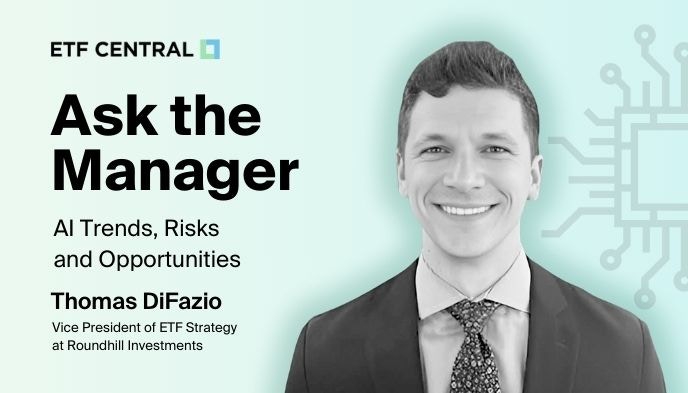
Ask the Manager: AI Trends, Risks and Opportunities with Roundhill's Thomas DiFazio
Roundhill's Thomas DiFazio shares his thoughts on the AI boom and more in this latest edition of "Ask the Manager".

Keep up with what matters in ETFs
Get timely ETF insights, market trends, and top ideas straight to your inbox.
Your newsletter subscriptions with us are subject to ETF Central's Privacy Policy and Terms and Conditions.
Amid the DeepSeek chaos, we caught up with Thomas DiFazio, Roundhill Investments’ VP of ETF Strategy, to chat about how AI is shaking up industries and pushing the boundaries of innovation. Generative AI is a game-changer, and Thomas breaks down its growth, trends, risks, and how it’s creating new investment opportunities.
What is the difference between AI and generative AI?
Traditional AI applications analyze trends and patterns based on pre-existing datasets and information. Ultimately, traditional AI is bound by the limitations of the dataset and information provided. Generative AI not only has the capability for this workload but also expands on it. Generative AI refers to artificial intelligence models that can create new, unique original content. By learning patterns, structures, and trends from existing data, generative AI models can write full essays, generate unique images, create audio, and generate virtual models. In short, while AI is the buzzword, Generative AI is where the growth is.
What is the growth potential of AI?
The rapid adoption of OpenAI’s ChatGPT is case-in-point for the growth potential. It took ChatGPT just 2 months to surpass 100 million users, outpacing Tiktok (9 months), Instagram (30 months), Pinterest (41 months), and Spotify (55 months).
After surprising the AI industry with its low cost AI model, DeepSeek saw its app catapult to the top of the Apple’s App Store while its web traffic has been rapidly increasing from a couple hundred thousand visitors in late-December to over 6 million visitors on January 24th (Source: PCMag).
Generative AI is not just a technology story. AI can impact various industries like entertainment, art & design, health care, financial services, architecture, engineering, and education. Because of its potential reach, we see the total addressable market for generative AI enterprise software to be roughly $120 billion. Incredibly, Goldman Sachs estimated that AI could be involved in trillions of dollars of global economic activity over the next decade.
What trends are you currently seeing in the AI space?
The counted mentions of “AI” in S&P 500 company transcripts is surging. The excitement around AI’s potential and applicability has catalyzed a level of introspection for process optimization that is sector agnostic. “How can we leverage AI to optimize our day-to-day processes” is a question that likely every S&P company is looking to answer. This has catalyzed a broader spending and investment cycle in the AI space. There will likely be some fits and starts as a result, but is a necessary consequence for a young industry that is in a stage of experimentation and innovation.
There is enthusiasm around how AI can impact and transform every industry, but CHAT is mostly focused in Technology stocks currently. Do you see this trend persisting over the long-term?
Presently, CHAT is predominantly focused within the Technology and Communications sectors. Those two sectors alone command a roughly 85% weight of the portfolio. However, AI is not bound to just Technology because other sectors will play a part in how the industry grows. An important consideration will be power generation. It is well documented that the demand for infrastructure is rising given how power intensive generative AI technologies are. Consequently, companies within the Utilities, Energy, and Industrials sectors could play a role in CHAT as alternative routes for investing in the AI theme. While small positions currently, CHAT already has some exposure to Utilities (CEG, VST, TLN) and Industrials (VRT, ETN) that we believe offer a differentiated approach to generative AI.
What are the risks to the generative AI space currently?
Generally speaking, generative AI stocks could trade at a valuation premium to the broader S&P 500 given their growthier profiles and high expectations for the space. Investors may struggle to find “value” when parsing through the space. That said, valuation extremes can persist and valuation as a whole can be a poor short-term timing. We’d also highlight that the median NTM P/E multiple for CHAT has come in from a high of 34.5x in March of last year. The median NTM P/E for CHAT now sits near 29x with the fund up 15% since the end of March 2024. Fundamental growth is contributing to the return of the fund.
While shareholder return is not an expectation at smaller, growth-oriented AI companies, it is more of an expectation for certain large and mega-caps. While not known for their dividend yields, AAPL, GOOGL, NVDA, META, and MSFT are in the top twenty contributors for S&P 500 buybacks. These companies could be scrutinized for growing capex numbers if it comes at the cost of shareholder return.
More recently, the focus on Chinese AI startup DeepSeek highlights the broader risk of market disruption to current AI leaders. DeepSeek reportedly has trained its high performance AI models at low cost without the use of prevailing technology from U.S. firms. The immediate market reaction has been profoundly negative, but time is needed for the dust to settle and determine the true fundamental impact to the global AI industry.
Should investors looking to capture the AI theme just buy NVDA?
NVDA has been the flag bearer for the AI revolution for some time now, and admittedly, it is hard to bet against it. Its new line of Blackwell chips are highly anticipated by the AI industry at large for their state-of-the-art capabilities. NVDA’s influence and impact on the AI theme is indisputable, but it could begin to be challenged if supply issues for the Blackwell chips persist while competitors come to market with potential alternatives.
Diversification would be the argument against only owning NVDA for AI exposure. NVDA saw its market cap rise by over $2 trillion in 2024. Rightfully so, NVDA now has extremely high expectations to pair with its dominance. In our view, there are still nascent opportunities within the AI space to capitalize on.
The Magnificent Seven and AI tend to be closely associated with each other among investors. Do you agree with that grouping?
Currently, we do agree with the close association. As a group, the Magnificent Seven are putting forward the money to back it up. Microsoft President Brad Smith recently shared in a blog that Microsoft plans to spend approximately $80 billion on AI-enabled datacenters to train AI models and deploy AI and cloud-based applications in their 2025 fiscal year. On January 24th, Mark Zuckerberg shared Meta’s intention to spend $60-65 billion in capex spending in 2025 while growing their AI teams “significantly”. Zuckerberg also said Meta plans to build a 2GW+ datacenter to power their efforts. There is serious money being dedicated to scaling AI initiatives within the Magnificent Seven.
Tell me about one of your smallest positions that you’re excited about in the portfolio.
Oracle (ORCL) is a roughly 3% weight within CHAT. President Trump’s recent announcement of the Stargate Project could be a powerful catalyst for the stock. To recap, the Stargate Project is a $500 billion private artificial intelligence partnership between founding members OpenAI, Oracle, Softbank, and investment firm MGX. The goal is to research, develop, and build artificial intelligence infrastructure in the United States, with a data center project in Texas already commenced. While details are still to come, the Stargate Project, with the support of the U.S. administration, could serve as a powerful growth catalyst for Oracle to become a serious leader within AI software infrastructure.
Global ETF Survey 2026 is Live!
With 1,790 new products launched by July 2026, choosing is harder than ever. Our Global ETF Survey 2026, built on 620 professional investors and allocators, shows how active, fixed income, options-based and thematic ETFs are reshaping fund selection.
About Thomas DiFazio
Thomas is Vice President of ETF Strategy at Roundhill Investments, an SEC-registered investment advisor focused on offering innovative ETFs. He is responsible for developing product-specific content and implementing product marketing campaigns.
Prior to joining Roundhill, Thomas worked 8 years at Strategas Securities on the institutional research desk, specializing in macro research, asset allocation, and technical analysis.
Thomas has earned the Chartered Market Technician® (CMT) designation and is a member of the CMT Association. He holds a BA in Economics and a Minor in Psychology from Villanova University.
Please note this article is for information purposes only and does not in any way constitute investment advice. It is essential that you seek advice from a registered financial professional prior to making any investment decision.

Latest ETF News
See all ETF newsAsk the Manager: Pieter Vorster on the NICO ETF and the Nicotine Transition

Ask the Manager: Tian Yang on Capital Cycle Investing and the VPX ETF


Ask the Manager: Kenneth Wong on Building the Next Wave of ETF Innovation, from Options to Korea's AI Semiconductor Opportunity




 Advantages of ETFs over Mutual Funds1/6
Lower Costs
In this guide, we'll explore the advantages of ETFs over mutual funds, giving you valuable insights into why ETFs have gained significant popularity among investors like yourself.
Leveraged ETFs: Unlocking the Potential for Amplified Returns1/6
Understanding Leveraged ETFs
Explore leveraged ETFs: potential for amplified returns & risks. 5 ETFs to consider across equities, commodities & fixed income.
What is a Leveraged ETF?1/6
Introducing Leveraged and Inverse ETFs
In this guide, we'll dive into the world of leveraged ETFs, exploring their definition, mechanics, potential risks, and rewards.
Recent educational content

ETF Trends
ETF Industry KPIs October 5, 2026
This week’s KPI data overview highlights key metrics and trends shaping the ETF landscape.

ETF Trends
ETF Industry KPIs September 28, 2026
This week’s KPI data overview highlights key metrics and trends shaping the ETF landscape.
ETF Trends
ETF Industry KPIs September 22, 2026
This week’s KPI data overview highlights key metrics and trends shaping the ETF landscape.
First Look ETF
First Look ETF: Income, Corporate Arbitrage, and Growth and Value Investing
First Look ETF September 2026: iCapital, Mast Investments and North Square unpack new ETFs targeting monthly income, merger arbitrage and complementary growth and value exposure.

Browse all educational columns



ETFs’ Next Act: From Access to Selection
With 1,790 new products launched by July 2026, choosing is harder than ever. Our Global ETF Survey 2026, built on 620 professional investors and allocators, shows how active, fixed income, options-based and thematic ETFs are reshaping fund selection.