Turn ETF ideas into real portfolios. Try the builder now →



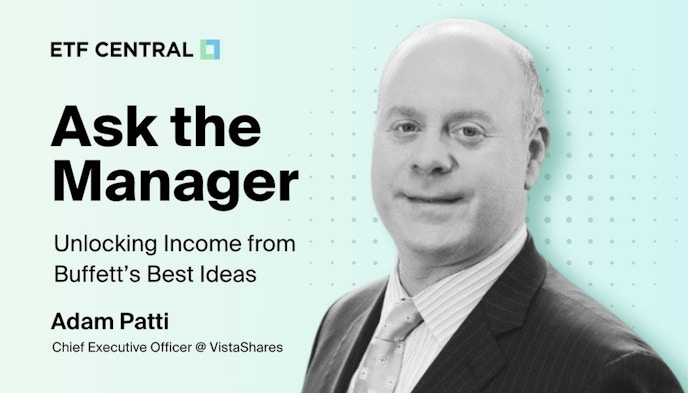
Ask the Manager: Adam Patti on Unlocking Income from Buffett’s Best Ideas
Buffett never paid a dividend — but Adam Patti and VistaShares found a way to turn his portfolio into monthly income.

Keep up with what matters in ETFs
Get timely ETF insights, market trends, and top ideas straight to your inbox.
Your newsletter subscriptions with us are subject to ETF Central's Privacy Policy and Terms and Conditions.
Welcome to Ask the Manager, ETF Central's series where we sit down with top experts, analysts and portfolio managers to dive into the latest investment trends, market updates, and economic insights.
This week, we sat down with Adam Patti, CEO of VistaShares, to explore how his firm is delivering high monthly income by blending Buffett-style investing with a modern options strategy through their new ETF, OMAH.
Why did you launch an Income Product based on Berkshire?
Warren Buffett is obviously one of if not the greatest investor of all time and the long-term performance of Berkshire Hathaway (BRK.B) has for decades made it one of the core portfolio holdings of choice for equity investors with long time horizons.
But Berkshire is also famous for not paying a dividend, so we asked ourselves the question, “how can we build an ETF that mirrors the largest holdings in the Berkshire portfolio while also paying high monthly income?”
The answer to that question wound up becoming the VistaShares Target 15 Berkshire Select Income ETF
Tell me about the ETF’s strategy
OMAH is actively managed with the equity component made up of exposure to BRK.B itself as well as Berkshire’s top 20 publicly disclosed equity holdings. Alongside that, the fund utilizes a proprietary data driven options strategy that is designed to deliver a targeted annual income of 15%, with monthly distributions of approximately 1.25%.
As excited as we are about this strategy, we’re equally excited about the team behind it. VistaShares may be a relatively new ETF brand, but I’ve been in the ETF and indexing space for the better part of three decades, as have many of my colleagues.
On the options side, the strategy is being run Jay Pestrichelli, Chief Trading Officer with Tidal Financial and one of the true pioneers of this fast-growing equity/options ETF category.
How do you achieve the 15% target income?
OMAH’s income strategy is constructed around the use of options strategies involving contracts on the securities that make up the equity sleeve of the portfolio. We sell Call Options and also make use of Call Spreads.
It’s an approach that has gained a great deal of attention and a number of adherents in recent years, but this is the first time it’s been used to help investors “invest like Buffett” with significant potential monthly income.
How do you use OMAH in a portfolio?
Part of what makes OMAH such a compelling vehicle is the fact that it can play numerous roles in a portfolio.
OMAH’s large- and mid-cap equity exposures make it an ideal component of a core equity portfolio, while the 15% target income it seeks to deliver makes it a compelling addition to an income strategy, perhaps as a complement or replacement for other high-yielding exposures.
Interestingly investors who hold BRK.B have been migrating to OMAH to create a “synthetic dividend” for their existing BRK.B exposure.
What is the role of an income product in today’s volatile markets?
I think OMAH is a great example of how much the definition of “income product” has changed in recent years.
The innovation in the ETF industry has really allowed investors and advisors to think much more creatively than the staid “this is my equity allocation… this is my bond allocation…” approach of old.
With OMAH, one now has the potential for both significant income generation and long-term capital appreciation. It’s possible to slot that just about anywhere in an investor’s portfolio and find a meaningful role for it.
Like what you're reading?
Stay in the loop — get the latest ETF insights: trends, analysis, and expert picks.
About Adam Patti
Adam is a pioneer in the Exchange-Traded Funds industry. Prior to VistaShares, Adam founded IndexIQ with a vision to combine institutional quality alternative investment strategies with the power of ETFs to enhance portfolio construction for all investors. IndexIQ established itself as the leading alternative investment manager in the ETF industry and was acquired by New York Life Insurance Company in 2015.
As Chairman & CEO of IndexIQ, Adam was an architect behind IndexIQ's award winning product line of alternative investment strategies, and post-acquisition worked to successfully integrate the firm into the New York Life Investments infrastructure, including the roll-out of IndexIQ branded ETFs globally.
Prior to founding IndexIQ, Adam held a series of senior executive roles at TimeWarner, including at Fortune Magazine where he led Fortune Indexes, the creator of the first smart beta index. Fortune Indexes was an early entrant into the ETF industry, having launched the Fortune 500 ETF in partnership with State Street Global Advisors back in 2000.
Please note this article is for information purposes only and does not in any way constitute investment advice. It is essential that you seek advice from a registered financial professional prior to making any investment decision.

Latest ETF News
See all ETF news
Ask the Manager: Kenneth Wong on Building the Next Wave of ETF Innovation, from Options to Korea's AI Semiconductor Opportunity
Ask the Manager: Kristof Gleich on Why AI Is Becoming an Asset Class
Ask the Manager: Vince Lorusso on Active Equity in an AI-Driven Market




 Advantages of ETFs over Mutual Funds1/6
Lower Costs
In this guide, we'll explore the advantages of ETFs over mutual funds, giving you valuable insights into why ETFs have gained significant popularity among investors like yourself.
Leveraged ETFs: Unlocking the Potential for Amplified Returns1/6
Understanding Leveraged ETFs
Explore leveraged ETFs: potential for amplified returns & risks. 5 ETFs to consider across equities, commodities & fixed income.
What is a Leveraged ETF?1/6
Introducing Leveraged and Inverse ETFs
In this guide, we'll dive into the world of leveraged ETFs, exploring their definition, mechanics, potential risks, and rewards.
Recent educational content

ETF Trends
ETF Industry KPIs September 14, 2026
This week’s KPI data overview highlights key metrics and trends shaping the ETF landscape.

ETF Trends
ETF Industry KPIs September 8, 2026
This week’s KPI data overview highlights key metrics and trends shaping the ETF landscape.
ETF Trends
ETF Industry KPIs August 31, 2026
This week’s KPI data overview highlights key metrics and trends shaping the ETF landscape.
ETF Trends
ETF Industry KPIs August 24, 2026
This week’s KPI data overview highlights key metrics and trends shaping the ETF landscape.
Browse all educational columns



Expert-Built ETF Portfolios, All in One Place
Don’t start from scratch. Discover ready-made ETF portfolios built by professionals to match different goals, timelines, and market views. Use them as inspiration or as a starting point for your own allocation.