Create, analyze, optimize your ETF portfolio. Start now →



Agricultural ETFs and Current Developments Occurring Within the Agricultural Commodities Landscape
Agricultural commodity ETFs can play an additive role in one’s portfolio.


Keep up with what matters in ETFs
Get timely ETF insights, market trends, and top ideas straight to your inbox.
Your newsletter subscriptions with us are subject to ETF Central's Privacy Policy and Terms and Conditions.
While the broad-base performance of agricultural commodities has been negative year to date, the performance of select sub-components has been particularly noteworthy. Though inflation and the actions of central banks are key factors that drive commodity prices, unforeseen developments - such as El Nino weather concerns or abandoned trade agreements – can shape market pricing.
This article will provide a brief overview of recent developments impacting agricultural commodities broadly and highlight the influential forces behind the performance of select sectors.
Like what you're reading?
Stay in the loop — get the latest ETF insights: trends, analysis, and expert picks.
Current developments impacting agricultural commodities
The UN FAO Food Price Index, a measure of the monthly change in international prices of a basket of food commodities, averaged 121.4 points in August 2023, down 2.6 points (2.1 percent) from July, reversing the rebound registered in the previous month. While the index has been trending lower since the price shocks in 2022, it still remains elevated compared to 2020 and 2021.
Agricultural commodity prices are likely to continue their trend lower this year, as economic data has shown that inflation risk has declined and there is a general belief that there will be no additional rate hikes for the year. However, exogenous events can change this outlook. Presently, the Panama Canal drought is a cause of concern given it coincides with a risk of the El Nino weather phenomenon intensifying this year, leading to even drier conditions. Climate risks will affect supply chains adversely and could lead to consumer prices becoming elevated in the short- to medium-term.
The demands of larger economies can also influence price. In August, the FAO All Rice Price Index rose by 9.8 percent month-on-month to reach a 15-year nominal high, due to trade disruptions in the aftermath of India's July ban on Indica white rice exports. Given uncertainty over the ban’s duration and concerns that export restrictions would be extended to other rice types, vendors began holding back stock and/or limiting their sales amount.
A look at performance and developments of sub-sectors
As observed from the following chart, the return performances for agricultural commodities over the past year has varied. While the broad S&P GSCI Agricultural index ended 2022 with a 12% return, its year-to-date performance has been negative as mentioned earlier.
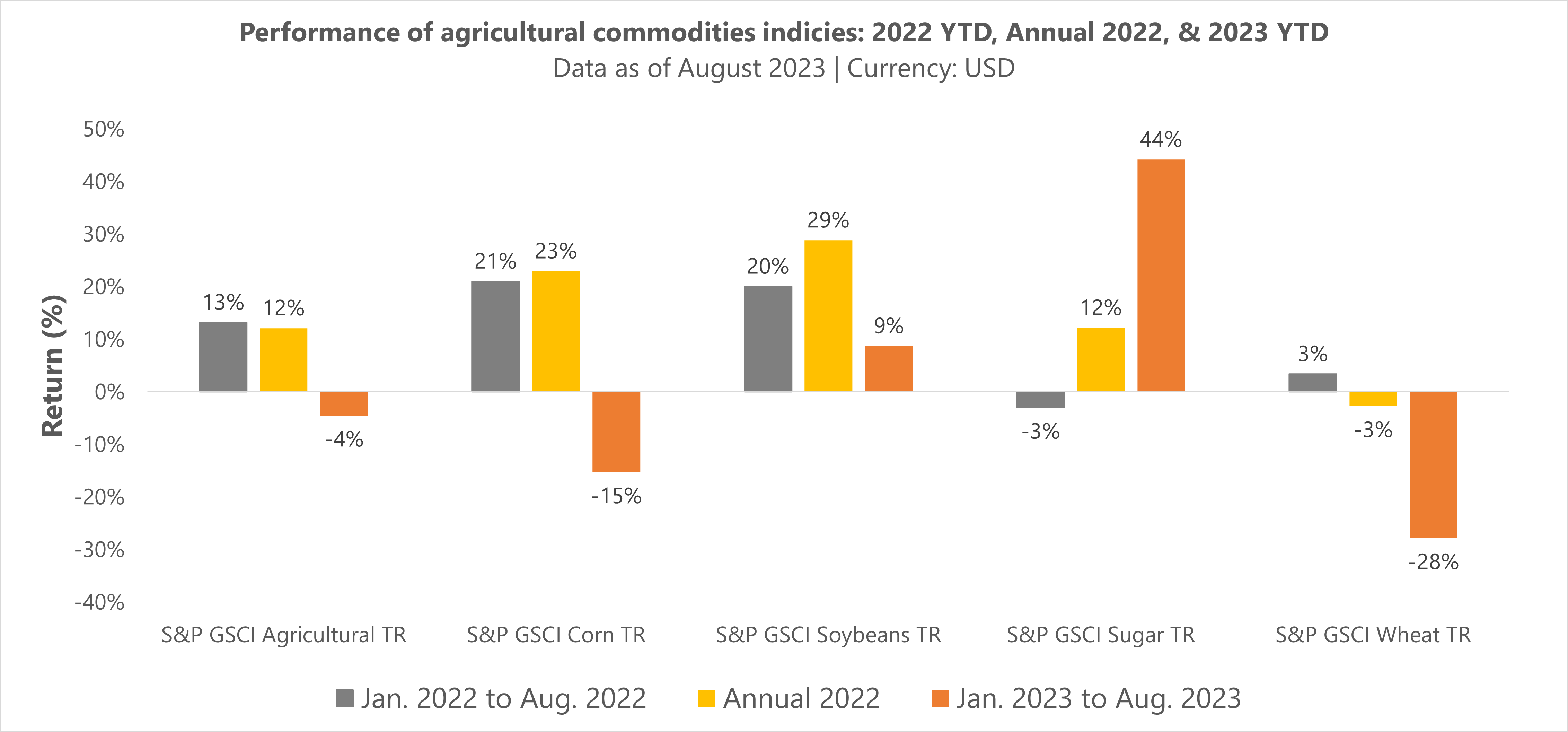
Regarding the year-to-date performance of the S&P GSCI Corn Index and S&P GSCI Wheat Index, the impact of the Russia-Ukraine conflict on Ukrainian corn and wheat supply continues to weigh. While the resumption of the Black Sea grain initiative provides a measure of hope that Ukrainian grains will re-enter the global market, to what degree is unknown.
The strong year to date performance of the S&P GSCI Sugar index was due to heightened concerns over the impact of the El Niño weather phenomenon on global production prospects. In India, below-average rains in August were detrimental to sugarcane crop development, while persistent dry weather conditions in Thailand are expected to negatively affect the 2023/24 sugar production. The modest performance of the S&P GSCI Soybeans TR can be attributed to a decline in world prices due to improving soybean crop conditions in the United States of America. Additionally, Brazil has gained expertise in soybean production, allowing them to be a material contributor to global exports in the short-to-medium term.
Why consider investing in agricultural commodities
Though the current performance of agriculture commodities may vary, as evidenced from the preceding data, interested investors would be wise to take a broader look at the asset class. Alternative assets, such as agriculture commodities, have proven to be additive components to bond and equity portfolios, given their ability to hedge inflation and their low/negligible correlation to traditional assets.
In looking at the trailing performance of each asset class, as of December 2022, using their respective indices as a proxy, an allocation to agriculture would have been additive to portfolio performance in most instances.

Investing in agriculture commodities through ETFs
For investors interested in gaining exposure to agriculture commodities, Teucrium is an ETF provider of commodity-based solutions focused on US Agriculture. Across the firm’s suite of solutions, investors can gain pure-play exposure to specific commodity types or benefit from diversified, single-asset portfolio offerings.
Direct, pure-play commodity ETFs offer investors a convenient way to gain exposure to the price of specific commodity futures including:
- Teucrium Corn Fund (Ticker: CORN), provides investors an easy way to gain exposure to the price of corn futures.
- Teucrium Wheat Fund (Ticker: WEAT) provides investors with an easy way to gain exposure to the price of wheat futures.
- Teucrium Soybean Fund (Ticker: SOYB) provides investors with an easy way to gain exposure to the price of soybean futures.
- Teucrium Sugar Fund (Ticker: CANE) provides investors with an easy way to gain exposure to the price of sugar futures.
Alternatively, for investors seeking more diversified exposure within a single-ticket portfolio the following could be of interest:
- Teucrium Agricultural Fund (Ticker: TAGS) is a passively managed fund of funds, that holds Teucrium’s single-commodity ETFs (CORN, WEAT, SOYB, CANE), in equal weight.
- Teucrium AiLA Long-Short Agriculture Strategy ETF (Ticker: OAIA) delivers access to an agriculturally focused quantitative strategy that has the potential to achieve positive returns regardless of market direction. The ETF will track the performance of the AiLA-S033 Index, a sophisticated long-short investment strategy in the agriculture sector.
Please note this article is for information purposes only and does not in any way constitute investment advice. It is essential that you seek advice from a registered financial professional prior to making any investment decision.


Latest ETF News
See all ETF newsBeyond Big Tech: The Increasing Specialization of AI ETFs


There's an ETF for That? Humanoid Robotics and Physical AI

How Some ETF Issuers Use Their Own Funds for Cash Management

These Public-Private ETFs Invest in Polymarket and Anduril

There's an ETF for That? Frontier Markets



 Advantages of ETFs over Mutual Funds1/6
Lower Costs
In this guide, we'll explore the advantages of ETFs over mutual funds, giving you valuable insights into why ETFs have gained significant popularity among investors like yourself.
Leveraged ETFs: Unlocking the Potential for Amplified Returns1/6
Understanding Leveraged ETFs
Explore leveraged ETFs: potential for amplified returns & risks. 5 ETFs to consider across equities, commodities & fixed income.
What is a Leveraged ETF?1/6
Introducing Leveraged and Inverse ETFs
In this guide, we'll dive into the world of leveraged ETFs, exploring their definition, mechanics, potential risks, and rewards.
Recent educational content

First Look ETF
First Look ETF: Income, International, and Cash Flow ETFs
In this season 6 episode of First Look ETF, Stephanie Stanton @etfguide examines the latest ETF marketplace trends with NYSE and guests.


ETF Trends
ETF Industry KPIs October 5, 2026
This week’s KPI data overview highlights key metrics and trends shaping the ETF landscape.

ETF Trends
ETF Industry KPIs September 28, 2026
This week’s KPI data overview highlights key metrics and trends shaping the ETF landscape.
ETF Trends
ETF Industry KPIs September 22, 2026
This week’s KPI data overview highlights key metrics and trends shaping the ETF landscape.