Create, analyze, optimize your ETF portfolio. Start now →



Active fixed income in an ETF wrapper
Active fixed income ETFs can help investors construct strong and cost-effective portfolios.

Keep up with what matters in ETFs
Get timely ETF insights, market trends, and top ideas straight to your inbox.
Your newsletter subscriptions with us are subject to ETF Central's Privacy Policy and Terms and Conditions.
John Ecklund and Bob Fields
Fixed income ETFs have experienced tremendous growth in assets, driven largely by passive fixed income strategies, but investors seeking to make use of active ETFs have had limited choices. However, that dynamic is changing.
While some investors may prefer passive fixed income investing, it may not always create all the outcomes investors expect from their fixed income allocations, including diversification and potential return enhancement. In addition, passive investors are vulnerable to the changing investment characteristics of fixed income indices and could miss out on the benefits of exposure to securities and sectors that are not represented in a given index, especially in volatile interest rate environments.
More recently, fixed income ETFs are transforming debt investing. Actively-managed fixed income investments can help investors construct strong, well-diversified portfolios. Skilled and experienced active managers have the tools to inform security selection, identify return-enhancing opportunities and manage duration and risk – as well as the flexibility to respond to ever-changing markets.
Like what you're reading?
Stay in the loop — get the latest ETF insights: trends, analysis, and expert picks.
The case for active fixed income ETFs
In our view, passive fixed income strategies can attempt to mimic an index, but on their own they may not lead to all the outcomes that investors traditionally expect from their fixed income allocations, including enhanced returns, lower volatility and diversification. As a reminder, the largest holdings in a fixed income index, are those that issue the most debt. Do investors inherently want their largest holdings to be the largest borrowers? In an environment of rising rates in conjunction with increased market volatility globally, active, flexible decision-making is even more critical to portfolio performance in a changing economic environment.
Greater diversification
While the S&P 500 Index captures more than 80% of the U.S. stock market, bond indices are less reflective of the markets they seek to emulate. The benchmark for U.S. investment-grade bonds, the Bloomberg US Aggregate Bond Index (also known as “the Agg”), captures only 49% of the U.S. bond market. Diversified core fixed income investors need to be aware that the Agg remains highly concentrated in U.S. Treasury and agency mortgage-backed securities (MBS), which represent nearly 70% of its underlying assets. The index’s rule-based construction, designed in the 1980s, excludes many securities that investors prefer to deploy in a modern, well-diversified portfolio: certain agency mortgage securities, most asset-backed securities and approximately 40% of all corporate bonds.
The Agg excludes large parts of the U.S. bond market
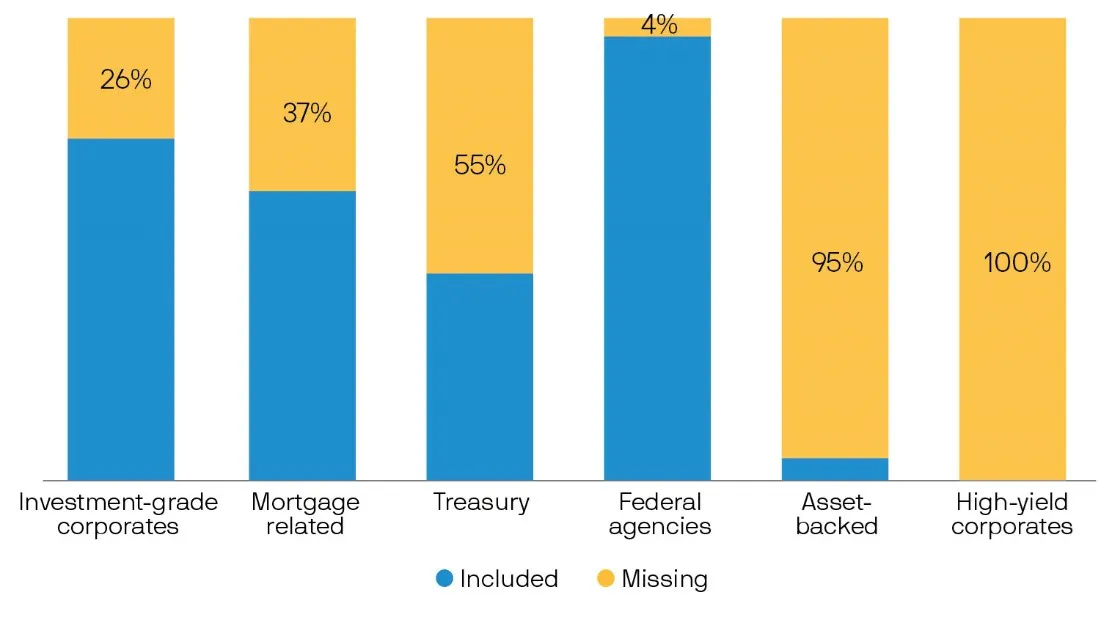
Investors seeking broader market diversification need to look beyond the rigidity of the Agg for exposure to a more complete set of opportunities – and access to sectors such as asset-backed securities, high yield bonds and emerging market debt – to potentially generate additional income and return.
Ability to make active decisions
The current interest rate environment is an excellent example of why flexibility to make active decisions is critical. Since a passively-managed fund is designed to track an index, there is no opportunity to make active decisions, such as making tactical allocations as well as managing duration and risk.
As rates rise, investment managers have the flexibility to lower duration versus the Agg to mitigate declining bond prices. Depending on the fund’s objective, managers may have the flexibility to upgrade credit quality, increase liquidity profile and capture yield by allocating to other sectors of the fixed income market.
Enhanced returns
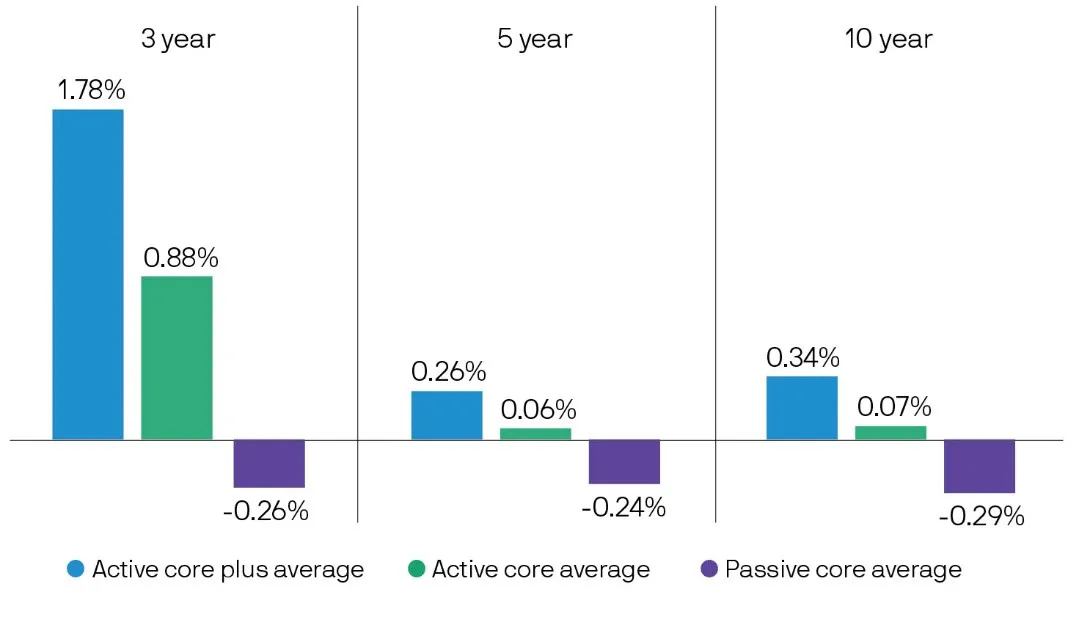
Active fixed income management has shown its ability to deliver excess returns net of fees – a fact that may surprise some staunch advocates of passive investing in equities. Within each of the two largest bond fund categories – core bond and core-plus bond – the average active fund outperformed the Agg as well as the average passive core bond fund over various economic cycles.
In addition, not only do active fixed income managers outperform their passive peers net of fees, over the long term, they have also outperformed on a risk-adjusted basis.
Within the largest bond categories, active management has added value
Excess annualized return (%) over the Bloomberg US Aggregate Bond Index
Increased liquidity
An added benefit of active fixed income ETFs is that they provide enhanced access to liquidity. Unlike actively managed mutual funds, ETFs trade in the secondary market, giving investors the ability to buy and sell throughout the day. In addition, by virtue of this trading, the ETF vehicle provides investors with real-time price discovery on the value of their portfolios, allowing investors to see how their risk profiles may be changing.
The diversity of the investor base for active fixed income ETFs also supports the liquidity of the product: Not all owners of an ETF are sellers at the same time. Investors can gain exposure to active fixed income ETFs through long and short positions or by buying and selling options, all of which help reinforce the liquidity of the ETF market.
Why active fixed income in an ETF wrapper?
For investors utilizing an ETF to access active fixed income, the benefits could be far-reaching. The unique mechanics of ETFs have the potential to revolutionize the delivery of active fixed income strategies. Investors stand to profit from daily transparency into fund portfolios, lower overall management fees and reduced cash drag. Exchange trading provides investors with enhanced price discovery and greater intraday liquidity – a material benefit in times of market stress.
Building stronger portfolios
With the crosscurrents of volatile rates and the possibility of persistently higher inflation combined with a slowing economy, active fixed income managers continue to see ample opportunities to enhance portfolio returns and mitigate risks.
ETF investors have the freedom to choose from an expanding array of active approaches as they become more readily available – including core strategies that provide diversification to broad equity exposures, complementary strategies that reduce overall portfolio risk and sector strategies that enhance income and total return.
Designed as building blocks for constructing stronger, more cost-effective portfolios, active ETFs hold the potential to transform the future of fixed income investing.
Mutual funds have fees that reduce their performance; indexes do not. You cannot invest directly in an index. The Bloomberg U.S. Aggregate Index is an unmanaged index representing SEC-registered taxable and dollar-denominated securities. It covers the U.S. investment-grade fixed rate bond market, with index components for government and corporate securities, mortgage pass-through, and asset-backed securities.
Investing involves risk, including possible loss of principal. Investment returns and principal value of an investment will fluctuate so that an investor’s shares, when sold or redeemed, may be worth more or less than their original cost. ETF shares are bought and sold throughout the day on an exchange at market price (not NAV) through a brokerage account and are not individually redeemed from the fund. Shares may only be redeemed directly from a fund by Authorized Participants, in very large creation/redemption units. For all products, brokerage commissions will reduce returns.
Actively managed funds typically charge more than index-linked products. Diversification may not protect against market loss.
Explore more
A strategy for fixed income diversification
Our framework for fixed income diversification seeks to help investors generate income and reduce overall portfolio volatility.
JPMorgan Core Plus Bond ETF (JCPB)
Enhance your core. JCPB expands opportunities for returns and income by combining a broad foundation of high-quality core bonds with dynamic sector allocation and a macro overlay.
JPMorgan Income ETF (JPIE)
Genuine diversification has helped make consistent income the outcome. Using a flexible, well-diversified fixed income approach, JPIE seeks to maximize income for a prudent level of risk.
The value of investments in mortgage-related and asset-backed securities will be influenced by the factors affecting the housing market and the assets underlying such securities. The securities may decline in value, face valuation difficulties, become more volatile and/or become illiquid. They are also subject to prepayment risk, which occurs when mortgage holders refinance or otherwise repay their loans sooner than expected, creating an early return of principal to holders of the loans.
Securities rated below investment grade are considered "high-yield," "non-investment grade," "below investment-grade," or "junk bonds." They generally are rated in the fifth or lower rating categories of Standard & Poor's and Moody's Investors Service. Although they can provide higher yields than higher rated securities, they can carry greater risk.
Segments
See all
Mentioned ETFs
No specific ETFs were tagged
Further reading


Latest ETF News
See all ETF newsEquity Investing 101: Understanding U.S. Large-Cap Growth ETFs


Tony's ETF Buyer's Guide: Sector ETFs (Vanguard versus State Street SPDR)

Options Strategies in ETFs, Part 4: Put-Selling and Leverage

Options Strategies in ETFs, Part 3: Buffer ETFs




 Advantages of ETFs over Mutual Funds1/6
Lower Costs
In this guide, we'll explore the advantages of ETFs over mutual funds, giving you valuable insights into why ETFs have gained significant popularity among investors like yourself.
Leveraged ETFs: Unlocking the Potential for Amplified Returns1/6
Understanding Leveraged ETFs
Explore leveraged ETFs: potential for amplified returns & risks. 5 ETFs to consider across equities, commodities & fixed income.
What is a Leveraged ETF?1/6
Introducing Leveraged and Inverse ETFs
In this guide, we'll dive into the world of leveraged ETFs, exploring their definition, mechanics, potential risks, and rewards.
Recent educational content

ETF Trends
ETF Industry KPIs September 8, 2026
This week’s KPI data overview highlights key metrics and trends shaping the ETF landscape.

ETF Trends
ETF Industry KPIs August 31, 2026
This week’s KPI data overview highlights key metrics and trends shaping the ETF landscape.
ETF Trends
ETF Industry KPIs August 24, 2026
This week’s KPI data overview highlights key metrics and trends shaping the ETF landscape.
What’sTheFund
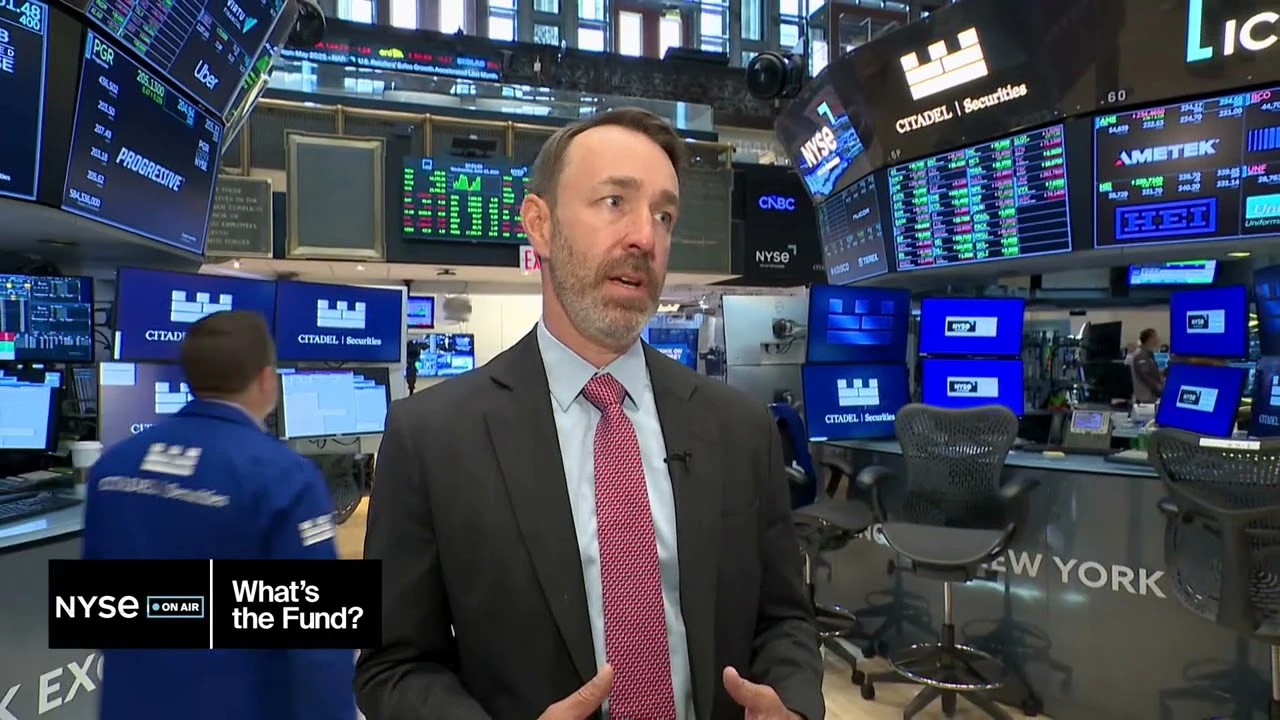
What's the Fund | Ocean Park Diversified Income ETF (DUKZ)
James St Aubin, Chief Investment Officer at Ocean Park Asset Management, discuss the DUKZ ETF, exposing investors to the whole spectrum of asset classes in the fixed income markets, through their rules-based process.

Browse all educational columns



Build and Analyze Your ETF Portfolio Like a Pro
Create your own ETF portfolio in minutes and instantly see allocations, exposures, performance, and risk. Visualize diversification across asset classes, regions, and sectors. Stress-test ideas, compare benchmarks, and refine your strategy with professional-grade analytics.