Global ETF Survey Is Live! 600+ ETF Professionals Weigh In. See Results →



3 ETFs that Beat the S&P 500 in 2024
Here’s a look at which ETFs managed to outperform the benchmark index this year.


Keep up with what matters in ETFs
Get timely ETF insights, market trends, and top ideas straight to your inbox.
Your newsletter subscriptions with us are subject to ETF Central's Privacy Policy and Terms and Conditions.
Beating the S&P 500 net of fees is no easy task. The index itself doesn’t suffer from sources of drag like fees, taxes, trading costs, or cash holdings, which ETFs contend with.
As of June 30, data from SPIVA estimates that 57.05% of all U.S. large-cap funds underperformed the index over the trailing one-year period. The flipside? The 42.95% of large-cap funds that did outperform.
Of course, it’s worth noting that as time goes on, the number of outperformers steadily shrinks due to the consistent challenge of maintaining an edge.
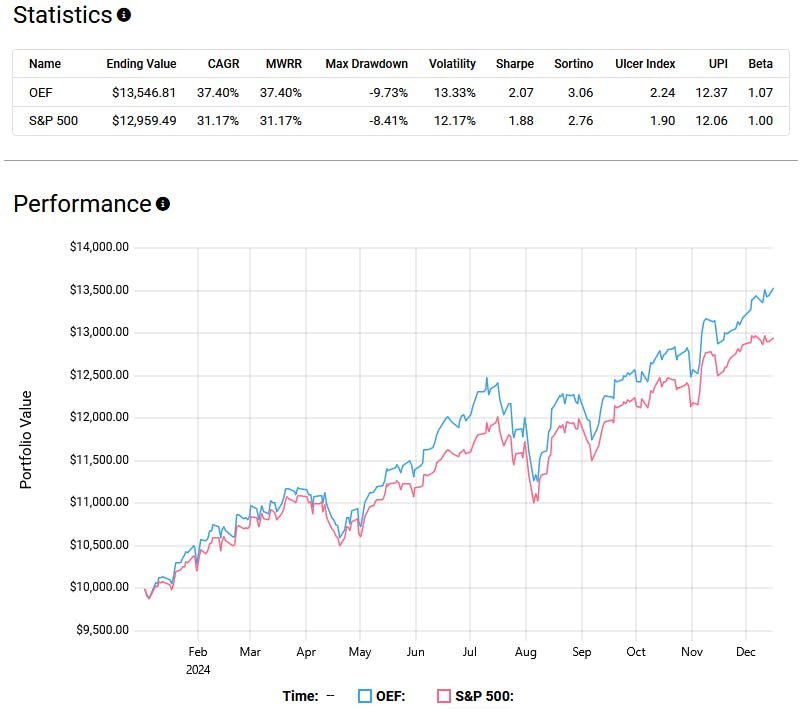
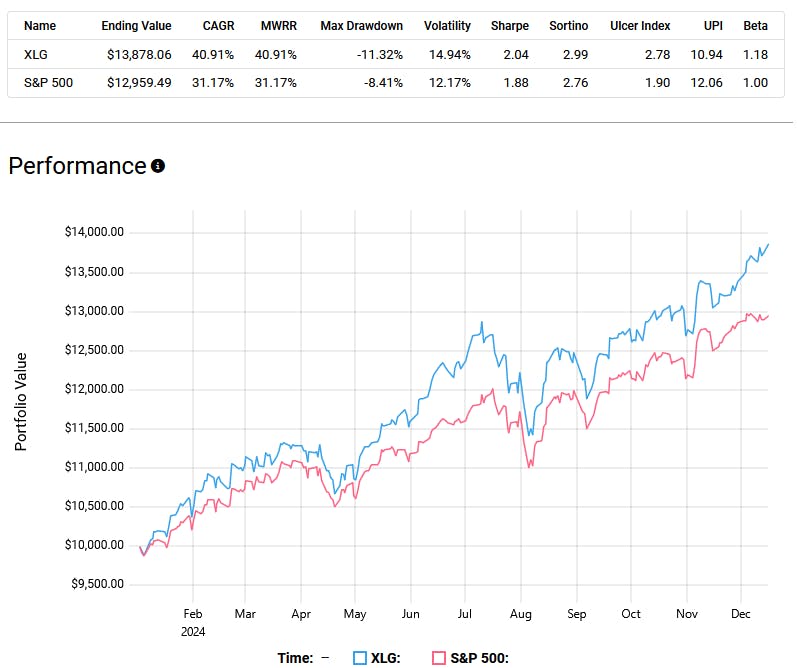
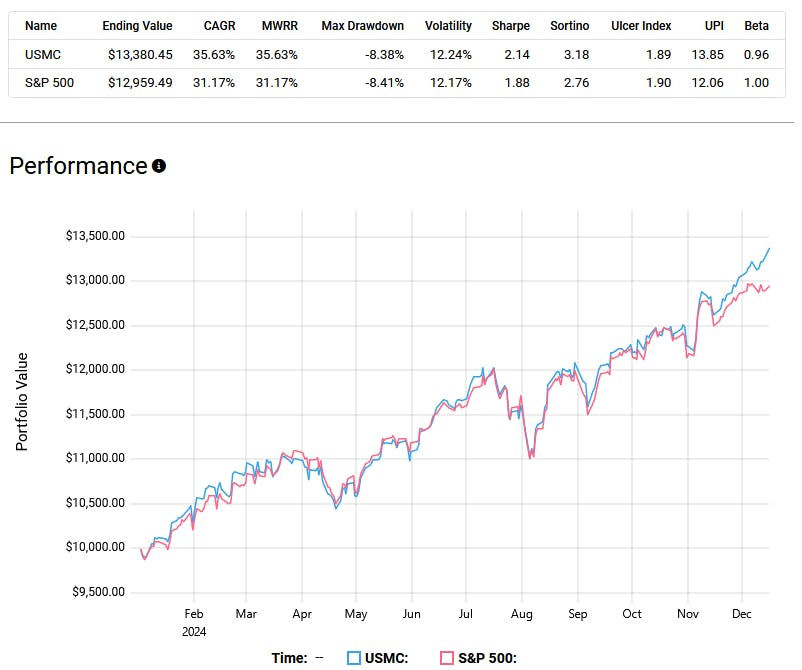
Still, for 2024, a decent number of U.S. equity ETFs managed to pull ahead of the S&P 500’s 31.17% YTD return, delivering impressive gains through December 16. Let’s take a look at the standout winners so far according to the ETF Central screener.
Global ETF Survey 2026 is Live!
With 1,790 new products launched by July 2026, choosing is harder than ever. Our Global ETF Survey 2026, built on 620 professional investors and allocators, shows how active, fixed income, options-based and thematic ETFs are reshaping fund selection.
iShares S&P 100 ETF OEF+0.73%
First up is OEF, which tracks the S&P 100 Index. This benchmark is a bit of a relic from the early 2000s when it was still widely quoted. While it doesn’t make headlines much anymore, it remains relevant, commanding $15 billion in AUM.
The S&P 100 focuses on the top 100 stocks within the S&P 500, meaning you get heavier exposure to mega-cap companies. As expected, the ETF skews heavily toward technology, even more so than the broader S&P 500, with 38.3% sector exposure. OEF’s expense ratio is a modest 0.20%.
Invesco S&P 500 Top 50 ETF XLG+0.74%
The natural progression from OEF in terms of concentration is the Invesco S&P 500 Top 50 ETF, or XLG. This ETF tracks the S&P 500 Top 50 Index, which, as the name suggests, holds only the largest 50 stocks in the S&P 500.
With XLG, you’ll see even more exposure to mega-cap stocks, particularly in the technology sector, which currently makes up 43.57% of the portfolio. That said, it’s a solid alternative to Nasdaq-100 ETFs since it doesn’t arbitrarily exclude financials, giving you exposure to companies like JPMorgan Chase, Berkshire Hathaway, Visa, and Mastercard.
XLG charges the same 0.20% expense ratio as OEF and currently holds just over $7.8 billion in assets under management.
Principal U.S. Mega Cap ETF USMC+0.82%
USMC also leans heavily toward mega caps, continuing the “bigger is better” theme of 2024. However, unlike OEF and XLG, this ETF is actively managed rather than tracking a traditional index.
Here’s how it works: USMC starts by screening the top 50% of the S&P 500 by market capitalization. From there, the largest 10% of that group are weighted by market cap, while the remaining 40% are weighted based on Principal’s proprietary financial strength score.
The result is a portfolio with a relatively high 55.88% active share, meaning it deviates significantly from its benchmark — a good sign for those seeking true active management.
Despite being actively managed, USMC bucks the trend of high fees, charging just 0.12% — lower than both OEF and XLG. It also boasts an impressively low turnover rate of 0.5%, making it a rarity in the active ETF space.
Please note this article is for information purposes only and does not in any way constitute investment advice. It is essential that you seek advice from a registered financial professional prior to making any investment decision.
Latest ETF News
See all ETF newsBeyond Big Tech: The Increasing Specialization of AI ETFs

There's an ETF for That? Humanoid Robotics and Physical AI

How Some ETF Issuers Use Their Own Funds for Cash Management

These Public-Private ETFs Invest in Polymarket and Anduril

There's an ETF for That? Frontier Markets



 Advantages of ETFs over Mutual Funds1/6
Lower Costs
In this guide, we'll explore the advantages of ETFs over mutual funds, giving you valuable insights into why ETFs have gained significant popularity among investors like yourself.
Leveraged ETFs: Unlocking the Potential for Amplified Returns1/6
Understanding Leveraged ETFs
Explore leveraged ETFs: potential for amplified returns & risks. 5 ETFs to consider across equities, commodities & fixed income.
What is a Leveraged ETF?1/6
Introducing Leveraged and Inverse ETFs
In this guide, we'll dive into the world of leveraged ETFs, exploring their definition, mechanics, potential risks, and rewards.
Recent educational content

First Look ETF
First Look ETF: Income, International, and Cash Flow ETFs
In this season 6 episode of First Look ETF, Stephanie Stanton @etfguide examines the latest ETF marketplace trends with NYSE and guests.


ETF Trends
ETF Industry KPIs October 5, 2026
This week’s KPI data overview highlights key metrics and trends shaping the ETF landscape.

ETF Trends
ETF Industry KPIs September 28, 2026
This week’s KPI data overview highlights key metrics and trends shaping the ETF landscape.
ETF Trends
ETF Industry KPIs September 22, 2026
This week’s KPI data overview highlights key metrics and trends shaping the ETF landscape.