NYSE CRTR Economy Event Watch the replay →



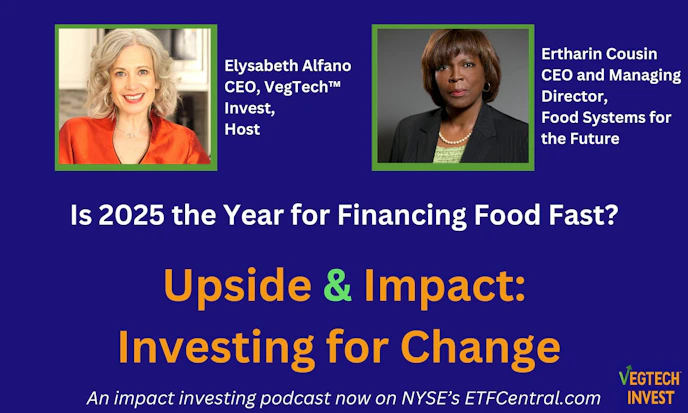
Is 2025 the Year for Financing Food Fast?
Ertharin Cousin and Elysabeth Alfano discuss boosting nutritious, efficient food systems, exploring policy, finance, and climate impacts.

Keep up with what matters in ETFs
Get timely ETF insights, market trends, and top ideas straight to your inbox.
Your newsletter subscriptions with us are subject to ETF Central's Privacy Policy and Terms and Conditions.
Former U.S. Ambassador to the United Nations Agencies for Food and Agriculture and Executive Director of Food Systems for the Future, Ertharin Cousin, joins CEO of VegTech Invest and host Elysabeth Alfano, to discuss how we are going to feed the world more nutritiously and efficiently by connecting policy and finance.
Specifically, they discussed
- What is the Food Systems for the Future Institute?
- Given your long tenure as the Ambassador to the UN Agencies for Food and Agriculture and as Executive Director of the UN World Food Programme, how have you seen the landscape around global nutrition and food insecurity change?
- At COP28, the World Bank declared that Food Tech is Climate Tech. There is a growing understanding of the overlap of food systems and energy use and food's impact on Climate Change. Why is funding/investing in food systems transformation so low?
- With 5-year plans on the horizon for companies and countries, do you expect to see investing in food systems transformation tick upwards as organizations lay the groundwork to meet 2030 goals?
- What is the piece of the puzzle of food systems transformation that is holding up funding?
- In talks with Cargill, a senior level management director stated that they thought once the dominos started shifting in food systems that the whole system would shift really quickly. Do you agree?
- Given #6, would you like to make any predictions?
The ETF Industry Is Evolving Fast
From AI infrastructure to active strategies, the ETF landscape is shifting. Share your perspective in the 7th Annual Global ETF Survey and get exclusive early access to the final report.
Listen to the full podcast on Spotify
Watch the video here on YouTube
Full transcript
Elysabeth: Hey everyone, welcome to the VegTech Invest Upside & Impact podcast. I’m your host, Elysabeth Alfano, the CEO of VegTech Invest, Advisor to the Plant-based Innovation and Climate ETF, EATV. On Upside & Impact I chat with the leaders and movers who are shaping and growing impact investing for meaningful change. We “pull up as we go up” as the expression goes so this podcast is all about making meaningful and productive impact while also managing one’s portfolio for upside. Of course, always managing for upside.
If you’d like more information about VegTech Invest you can visit us at VegTechInvest.com and subscribe to our newsletter. You can also find us on LinkedIn and on Twitter @VegTechInvest. We record live every first and third Wednesday of the month on our LinkedIn page at 1:30pm eastern standard time. So, check us out live and be sure to bring your questions.
Now if you’re listening as part of a podcast, of course subscribe to this podcast right now so that you never miss an episode. And if you’re listening on iTunes, be sure to leave a 5-star review. It really does help.
So now let’s get down to today’s show and thanks for being with me on today’s episode of VegTech Invest’s Upside & Impact. And as always, a reminder, this podcast is for informational purposes only and is not meant to recommend any specific company or investment. Now, onto the show.
Hi everyone, I’m Elysabeth Alfano, CEO of VegTech Invest. I’m so happy to be here on the New York Stock Exchange podcast, Upside & Impact: Investing for Change. On this podcast, of course, I cover all the sustainability investing opportunities, sustainable building materials, novel energy, electric vehicles, new transportation, new areas to create wealth and impact in investing. But of course, a subject that’s near and dear to my heart and really where I am a systems expert, is food systems transformation.
So, I’ve been talking a lot on this podcast about 2025. Will it be that critical year when companies as well as countries start to invest to meet their 2030 goals? We all have a hunch that no one’s really done that much. Will 2025 be that year when they start investing in food systems transformation because of its impact on the climate? Well, I’ve given my perspective over the previous couple of episodes, so now I want to bring on a systems expert.
I want to bring on the former ambassador to the UN Agencies for Food and Agriculture, the former executive director of the World Food Program, and the current CEO, founder, and executive director of Food Systems of the Future, Ertharin Cousin. Thank you for being with me today.
Ertharin Cousin: I’m delighted by this opportunity. Thank you so much.
Elysabeth: Wow, so gracious of you. Okay, just level the playing field here. What is Food Systems for the Future and what are you doing in that regard?
Ertharin Cousin: Well, Food Systems for the Future has a vision of a world without malnutrition. Our mission is to achieve that vision through the sustainable transformation of the food system through human health and environmental health. You can’t do one without the other, and by ensuring that the system provides adequate financial remuneration to all actors across this food system from the farmer to the investor and that we bring consumers along with us. Big goals, big mission, but that’s what it’s going to take for us to ensure that everyone has access to the nutritious food required to support their diet and human health.
Elysabeth: Yeah, I love that. It may be surprising for some to know on this podcast that those who pick the food for us globally are often the ones who are the most malnourished. Could you inform us as to why that is?
Ertharin Cousin: Well, because farmers don’t get paid enough, wherever they are in the world. The most vulnerable farmers to climate, suffer from the impacts of lack of access to the adequate seeds and tools, who suffer from lack of investment, who are often the small farmers who feed most populations in the countries across the globe are the poorest people in that country. As a result, particularly between the times of harvest and the next planting, they’re the hungriest people.
Elysabeth: Yeah, it’s just amazing. Two little heads up there. Two weeks from now, folks, I’m going to have the deputy undersecretary of agriculture, Sanah Baig, here to talk about farmers. We’re going to deep dive into really what that looks like coming out of the USDA 2022 census report, which now has the results in early 2024. So, we will look at that because it’s going to be different than what you think. What does the global farmer look like? It’s going to lean more towards big corporations than the small farmer, but we’ll get into those details.
So, I think it's very interesting that those involved in the farm system are often those who don’t have enough food. So worrisome. You started the conversation with the fact that we have huge goals and I think to boil it down for people, we need to feed more people with more nutritious food in a shorter amount of time, traveling shorter distances, using fewer resources, and creating less damage. So how are we going to do that?
Ertharin Cousin: Well, I believe that the change happens at the nexus of policy and finance and where we can drive the catalytic policies that are necessary to support the change that is required and provide the amount of funding to support farmers’ actions to develop the markets that are required, we can drive the change that you’ve just described.
Elysabeth: So, this to me is inspirational. I’m very hopeful about this. The reason being is when I was at COP28 where we met very briefly in passing and then luckily, we were able to meet again in more depth at the US Sustainable Investment Forum in June of 2024 in Chicago, The World Bank at COP28 said that Food Tech is Climate Tech and that we need to start investing along those lines. I wonder if you could elaborate your thoughts on that and how much money it’s going to take to do that.
Ertharin Cousin: Well, here’s the reality: We’re not going to solve this problem by coming up with quick slogans. This is a hard slock that is required to move us from where we are to the sustainable transformation of the food system that we talked about to achieve that desired goal of ensuring access to an affordable nutritious diet by all. Right now, as you and I are sitting here, 3.1 billion people cannot afford access to an affordable, nutritious, diverse diet daily.
As you know, our food system consumes 70% of the freshwater draws on an annual basis and our food system is the primary driver of the biodiversity challenges that we are witnessing across the globe. So, the type of change that is necessary is not going to instantaneously come. We saw this when some $3 billion was invested in cultivated meats, for example. $3 billion was invested in cultivated meats over a 10-year period and then we saw lots of bankruptcies in 2020 to 2023 that resulted in a lot of the venture capital moving out of the market because people were looking for fast answers.
AgTech, food tech, agriculture, and food systems don’t move at the pace of fintech, but the opportunities for those who invest in these areas are quite significant, but it requires patient investments. Too often when capital that flows into food systems seeks to drive quick change, the science doesn’t move as fast as they want. The seasons don’t move as fast as you want, and then the follow-on capital doesn’t come and as a result the companies fail.
We should not sit here and say, “2025, let’s move lots of money.” Let’s move smart money into food systems that recognizes that the capital must be patient to support not just the idea of what is possible, but building into companies the ability to have the operations that can bring down prices of the production of cultivated meats, of what I like to call supplemental proteins, that can support that transformation but also the tools that support sustainable livestock management. This includes the new feeds that are necessary to reduce the methane emissions of cattle, tools that will support the measurement of carbon sequestration in AgTech that will support the farmer’s ability to move from the agricultural production systems of today to the systems that we need tomorrow that also meet the climate demands for the monitoring, measurement, reporting, and verification.
All that work, it’s not going to happen in one year. It’s not going to happen in one year, but if asset managers and owners recognize that this opportunity may not move at the pace they want, but will deliver the returns that they need, we can move forward.
Elysabeth: So, I think here’s where policy comes into play. Policy can slow down a little bit the expectations of let’s say fintech and bring it into reality that what you’re really talking about is an infrastructure build out. I know the work that we do at VegTech Invest and our investments in the public market are all supply chain related. So, it’s less of the product that one singular product is going to change the food system, but more building out, laying that foundation, and putting the bricks down so that when you have increased demand you have increased capacity to produce and you just kind of grow this supplemental complementary system that is indeed less extractive.
You’ve been saying some great stats here. I’ll add some. The United Nations Environment Programme notes that the food system is responsible for 30% of all greenhouse gas emissions and that the animal component of that is responsible for 60% of the 30%, so 18%. These are big numbers. If you’d like to impact climate change and food is 30% of greenhouse gas emissions, that’s a big number. When you say smart capital, and I see what you’re saying, to lay the groundwork, build the foundation, and be more patient, I also think of blended capital. Wall Street Money, VC money, government money and philanthropic money. Do you see these four players coming together around food systems transformation?
Ertharin Cousin: There’s a lot of talk happening about them coming together. We’re not seeing enough examples of it happening, but the difference between now and five years ago is that the conversations are occurring to begin to bring those capital owners together and those capital managers together. The opportunity that we have, though I think is dependent upon our ability to build models of success that will move us from the challenge or the questions regarding risk and the conversation about that, limit the private sector capitals’ interest in this space to supporting the opportunity because we can de-risk or to minimize risk.
Elysabeth: So, you’re talking about something like off-take agreements where a company may be willing to put in the capex to build those extra factories, let’s say in complementary proteins, if they know that there’s a buyer at the end and that buyer is guaranteed maybe through some government help. I’m just talking about these being “maybes.” Is that what you mean by de-risking?
Ertharin Cousin: I think that’s part of it, but it’s also the types of capital that we bring. For Agtech innovations, you need PRI capital when you’re talking about that first loss capital that limits the potential for loss from private sector capital that will bring more of that private sector capital that is less concerned about the asset class of food and ag, which too often is seen as far too risky.
In addition to off-take agreements, it’s also the kinds of investment that we saw with the IRA in the energy space that moved capital into production of chips, for example, that would not have otherwise invested those large sums of capital in the U.S. without the intervening government funds that supported those investments that ensured that there would be a market. We don’t have that level of government support for the investment in agriculture that we’ve seen in energy. That needs to change.
Elysabeth: Okay, so I’ll throw some numbers out at people. Recently, I had the Senior Energy Analyst for Bloomberg Intelligence on this show, and he was saying that right now about $1 trillion a year is spent on gas and oil and $2 trillion is spent on novel energy. They’re trying to get that ratio to be one to three rather than one to two but still you’re looking at $2 trillion. A lot of it is coming from the IRA Act, so the Inflation Reduction Act, but still $2 trillion is a great number.
Now you’re getting maybe 2.5% going to food systems transformation. The numbers from the World Bank are 2.5%-4% of what we spend on climate tech goes to food. I’m wondering why so little. The data’s there. The United Nations Environment Programme is saying 30% of all greenhouse gas emissions, and you’re talking about 70% of water. It’s a leading cause of deforestation. Why are we so slow to recognize the power of changing food systems transformation and cheapness if you will.
The World Bank and I think I’m maybe quoting you on this- the World Bank says between $350 and $450 billion a year and I believe you said at the US SIF conference that the FAO, Food and Agricultural Organization, is calling for $650 billion a year for the next ten to fifteen years in food systems transformation. That’s a whole heck of a lot less than $2 trillion.
Ertharin Cousin: It’s a whole heck of a lot less than $2 trillion, but the advocacy for the movement of that capital has not been at the same pace or level for food investments from the government as it has been for energy. Much of that is because we’ve been unpopular in the climate community for a very long time. You know this. You were at COP. There was no food day. We fought to get a food day with a recognition that you could not achieve the Paris Climate Accord if you did not bring ag and food into the conversation, more importantly into the investments that were necessary for change.
The challenge is much of the technology that is required to support that transition to the transformation that we need in the food system is not online today. We can’t pretend that we can make the change if we don’t have the tools to deliver the outcomes.
Elysabeth: So, this I understand. This is the point of, I’ll use your expression here, smart capital. Investing in the innovations is an excellent return on investment because people don’t have wealth creation because a company went up 2% in revenue one quarter. They have wealth creation because we all no longer have a landline. We’ve moved to a cell phone. We have digital photos, and we don’t buy film. These sort of mass adoption principles that are filtered into a society. That’s when real wealth is created.
So that’s a great way to spend your money is building out those novel technologies that people will adopt en masse. But there’s resistance to it, as you say. I’m wondering, are we fighting against lobbyists? Is that who’s creating it?
Ertharin Cousin: We’re fighting against the reality that it takes longer to bring those innovative interventions online in the food system than it does in fintech or even in health tech. As a result, the traditional VC capital that is looking for those unicorns don’t consider food tech and AgTech in that space. If you think about all the money that went into cultivated meat and the valuations that we saw two years ago versus those same companies, the ones that are still alive and the valuations today, it’s because they rushed to market to meet the demands of the capital, yet they had not perfected the production of those products to bring down the cost. As a result, there was no consumer demand.
Elysabeth: Yeah, so everyone, just to make clear what she’s saying. It’s a longer innovation curve than something like fintech, but I’ll also give maybe another shade to this conversation. Some of that technology like cultivated meat, we are still six, eight, or ten years away from that. That’s a deep scientific hurdle that we’ve got. Things like fermenting microbes, we’ve been fermenting yeast and beer and now it’s more sophisticated technology than that. You look at ABInBev that is starting to ferment proteins. They’re the largest fermenter in the world. There’s not that much capex needed to change that beer fermentation tank over to a protein fermentation tank. I just say that as a silver lining. We’re not there yet, but the money it’s going to take to get there is less than it’s going to be to electrify the entire grid for electric vehicles.
Ertharin Cousin: Exactly, and the difference it will make in both environmental health and human health. That is the one factor that we must consider when we talk about food and ag, is that unlike energy and even fintech, you are also investing to ensure the health of our population, as well as the health of our environment. So much of what we consume today and how we consume it is the cause of diet-related disease that we are beginning to see the money now. We’re seeing investors go into food as medicine, recognizing that the investments in the food system that are required to produce food as prevention has not come.
So, let’s then invest in giving people access to food upon the onset of diet-related disease. While I don’t want to diminish the potential good impact and positive impact of food as medicine, imagine if food is healthy. If we were investing in a food system that can provide affordable nutritious food before the onset of diet-related disease.
Elysabeth: This has so many financial implications because, of course, if one has these opportunities for their personal health, then you’re talking about bringing personal healthcare costs down and let’s say government total country healthcare costs down. At the same time, back to the United Nations, the top three reasons for the next pandemic, not the one we’re still toying with today I guess one would say, but the next one, are all related to eating meat and the top two are related to the intensification of animal factories.
So, you talk about the societal large cost of things like antimicrobial resistance because of the antibiotics for all the animals and then the pandemic risk. This conversation is about the carrots of getting better and the sticks if we don’t. I see this as still moving, perhaps we’ll say too slowly. The change I’ve seen in the last six months since COP28, the more people asking me- you know people interview me as well as I interview others and people are asking me to be a part of the climate conversation that are now seeing that Venn diagram and that overlap. People that I couldn’t get to listen to me about the impact of food on climate now are asking me to be a part of their panels, etc.
It’s all anecdotal, but I’m seeing in the last four to six months, a huge shift. What have you seen recently?
Ertharin Cousin: The exact same thing. The doors are open, and chairs are pulled up to the table for our food system actors to participate. Yet, we are not yet translating that into capital flows. But step by step, we’re getting that seat at the table. We now have a responsibility to use it to demonstrate what is possible and to answer the questions that are being raised about the viability, for example, of regenerative agriculture on actual carbon reduction.
There’s lots of questions about agricultural carbon credits because of issues related to sequestration, issues related to permanence, leakage, and new tools coming online to support those measurements, new AgTech tools. You’re seeing more dollars going into that. We also need to ensure that we develop models for measuring, monitoring, reporting, and verifying on that carbon to ensure that this is not a short-term investment because the climate activists say greenwashing is not working. So, we as a community must perform the work that is necessary to develop those tools that will answer those questions of greenwashing with the right results.
Elysabeth: I know the work that we do at VegTech Invest, we’re constantly talking about our global temperature warming potential of our investments as 1.18 degrees Celsius, so way below the Paris Accords. The S&P 500 is 2.84. That’s where the world is investing, for a temperature warming of 2.84. So, it’s the power of our money. You see how your investments can make a big difference.
I want to go back to regenerative agriculture. Is it natural? Is it organic? Oh no, I’m afraid that we’re falling into the buzzword label. So, I want to bring it out for people. Regenerative agriculture, we’ve talked about it on this show, really meaning soil health. Bringing back nutritional soil, stable soil, soil that doesn’t wash away every time you have a rain, soil that isn’t completely depleted, and that can produce vegetables that have more nutrients, etc.
As we move to less monocropping, growing the crops to feed animals- and it’s silly because these crops have protein and fiber and they could go right to people, but they go to animals. That needs land, water, time, etc., so you get a very inefficient system there. As we monocrop less for animals and we do more crop rotation and get complementary proteins, other legumes, and great soil health, cover crops of legumes, you get these to people. It’s very exciting. Again, we originally started this conversation on nutrition, so it’s much healthier for people.
But I also have the flip side concern that the regenerative animal portion has the potential to perhaps bring down some methane emissions, but then you have so few animals that you’re not feeding people. Regenerative agriculture means less animals.
Ertharin Cousin: Regenerative agriculture does not mean less animals. No, no, no, no, no. In fact, regen ag includes bringing animals back on the farm. That’s part of the regenerative agriculture movement. Regen ag means sustainable livestock management. It means feeds that support the reduction of methane. As well as all the other ideas that you put forward regarding cover crops and no till and using precision agriculture to support less chemicals to stop runoff. All those things are part of it as well, but I don’t want to leave your audience with a suggestion that it’s one or the other between livestock and transitioning our agricultural practices.
We need a diversity of solutions. I think we as a community of actors fall short for consumers as well as for the potential of what is possible from the business standpoint, if we only point to one set of solutions as a pathway to success.
Elysabeth: Yes. I’ll say with the growth of an interest in food systems, I do see a lot of internal bickering. I won’t call it fighting. I’ll call it internal bickering. “No, it’s my way.” “No, it’s my way.” Obviously, we’ll take all hands on deck. The global food system is worth $14 to $19 trillion, depending on who you ask. The protein portion is $1.4 trillion. That’s not including dairy which is almost $900 billion. It’s almost $1 trillion. It’s around $892 billion right there. So clearly this doesn’t get changed in a day, and clearly it doesn’t get changed with one solution. In fact, it’s many solutions and all working together.
We’ve got eighty billion animals in factories, so to me it seems one would say it’s going to be less animals in regen ag, but we too as consumers maybe play a role in that we reduce a little bit what we eat and at the same time cultivated meat is coming online and then we still have animals maybe from the regen ag perspective but it’s all of it together. You see the mathematical equation of it being all of it together.
Maybe we can go back to the Inflation Reduction Act. We’ve kind of talked around it, but if I can get a personal expectation. Did you think you’d see more food systems investment in that, or did it come out just as you thought it would?
Ertharin Cousin: It came out just as I thought it would. I think we have a lot of work to do as a community, and that bickering that you just described limits our ability to develop the partners that are necessary in the political sphere to drive the increase in investment from the government. The opportunity that we have is to embrace the narrative. I always smile at those who say, “There’s no such thing as climate change.” But even if you’re in that camp, you believe in soil health, you believe in maximizing the economic potential of farmers, you believe in supporting access to affordable nutritious food to ensure that we are addressing the issues that our diets are creating on our health today.
With that level of advocacy and that narrative, we have an opportunity as a community of actors to continue to ensure that we are talking about the investments that are necessary to achieve those goals that I’ve just described. As opposed to debating amongst one another what should not be funded. Limiting the dollars for all.
Elysabeth: Yes, I couldn’t agree more. I’ll say as I’m a silver lining kind of person, I had hopes for the IRA, but a little-known fact is around the same time, maybe even before actually, the Biden administration came out with the synthetic biology and synthetic biology manufacturing bold goals. This is different from giving money, but it’s bold goals for the country- because food security is an issue of national security. I know that that concept doesn’t fall short on you.
Sure, we’re bringing back some semiconductor production to the United States, but also maybe we want to make sure that we’re leading the food conversation in IP and innovation. No one wants to be in the back of the bus on food innovation. So, I was pleased to see those bold goals and synthetic biology and SynBio manufacturing really incorporating food systems. And page 20, if anyone cares.
Ertharin Cousin: I’m impressed. I’m impressed. How do we take those bold goals and turn those into financial support, into government investment, and into new programs that are supporting the entrepreneurs that are performing the work out there?
Elysabeth: Well, let me ask you if I’m being naive here. I believe in public markets. I believe in the market, which is why I do the work that I do with VegTech Invest. I see it as unfolding perhaps in this way. Of course, it will take all hands on deck. There’s no one way, but companies haven’t done much. Companies, not countries now. Companies haven’t done much to meet their 2030 goals, but they have all made commitments. So here we go into 2025, and it’s not very long to have a climate impact.
So, I’m wondering if they’re all going to start taking their cafeterias two-thirds plant-based. It costs no money. Zero. It can be implemented in a week, and you can immediately go to your boss and say, “Look at me. I did my job.” I mean, it’s very easy to get credit on that one. So, I wonder if you’re going to start to see a pull through as hospitals, prisons, corporations, schools, universities, and particularly younger generations are interested in this stuff as well. You’re going to see that those ingredients, through a food service, start creating more demand, start getting the money and people might be able to track that there’s an interest and we need to produce more. That might signal the government to throw money and this. What do you think?
Ertharin Cousin: I love your examples and the possibility of them is quite intriguing, but I think you’re missing one element and that’s the consumer. We’re not bringing the consumer along in this conversation and all the data continues to say that consumers are not willing to pay more for plant-based, for less sugar, and for sustainably grown foods. Until we can bring that consumer demand- I had a farmer in Iowa say to me, “I will grow what the consumer will buy.” I have companies that say, “We bring sustainably produced products and sustainably produced livestock onto the shelf. We put it on the shelf and consumers don’t purchase it.
Elysabeth: It’s too expensive.
Ertharin Cousin: What do we do from the technology side to bring down the price to parity with what is already on the shelf. I’ve watched the work occur to change the taste because consumers buy first on taste, second on price. The textures and all those issues that we were talking about years ago, we addressed them at a cost. As a result, those solutions are only available to the affluent. So now, where’s the work that is necessary and where’s the catalytic government support to drive the increase in the production and consumption of these products through investing in those companies that are doing that work that can then bring the price down and that can then participate in the type of activities that you’ve just described.
Elysabeth: Price, price, price. We talk about it a lot on this podcast. There have been some good examples. I’ll say the Bezos Earth Fund dedicating a billion dollars to food systems transformation. $30 million of that went to North Carolina, one of the largest pig producers in the United States. So, North Carolina State University, shout out to you. Well done you, getting that $30 million grant on sustainable proteins for the Bezos Sustainable Protein Center. Then a center in the UK also received $30 million and I understand there’s more funds coming. Do you think this kind of large philanthropic move makes the government take notice?
Ertharin Cousin: It takes us back to what you were talking about before. It’s all hands on deck. Moving that philanthropic capital to change and build those models of success, if you recall, that’s what I talked about, is that we need proof that this works, that consumers will buy, and then that will move the demand and as a result the interest by legislators in supporting a faster pace of that change that’s necessary.
Elysabeth: So, because predictions are always fun and no one knows the future, so it’s just fun for people, what kind of predictions are you making specifically? I’ll give you a little anecdote. I was hiking in Bhutan. There was no one on the trail except a Cargill executive, so he and I ended up doing some of the hike together and of course all we talked about was food systems transformation. He said, “I don’t know when the change is going to happen, but when it happens it’s going to go really quickly.” I wondered if you had any predictions about how fast it will happen or the farm bill or just anything you’d like to say about where you think we’re going? You talked about where we came from. How about where we’re headed?
Ertharin Cousin: So, what Covid proved was a basic economic lesson and that is that demand fuels change. When there was a lockdown and people could not work and there was no access to food, then governments began to invest in the box program and in other vehicles to support the immediate access to food because we saw long lines of people at food banks. Crisis will move us to action.
The challenge is that the climate crisis will detrimentally impact our food system in a way that will require and demand the governments act. I don’t wish this on anyone, but I’m watching us deplete the aquifers in the center of our country. The peach crops fail in Georgia, the peach state. The orange crops fail in Florida. All of that is directly related to climate and all that affects how our food system produces. As the stresses on our food systems continue and they will continue to drive prices because of supply chains, consumer demand will then push on those government officials to invest in alternative supplements, alternative farming practices, and all the things that we are talking about today that we don’t receive enough government support for, either from the policy standpoint or from the financial standpoint, with crisis will occur.
I’m out here having the conversations in hopes that we can avoid that crisis, those lines to drive that demand, but if we don’t heed the challenges that are on the horizon, the crisis will make the changes and force the changes.
Elysabeth: So, I have two comments on that. My first is to my listeners, everybody, we have a choice. We can spiral down, although the Cargill person said it’s going to happen quickly. He was talking about the food systems shift. But the reverse can also happen quickly. We can move to more methane, which produces more climate change, which makes growing vegetables more difficult, which means cows need more, which makes water more difficult, which means cow herds die, which means beef goes up, which means prices skyrocket.
So, we can spiral downward, or we can spiral upward. So, the choice is maybe ours, but then I will also push back a little bit on the fact that if we didn’t have so many subsidies masking the real factor that our food system- blessed as it was right after World War II, it has served us so well. We have outpaced it. Our population growth and the natural resources that we have. According to the United Nations, we’re going from eight billion people to ten billion people by 2050, but you’re not getting more land and you’re not getting more water. So, it’s served us well.
It’s not serving us well now, and I’m not sure the consumer realizes this because they’re protected with subsidies keeping the prices in line. Now, do I want people to go hungry? Absolutely not. So, I understand why the government does this, but I don’t know that people know that the food system isn’t working. The consumer, I don’t know that they know that the food system isn’t working for them because they’re still buying things at give or take the same price. Do you have any thoughts on that?
Ertharin Cousin: Yeah, and I hate it to pay it such a dystopian outcome for our food system because while I’m a pragmatist, I’m a hopeful pragmatist and that’s why we do the work every day to build the support for the change that is the transition that is required. You’re right. I don’t think the average consumer has any real understanding of where their food comes from and how it’s produced. Again, that is our failure to build in consumer awareness programs.
But we’re beginning to see, from the food is medicine conversations, more dialogue around the direct relationship between health, food production, food consumption, and diverse diets beyond the processed foods and more fruits, vegetables, and legumes. We have an opportunity to expand that dialogue with consumers around environmental health as well, and to demonstrate how that diverse diet is directly related to environmental health.
Elysabeth: 100%. I’ll say here for those interested in fast capital, after we made so many good arguments for slow capital, but if you are someone who’s just hell bent on fast capital, I think this is going to be an interesting tech area where the individual has more access to their own health information and reading their stats every morning by taking a little pinprick. You’re not going to have to go to the doctor and get labs and it’s expensive. It’s going to be very readily available to you and that’s going to increase consumer knowledge of their own health and I think that’s going to be a driver for diet change and that tech around reading your own health stats and personalized nutrition. I think it is a very interesting part of this whole conversation. That might be one area of a prediction that I’ll make that I think there'll be some great tech innovations coming out of this.
Ertharin Cousin: I appreciate that and I think the democratizing of those health innovations much like the democratizing access to cell phones changed how we communicate with one another, the democratizing of that health information beyond today where it’s available primarily to the affluent, will begin to make the societal change that is necessary for us to see the demand by consumers for the more diverse food system that we are now discussing.
Elysabeth: So, as we wrap up here, I want people to take away that we both are optimistic and we see changes on the horizon. We see the pace of change has really ramped up in the last year or last six months, and while we’re advocating for slow capital, there is lots of money to be made here. So don’t take away from this conversation that there are no opportunities to make money. There are big opportunities to make money here. Would you agree?
Ertharin Cousin: There are big opportunities to make money which is why I do FSF Ventures. Our organization is launching a Food Is Health fund to support the investment into many of those innovations that you’ve just been talking about. We are receiving a significant amount of interest for our work because there’s a recognition that there is opportunity in this space, not just to drive nutrition impact, but financial return.
Elysabeth: Yes, and for those of you who are listening and not watching, FSFInstitute.net. That’s going to get you to the Food Systems for the Future website. You can learn all about this stuff. I have some very short exit questions for you, but anything you want to say about the farm bill? What do you think is going to be in there? Anyone’s guess.
Ertharin Cousin: Anyone’s guess. I don’t expect us to have a farm bill before the election and I expect the election to determine exactly what kind of farm bill we’re going to see. Regardless of what the outcome is of this election, there’s much work for all of us to do because we cannot allow partisan politics to determine the future of our food system in this country.
Elysabeth: Yes, and if you think that this is a bleeding-heart liberal left dialogue, let me restress what we talked about which is that food security is national security. China put in their five-year plan in 2020, food systems innovation, because they’re concerned with feeding 1.4 billion people. Only 7% of their land is arable. You can’t feed 1.4 billion people by yourself. That means they trade with us. What kind of stance can they take in trade if we control their food? So, they want to be finding other ways to make food than what you can grow in the ground.
Food security is an issue of national security and I think all sides of the aisle can agree on that. As I wrap up truly with my exit questions. What do you wish you knew ten years ago that you know now?
Ertharin Cousin: What I wish I knew ten years ago that I know now is that everybody can be right. Ten years ago, I thought that we needed to rally around a certain set of ideas to move the food systems forward. What I’ve learned over the last ten years is that this diversity of solutions that is required, as you said, will require all hands-on deck. Bringing forward the solutions that are necessary will require a unity amongst us as actors in this space to achieve the support that is necessary both from consumers, investors, as well as from policymakers.
Elysabeth: Oh my gosh, everybody, I hope you just appreciate the knowledge drop that is happening here today. I love that outlook. Thank you so much for that. Everyone can be right. That feels good all-around for sure. Okay, you’re having a tough day. Things aren’t going as you would like. What’s the one phrase you tell yourself to get yourself back in the groove?
Ertharin Cousin: “It always seems impossible until it’s done,” - Nelson Mandela. He did it. He proved it, and I believe it.
Elysabeth: Oh my gosh, I love it. Okay and the same tough day where things aren’t going as you would like, and you didn’t have time for lunch. What is your go-to snack?
Ertharin Cousin: Watermelon.
Elysabeth: Watermelon!
Ertharin Cousin: Watermelon. It is in season and there is always a fresh watermelon in my refrigerator. I’m a snacker and you can snack on watermelon all day long. I love it.
Elysabeth: You’re so healthy. Gosh, I love watermelon juice. Watermelon and lime juice is one of my go-to juices.
Ertharin Cousin: Oh, that’s a goodie.
Elysabeth: Oh my gosh, I want to thank Ertharin Cousin. Am I saying that right? I grew up in France. I want to say Cousin, but it’s really Cousin, right?
Ertharin Cousin: If you go visit my cousins in Louisiana, they all say Cousin. But my dad started saying Cousin when we moved to Chicago. So, we’re the Cousin part of the family, but everybody else, you’re absolutely right, they’re Cousin.
Elysabeth: FSFInstitute.net. Ertharin Cousin, I want to thank you so much for being here. You are just a wealth of knowledge and I hope that you’ll come back in 2025. Let’s get this election behind us, everybody, and then really see where we are. So maybe another nine months from now let’s do it again. Ertharin, you don’t go anywhere. Everybody else on LinkedIn, Facebook, and YouTube I will see you in about two weeks. Ertharin, stay put. Bye, everybody.
Thanks for being with me everyone on today’s episode of VegTech Invest’s Upside & Impact. I hope that you’ve found this to be a knowledge drop and I’m always here to answer any questions so please feel free to reach out to me on LinkedIn. Elysabeth Alfano, you can find me there. I’m also on Twitter @ElysabethAlfano and you can find the VegTech Invest pages on both LinkedIn and Twitter.
Sign up for our newsletter at VegTechInvest.com and share this podcast with your colleagues, friends, and clients. And of course, be sure to subscribe to this podcast to never miss an episode. Remember we record live on the VegTech Invest LinkedIn page every first and third Wednesday of the month at 1:30pm eastern standard time. So come find us there to join the conversation live. Until then, thanks for leaving a 5-star review on this podcast app because it really does help.
If you’d like more information about VegTech Invest you can visit us at VegTechInvest.com and subscribe to our newsletter. Okay everyone, great show today. See you next time on VegTech Invest’s Upside & Impact.
VegTech Invest is a registered investment advisor focused on investing in sustainable food and materials. This podcast is for informational purposes only and should not be relied on as the basis for investment decisions. It does not constitute either explicitly or implicitly any provision of services or products by VegTech Invest. All statements made regarding companies and securities are strictly beliefs and points of view held by VegTech Invest or podcast guests and are not endorsements or recommendations to buy, sell, or hold any security. Clients of VegTech Invest may maintain positions in the securities discussed in this presentation. VegTech Invest believes that the information presented is accurate and was obtained from sources that VegTech Invest believes to be reliable. However, VegTech Invest does not guarantee the accuracy or completeness of any information and such information may be subject to change without notice from VegTech Invest.
Certain statements in this presentation may be statements of future expectations and other forward-looking statements that are based on VegTech Invest’s views and assumptions at the time of publication and involve risks that could cause actual results, performance or even events to differ materially from what is expressed or implied by such statements. VegTech Invest’s strategies are actively managed and not intended to replicate the performance of any cited index which may differ materially. You cannot invest directly in an index.
Segments
See all
No specific market segments were tagged
Mentioned ETFs
No specific ETFs were tagged
Further reading
Latest ETF News
See all ETF newsThis is How Calamos Turned Wall Street’s $100 Billion Secret Into an ETF




From Dot-Com to ETFs: How One Entrepreneur Helped Spark an Investment Revolution

 Advantages of ETFs over Mutual Funds1/6
Lower Costs
In this guide, we'll explore the advantages of ETFs over mutual funds, giving you valuable insights into why ETFs have gained significant popularity among investors like yourself.
Leveraged ETFs: Unlocking the Potential for Amplified Returns1/6
Understanding Leveraged ETFs
Explore leveraged ETFs: potential for amplified returns & risks. 5 ETFs to consider across equities, commodities & fixed income.
What is a Leveraged ETF?1/6
Introducing Leveraged and Inverse ETFs
In this guide, we'll dive into the world of leveraged ETFs, exploring their definition, mechanics, potential risks, and rewards.
Recent educational content
Asset TV
The ETF Show - New Autism-Impact ETF Launched
Defiance ETFs has launched the first ETF, $ASD, focused on the autism ecosystem, investing in companies that provide services, products, and research related to autism and neurodivergence.


ETF Trends
ETF Industry KPIs June 1, 2026
The ETF Industry saw 22 New Launches, 1 Ticker Change and 1 closure last week.

ETF Trends
ETF Industry KPIs May 20, 2026
The ETF Industry saw 44 New Launches, 3 Mutual Fund Conversions and 9 closures last week.
Asset TV
The ETF Show - Politics Becomes Investable Trade through ETFs
Dan Weiskopf, Senior Portfolio Manager at Tidal Financial Group spoke with the ETF Show about Subversive ETFs that help investors trade like politicians.
Browse all educational columns



The ETF Industry Is Evolving Fast
From AI infrastructure to active strategies, the ETF landscape is shifting. Share your perspective in the 7th Annual Global ETF Survey and get exclusive early access to the final report.